31 August 2014

Sam Hamm’s Plans for Robin in 1989

In Comics Alliance’s interview with Sam Hamm, first screenwriter of the 1989 Batman, he said:
The studio insisted on having Robin in the picture, and Tim and I couldn’t figure out how or where to squeeze him in. We spent a whole weekend pacing around in a sweat, but we couldn’t get anywhere, and we finally decided that we would have to call the WB brass and tell them there would be no Robin.

Then, moments away from picking up the phone, we started spitballing again, and miraculously, we came up with a really cool Robin sequence. So a couple of years later, when production is underway, and the picture is running over budget, what does the studio decide to cut? You guessed it – Robin! And in the end, nobody missed him.
Well, I did.

Here’s one version of the scene Hamm came up with, from an early version of the screenplay. This comes toward the end of the movie, after Batman and the Joker have already been tussling. The Flying Graysons are performing their trapeze act…suspended from helicopters. And Batman, for some reason, is on horseback.
ANGLE ON FLYING GRAYSONS

GRAYSON has just completed a double somersault in midair, landing in the capable hands of his wife. Now they're swinging again, building momentum as he prepares to make the return leap back to his own trapeze.

INT. HELICOPTER - THAT MOMENT

In the bay of the helicopter stands a kid, fifteen, compact, tough, and wiry: DICK GRAYSON. Like his parents, he's wearing a red-and-green suit. From the copter, he's got a perfect bird's-eye view of the BATMAN-JOKER chase.

PILOT
Ready to go, Dick?

DICK
What's all the ruckus down there?

EXT. PARK - GROUND LEVEL - THAT MOMENT

The VAN bounces over rocks and bushes, narrowly avoiding trees, with BATMAN in hot pursuit.

INT. VAN - THAT MOMENT

At the foot of a hill, the JOKER spies a truck. On its side, in bright red letters, a WARNING: "DANGER - FIREWORKS. FLAMMABLE LOAD."

The JOKER reaches into the back for a HIGHWAY FLARE.

JOKER
Head for the truck!

INT. HELICOPTER - THAT MOMENT

Hovering over the chase scene, DICK catches sight of the JOKER. He GASPS IN SHOCK as a LIT FLARE flies from the back of the VAN... directly into the FIREWORKS TRUCK.

EXT. PARK - GROUND LEVEL - A MOMENT LATER

THE BATMAN is thrown off his horse by the shock of a massive EXPLOSION. All at once, THE SKY IS FULL of BURSTING, INCANDESCENT COLORS!!

THE JOKER hangs out of the rear of the van, looking up, an expression of PURE DELIGHT on his face.

JOKER
I love fireworks!

ANGLE ON HELICOPTERS

LURCHING AND SPINNING IN THE SKY as FIREWORKS rocket past. One of them takes a dead hit on the rotor. JOHN GRAYSON falls to his death instantly; a moment later, the COPTER plummets into the trees with a resounding, fiery CRASH.

MARY GRAYSON hangs from the second copter as it bobs and weaves out of control. ONLOOKERS SCREAM IN TERROR.

EXT. STREET - THAT MOMENT

THE JOKER'S VAN bursts out of the park and speeds up a wide, cordoned-off avenue. Overhead, THE SECOND COPTER veers wildly, out of the park now, swinging dangerously close to the tall buildings along the avenue.

INT. HELICOPTER - THAT MOMENT

DICK GRAYSON at the mouth of the bay, hanging on by a canvas strap. He watches helplessly as his MOTHER swings into a POWER LINE and drops three stories to the pavement.

DICK
NO! NOOOOOOOO!!!!

His face is contorted with rage and pain. The PILOT struggles desperately to right the copter, barely avoiding a collision with the nearest building. And then -- before THE PILOT can make a move to stop him -- DICK HAS JUMPED OUT OF THE COPTER.

ANGLE ON DICK

With astonishing physical grace, he DIVES. GRABS A FLAGPOLE. Executes a perfect somersault. FLIPS onto a nearby fire escape. VAULTS to the next fire escape down. And LEAPS OUT OVER THE STREET --

-- MAKING A PERFECT TWO-POINT LANDING on his intended target... THE ROOF OF THE JOKER'S VAN!!

INT. VAN - THAT MOMENT

THE JOKER hears a THUNK overhead. He casually lifts his gun and BLOWS A HOLE THROUGH THE ROOF OF THE VAN.

EXT. ROOF OF VAN - MOVING - THAT MOMENT

The blast just misses DICK. He sprawls flat, YANKS at the chrome luggage rack on the roof of the van, and BREAKS OFF A FOUR-FOOT SHAFT OF METAL.

ANOTHER SHOT through the roof. DICK rolls forward, hoists his chrome spear over the windshield.

INT. VAN - THAT MOMENT

SPLINTERED GLASS flies everywhere as DICK RAMS THE SHAFT THROUGH THE WINDSHIELD. THE DRIVER dodges left and LOSES CONTROL OF THE WHEEL.

EXT. ROOF OF VAN - MOVING - THAT MOMENT

The VAN careens wildly toward an OVERPASS. DICK rises up into a crouch just in time to see a sign which reads "DANGER -- LOW CLEARANCE." He's about to get his head taken off!

ONE SECOND BEFORE IMPACT a BLACK-CAPED SHADOW swings across the street and SCOOPS DICK OFF THE ROOF OF THE VAN.

EXT. STREET - NIGHT

BATMAN AND DICK tumble to the pavement. THE VAN knocks over a fire hydrant and STOPS. DICK is already on his feet, ready to CHARGE THE VAN, when BATMAN throws a powerful arm around his waist.

DICK
LET ME GO! LET ME --

THE JOKER steps casually out of the van. TWO GOONS with MACHINE GUNS emerge behind him. PEDESTRIANS SCREAM as the GOONS level their guns at the CROWD.

DICK (cont.)
YOU PIECE OF -- YOU MOTHERF--

DICK is kicking, screaming, clawing, biting. BATMAN has his hands full restraining the kid.

JOKER
Like your boyfriend. He's kinda hot.
(glowering at BATMAN)
Hands off the belt.

BATMAN
Take me. Let the boy go.

JOKER
Gosh, I could kill you, but then you'd miss my party. And I'd be real, real sad if you couldn't make it.

BATMAN
What are you talking about?

JOKER
Batman! Don't you even recognize your old pal Jack? After all...
(cackling insanely)
You made me what I am today.

BATMAN cocks his head in puzzlement as DISTANT SIRENS BLARE. The JOKER and his HOODS -- guns still aimed at the crowd -- back away and race off on foot, vanishing into the night.

DICK BREAKS FREE and BOLTS AFTER THEM. BATMAN throws him to the street with a flying tackle. The boy is hysterical.

DICK
HE KILLED MY PARENTS! HE KILLED MY --

BATMAN flinches at the sound of the words. He reaches into his belt and -- mercifully -- breaks a KNOCKOUT CAPSULE under DICK's nose.
Yes, it goes on.

30 August 2014

Serious

An exchange from the New York Times Magazine earlier this month, in an interview with actor Aubrey Plaza:

Can your friends or family tell when you’re being genuine with them?

Sometimes. I think it’s just the tone of my voice that throws people off.

Zooey Deschanel recently told me, “Everything that you say to someone sounds like you’re mocking them.”

I was like, “But I’m not.”

And she was like, “Even when you just said that, it sounded like you were mocking me.”
Years ago I would not have believed in the existence of people named Zooey Deschanel and Aubrey Plaza.

29 August 2014

General’s Death Exploited by People with OIP Derangement Syndrome

On 14 August, Maj. Gen. Harold Greene was interred at Arlington National Cemetery, nine days after he had been shot and killed by an Afghan soldier. A military engineer who had never been deployed to a combat zone before, Greene was the highest-ranking US military officer killed by enemy action since the 2001 attack on the Pentagon, the highest-ranking US general killed since the Vietnam War.

Even before that funeral, right-wing critics of President Barack Obama started to complain that he’d show his disrespect for the military by not attending. Morris Davis, a retired US Air Force colonel now teaching at Howard University, saw a need to respond. As he explained to a contributor to the online Washington Examiner:
A couple of days ago I saw several people observe that President Obama was somewhere between disrespectful and treasonous for not attending the funeral of Major General Greene, which triggered the usual flood of anti-Obama hate that is prolific in some right-wing circles.

I knew from my 25 years of military service that it wasn’t common for Presidents to attend military funerals and I figured this fell into the same category as Obama is a communist because he was seen without an American flag pin on his jacket lapel or Obama hates the military because he didn’t go to Arlington Cemetery on Memorial Day; in other words, I knew he was getting bashed again for doing exactly the same thing most of his Republican predecessors had done in similar circumstances.

To note the hypocrisy of the Obama-haters, I used sarcasm and tweeted that he had broken with the tradition Presidents Nixon and Bush 43 set when they attended the funerals of the last General killed in the Vietnam War and the highest ranking officer killed in the 9/11 terrorist attack on the Pentagon, which, of course, neither of them had done.

And in the right-wing’s bash-Obama glee, my tweet has been retweeted a couple of hundred times without anyone taking two minutes to Google to see if it’s true. It’s similar to a Chinese news agency reprinting that Kim Jong-un had been named the sexiest man alive without checking and finding that The Onion is a satirical site. It’s also a sad commentary on how gullible people can be and how willing they are to latch onto “news” that supports the narrative they want.
In sum, Col. Davis laid a trap for people with OIP Derangement Syndrome.

Davis sent that clear explanation to one of the “journalists” who had based a dispatch on his tweet without confirming that they had interpreted it correctly. The contributor issued a retraction, albeit one that blamed the colonel instead of his own lack of fact-checking.

Of course, that correction and the precedents set by previous Presidents haven’t stopped complaints from right-wing media. After all, as Col. Davis noted, OIP Derangement Syndrome is based on double standards.

People with visceral dislike of President Obama are also complaining:
  • That the Secretary of Defense didn’t attend the funeral, either. I got to see that in my Facebook feed. Yet standard, easily found news sources, including the New York Times, National Public Radio, and Stars and Stripes, reported that Chuck Hagel and other Defense Department officials had been at the event. Hagel appears above in a photograph from the army’s homepage.
  • That the White House sent a more respectful delegation to the funeral of Michael Brown, the unarmed eighteen-year-old shot with his hands in the air outside St. Louis. In fact, the federal delegation to that event consisted of an “Assistant to the President and White House Cabinet Secretary,” a “Deputy Director of the White House Office of Public Engagement,” and “an advisor to the public engagement office.” In Washington protocol, none of those officials come close to Hagel, a Cabinet secretary.
  • That President Obama “hasn’t even ordered flags to be flown at half-staff, like he did for the death…of singer Whitney Houston.“ In fact, Gov. Chris Christie ordered flags to half-staff in New Jersey, Houston’s native state; the President took no such action.
Snopes called that last lie “a long-running piece of political misinformation.” In other words, it’s one of the ways people with OIP Derangement Syndrome try to justify their deep-seated prejudices.

28 August 2014

Indomitable

Last weekend the New York Times Book Review ran an interview with Malala Yousafzai, the Afghan teenager attacked by Taliban gunsels because she continued to attend school. Her answers included this surprise:
Were there particular books that helped you get through the recovery process after the attack on you by the Taliban?

“The Wonderful Wizard of Oz” was the first book I read in the hospital. I had been having headaches and couldn’t read or focus properly for a while. It is a lovely book, and it was given to me by [Prime Minister] Gordon Brown — he sent me 25 books, and this was my favorite.
I like to think that the simplicity of that book’s storytelling, and its indomitable heroine, were what Yousafzai needed at that time.

27 August 2014

Images of Oz Coming Through

Images of Oz is an eighty-page 6x9 paperback showcasing the Oz illustrations of S. P. Maldonado.

It includes an Oz comic that Shawn and I did together a few years back titled “The Ransom of Button-Bright.”

There’s also an Oz comic by Shawn and Jared Davis, as well as many standalone illustrations of Oz characters.

Images of Oz is available only through Lulu.com.

26 August 2014

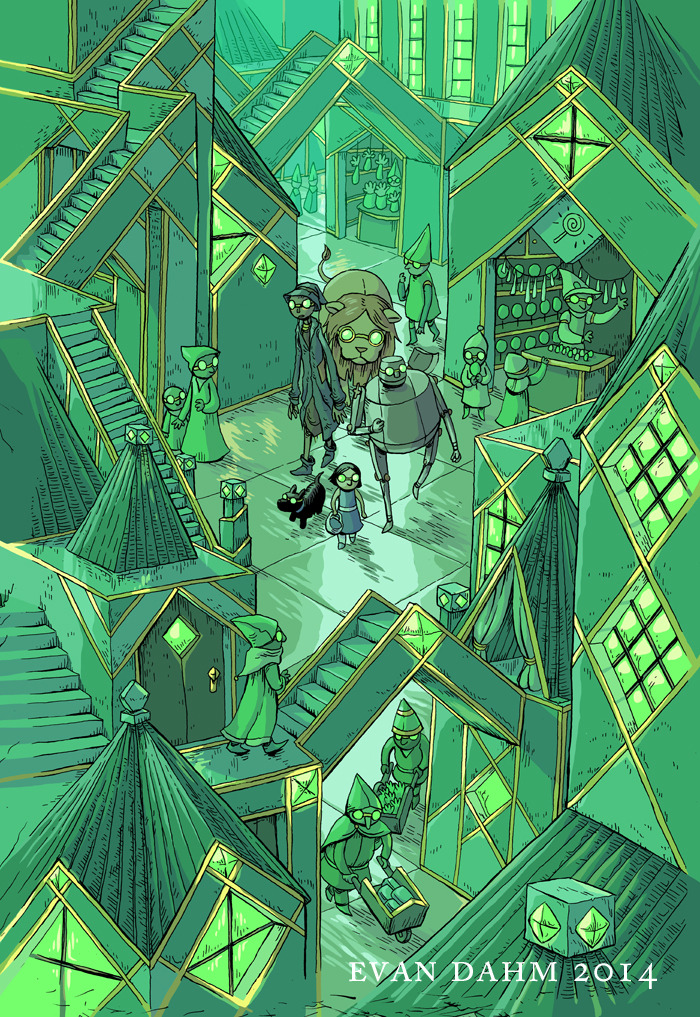
A New Look at the Emerald City

Evan Dahm is more than halfway through illustrating L. Frank Baum’s Wonderful Wizard of Oz.

This Tumblr post shows Dahm’s process for this illustration. Follow his progress at Baum by Dahm.

25 August 2014

The Sheriff of Loving County

This New York Times article about radioactive waste and a very small county in west Texas included the photo shown above.

You might spot the detail that sent me on a research journey which ended at this Find-a-Grave page about Edna Reed Clayton Dewees, along with some Wikipedia entries. And that led to this set-up for a series of murder mysteries—

It’s January 1945 in a very small county in west Texas called Loving, tucked alongside the Pecos River. Twenty-three-year-old Edna Reed has been working at Pecos Army Air Field, having previously contributed to the war effort by operating a lathe in a Fort Worth aircraft plant. But before those jobs, Edna was Deputy District Clerk in another county, so she knows the levers of the local government.

When the position of Loving County sheriff becomes vacant and there aren’t enough young men around, the town fathers ask Edna to accept the post. Then she finds that she likes being sheriff. So, even though no woman has ever been elected sheriff in Texas, Edna Reed decides to run for the job.

For a wide-open place, Loving has a shady history. It was first incorporated by out-of-state businessmen who fled with all the official records when their fraud was exposed, then reincorporated in 1931 as its population was rising suddenly.

Now the war has ended and soldiers are coming back to Loving County. How will the local establishment deal with those men’s new ambitions, values, and troubles? Does any of them want to become sheriff, or become Edna’s husband? The place has very little reported crime, but what secrets lurk in its past? Can young Edna Reed keep the peace in Loving County without carrying a gun?

And so far, all that is nonfiction.

24 August 2014

Roy Harper, the Anti-Dick Grayson

Just as DC Comics had to separate Green Arrow from Batman, its storytellers had to figure out a way to make Green Arrow’s young sidekick Speedy different from Robin, the Boy Wonder.

For decades the two characters existed in parallel—helping their mentors in fighting crime, providing useful sounding boards, and expressing the emotions of young readers. Dick Grayson was a teen orphan living with Bruce Wayne. Roy Harper was a teen orphan living with Oliver Queen. And their paths never crossed.

In 1964 Robin began working with Aqualad, Kid Flash, and Wonder Girl as the Teen Titans. But Speedy was notably absent. Fans wrote in, asking why the line’s other long-time kid sidekick was being left out.

So Teen Titans, #4 and #11, featured guest appearances by Speedy. And in issue #19 he became an official member of the team—and also managed to score a date with Wonder Girl, thus distinguishing him from all the other teammates who had crushes on her. But not by much.

The real differentiation began in 1971 when Neal Adams and Dennis O’Neil used the character of Roy Harper to explore the issue of drug use—a breakthrough for DC. Green Arrow discovered that his sidekick had become addicted to heroin. Not so badly that he couldn’t kick the habit within two issues, but enough to suggest a new direction for Speedy.

The Teen Titans series, aimed at a younger audience, never mentioned Speedy’s heroin troubles through the 1970s. Its writers tried sought other ways to set him apart from Robin: he and Wonder Girl remained a casual couple, and he was a bit more hot-headed. There was enough space between the characters for the series’ last issue to retroactively establish Speedy as a founding member of the team.

In the early 1980s Marv Wolfman and George Pérez brought Roy Harper back for occasional appearances in the New Teen Titans magazine, this time referencing his troubled past. Now working for a government agency, he joined the Titans in attacks on drug dealers. Those issues also portrayed him as an incorrigible ladies’ man just as Dick Grayson was entering a serious (and sexual) relationship with Koriand’r.

Finally, after Crisis on Infinite Earths Wolfman and Pérez added another layer to Roy Harper’s character. New Teen Titans, vol. 2, #21, revealed that he’d gone undercover [!] and had an affair with an international assassin named Cheshire. They’d even had a child together. Dick (now Nightwing) and Kory were having sex, but Roy was having unprotected sex with a villain!

That provided such a distinction between Dick Grayson and Roy Harper that Wolfman could write a story in Action Comics Weekly of their adventures together looking for Roy’s daughter. Where once Robin and Speedy couldn’t be on the same team, now Nightwing and Speedy could play off each other for several issues on end.

Roy Harper had become DC Comics’s anti-Dick Grayson. Dick was charming, respectful, and monogamous. Roy hit on almost any woman he met, especially when he was on duty. Dick became the one member of the original Titans who never married or had kids. Roy did the kids part first and muddled through as a single dad.

Nightwing was the young hero who did everything more beautifully than anyone else, whom everyone trusted. Roy was the character who managed to screw up most of the time. He bounced among among crime-fighting identities: Speedy to Agent Harper to Arsenal to Red Arrow and back to Arsenal. He owed his co-workers money. He took over the Titans, and the team fell apart. He formed the Outsiders for Dick to lead, and made a stupid fundamental error from the start. Nonetheless, he kept going. The result was a far more compelling character, a favorite for some readers.

While not all of Roy Harper’s background gets transferred into other versions of the DC Universe, his definition as the anti-Dick Grayson does. When the Teen Titans television cartoon introduced Speedy in a later season, producer David Slack explained, “we were looking for someone to mirror Robin.” In the sillier Teen Titans Go, the producers even have actor Scott Menville provide both rival characters’ voices (and of course make in-jokes about that).

DC’s “New 52” universe wiped out the Titans’ past and left little time for Roy Harper to have worked with the new Oliver Queen. Nonetheless, it reintroduced Roy as “the worst former sidekick ever” in Red Hood and the Outlaws. That may not be the best treatment for him, but at least it’s better than the Cry for Justice/Rise of Arsenal miniseries of 2010, which were so poorly received they were quickly written out of continuity. And it does preserve Roy Harper’s distinct role in the DC Universe.

23 August 2014

Putting Distance between Green Arrow and Batman

As I described on Thursday, DC Comics’s syncretism meant the company sometimes ended up owning two quite similar characters/trademarks. That pushed its staffers to come up with creative ways to distinguish them, expanding the bounds of its superhero stories.

Thus, in 1986 the company put Superman and his most successful equivalent from another publisher, Captain Marvel, in the same universe. And the editors and writers started emphasizing what made them different.

The fact that Captain Marvel is really a kid named Billy Batson—i.e., even more of a naïf than Kansas farmboy Clark Kent—became the defining aspect of his character. Storytellers also found more significance in how Captain Marvel’s powers arose from some form of magic (rather than, like Superman’s, through science).

Wonder Woman didn’t present such problems because no other company had such a powerful female hero. Instead, DC had to struggle with America’s changing picture of the ideal woman—and that’s another story.

As for Batman’s equivalents, it’s important to note what defined that character for most of his 75-year history. It wasn’t being dark and brooding and driven by vengeance. In fact, from the early 1940s through the mid-1980s, Batman was a cheery special independent agent of the Gotham police who just happened to dress as a bat. What defined him was:
  • He had no special powers beyond being a very smart, very athletic man.
  • He wore a mask to preserve his real identity.
  • He was an immensely rich socialite.
  • He had a lot of cool bat-themed gadgets and vehicles to deploy in a fight.
  • He worked with a teen-aged assistant.
That formula proved so popular that in 1941 DC’s sibling company, All-American Publications, created its own version: Green Arrow. He, too, wore a mask to disguise his life as Oliver Queen, an immensely rich bachelor. He used trick arrows, an Arrow Car, an Arrow Plane, an Arrow Signal, and even an Arrow Cave. And of course Green Arrow had his own kid sidekick, Speedy.

For a long time, DC kept Batman and Green Arrow apart. While Batman was an occasional member of the Justice Society of America, Green Arrow was relegated to a lesser hero team, the Seven Soldiers of Victory. Stories about him and Speedy appeared in World’s Finest after Batman and Robin’s, but the heroes never met. Green Arrow survived in backup stories through the early-1950s crash of superhero comics, probably because DC editor Mort Weisinger had co-created him, but he never had his own magazine.

When DC launched the Justice League of America, first in The Brave and the Bold and then in its own title, Batman made brief appearances. But Green Arrow didn’t show up at all, prompting fans to ask why he was left out. The problem, I suspect, was that he seemed too similar to Batman—why would the team need them both?

After popular demand, Green Arrow finally joined that group in Justice League of America, #4. Batman then stopped appearing so often, and it wasn’t until issue #10 that both characters showed up on the same cover.

Eventually the proximity of two similar characters prompted a new generation of creative minds to come up with ways to distinguish them—and to take superhero comics in a new direction. In 1969 artist Neal Adams gave Green Arrow a new look with a Van Dyke beard (at a time when facial hair had a politic meaning). Writer Dennis O’Neil made radical changes in the character of Oliver Queen. He lost all his money—no longer a millionaire with an unending supply of gadgets. He started a romance with an independent crime-fighting colleague, Black Canary.

While Bruce Wayne was then showing a new sort of social conscience with the Wayne Foundation, O’Neil had Oliver Queen start speaking loudly for political justice and change. Now the character stood out in Justice League meetings—in fact, he came to alienate some members of the group. It wasn’t just his politics but his temper and attitude. Green Arrow thus became one of DC’s first examples of a superhero who wasn’t a paragon in every way.
As a result, Green Arrow became an interesting character, perhaps for the first time. O’Neil and Adams partnered him with Green Lantern in a series of stories exploring social issues in America. Those highly regarded tales didn’t sell well enough to keep the Green Lantern magazine from cancellation in 1972, but they did cement the new character of Oliver Queen for readers. As a result, it became possible for him to be a foil for Bruce Wayne/Batman in subsequent decades rather than a pale green copy.

A similar process occurred in the late 1980s after DC introduced the Charlton character of Ted Kord, the Blue Beetle, into its main line. He, too, was a masked man without powers but with a lot of gadgets and smarts. He ended up on the Justice League with Batman. But that was the start of the grim, antisocial Batman we know today, and the magazine’s creators moved that Blue Beetle in the opposite direction, toward comedy.

With the “New 52,” DC brought Wildstorm Comics’s Batman equivalent, Midnighter, into its standard universe. Already Midnighter had been established as gay and happily partnered with the Wildstorm equivalent of Superman, providing more distance from the Caped Crusader. Now Midnighter is showing up in Grayson, actually offering storytelling value in how the character is a version of Batman.

22 August 2014

Show Me OIP Derangement Syndrome

Back in 1984 the journalist Michael Kinsley wrote that a Washington “gaffe” occurs when a politician accidentally tells the truth. We had an example of that in Poplar Bluff, Missouri, this week.

KFVS in Missouri reported on a city councilman named Peter Tinsley posting “what some call racist photos” on his Facebook page last year. Those photos, as Talking Points Memo shows, include a doctored image of President Barack Obama as an African witch doctor and another referring to him as “a lyin’ African.” So yeah, they were racist.

Once exposed, Tinsley told a council session: “I apologize from the bottom of my heart. . . . At one time, I was a very active Republican, very opposed to Obama.”

Local Republicans led by an organizer named Eddy Justice quickly reacted to that by insisting that “Tinsley's posts are not representative of the party” even though he is, in fact, an elected representative of the party.

Tinsley then offered another apology for his Facebook habit: “I want people to know that I am very remorseful for it. It was inappropriate. I believe I got caught up in an emotional moment of sharing jokes.” Sharing jokes with whom? Tinsley didn’t say. But we can presume that the Facebook friends of “a very active Republican” include a lot of other local Republicans. Nonetheless, Tinsley insisted: “Anything that I have said, that I referred to the activity because I was a Republican, that is not true. It’s not an excuse.”

And yet it is a reason. Tinsley was caught up in social circles so infected with OIP Derangement Syndrome that he lost sight of the line between reasoned, face-based, respectful political debate and expressions of simple hostility.

As for Eddy Justice, I’m quite willing to accept that he rejects racist jokes. I suspect that in his years as a Tea Party and Republican organizer he’s seen and heard worse such comments, and I hope he’s always been as quick to object to them. I can’t help but note, however, that Justice’s own Facebook page displays:

  • complaints about President Obama taking vacations, even though he’s done so at a rate so far less than President George W. Bush (12 August).
  • insinuations about “Remember when First Ladies were actually ladies?” (25 July).
  • a claim about the cost of health coverage rising 150%—and Justice is himself an insurance agent who sells health policies, so he should know the truth (6 May).
Double standards, snobbish sneers, and lies are all also symptoms of OIP Derangement Syndrome.