09 August 2006

Rolling in John Dough

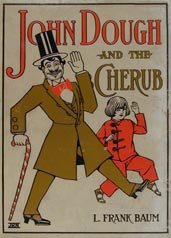
On Friday evening, I'll speak at the Munchkin Convention in Princeton, New Jersey, about John Dough and the Cherub, L. Frank Baum's fantasy novel for 1906.

More peculiarly, I plan to speak about the roots of this book in:

Can I pull this off? Come to the Munchkin Convention and find out!

The new phone book's here!

The folks at Writer's Digest Books were nice enough to send me a copy of the 2007 Children's Writer's & Illustrators Market, so I'm grabbing this chance to acknowledge that fact and to repeat the good advice that every writer for children who's submitting manuscripts needs an up-to-date market guide like this one.

Alice Pope at CWIM has also started a blog, with detailed reports about the Society of Children's Book Writers & Illustrators annual meeting in Los Angeles last weekend.

08 August 2006

Not so funny when someone loses his eye

Last Friday, the New York Times crossword puzzle had "Like Polyphemos," or something similar, as one clue. "I just heard someone talking about Polyphemos at the house where I was visiting," I thought. "Yes, I remember: it was Justin. I could get on the phone and ask Justin what 'Like Polyphemos' might mean."

Justin is five.

I decided to save my pride and work out the answer for myself. (My recurring problem with remembering Polyphemos is that "famous" doesn't seem like the most appropriate name for that mythological figure. In fact, he doesn't seem like the sort to have a proper name at all.)

Even before I visited Justin and his family's house, I'd heard that he's now a (metaphorically) huge fan of the Greek myths, so one of my presents was It's All Greek to Me!, the Time Warp Trio's visit to Olympus. Since Justin already knows the straight stories, I figured he'd appeciate Jon Scieszka's silly take on those characters. His mother told me that on at least one night since she found him asleep with the book fallen from his limp hand, so it seems to have been a hit.

However, I kept mum about how there's now a Time Warp Trio TV show. The elaborate Time Warp Trio website promotes that PBS series. Curiously, it doesn't promote the books. You can find an occasional TWT title by looking under "Books and Links" for an episode based on one of those books, then scrolling down the long list of auxiliary reading--but there's still no easy link.
The books aren't even listed under "Stuff to Buy"; instead, there's a hint that TV spin-off books might be coming, which usually isn't a good thing in terms of quality. And this from an author who founded Guys Read.

07 August 2006

Fantasy spans the Globe

In Sunday's Boston Globe book review half-section, Chris Abouzeid, author of Anatopsis, reviewed six recent fantasy novels:

  • Peter and the Shadow Thieves, by Dave Barry and Ridley Pearson
  • Fly by Night, by Frances Hardinge
  • Murkmere, by Patricia Elliott
  • Pucker, by Melanie Gideon
  • Monster Blood Tattoo: Foundling, by D. M. Cornish
  • Ranger's Apprentice, Book Two: The Burning Bridge, by John Flanagan
This was a round-up review, so each title received only a paragraph or two of attention. But it was also the lead review of the issue, showing the elevated status of fantasy novels for young people today. Can we imagine that sort of treatment ten years ago, before HP?

Abouzeid offered his own general observation on trends:
When I was a young adult (way back in the 1970s), fantasy was Tolkien and Lewis, L'Engle, Le Guin, and Alexander, and once you'd run through this magical canon, there was almost nothing else. Worse yet, the difference between young adult and juvenile fantasy was only the reading level. Adolescence didn't seem to exist for fantasy authors.
Of course, that's one reason fantasy is so popular with young adults.

The Sunday Globe also included two items about the "Wonderful Art of Oz" exhibit at the Eric Carle Museum of Picture Book Art in Amherst, Massachusetts.
  • In an AP dispatch, Adam Gorlick reported on the exhibit and how portrayals of Oz's main characters have changed over the years. "'Baum's Dorothy was more aggressive and independent," said Michael Patrick Hearn, the guest curator of the exhibit... 'She doesn't cry all the time like Judy Garland's Dorothy.'" Indeed, Dorothy hardly cries at all in Baum's books--only twice, that I recall.
  • Jan Gardner of the Globe also noted the exhibit, and wrote, "Members of the International Wizard of Oz Club made a strong showing at the opening."

06 August 2006

New Muppet to fill an old hole?

Today's New York Times Arts section reports on the creation and deployment of Abby Cadabby, a new little girl Muppet for the upcoming season of Sesame Street. She'll appear on The Today Show later this week. If that sounds like a marketing campaign, it is. Sesame Workshop announced Abby's coming in this June press release, and the Times article makes clear that writers didn't just set out to create a character--they wanted to create a star.

Abby's pink color, big eyes, pompom hair, and status as a fairy in training were all givens. Unlike some previous female Muppets, she wasn't designed to counteract feminine stereotypes; she embodies them. "On the set the joke was about the new toy on the block," the Times reports, "...a dig at the obvious marketability of the new pretty-in-pink creature."

The Muppet and Sesame Street writers have long been criticized for not coming up with enough strong female characters. This trend was especially obvious on the prime-time series Muppets Tonight, whose only major new female character was Spamela Hamderson, a one-note parody that would have been at home in Playboy magazine, circa 1970. But the Sesame Workshop writers have a point that depicting exaggerated traits in males carries less danger of echoing gender stereotypes; a girl monster as trepidatious as Telly could seem sexist, while a boy monster as tough and strong as Herry raises no complaints (and can be used to show boys' soft sides).

The irony here is that there have always been strong but feminine little girls among the Sesame Street Muppets. First was the character of "Betty Lou." She evolved into Prairie Dawn, who retained the original's interest in directing pageants but is also eager to be a news reporter. You do not want to get in these little girls' way. Yet they never gained the merchandising power of Big Bird, Elmo, or Grover. Were they too much like ordinary girls, with no wings or magical powers? Or were they too competent to win sympathy?

05 August 2006

Alfred Hitchcock's .00003 Investigators

On Fuse #8's recommendation, I checked out the Book-a-Minute website, offering summaries of classic books boiled down to the density of a neutron star.

For instance, the site's distillation of one--heck, every--Three Investigators mystery novel runs to 94 words, and that's one of the longer ones.

But it's woefully incomplete! This summary says nothing about two of the three boys getting captured by the bad guys while the third rushes back to the salvage yard to bring the big Swedes. Honestly, you'd think the summarizers had never read forty of these books.

04 August 2006

Harvey Fierstein is Mr. 101!

Today's New York Times brought news that Harvey Fierstein has replaced Chris Elliott as Heat Miser in this year's remake of The Year Without a Santa Claus. To which the only reasonable response seems to be...

THEY'RE REMAKING THE YEAR WITHOUT A SANTA CLAUS?

Granted, the 1974 Rankin-Bass stop-motion filming wasn't the best of that studio's TV movies. In other words, it was no Rudolph, the Red-Nosed Reindeer, or even Rudolph's Shiny New Year. The only thing most people remember about Year Without is the duel/duet of Heat Miser and Snow Miser, and I, at least, have trouble remembering exactly which holiday special those scenes appeared in.

But did that 1974 version leave unanswered questions? Does Phyllis McGinley's 1957 novel have scenes that the filmmakers just weren't allowed to show young audiences during the Nixon administration? Does stop-motion animation not appeal to kids who want the sinuous movement of computer animation?

No, I bet the key to NBC's green light lies in the original's appeal to adults who were kids back then. Hence the cast of celebrities from adult comedy shows, starting with John Goodman as Santa and Carol Kane as Mother Nature.

The director, Ron Underwood, did the fine Mouse and the Motorcycle and Runaway Ralph TV adaptations back in the pre-CGI 1980s. (The latter starred young Fred Savage.) So perhaps this remake will outshine the original. But still, it seems like the child audience might in fact be an afterthought.

03 August 2006

From the Grimms to the Oneidas

Lately I've been reading a scholarly study of Oneida storytelling by historian Anthony Wonderley. It examines the largely unpublished stories collected in the early 20th century by Hope Emily Allen from women who helped maintain the Oneida Community Mansion House, particularly Lydia Doxtater and Anna Johnson.

At the time, the Oneida community in central New York was in difficult legal disputes over whether they still existed as a nation, or whether their lifestyle had become so Europeanized and their traditions so attenuated that they no longer deserved court recognition as a collective entity. This played out in court battles over land, naturally: were mortgages and deeds signed by individual Oneida people valid, or did those individuals not have the power to sell or mortgage tribal land? (On top of that dispute is one that has reappeared more recently, and more significantly: were any agreements between the Oneidas and other Iroquois nations and the state of New York valid after the adoption of the US Constitution? And, given that the law clearly says no, what is the remedy for the people whose ancestors lost land rights as a result of those invalid agreements?)

Some of the stories that Allen collected from her neighbors in 1916-1926, Wonderley shows, are versions of European wonder tales documented decades before by the brothers Grimm. No such tales are previously documented from Iroquois or related sources. Some involve technology that's not only Old World, but modern. For instance, there's one that strikes me as a summary of the more outlandish version of The Adventures of Baron Munchausen, balloon and all.

However, Wonderley also points out how the Oneida storytellers' versions of these tales incorporate details from their own traditions: red osier swtiches, for instance, and the balloonist's sharpshooter companion using a bow and arrow instead of a musket (as in the Terry Gilliam movie and other versions of Munchausen). Thus, the stories document both the influence of the surrounding Europe-based culture on the Oneidas and the survival of their own cultural traditions.

02 August 2006

Smallest of the "Greatest Generation"

Greg Fishbone alerted me to a recent tempest in a teapot (well, actually in Kansas City) over whether Mickey Carroll is "the last living Munchkin" from the MGM movie or (as he and the Kansas City Royals accurately stated all along) "one of the last living Munchkins." The Deadspin blog provides a roundup of the affair and the last word.

In a week I'm off to the Munchkin Convention, so named because Munchkinland is the eastern part of Oz and this event has taken place in the eastern US for decades. Occasionally one or two MGM movie veterans speak there, which usually means Munchkins since all the principal performers have died. Several Munchkin performers who are still alive and healthy have created retirement careers for themselves making personal appearances in and out of costume.

Those surviving Munchkin performers tend to have been in their late teens in 1938, when they shot their scene. That means they were about twenty years old when the Japanese military attacked Pearl Harbor, bringing the US into World War 2. The young men therefore faced the question of how to serve their country. But because of their height, they were all classified as 4-F, ineligible for military service.

If there's a Q&A session at a convention, I ask the men about their experiences of the war, and the answers are usually quite interesting, as well as fresh to folks who've heard all the stories from the MGM set. Some of these young men stayed on their jobs, especially on farms, where the work was deemed vital to the nation. Others found ways to serve the war effort outside the military.

For example, Meinhardt Raabe, who played the Munchkin coroner, trained pilots as part of the Civil Air Patrol. He was, he says, the smallest licensed pilot of the time, and ended up flying more types of airplanes than he would have in military service. Raabe discusses that work, and other parts of his career, in Memories of a Munchkin, which turned out to be a better book than I expected. It sounds like a hodgepodge, but it really does hang together, and the production values are excellent. Raabe is also one of the most dedicated marketers I've ever met.

Another ex-Munchkin, Texan Clarence Swenson, worked on repairing the radar equipment in planes at airbases in the US. He found that his small size gave him an advantage in reaching inside the nosecones, letting his crew avoid the delay of having another team come out to remove those cowlings and thus to cut the planes' time out of service. [Swenson and his wife were at the 2006 Munchkin Convention, allowing me to update this paragraph.]
01 August 2006

Carnival of Akkordionspieler at last!

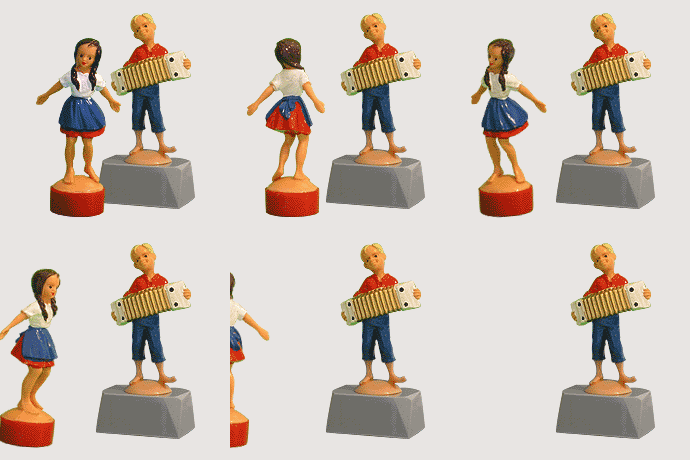
Back on 11 July, I issued a call for entries for an online Carnival of German Kids Playing Accordions in Tents. I supplied a graphic model.

Fuse #8 produced an image from Don Parrish's trip to North Korea. Parrish writes, "We also attended the Mangyongdae Schoolchildren's Palace, were we saw the propaganda kids, the ones routinely photographed by tourists. They were supposed to smile as they played musical instruments or embroidered." And what musical instruments? Accordions, of course! No Germans, no tents, but by the large number of kids and accordions (and the small number of alternatives) I say this qualifies.

Becky commented, "My Canadian mother-in-law (of German extraction) plays the accordion, and after 12 years it still gives me the willies..." So there's an untented German-Canadian example--also a stretch, but beggars can't choose.

Even I, with all my interest in this important topic, couldn't come up with blog items that fit all the criteria. But some webpages came reasonably close.

The Accordion Orchestra of Maisach sponsors a Pupils' Orchestra for musicians aged 8 to 14. Again, the large number of kids and accordions makes up for the lack of a visible tent.

In May, Legoland Deutschland hosted a concert with "Ensembles from more than 7 nations...demonstrating that the accordion can be used to interpret all kinds of music." Rap-polka fusion, for example.

In a situation that cries out for analysis, the Jewish Museum Berlin has illustrated a page on Freud's theory of "drive/trieb" with a figurine of a blond boy playing the accordion.

And although technically he hails from Austria, not Germany, I must acknowledge the "jungen Akkordeonspieler Lukas."