Showing posts with label the sporting life. Show all posts

27 November 2024

“Real honest to goodness…pie slinging contests”

Mass pie-tossing definitely returned to American movies in 1927, and not just in Laurel and Hardy’s “Battle of the Century,” released in December.

The surviving examples appeared first in a particular type of movie: the kid gang comedy. That makes sense because the core viewers of those movies were so young they weren’t:

  • tired of the Keystone-style comedy of the previous decade, given that they had probably never seen those films.
  • influenced by what the press deemed properly funny for modern audiences.
In May 1927, the Bray Studios registered a short called “The Big Pie Raid,” directed by Stan De Lay (IMDB; YouTube; clearer extract on YouTube). This was part of the McDougall Alley series, running from 1926 to 1928—an obvious imitation of the Our Gang comedies, but with even more blatant racism.

The Library of Congress filing for “The Big Pie Raid” summarized its plot like this:
The two gangs are having it out on the football field. The winning team has been promised a party by one of the girl spectators. Oatmeal, a little colored lad, wins the day for his side and the result is that the team goes down to enjoy the blowout. After much ice cream and cake and speech making they adjourn to the lawn to play games.

The losers of the football game however are on the job and attack the party with mud pies. Real honest to goodness mud pie slinging contests ensue with the victors of the morning coming out victorious but not until all the pies of a bakery wagon had been used and not until Oatmeal had come to the rescue with his little friend Farina [sic—Fatima], that gasser of animals, the skunk.
At around the twelve-minute mark, a wagon helpfully labeled PIES loses a wheel near the kids’ mud fight. That leads to a “Real honest to goodness” pie fight, with combatants and one spectator hit. Since Bray named the movie after that part of the scenario, the studio clearly saw the pie fight as an attraction for its target audience.

The typographical error inserting the name Farina into the synopsis of “The Big Pie Raid” shows how much the makers of this series had the Our Gang movies on their minds. McDougall Alley featured a little black child called Oatmeal, played by Hannah Washington. Just as the character of Farina was variously identified as a girl or a boy in early years, “The Big Pie Raid” presents Oatmeal as a boy so that he can play in the football game.

Even though Oatmeal is the hero of both the football game and the subsequent fight, he and his Chinese-stereotype friend Free-Gin have to be snuck into the older white kids’ party. One difference between this movie and the typical Our Gang shorts is that the McDougall Alley kids are more bourgeois than their rivals rather than poorer.

In December 1927, Fox released “Wild Puppies,” directed by Clyde Carruth (IMDB; YouTube; Library of Congress shot list). Like “The Big Pie Raid,” this short comedy moves from a football game to a gang fight that parodies trench warfare. However, its special effects are more elaborate and amusing. While most of the missiles are vegetable, ultimately fat boy Albert Schaefer throws pies down onto three members of the rival gang. The climactic bits show the bad guys trying to escape a lion, scenes that actor Coy Watson, Jr., wrote about in The Keystone Kid.

In both “The Big Pie Raid” and “Wild Puppies,” the leader of the rival gang, and the person whose face takes the most mess, was Jack McHugh. He’d been the center of an earlier kid gang series from Century before being upstaged by Malcolm Sebastian as “Big Boy,” his little brother.

McHugh would make one appearance in an Our Gang film: “Shivering Shakespeare” (1930). Once again, he played a rival gang leader who starts a pie fight. It seems to have been a specialty.

COMING UP: But that wasn’t the first pie-throwing in an Our Gang movie.

16 May 2020

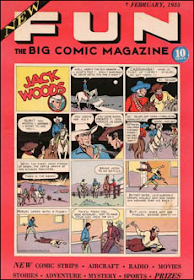
New Fun with Jack and Bill

In 1935, National Publications issued its first magazine collection of original comics. New Fun was thus the first comic book from the company founded by Malcolm Wheeler-Nicholson that eventually became DC Comics.

That magazine basically tried to replicate a Sunday newspaper comics section. It was as large as a tabloid newspaper. Though the interior was all black and white, the company quickly moved to color printing, suggesting that was always the plan.

Most significant for the storytelling, the magazine offered twenty different comics, each on a single page. (Twelve more interior pages were filled with prose and advertising.) Some of those comics ended in gags, but most were serialized adventures. Most were also obvious knock-offs of popular newspaper strips or genres. The stories were aimed at different audiences, from little kids to adults looking for thrills.

The advertising reflected that same hope that the magazine would appeal to a broad audience. There were ads for model airplanes, for example, but also ads for job seekers. There were multiple ads for razor blades, indicating that the publisher expected a significant portion of the readers to be shaving. Some ads were aimed at men and a few at women. As National Publications narrowed its target audience to kids, some of those ads went away while others stuck around for decades.

One of the latter was for Charles Atlas’s bodybuilding lessons. From the start Atlas built his campaign around the graphic story of “The Insult that Made a Man out of ‘Mac’.” A scrawny young man gets humiliated in front of a girl on the beach, builds up his muscles, and returns to beat up that bully—in front of more admiring girls. The art was later redrawn, but the script didn’t change much.

One New Fun page turn later, however, came another bodybuilding ad built around another little story, but with a different message. The Jowett Institute of Physical Culture titled its comic “Jack ‘Puts One Over’ on His Boy Friend!” Girls appear in only half of its six panels (instead of seven out of nine in the Charles Atlas story). The relationship between Jack and his pal Bill is more developed than the one between Jack and Hannah. The institute also offered a “FREE Book with Photos of Famous Strong Men.” A different sort of appeal.


05 May 2020

Rio Grande and Roman Riding

Rio Grande is the third western that John Ford made about the US Cavalry with John Wayne as one of the stars. Ford made it only because the head of the Republic studio demanded another western before financing the movie Ford really wanted to make, The Quiet Man.

As such, Rio Grande was quickly shot, with even more continuity lapses than usual. (Ford always delivered minimal footage so the studio couldn’t edit his movies into something he didn’t want.) There are a few too many musical numbers, and the central story of a cavalry colonel, the wife he won during the Civil War, and the son he barely knew who becomes one of his recruits gets played out but not deeply explored.

At the same time, Rio Grande works. Shot in the Moab Valley of Utah, its visuals are amazing. Wayne and Maureen O’Hara are strong in their roles, and Ford’s usual cast of supporting players enact their usual parts well. The jokes land. The final action sequence is set up by just a couple of shots in the opening montage. The movie might have been a masterpiece if its makers had put more into it, but it’s as entertaining as it needs to be.

One of the most impressive scenes comes early as a sergeant, played by Victor McLaglen, challenges the new cavalry recruits to do “Roman riding,” standing astride two galloping horses. There’s no reason for this to be in the movie but spectacle. That skill never comes back later in the action, but it looks good on screen. And it looks even better when you realize that the actors—Ben Johnson, Harry Carey, Jr., and Claude Jarman, Jr.—performed the Roman riding themselves.

Now I knew Johnson got into the movies as a horseman, supplying horses and then doing stunts before becoming an actor. But Jarman started out as a child star in The Yearling. I had to go back in the video to confirm that yes, there’s one unbroken shot of him vaulting onto two horses, standing, and riding off. So I went hunting for the story behind that sequence.

A few years back, Arthur Arnell posted excerpts from a conversation with Carey on a John Wayne discussion site. Carey recalled his and Johnson’s first conversation with Ford about the movie:
The old man sat there for a while, and finally said, “You guys know how to Roman ride?”

I said, “No, sir,” and Ben said, “No, sir,” and Ford said, “You’re going to have to learn it; we’re going to have Roman riding!”

We knew what it was, and Ben being real careful said, “Well, Mr. Ford, how long before we have to know how to do it?”

And he said, “A month.” So Ben looked at me and I looked at him and we both thought, “Oh, s**t!”
The two actors started training. At first it was so difficult that after riding sessions they “had to go to a nearby town to visit a physiotherapist,” Arnell reported. But after three weeks they could show off their new skill to the director.

Ford was pleased. In fact, Carey recalled, “I’d never seen the old b******d so happy.” And he decided, a week before filming, that Claude Jarman should also ride that way.

Jarman was only fifteen years old at the time, though tall enough to play a West Point dropout. According to Carey:
Now he looked like he barely rode at all, but he came out, croupered those horses, jumped up on my team, and went down the road no practice.
So basically the scene in the movie played out just like real life.
Ben said, “Well, Jesus Christ.” We wanted to crawl under a board. And old man Ford said, “Well, Jesus, it took you guys three weeks, for Christ’s sake.”

Ben said, “He’s never been hurt before, Mr Ford.”

Ford said, “What?” He made you repeat everything.

“Well, he’s never been mashed up or hurt, he’s not afraid.”

“You’re goddam right, he’s not afraid!”

So Claude rode, too. He used my team since we only had two. It was unusual for people who had critical parts in a movie to do that kind of stunt, but Ford would do it. We shot that Roman riding sequence right in the middle of the picture, and we were even out Roman riding every morning on location.
Carey added that Jarman, unlike his adult castmates, “felt no ill effects whatever” from standing on horses.

A man named William T. Brooks, who had been on extra on Rio Grande, added some moviemaking details on that discussion site:
They were not attached to the horses, but they did have on black rubber sole tennis shoes. But if you look close the next time that you watch the film, you might see that the horses have “trace straps” holding them together so they would not go in different directions.
And the final word from Jarman’s autobiography:
They seemed as surprised as I was when I stood up without a hitch on my first try! Ben even seemed a little chagrined that I took to trick-riding so easily and was heard to mutter, “The reason that kid did it so easy is that his feet are so goddamned big they just wrapped around the horse’s back!”

21 August 2018

Discovering Lost Tales of Oz

Joe Bongiorno’s Royal Publisher of Oz releases its latest book today: the short-story anthology Lost Tales of Oz, featuring illustrations by the multiple-Eisner winning artist Eric Shanower. This volume contains eighteen stories—over 500 pages of new fiction in all—inspired by and adhering to the Oz book series.

One of those stories is a little piece by me called “Ojo and the Woozy.” For folks who haven’t read The Patchwork Girl of Oz, in the jacket art above Ojo is the boy dressed in Munchkin blue and frills near the left side, and the Woozy is the cubist blue creature at the far left.

In the same year that he released The Patchwork Girl of Oz, L. Frank Baum wrote six short books collectively titled Little Wizard Stories of Oz. Each was about two established characters, such as Dorothy and Toto, or Jack Pumpkinhead and the Sawhorse, having a brief adventure together.

Several years back, I set out to create a new story along those lines, using some pair of characters Baum didn’t get to. Ojo and the Woozy felt like a natural choice. In Baum’s seventh Oz book they travel together to the Emerald City. The Woozy is almost always calm, cheerful, and straightforward while Ojo is a moody fellow, so their personalities can play off each other.

My “Little Wizard” story ended up never leaving the vicinity of the Emerald City. The drama of Ojo and the Woozy’s adjustment to life there after having spent years in isolated forests was too interesting. As a result, this tale offers its heroes no greater challenge than being a shy new boy who doesn’t know how to play the local sports.

Which is, of course, a great challenge indeed. I may have given Ojo some of my own childhood experiences.

Lost Tales of Oz is available in hardcover and paperback via Lulu.

21 September 2014

Burt Ward’s Karate Lessons

In 1965 Burt Ward did some karate demonstrations as part of his audition for the part of Dick Grayson/Robin on the upcoming Batman TV show. Those somewhat awkward screen tests are now on YouTube, of course.

Ward’s Wikipedia entry states that he had a black belt in Taekwondo—but that statement is followed by the ominous “[citation needed]” note.

In fact, back in November 1968, Black Belt magazine reported on Ward’s attempt to catch up to what his publicists were saying about his martial-arts skills. It says that “chopping a brick in half” for his screen test was “a trick he’d picked up from karate enthusiasts.”

Ward started to study with Young Ik Suh (1939-2013), a local Taekwondo teacher from Korea. At first he worked on the moves needed for the next day’s filming, according to the Black Belt article. But after Bruce Lee appeared on the show as the Green Hornet’s partner Kato, Ward felt he needed deeper knowledge.

Young therefore developed a six-month “Quick Course in Karate” to teach Ward the fundamental concepts and over 300 moves. The article is written in the same breathless prose the studio publicists would have used, and it’s unclear when during the show’s run those lessons took place. By the time the magazine appeared, Batman was off the air.

21 April 2014

The Marathon Tradition Endures

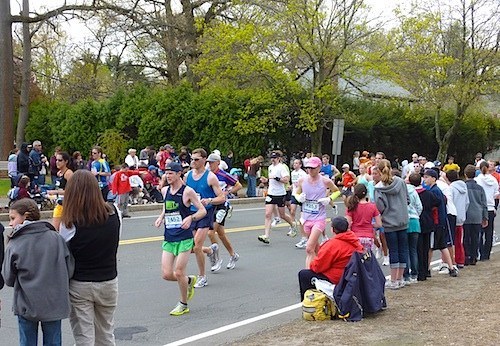
I live about three blocks from the route of the Boston Marathon as the race winds through Boston’s suburbs toward the Back Bay. For many years every Marathon Day looked much like the photo above, with families lining both sides of Commonwealth Avenue to watch, cheer, and pass out cups of water or other replenishment.

Naturally, the kids clapping and holding out water would edge into the road, and every half hour or so a motorcycle cop would roll slowly along the gutter, herding everyone back. Early in the race people would wait for a break in the runners and then dash across to visit friends on the other side, sometimes getting stranded until the field thinned out again. Some parties brought multiple lawn chairs, campers, and spreads of food, either to eat or to sell to other spectators.

But that was before last year’s bombs.

Three days ago, we found that the whole of the race route through town had been marked off with orange plastic delineators, or “candlesticks” as a cousin told me the professionals call them. On the side of the street away from driveways, a cord had already been threaded through those plastic stakes. Clearly the public-safety officials were planning to keep everyone off the road.

Meanwhile, race organizers issued several strict warnings about this year’s event. No unauthorized runners. No running in costume. No march along the route by service people. No backpacks, coolers, or thick blanket rolls. All understandable regulations, but I feared the Marathon I enjoyed would disappear.

I’m pleased to say that even with cords strung on both sides of the road and signs warning that all coolers, backpacks, and other bags were subject to search, the atmosphere is much the same. Kids were still edging out into the road, just not as far. People still dashed from one side to the other, just not as often. There were plenty of lawn chairs, coolers, and unrolled blankets, as well as plenty of security officers. And at least one runner in a tutu.

03 February 2014

Right Wing Just Can’t Say Cheerio to Bigotry

In May 2013, Cheerios ran a commercial featuring a family with a black father, white mother, and cute little girl. That prompted a spew of racist tweets.

Last month, Cheerios previewed a new commercial featuring the same family. On 29 January, someone at MSNBC tweeted: ”Maybe the right-wing will hate it, but everyone else will go awww: the adorable new #Cheerios ad w/biracial family.”

A couple of hours later, MSNBC tweeted: “Earlier, this account tweeted an offensive line about the new Cheerios ad. We deeply regret it. It does not reflect the position of msnbc.”

Nevertheless, the next day Reince Priebus, chairman of the Republican National Committee, complained that MSNBC had “denigrated and demeaned Americans -- especially conservative and Republican Americans,” and ordered his staff not to appear on the network. MSNBC issued another apology.

On Sunday, the commercial appeared during the Super Bowl. It prompted some racist tweets, but more supportive ones.

However, a patriotic commercial for Coca-Cola got much more vitriol, including bigoted complaints from former Republican Congressman Allen West, radio hosts Glenn Beck and Todd Starnes, and others from “the right-wing.”

As of today, Reince Priebus, defender of “denigrated and demeaned Americans,” has not been heard from. Meanwhile, despite his effort to spin away the awkward fact, “the right-wing” continues to perpetuate its own stereotype.

18 November 2013

Why Any Hollywood Auteur Needs a Good Personal Assistant

From the New York Times Book Review’s Q&A with movie director J. J. Abrams:

When [our youngest son] was in kindergarten he brought home some books by Mo Willems, who has one of the most remarkable comedic voices I’ve ever read. His sense of humanity — of heart and generosity — is staggering.

I was so blown away, I got his number from his agent and called him. I was essentially a sycophant, expressing what a deep fan of his I am, how I would love to work together one day. He was quiet on the phone, almost monosyllabic, disinterested. Frankly it was a bit of an odd reaction.

It wasn’t until the next day that I discovered that I had, in error, called Mo Williams of the Portland Trail Blazers.

29 October 2013

Games Acknowledgements Play

At the end of Fantasy Baseball, author Alan Gratz thanks a number of writing colleagues (including Laurel Snyder) for their support, and a number of literary estates, including those of Brian Jacques, Madeleine L’Engle, and the still-quite-alive Ingrid Law, for permitting him to use characters under copyright.

Also among the latter group is: “the estate of Ruth Spencer-Davies for letting me borrow the inimitable Nanny Mae and her feline companion Mrs. P.”

There was no Ruth Spencer-Davies.

Nanny Mae shares some characteristics with P. L. Travers’s Mary Poppins and perhaps Christianna Brand’s Nurse Matilda (better known as the cinematic Nanny McPhee). But, whether pushed by copyright requirements or not, she appears to be Gratz’s own creation.

The conceit of Fantasy Baseball is a boy caught in a realm of make-believe characters. We readers have to believe that Nanny Mae is such a character, from a series we’ve never read or perhaps one we’ve forgotten. And the line in the acknowledgements serves that fictional purpose.

I’m running this on a Tuesday because Dorothy Gale is a major character in Fantasy Baseball, founder of the team Alex Metcalf finds himself playing for. Other characters from the Oz books also appear, including Scraps, Tik-Tok, and Jack Pumpkinhead. The threat underlying the plot is that those characters will be forgotten in our culture and disappear from the playing field.

But if Nanny Mae lives on with no other evidence for her existence on the web, then surely Jack Pumpkinhead will, too.

03 October 2013

Daniel Pucca’s Mini, and Adolescent Memories

Yesterday I discussed Daniel Pucca’s mini-comic My Dutch Foreskin, focusing on the lettering. Because that’s the first thing you think of when you read that title, right?

Pucca was an American in a Dutch intermediate school when word came down that the health exam would require boys to roll back their foreskins. He didn’t know what that meant. (The comic establishes that at that moment Daniel was living with his grandmother, so he didn’t have anyone he felt comfortable asking.) When he found out, he thought something was terribly wrong with him.

Like Pucca, I was born in the period when almost all American boys were circumcised soon after birth. So was my father. I don’t think I saw an uncircumcised penis until I was in junior high, when gym class included showers with a single classmate, a newcomer from Australia, who still had a foreskin. He was thus in the opposite position from young Daniel in Holland. I didn’t know that fellow well, so I have no idea of how his experiences mirrored Daniel’s, but that memory helped me appreciate My Dutch Foreskin.

A few years further on, I recall another immigrant classmate—a nice guy from Russia—feeling acutely embarrassed on a high-school trip to Montreal when he had only a tiny European-style men’s bathing suit while the rest of us boys were in baggy American trunks. (Mind you, the baggy shorts of the 1980s were nothing compared to the voluminous fashions of more recent decades.)

I remember my immigrant classmate standing at the side of the Montreal Olympic pool in his snug swimsuit, asking if anyone had another suit to lend him. But of course we were all away from home, and in the pool besides. We kept telling him to just get in the water where none of the girls could see clearly. But of course the only cure for adolescent self-consciousness is time.

22 June 2013

Phearse Competition

Last night, the first night of this year’s Winkie/International Wizard of Oz Club Convention, director David Maxine recruited me into being one of the players of the “It’s the Baum!” game show. My team, named the Horners, included Miriam Goldman, Robin Olderman, and Jim Vander Noot. Our opponents were the Hoppers—named in honor of the feuding nations in The Patchwork Girl of Oz, published 100 years ago.

The game required pairs from each team to identify people associated with Oz in some way: characters, creators, adapters, performers, etc. One player saw the person’s name on a screen and gave clues to the other, facing away from the screen. This required both players to recognize the people—or to arrive at the correct answer some other way.

My young mind was wired for trivia, and I retain a lot about the Oz books: the predecessor of King Krewel (King Phearse), whose name begins with the word “high” (High Boy), what young hero of an Oz book shares a name with Batman’s partner (Robin S. Brown).

I haven’t absorbed as much about more recent adaptations, such as who played Glinda in the original Broadway production of The Wiz (Dee Dee Bridgewater). But watching this game played last year showed me the importance of being flexible in how one passed clues to one’s partner. Therefore, when faced with the unfamiliar name of the nerve specialist in Return to Oz, I went with “The professional title of a physician…Comedienne Jo Anne” (Doctor Worley).

Some of the names were even more obscure—to the point that we joked their association with Oz was being the person in history least associated with Oz. At one point my partner and I got the name “Bebopma,” which is a throwaway joke in Jack Snow’s reference book Who’s Who in Oz. Game judge Eric Shanower later told me that he got so frustrated that we didn’t just say “Pass” to such a ridiculous challenge that he sounded the alarm for an illegal clue. But that probably saved us time we put toward earning another point.

Which turned out to be crucial. Our team got off to a good start, thanks in part to my juvenile mind. We added a couple of points in the next round. By the Hoppers’ last turn, we Horners were ahead by seven points.

But then Anil Tambwekar and Glenn Ingersoll pulled off a comeback as exciting as a Ray Allen three-pointer and tied the score. And since there were no tie-breaker questions prepared, everyone won a prize. It was the Baum.

30 May 2013

Taking Inspiration and Making It Chittier

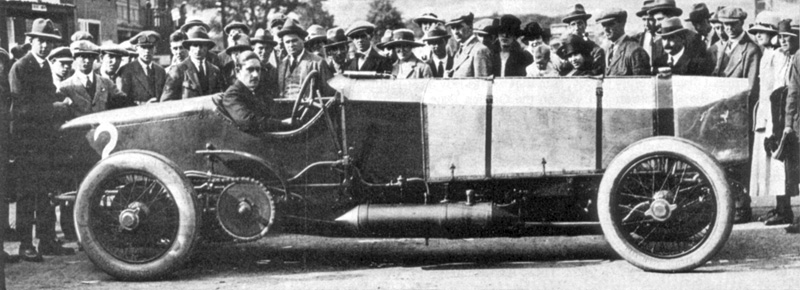
From the Oxford Dictionary of National Biography comes this life of Louis Vorow Zborowski, a racing-car maker and driver active in Britain in the early 1900s.

Zborowski provided the inspiration for one children’s adventure novel with his post-World War I application of aeronautic technology to automobiles:
The end of the war led to the ready availability of large capacity aero engines, exactly the type Zborowski needed to build his own racing cars in the stables at Higham Park. . . . The first car, powered by a 23 litre 6 cylinder Maybach aero engine used in Zeppelin airships, and fitted with an angular body made by Blighs, was christened Chitty-Bang-Bang. A second car, Chitty-Bang-Bang II, was powered by an 18.9 litre Benz aero engine. . . .

Chitty-Bang-Bang was driven up from Kent on trade plates to make a winning début at the opening meeting of the Brooklands season in March 1921, attracting much attention as the ‘mystery’ car (The Times, 29 March 1921). . . . The novelist Ian Fleming, who had seen Zborowski’s car at Brooklands in the early 1920s, and who was later a visitor to Higham Park, used elements of it in his children’s fantasy Chitty-Chitty-Bang-Bang (1964–5).
Both Zobrowski and his father died in racing-car accidents.

04 January 2013

Fastest Game in Chestnut Hill

This is a retrospective posting about what I did on Friday. Godson and family were in town, so we all went to the Yale–Boston College hockey game. Godson’s mother took the photo of the rink above. I’m on the left and Godson’s Uncle is on the right.

Toward the back you can see the glow of the Jumbotron. At one point Godson, Godson’s Brother, and their cousins were all on the big screen, jumping around to be noticed—a highlight of the evening.

The Jumbotron also figured into the introduction of Boston College’s team. At the start of the season, it appears, all the varsity players were videotaped in their uniforms, voguing for the cameras with their sticks across their shoulders. I kept thinking that the choreography was developed with the expectation that they would be shirtless. “Big baggy maroon and gold jerseys? Oh, honey, you should have told me! I was thinking little bow ties. Well, it’s too late now.”

Anyhow, Yale won 3-3. Which is to say, the Bulldogs were ranked lower going into the game but dominated the play and outshot the Eagles more than two-to-one. Excellent goalkeeping by BC’s Parker Milner and successful penalty killing meant that the home team lead for most of the way. Then Yale rolled off three straight goals before getting into their own penalty trouble. But in the end, even the BC Hockey Blog agrees, the Eagles were lucky to come out with a tie.

11 October 2012

Memories of the Mad Duck

I reread a lot of favorite books as a preteen and teen, but I think there was only one in which I actually marked the chapters with stars to designate my favorite parts. That was Mad Ducks and Bears, George Plimpton’s second football book.

In Paper Lion Plimpton recounted his weeks embedded with the Detroit Lions as a fourth-string, pre-season quarterback in 1963. In contrast, Mad Ducks and Bears is a grabbag of reminiscences: watching Paper Lion turn into a movie starring Alan Alda, Plimpton’s similar turn with the Baltimore Colts in 1971, training-camp pranks, and so on. And it’s hilarious.

Providing the extra energy in Mad Ducks and Bears is one of the defensive linemen Plimpton had met on the Lions: Alex Karras, the Mad Duck, who died yesterday at age 77. (The Bear was John Gordy, another lineman Plimpton remained friends with.) Some of the book’s funniest chapters describe the prank-ridden Alex Karras Golf Classic, for example.

But there are also great insights into the life and work of football players. The book transcribes recordings of Karras and Gordy during a game, for example. Karras was so near-sighted he couldn’t see the action from the sidelines, and he trash-talked most of his time on the field. Plimpton followed the players after they retired, observing that ex-backs put on weight while ex-linemen finally got to slim down.

In November 1970, Tom Dempsey of the New Orleans Saints lined up to try a field goal of more than sixty yards against Karras’s Lions. That was the lineman’s last season. Karras went on the Tonight Show later that month, talking about how none of the Lions believed Dempsey had a shot at making such a long kick, so they didn’t even try to block. In fact, Plimpton wrote, Karras (number 71) was the first defender through the line of scrimmage, heading for the ball, the way the game was meant to be played.

19 September 2012

The Goal

From Judith Matloff”s article “Fighting Words” at the Columbia Journalism Review discusses the problem with common martial euphemisms:
My 11-year-old son was astounded to hear that “friendly fire” was not friendly at all. “You’ve got to be kidding,” he nearly spat when he learned the definition: killing fellow troops by accident. “I thought it meant you shot at but didn’t hurt someone. Why don’t they just say it’s like a home goal?”
Incidentally, “home goal” appears to be a recent, perhaps egg-corned version of “own goal,” the venerable soccer term for putting the ball into one’s own net. Though far less popular on the web than its predecessor, “home goal” has started to appear in newspaper headlines.

18 August 2012

The Ancient Games

I may have mentioned that Godson and Godson’s Brother live in London. Where they just had the Olympics. In fact, some bicycle race passed two blocks away from their house. Their back yard looked out onto ceremonies on the Thames. And the family had tickets to a number of events.

So I asked the lads:

  • What was your favorite thing that you saw at the Olympics?
  • Was it more or less cool than this would be?
Godson wrote back:
My Favorite thing was the fencing (Aka hitting people with sticks made of metal) which was great as I fence myself…
Godson’s Brother said:
I liked the Taekwondo and the Handball…
But they agreed on one thing:
G: …however it did not involve the fencers riding dinosaurs!

GB: …but it was less cool.
So there you have it. For eleven-year-old boys, dinosaur walking through mall trumps Olympics. Dinosaur even trumps hitting people with sticks made of metal.

16 February 2012

3G, IEPs, ADHD, and Fangbone


When young prehistoric warrior Fangbone reaches “our world” in Michael Rex’s Fangbone: Third-Grade Barbarian, he tries to blend in with other children by entering a school. This might seem difficult since he’s shirtless, carrying a sword, and from a preliterate culture.

But Fangbone happens to tag along with Bill from room 3G. Bill’s teacher, Ms. Gillian, is unfazed by this new student. When she learns Fangbone can’t read, she just whispers (the lettering gets small), “You’re in the right class. Welcome to 3G. Everyone here learns at their own speed.” Of course, she hasn’t received an IEP or any of the other paperwork real schools require.

We might chalk this up to plot convenience, but the story actually foregrounds issues of disabilities. Bill takes medicine so, he tells Fangbone, “I don’t go all hyper, like BlAaAaAh!” The other kids in the class are eccentric or beyond. Two-thirds of the way through the book, Bill admits to Fangbone that room 3G “is the LOSER CLASS! . . . We’re just a bunch of messed-up LOSERS!!!”

Fangbone responds by dropping his prejudice against meaningless games and helping his friend’s class win the dodgeball tournament. In fact, he does nearly all the throwing himself. All of 3G gets “I’m a winner!” decals. But it’s worth considering what Fangbone would have done if the first student he’d met had been Duncan, the verbal bully. Would his warrior ethos have fit just fine in another classroom?

The theme continues into the book’s climactic fight. Fangbone tells Bill to relax and focus. Bill answers that he can’t because “I didn’t take my medicine!” Yet the story presents hyperactivity as a strength, not a liability. As a monster charges, Bill shouts, “I like it when things move fast!” He, Fangbone, and 3G take down their foe.

In that respect, Fangbone: Third-Grade Barbarian falls squarely into the recent trend to portray official disabilities as special powers, as Sayantani DasGupta discussed at From the Mixed-Up Files…

(Comments based on autographed advance copy from Renin Publishing Services.)

15 October 2011

In the Arena with Greg Fishbone, Author of Galaxy Games

Today Greg Fishbone zooms through Oz and Ends as part of his planet-spanning Galaxy Games blog tour.

Greg and I went to the same high school, but just far enough apart that we were never in the same building until we became colleagues and friends through SCBWI New England. I’ve had the pleasure of watching Galaxy Games expand from a pinprick of fusion energy into a growing hardcover series (and I’m already hooked on volume 2).

We didn’t have a locker room, but Greg kindly granted this interview anyway.
For folks who weren’t in the room at the time, please tell the story of how you invented the Galaxy Games.

The room in question was a breakout session at an SCBWI (Society of Children’s Book Writers and Illustrators) conference in Los Angeles. An editor was presenting a workshop on writing series for middle grade boys. She assigned us all genres in which to create a pitch, on the spot. Mine was sports. Since you were in the room, you heard me give a pitch for something I called “Galaxy Games” that was a lot like how the Galaxy Games series really did turn out.

For folks who were in the room but weren’t inside my head, I can go into even greater detail. Actually, I was disappointed at being given sports as a genre instead of fantasy or science fiction, which I thought of as my strengths. I follow sports, but I’d never read any sports series books, and I’d certainly never considered writing them. The first thing that came to mind was a manga called Slam Dunk, which follows a boys’ basketball team through a season of ups and downs. Another thing I had in mind was a baseball movie called The Bad News Bears, which was full of funny moments and dysfunctional players. The third thing was aliens, and lots of them. That’s where my high concept came from: The Bad News Bears in space, battling aliens in a season-long sports tournament.

How has Galaxy Games grown over the years since you first had the idea?

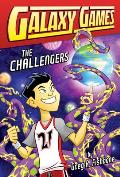
My original idea was to write a whole bunch of short chapter books. Now I have a smaller number of thicker and more complex books. The starting point has also changed. Originally, Earth was already in the tournament on Page 1 and we really didn’t know how. The Challengers tells that story and lets us see the first aliens arrive and the chain of wacky events that turn an ordinary Earth kid like Tyler Sato into a planetary team captain.

As a writing colleague, I've heard about a lot of your interests—the law, website design, real estate, schools, the Red Sox, wife and child—but until I read Galaxy Games: The Challengers I didn’t know about your experience with Japan. Tell us about that and how it fed into the book.

I studied in Tokyo during law school and have spent more time in Japan than in any other country outside the United States. I’m also a fan of manga and had an anime/manga style in mind while I was writing the series. When it came to fleshing out a team of kids from all over Earth, it was natural for me to put a special focus on Japan.

Are you choosing other Galaxy Games settings based on places you’ve traveled? Aruba? Ossmendia?

Since you’re read some early chapters from Book #2, you know that there will be a prominent character from Aruba for which I’m thankful to have spent some time in the Caribbean. I’m quickly running out of places I can write from actual experience, though, unless there’s a travel grant I can apply for. Ossmendia is like Europe in that I’ve only been there in my imagination.

Who or what are some of your influences as a storyteller? What storytellers did you find funny as a kid? What science fiction did you like most?

My mother is my greatest influence as a storyteller. She can take any incident and make it more dramatic and humorous at the same time. For science fiction influences, I’ll go with Isaac Asimov, Madeleine L’Engle, Piers Anthony, Frederic Brown, and Douglas Adams. For humor, I’ll single out Bugs Bunny.

Tyler Sato, the hero of Galaxy Games, gets a reputation as the best young athlete on the planet, but his skills are really average. And his choices for Earth’s true top young athletes seem questionable (though el Gatito would disagree). Were you aiming to write a sports book for kids who aren’t terribly good at any sports?

I could have made all the kids into superstars, but what fun would that be? My goal was that each member of the team would be chosen for exactly the wrong reason but would turn out to have some other quality, trait, or skill that would make them exactly the right player to be on the team at exactly the right time.

The Galaxy Games series takes the structure of a sports book: the training, the team dynamics, the higher and higher levels, the “big game” that decides everything. But a lot of the competitions are iffy. Adults keep trying to fix the games. The players all take advantage of loopholes in the rules. What does that tell our planet’s young athletes and sports fans?

That I’m a cynic? No, that’s not right. I think the key point is that sports is about more than just what happens on the field during game time. There’s training, practice, the locker room, the clubhouse, the team bus, the owner’s box, the bleachers, the bench, the talk radio shows, and everything else. This can’t just be a story about kids playing a game because too much planetary honor is on the line.

Which Galaxy Games Challenger do you identify with most?

Tyler Sato.
Thanks, Greg! And now, today’s Galaxy Games puzzle piece.

09 November 2010

A Child I Can Hold Without Judging

A message from the Digitial Comic Museum made me revisit that site, which archives public-domain comics. While following the trail of Yankee Doodle Jones’s boy sidekick Dandy (not to mention Johnny Rebel and Yankee Boy), I tripped over this soccer story from Yankee Comics, #3, published in 1941. According to the Grand Comics Database, its creators are unknown.

“Young Americans” was a “kid gang” series, which in the 1940s meant ethnic stereotypes. There’s an Irish kid nicknamed Spud who says, “Begorra.” There’s Monty, who speaks in upper-class, perhaps even British, style, and wears glasses.

And there’s a black kid who has a nickname that emphasizes his blackness (“Eightball”), exaggerated red lips, the white gloves of a minstrel-hall performer, and a habit of saying things like, “Sho’ nuff.”

Yet Eightball comes up with a bright idea to defeat the nasty cheating Nazi soccer team, and the comic plays up that moment. The character’s broad accent comes and goes, but doesn’t get in the way of communicating. At least in this story, Eightball shows no fear of spooks, love of watermelon, or other elements of the standard racist stereotype. He’s even featured in the story’s last image, inviting readers to come back for more “Young Americans.“

Furthermore, this gang includes two little girls, pretty Brenda and grumpy Rosie. Both participate fully in the physical side of the game, scoring the winning goal together. When the nasty swastika-wearing Germans set out to hurt the girls in response, the boys fight them off—but only after Rosie bites one on the ankle. Until that last page with the boys, I don’t see even an implied suggestion that those girls aren’t “Young Americans” on equal terms. Just when I get used to seeing blatant racism and sexism in the pop-culture of this era, something like this comics tale comes along. Who created it? Perhaps the folks who originally designed the characters along stereotypical lines were replaced by another writer and artist who didn’t want to play that old game. We’ll probably never know. Yankee Comics lasted just one more issue.

01 December 2009

You Wouldn’t Want Anyone to Go Extinct, After All

I like how Dino-Hockey, by Lisa Wheeler and Barry Gott, and just reissued in paperback, appeared on a list of Best Hockey Books for Kids last month, as spotted on Chasing Spaghetti.

I like how there’s a blog called HockeyBookReviews.com.

But I love how the hockey-playing dinosaurs are wearing little helmets.