Showing posts with label stuck in the middle grade with you. Show all posts

06 December 2024

“Finding Friendships: Middle Grade Comics” Panel at MICE 2024

The Massachusetts Independent Comics Expo (MICE) takes place this weekend in the Fuller Building at Boston University, 808 Commonwealth Avenue.

MICE has been in that building for the past few years, but this is the latest the show has been scheduled, in the gift-buying season.

On Saturday, 7 December, I’m going to moderate a panel discussion at MICE titled “Finding Friendships: Middle Grade Comics.”

The four panelists are, in alphabetical order with their middle-grade books:
One thing that struck me in reading these creators’ work is how they all came to middle-grade storytelling from different directions.

Christmas was one of Margaret Atwood’s collaborators on Angel Catbird and drew or wrote other adventure comics for adults like Tartarus and Alien 3. Fong illustrated prose books for young people, including the YA anthology Banned Together. Hunsinger was best known for her short comic “How to Draw a Horse,” published in The New Yorker. She’s also co-created a picture book, My Parents Won’t Stop Talking. Lu is an educator here in greater Boston whose projects included a community mural in Chinatown.

It’s usually easy to see connections from these artists’ earlier work to their new books. For instance, Lu’s Noodle & Bao is about gentrification in an urban neighborhood. Hunsinger’s How It All Ends and “How to Draw a Horse” both start with sharing adjoining desks in a high-school class.

I interpret this confluence as a sign of the strength of the market for middle-grade graphic novels in recent years. Agents and publishers drew in talent from all directions, and we have a wider range of stories as a result.

31 October 2019

The Deep Roots of Willow Cove

Next summer will bring The Witches of Willow Cove, a new novel for tweens by Josh Roberts, one of my writing group colleagues.

Here are some extracts from Josh's interview at Writers' Rumpus:

Growing up, I lived in a three-story Victorian funeral home, complete with creaky floors, drafty windows, and a secret room sealed off from the rest of the house, so I spent a lot of my childhood making up stories to spook myself and my friends. . . . When I was younger, some of my friends were afraid to sleep over because the house was so spooky. But I have a lot of great memories from living there, too. And obviously it provided some fuel for my imagination.

I’ve always believed that the best spooky stories are the ones that feel like they could be happening to real people in real places. I knew from the beginning that THE WITCHES OF WILLOW COVE would be set in a small New England town like the one I grew up in. I knew I wanted it to be upper-middle grade, too, with characters right on the cusp of their teenage years, caught in that moment of their lives when they’re not quite grown up yet, but also not quite kids anymore. And I knew that my take on it would be: What happens when you find out you’re one of the spooky things that everyone’s afraid of? . . .

I think there’s a sort of comforting thrill that comes along with reading a spooky story—the promise that eventually the scary part will be over and things will generally sort themselves out. That release of tension is just as important as the frightening part. Maybe more so.
The Witches of Willow Cove will come from the appropriately named Owl Hollow Press, and the sequel, I happen to know, is already in the works.

17 July 2017

Airlocked-Room Mystery

In 2002, M. T. Anderson began his novel Feed with the line, “We went to the moon to have fun, but the moon turned out to completely suck.”

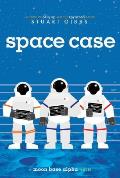
The first narrative page of Stuart Gibbs’s Space Case from 2015 includes the line, “Life in outer space sucks. Believe me, I know.”

I note that parallel not to underscore the similarity of the two books in the science fiction mode, but to introduce how they zoom off in different directions from that point.

Anderson wrote a young adult novel that took place mostly in its enervated narrator’s head and conversations. The big dramatic turns are shopping expeditions and a fatal disease. It turns out the moon isn’t the only place that completely sucks.

Space Case, in contrast, is for “Ages 8-12.” It’s plot-driven, not character-driven. The hero’s sucky life on the Moon gets a jolt of excitement from a mysterious death that only a twelve-year-old can solve. With a limited cast of characters, the lunar base a fine set-up for a murder mystery.

In the end, however, the science fiction wins out over the mystery in Space Case. The explanation for the death turns out to involve a scientific discovery that the narrator and readers weren’t privy to earlier in the story. Though that resolution’s beyond the bounds of current science, it’s not beyond the bounds of a science-fiction fan’s imagination.

18 November 2012

A Sidekick in the Pants

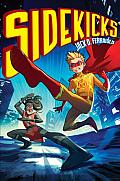
Sidekicks has a mighty “tween”-looking cover for a book that starts out with a boner.

In fact, teen-sidekick-getting-an-erection was the starting-point for novelist Jack D. Ferraiolo, as he explained on his blog:
I was a full-fledged Batman freak... and being that this was the early eighties (and the Batman comics from the 70s were still pretty available), the DC writers/artists were continuing the process of aging Robin up. I remember…looking at a comic of a late teen/early 20’s Robin and thinking, “Man, he should really cover up.” Here he is fighting hardened criminals – thugs, thieves, murderers – and he's wearing the tiniest pair of green jockey shorts imaginable. And no one mentions it?  I mean, not one street tough has something to say about Robin’s itty-bitty bikini bottoms? Especially with all those high kicks he was throwing around?
Actually, Robin’s friends had been calling him “Shortpants” for years by then. Marv Wolfman and George Pérez acknowledged the oddity of an eighteen-year-old in trunks as they discussed the early New Teen Titans. Mention of Dick Grayson’s bare legs was forbidden only for villains and, of course, Bruce Wayne.

Then came Frank Miller’s The Dark Knight Returns and more emphasis on realism/grittiness in superhero comics. In 2007, even DC addressed the erection question in Nightwing Annual, #2, which shows a late-teens Robin wishing for a longer cape and a minute to compose himself after getting too close to Batgirl.

Ferraiolo’s prose novel examines the plight of the adolescent sidekick through the voice of Bright Boy, ward of Phantom Justice. Their relationship is obviously modeled on that of Batman and Robin. As a dark-caped crimefighter, Phantom Justice says, “Good soldier”; he talks about “embracing the night” but can’t connect with anyone emotionally. There’s even an Alfred figure, a butler and voice of common sense.

However, in this world some people have been born with extra strength, speed, and/or intelligence. Phantom Justice and Bright Boy aren’t “badass normal” like Bruce Wayne and Dick Grayson. They’re “plus-plus.” And while their world has mad scientists with amazing inventions, there’s no Wonder Woman, Green Lantern, or Spectre to keep them from the top of the pecking order.

Reviewers obviously new to the superhero genre seem struck by the drastic reversals built into the plot, but those are common in adventure comics. What seems fresh to me is the realistic dialogue between the two adolescents feeling their way into a complicated love affair. On the downside, there are pages and pages of exposition.

I thought the biggest flaw in Sidekicks is that it ends with no “price of fantasy,” as Ellen Howard has termed it. At the start of the book, protagonist Scott feels like a nobody in high school and an embarrassment in the media—those are the costs of being a superpowered hero. (In addition, Scott’s parents died in an accident when he was little, but—unlike the ache that drives the Harry Potter books, even though Harry never knew his parents—we don’t feel that loss.)

At the end of Sidekicks [and that means SPOILERS AHEAD], Scott has solved the problems that bothered him at the start. He’s got a girlfriend, and pals, and cooler clothes, and public adultation, and freakin’ superpowers. For a while it looks like he has to pay a big price—he thinks two of the people he loves have died. But everyone turns out okay in various futuristic ways. The only person he really loses is someone whom he could never warm up to. Scott even manages to come out on top of the Oedipal conflict. It’s total wish-fulfillment with very little cost. [End of SPOILERS] But, as with the plot reversals, that probably won’t look like a flaw to teen readers not yet jaded about this genre.

Which brings me back to that cover. Amulet designer Chad Beckerman has shown how it went through a lot of changes, starting with a more realistic close-up of the main character (wearing braces, though I don’t think they’re mentioned in the book) before ultimately ending up with the art above. One intermediate version appears to the left. Twice, Beckerman writes, the design sketches had “too much crotch.” Yet “too much crotch” is exactly where the story starts.

Ferraiolo writes that he’s heard some criticism (from adults) and lost some library speaking gigs because people thought the novel was inappropriate for younger readers. I think the story’s quite appropriate for young adolescents. But the final cover’s cartoony art, and our culture’s assumption that all superhero stories are appropriate for kids, may suggest to some adults that this is a book for the middle grades.

17 September 2012

Upcoming Events in Boston Teen Lit

On Tuesday, 18 September, Boston GLOW is sponsoring two panel discussions on the theme of “Fight Like a Girl” at Hosteling International, 19 Stuart Street in Boston.

The middle-grade panel (ages 8-12) starting at 5:00 P.M. will feature authors Linda Mullaly Hunt, Padma Venkatraman, Erin Dionne, Jennifer Carson, and Ellen Booraem. The YA panel (ages 12+) follows at 7:00, and will include Terry Farish, Gina Damico, A.J. Paquette, Diana Renn, and Susan Carlton.

Boston GLOW is “a nonprofit aimed at fostering leadership skills among girls and women.” Its poster for the event is here.

The Boston Teen Author Festival is being organized by Emerson College’s publishing-program undergraduates with support from the Boston Book Festival. It is scheduled to take place on Sunday, 28 October, from 1:00 to 6:00 P.M., at the Bill Bordy Theatre of Emerson College, 216 Tremont Street in Boston.

Authors scheduled to attend are A.C. Gaughen, Amelia Atwater-Rhodes, Caitlin Kittredge, Daniel Waters, Diana Renn, Erin Dionne, Huntley Fitzpatrick, Jack Ferraiolo, Karsten Knight, Laurie Stolarz, Leigh Fallon, Marissa Doyle, Steven Goldman, Susan Carlton, and Wendy Wunder.

18 July 2012

The Influence of Middle-Grade Fiction on Wes Anderson

Movie director Wes Anderson, born in 1969, grew up reading the children’s books that librarians praised in the 1970s. Not that there’s anything wrong with that.

That influence was clear the moment that the narrator of The Royal Tenenbaums tells us that two of the siblings had lived surreptitiously in the Metropolitan Museum of Art, just as in E. L. Konigsburg’s From the Mixed-Up Files of Mrs. Basil E. Frankweiler, Newbery winner for 1968. That scene took less than a minute, as I recall; any longer, and it would have moved from homage to outright theft.

Anderson of course adapted Roald Dahl’s The Fantastic Mr. Fox, published in 1970.

According to Hollywood.com, Anderson had some more fantastic middle-grade models in mind for his latest movie, Moonrise Kingdom:
…Anderson returned to many of books and movies he loved as a kid. Anderson recalls Madeleine L’Engle’s A Wrinkle in Time [Newbery Medal, 1963], Mark Twain’s Huckleberry Finn (which the director suggests shaped the characterization of his young hero Sam Shakusky) and Susan Cooper’s ’60s [actually 1965 and 1973-77] fantasy series, The Dark Is Rising [Newbery Honor in 1974, Newbery Medal in 1977].

Anderson calls the first book in the saga, Under Sea Under Stone, “a tease,” in that at the core of the epic tale was a touching family story. But that didn’t stop him from immersing himself in the more fantastic elements as a kid.
Anderson was right in detecting something different about that first volume: Cooper didn’t envision the more fantastic sequels when she wrote it. In the US it even came from a different publisher. The epic qualities arrive in the second volume:
“There’s a poem that includes all these different symbols and talisman, and there’s this whole sort of mythology associated with it,” Anderson fondly remembers. “But it does not have the complexity of Tolkien. It’s young adult novel feeling, from the ’50s, ’60s, so there’s a sort of simplicity at the same time that there’s a very fleshed-out fantasy world. I remember carrying and wearing objects that I was imbuing with the powers of these talismans that were in the series.”
I don’t think the term “young adult” applies to any of those books, however. (Even Huckleberry Finn is either middle-grade or adult.) They’re all middle-grade novels, most about finding capability instead of finding identity. But of course “young adult” is a hot term today.

TOMORROW: The greatest influences on Moonrise Kingdom.

15 October 2011

In the Arena with Greg Fishbone, Author of Galaxy Games

Today Greg Fishbone zooms through Oz and Ends as part of his planet-spanning Galaxy Games blog tour.

Greg and I went to the same high school, but just far enough apart that we were never in the same building until we became colleagues and friends through SCBWI New England. I’ve had the pleasure of watching Galaxy Games expand from a pinprick of fusion energy into a growing hardcover series (and I’m already hooked on volume 2).

We didn’t have a locker room, but Greg kindly granted this interview anyway.
For folks who weren’t in the room at the time, please tell the story of how you invented the Galaxy Games.

The room in question was a breakout session at an SCBWI (Society of Children’s Book Writers and Illustrators) conference in Los Angeles. An editor was presenting a workshop on writing series for middle grade boys. She assigned us all genres in which to create a pitch, on the spot. Mine was sports. Since you were in the room, you heard me give a pitch for something I called “Galaxy Games” that was a lot like how the Galaxy Games series really did turn out.

For folks who were in the room but weren’t inside my head, I can go into even greater detail. Actually, I was disappointed at being given sports as a genre instead of fantasy or science fiction, which I thought of as my strengths. I follow sports, but I’d never read any sports series books, and I’d certainly never considered writing them. The first thing that came to mind was a manga called Slam Dunk, which follows a boys’ basketball team through a season of ups and downs. Another thing I had in mind was a baseball movie called The Bad News Bears, which was full of funny moments and dysfunctional players. The third thing was aliens, and lots of them. That’s where my high concept came from: The Bad News Bears in space, battling aliens in a season-long sports tournament.

How has Galaxy Games grown over the years since you first had the idea?

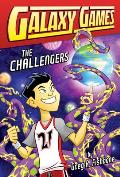
My original idea was to write a whole bunch of short chapter books. Now I have a smaller number of thicker and more complex books. The starting point has also changed. Originally, Earth was already in the tournament on Page 1 and we really didn’t know how. The Challengers tells that story and lets us see the first aliens arrive and the chain of wacky events that turn an ordinary Earth kid like Tyler Sato into a planetary team captain.

As a writing colleague, I've heard about a lot of your interests—the law, website design, real estate, schools, the Red Sox, wife and child—but until I read Galaxy Games: The Challengers I didn’t know about your experience with Japan. Tell us about that and how it fed into the book.

I studied in Tokyo during law school and have spent more time in Japan than in any other country outside the United States. I’m also a fan of manga and had an anime/manga style in mind while I was writing the series. When it came to fleshing out a team of kids from all over Earth, it was natural for me to put a special focus on Japan.

Are you choosing other Galaxy Games settings based on places you’ve traveled? Aruba? Ossmendia?

Since you’re read some early chapters from Book #2, you know that there will be a prominent character from Aruba for which I’m thankful to have spent some time in the Caribbean. I’m quickly running out of places I can write from actual experience, though, unless there’s a travel grant I can apply for. Ossmendia is like Europe in that I’ve only been there in my imagination.

Who or what are some of your influences as a storyteller? What storytellers did you find funny as a kid? What science fiction did you like most?

My mother is my greatest influence as a storyteller. She can take any incident and make it more dramatic and humorous at the same time. For science fiction influences, I’ll go with Isaac Asimov, Madeleine L’Engle, Piers Anthony, Frederic Brown, and Douglas Adams. For humor, I’ll single out Bugs Bunny.

Tyler Sato, the hero of Galaxy Games, gets a reputation as the best young athlete on the planet, but his skills are really average. And his choices for Earth’s true top young athletes seem questionable (though el Gatito would disagree). Were you aiming to write a sports book for kids who aren’t terribly good at any sports?

I could have made all the kids into superstars, but what fun would that be? My goal was that each member of the team would be chosen for exactly the wrong reason but would turn out to have some other quality, trait, or skill that would make them exactly the right player to be on the team at exactly the right time.

The Galaxy Games series takes the structure of a sports book: the training, the team dynamics, the higher and higher levels, the “big game” that decides everything. But a lot of the competitions are iffy. Adults keep trying to fix the games. The players all take advantage of loopholes in the rules. What does that tell our planet’s young athletes and sports fans?

That I’m a cynic? No, that’s not right. I think the key point is that sports is about more than just what happens on the field during game time. There’s training, practice, the locker room, the clubhouse, the team bus, the owner’s box, the bleachers, the bench, the talk radio shows, and everything else. This can’t just be a story about kids playing a game because too much planetary honor is on the line.

Which Galaxy Games Challenger do you identify with most?

Tyler Sato.
Thanks, Greg! And now, today’s Galaxy Games puzzle piece.

20 September 2008

The Cybils for 2008 Are Coming!

In early 2009, the children's literature blogging community will once again honor books published in the previous year with the Cybils Awards. As the organizers have explained:

We wanted a literary competition that combined the freewheeling democracy of the Internet with the thoughtfulness of a book club. . . . The winning books must combine quality and "kid appeal."
This season I'm going to be a judge in the Middle Grade Novels category. That's extended prose fiction for readers aged eight to twelve. (There's a new Easy Reader category, as well as Young Adult on the up side.) Nominations will be welcome from anyone and everyone at the Cybils blog on 1 October!

Until then, you can check out the tastes of the various evaluators at their various blogs.

Middle Grade Novel Panelists (Round I)
Middle Grade Novel Judges (Round II)