The Mystery of Baum’s Final Book
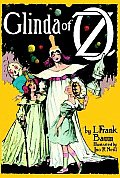
Unlike the preceding book, The Magic of Oz, it has a single, focused plot. Ozma and Dorothy venture to the northern edge of Gillikin Country to intervene in a war between two small communities. They get trapped there. Glinda leads an expedition to save them. With the help of local magic-workers, the rescuers succeed. Glinda repairs the war damage, and Ozma installs new rulers in the two communities.
And there the book ends. There’s no detailed return journey to the Emerald City, no celebration in Ozma’s palace, no concluding discussion among Ozma, Dorothy, and Glinda. Ozma says to no one in particular, “it is always wise to do one’s duty, however unpleasant that duty may seem to be.” Done. Baum had filled his requisite number of pages, composing 40,000 words.
The manuscript for Glinda of Oz survives at the Library of Congress. The only parts that have been digitized appear in this online exhibit, and they say contradictory things about who Baum wrote it.
The title page has a note in Baum’s own handwriting that says: “MS. Completed Feb 17th / 1917 by L. Frank Baum.” But the first manuscript page also has a note in his handwriting: “L. Frank Baum / Feb. 1918.” A note added to the manuscript by Baum’s family says, “Written January & February 1917. finished the night before L F entered hospital,” but we know Baum went in for surgery on his gall bladder on 18 Feb 1918. He had alerted his publisher, Reilly and Lee, to the new book just four days before.
Those contradictory clues convinced Baum’s biographer Katharine M. Rogers to theorize that he finished a first draft of Glinda in February 1917 and a second version a year later. Exactly a year later, which seems like a mighty coincidence.
I think Baum simply wrote down the wrong year on his title page. February was still early in the new calendar year, and he had a lot weighing on his mind as he prepared for surgery. That title page in turn confused the relative who knew he finished just before the operation. All the other clues about how Baum wrote his last three Oz books fall into place. He drafted them in the order they were later published over the eighteen months between August 1916 and February 1918, finishing just before he went into the hospital.
Mostly bedridden after that surgery, Baum spent his last year working with his family to polish those texts and prepare typescripts to send to his publisher. Baum died on 6 May 1919. The Magic of Oz was published a month later, and Glinda of Oz eleven months after that.
Someday, after this pandemic is over, I hope to visit the Library of Congress and examine the full manuscript of Glinda of Oz in the same way that I looked at The Magic of Oz. Does it match the book’s final text as closely? Rogers reported one scene revised to be less scary and a few other small changes. I’m curious about a passage describing the famous residents of the Emerald City that strikes me as stylistically distinct from the surrounding prose. Does that appear in Baum’s handwriting?
Still, even if someone else—a relative or an editor—filled out Glinda of Oz for Baum, they didn’t tack on a more detailed ending.