Showing posts with label comics history. Show all posts

19 September 2025

“The urchin who treads on the garden hose”

Film narrative began with the figure of a mischievous child.

The very first movies were “actualités” documenting how people, animals, or machines moved around in real life. The novelty and spectacle of seeing those actions on screen provided all the entertainment.

As one famous example, in early 1895 Louis and Auguste Lumière first exhibited their improved cinématographe with footage of workers leaving their factory. Exciting!

That summer, the brothers decided instead to stage a fictional event for their camera. The result is the oldest known movie with a plot (beginning, middle, and end) and the oldest film comedy.

The Lumières claimed to take inspiration from a prank played by their baby brother Edouard, born in 1884. If so, Edouard may have taken inspiration from comics, since cartoonists had been drawing variations on this prank since he was a baby. Antoine Sausverd rounded up examples in this article for Topfferiana. Lance Rickman discussed their cinematic influence in an article titled “Bande dessinee and the cinematograph: visual narrative in 1895.”

A journalist for the newspaper Les Allobroges published an interview about this movie with the Lumières’ former gardener Jean-François Clerc in 1949. In translation:
Suddenly, one fine summer morning, the two young men came to find me at the end of the garden where I was working, followed by that little rascal Edouard, all three carrying an extraordinary set of equipment. Louis set up the tripod, Auguste added his crank box on top, and Edouard went to get a garden hose a few steps away. Here was a dark lurking mystery in which I was to pay the price, while raising myself to the rank of the world’s leading film actor.

When everything was set up, while Louis was already holding the handle of his curious box, Auguste said to me: “François, take the jet and water in front of you, without worrying about us. Edouard, by pressing with his foot on the hose, will give you or take away water.” Things went as agreed and that’s how I watered in jerky jets, the water sometimes splashing in my face, while Louis and Auguste kept turning their famous handle, continually directing the glass eye of this box at me.
No footage of this action featuring Edouard has survived. Clerc may have misremembered his costar, or that first footage was a test of concept and the brothers came back for a more planned filming. Louis Lumière himself said in a 1948 interview:
Although my recollections are not very accurate, I think I may say that the idea of the scenario was suggested to me by a farce by my younger brother Edouard, whom we unhappily lost while an airman during the 1914-1918 war. He was then too young to play the part of the urchin who treads on the garden hose. I replaced him by a young apprentice from the carpenter’s workshop of the factory, Duval, who died after performing his duties as chief packer of the works for almost forty-two years. As regards the waterer, the part was played by our gardener M. Clerc, who is still alive after being employed at the works for forty years.
Different sources say young Duval’s first name was Daniel or Benoît.

In late 1895 the Lumières began to exhibit a 40-second movie variously titled “Le jardinier (The Gardener),” “Le jardinier et l’espiègle (The Gardener and the Mischief-Maker),” and finally “L’arroseur arrosé (The Sprinkler Sprinkled).” That movie has a clear plot. The boy steps on the gardener’s hose. Puzzled, the gardener peers at the nozzle, The boy hops off the hose, making water squirt into the gardener’s face. The gardener chases down the prankster and spanks him. The gardener goes back to work while the chastened boy walks off (with a glance at the camera).

The next year, the brothers filmed another version in a different garden with more depth of scene. This time, the prankster was played by a 22-year-old factory employee named Léon Trotobas. In 45 seconds the action comes full circle with the gardener spraying him back. (Some writers treat this as the first version. I’m agreeing with the sequence described by Movies Silently and others.)

“L’arroseur arrosé” was such a hit that the Lumières commissioned Marcellin Auzolle to draw a poster showing an audience enjoying it—the oldest known movie poster to show part of an actual movie.

Other moviemakers like George Méliès copied “L’arroseur arrosé,” sometimes exactly, sometimes trying to top the action. The 1899 British version, “The Biter Bit,” runs more than a minute and shows the gardener chasing the prankster (another man) around a tree before spraying him. Thus film slapstick grew.

12 January 2022

We’re #2!

Fawcett’s original Captain Marvel debuted in Whiz Comics, #2. There was no issue #1.

The Human Torch’s kid sidekick, Toro, debuted in Human Torch, #2. There was no issue #1.

Amazing Man debuted in Amazing Man Comics, #5, and then headlined Stars and Stripes, #2. Neither of those comic books had #1 issues, either.

Back around 1940, when those periodicals appeared, publishers tried to avoid #1 issues if they could. To newsstand vendors, the first issue of a magazine looked like an unproven product they could skip.

Fawcett published a couple of “ashcan” issues with different titles to secure its Captain Marvel copyrights and trademarks before sending Whiz Comics out into the market. Timely dropped a series after one tepid issue and retitled that magazine after its established star, the Human Torch. As for Amazing Man, the Comic Corporation of America simply started its series further along the number line than 1.

When companies canceled one series of stories and started another which seemed to have better prospects, they often changed titles but kept the numbering. Thus, the first Sub-Mariner Comics evolved into Official True Crime Cases in 1947, Amazing Mysteries in 1949, and finally Best Love, but the numbering climbed steadily from #23 to #33.

After a five-year gap, the Atlas company brought Prince Namor back in 1954, with Sub-Mariner Comics resuming at issue #33. That was neither exact nor logical, but what mattered was reminding retailers this character was an established draw.

Likewise, Daring Mystery Comics ran through #8 and was then succeeded by two series, both launching at #9: Comedy Comics in 1942 and Daring Comics in 1944. At Charlton in the late 1950s, Nyoka the Jungle Girl morphed into Space Adventures after Space Adventures lost its numbering to War at Sea.

That preference for presenting a new comics series as firmly established lasted into the succeeding decades. When Marvel shifted its monster and sci-fi magazines to superhero brands, the company changed the magazines’ titles but not their numbering. Thus, Journey into Mystery, #125, was followed by Thor, #126; Strange Tales, #168, by Doctor Strange, #169; and Tales of Suspense, #99, by Captain America, #100. Over at DC, My Greatest Adventure, #85, led into Doom Patrol, #86.

To be sure, Marvel’s other regular Tales of Suspense feature, Iron Man, got its own magazine with a #1 number and a “Big Premiere Issue” decal drawn on the cover. That presaged a new force on the comics scene—collectors who liked to own the first of something special.

In the 1980s the comic-book industry completed a huge shift from newsstands to specialty comics shops. One of the most visible effects was on the #1 issue. Collectors and resellers like that number. Once a liability, a #1 designation is now an asset. Comics publishers seize any opportunity to restart series and put out new #1s. There are, for example, four magazines designated as Nightwing, #1:
  • the first issue of a 1995 miniseries.
  • the first issue of an ongoing series started in 1996.
  • the first issue of an ongoing series started in 2011.
  • the first issue of an ongoing series started in 2016.
Increasingly new fans complain that all these #1 issues and reboots make it harder to follow the storylines and figure out what back issues to seek. But just as economic incentives made comic books designated #1 rarer in earlier decades, for now those forces push the other way.

06 October 2020

Making Space for Thomas Nast

Early this year, folks at the Massachusetts Historical Society contacted me and colleagues in the Boston Comics Roundtable and invited us to help create part of a new exhibit on political cartoons in American history. 

Our role would be to depict the life of Thomas Nast, the leading American political cartoonist of the late nineteenth century, in a series of new drawings. A particular room in the MHS’s handsome building on Boylston Street was reserved for this part of the exhibit. 

That room is round. It has two doors, three large windows, and a fireplace. There’s handsome wooden paneling up to about chest height. In other words, it’s not a simple box with off-white walls ready to be a neutral enclosure for art.  

Measuring the room and the available materials, I mapped out a display customized for that space. There would be nine rectangular panels around the edge of the room, one with introductory text and eight with cartoons tracing Nast’s life. Each new cartoon would incorporate Nast’s own artwork, either within the scene or as inspiration, showing the course of his career. 

As for the room’s quirks, I made them part of the display. The three cartoons set in the tall window spaces, depicting the height of Nast’s influence, would be augmented above and below with reproductions of his own caricatures and icons. Beside the fireplace would stand a cut-out of one of Nast’s famous drawings of Santa Claus. In the center of the room, a display case would showcase Nast’s pages for Harper’s Weekly from the MHS collection. It was a pretty clever scheme, if I say so myself. 

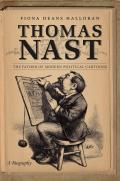
My colleagues recruited artists while I researched Nast’s life to find iconic moments and details. While there are many collections of his artwork, the best sources for biographical detail were Albert Bigelow Paine’s 1904 Th. Nast: His Period and His Pictures, based on conversations with the artist and published soon after his death, and Fiona Deans Halloran’s thorough, nuanced study, Thomas Nast: The Father of Modern Political Cartoons.

Then the virus arrived. We all hunkered down in our houses for a while. I continued the research. In fact, I’d just taken a bunch of Nast books out from the local library, and all their due dates were helpfully extended, and extended again. On eBay I found Nast’s first published print for Frank Leslie’s Illustrated Newspaper, cheap because the seller hadn’t recognized the artist. Some of my early ideas for cartoons didn’t work out. The MHS asked for more Massachusetts content. I revised and polished with my collaborators’ help. 

And then the virus stayed around. The MHS decided its building had to stay closed to the public through the fall. The exhibit built around a particular space would not appear in any space at all. 

16 May 2020

New Fun with Jack and Bill

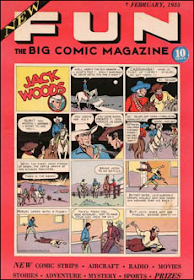
In 1935, National Publications issued its first magazine collection of original comics. New Fun was thus the first comic book from the company founded by Malcolm Wheeler-Nicholson that eventually became DC Comics.

That magazine basically tried to replicate a Sunday newspaper comics section. It was as large as a tabloid newspaper. Though the interior was all black and white, the company quickly moved to color printing, suggesting that was always the plan.

Most significant for the storytelling, the magazine offered twenty different comics, each on a single page. (Twelve more interior pages were filled with prose and advertising.) Some of those comics ended in gags, but most were serialized adventures. Most were also obvious knock-offs of popular newspaper strips or genres. The stories were aimed at different audiences, from little kids to adults looking for thrills.

The advertising reflected that same hope that the magazine would appeal to a broad audience. There were ads for model airplanes, for example, but also ads for job seekers. There were multiple ads for razor blades, indicating that the publisher expected a significant portion of the readers to be shaving. Some ads were aimed at men and a few at women. As National Publications narrowed its target audience to kids, some of those ads went away while others stuck around for decades.

One of the latter was for Charles Atlas’s bodybuilding lessons. From the start Atlas built his campaign around the graphic story of “The Insult that Made a Man out of ‘Mac’.” A scrawny young man gets humiliated in front of a girl on the beach, builds up his muscles, and returns to beat up that bully—in front of more admiring girls. The art was later redrawn, but the script didn’t change much.

One New Fun page turn later, however, came another bodybuilding ad built around another little story, but with a different message. The Jowett Institute of Physical Culture titled its comic “Jack ‘Puts One Over’ on His Boy Friend!” Girls appear in only half of its six panels (instead of seven out of nine in the Charles Atlas story). The relationship between Jack and his pal Bill is more developed than the one between Jack and Hannah. The institute also offered a “FREE Book with Photos of Famous Strong Men.” A different sort of appeal.


24 November 2019

Tom Lyle and the Robin Miniseries

In 1986 Tom Lyle, an aspiring comic-book artist in his thirties, went to a comics convention in Philadelphia. There he met Chuck Dixon, a young writer who was scripting Air Boy for Eclipse. Based on Lyle’s samples, Dixon got him the job of penciler on a related title, Sky Wolf. In a chat with Comics Interview magazine, Lyle credited that as “the event that triggered my career” in comics.

Lyle was recruited by DC Comics to draw Starman in 1988. After a couple of years, as he was wrapping up that assignment, Lyle asked Batman group editor Dennis O’Neil if he had any openings. O’Neil was planning a miniseries focusing the newly created Robin, Tim Drake.

“I’ve never been real thrilled with the Robins,” Lyle told his interviewer. “Dick Grayson, the original Robin, I couldn’t have given a flip about when I was a kid; it was like, ‘Get out of the way, kid, I want to see Batman.” But a job was a job.

O’Neil’s team wanted to make Robin into a martial-arts expert, so they needed a writer who understood the martial arts. Lyle suggested Dixon. He got the assignment and went on to be DC’s most productive writer of the decade. (On the occasion of his 40,000th comics page in 2017, Bleeding Cool noted Dixon wrote 106 issues of Robin, 89 issues of Detective Comics, 77 issues of Nightwing, 46 issues of Birds Of Prey, and 22 issues of Catwoman, to name a few.)

Dixon and Lyle’s first issue of the first Robin series carried a cover date of January 1991. The character of Tim Drake had been created by Marv Wolfman in issues drawn by George Pérez, Jim Aparo, and Norm Breyfogle, and his costume was designed by Neal Adams. But Dixon and Lyle’s portrayal fleshed him out by showing him on his own. Lyle was especially good at portraying Tim as a thirteen-year-old, lithe but not a powerhouse, the littlest guy in the fight who needed to think harder than anyone else to stay alive.

In the gritty, pouched, and overpumped 1990s, Robin was the equivalent of counterprogramming on broadcast television—standing out by doing something different. And it worked. According to Lyle, DC expected to sell about 200,000 copies of the first issue of the Robin miniseries. Instead, it sold three times that number.

DC asked the Dixon-Lyle team for a second miniseries about Tim Drake going up against the Joker, issued at the end of 1991. Then came a third, featuring the character the Huntress for an interesting contrast. That was the height of the speculative boom, and those magazines are festooned with holograms and other gimmicks.

Dixon and Lyle also collaborated on issues of Batman and Detective Comics showing Batman and Robin together. One of those magazines introduced Stephanie Brown as the Spoiler, who went on to become Tim Drake’s love interest, a fan favorite, and eventually Robin and Batgirl herself for limited periods. Lyle was also the artist for the first Robin Annual and the 1992 public service ad in which Tim decides to learn the facts about AIDS.

During that time, Lyle also plotted and penciled the early issues of The Comet for DC’s Impact imprint. In 1993 he started working for Marvel Comics on Spider-Man stories. That same year, DC launched the Robin monthly series with Dixon as regular scripter.

After another ten years or so, Lyle left monthly comics to become an art teacher at the Savannah College of Art and Design. Earlier this year he suffered an aneurysm, and last week he died, aged 66. Friends and fans have set up a Go Fund Me page for his family.

25 November 2018

“I think he should have a kid buddy”

The Library of Congress has a new exhibit featuring a recent donation, Steve Geppi’s vast collection of American comics and pop culture.

George Gene Gustines reported on the display for the New York Times. Many of the items reflect the interplay of comics and other media. For example, there’s the sheet music of a song inspired by the Yellow Kid. There’s the first mockup of the G.I. Joe action figure alongside one of the G.I. Joe comic books. There’s the storyboard for a Mickey Mouse cartoon.

But for the theme of the weekly Robin, the most important item is Joe Simon’s first drawing of Captain America, even before the hero started using a circular shield ( reportedly under pressure from the publisher of an earlier patriotic crime- and Nazi-fighter, the Shield). Created for Timely Comics publisher Martin Goodman, it labels some traits of his costume and logo.

At the bottom of the paper is this note:
Simon created this art in 1940. It shows how the popularity and practicality of the “kid buddy” was already evident to the superhero comics industry, only months after the debut of Robin the Boy Wonder.  And Simon recognized the principal benefit of a sidekick: giving the hero someone to talk to.

15 July 2017

Work with Children and Animals

This call for papers came up on the H-Childhood email list:

Child-Animal Relationships in Comics: Historical and Transcultural Perspectives

Many of the most well-known comics protagonists have pets or animal friends, loyal sidekicks in their daily lives and adventures: Charlie Brown has Snoopy, his independent, precocious dog, Calvin has Hobbes, a stuffed tiger acquiring life through the boy’s imagination, Beano’s Dennis the Menace eventually acquired an equally destructive canine companion called Gnasher, Tintin (successfully eluding the adult-child distinction, but remaining in many ways a child with a degree of agency accorded only to adults) has Snowy.

Already the Yellow Kid was accompanied by several stray dogs, cats and other animals, who accentuated the action and the humor. Decades later, the importance of animal sidekicks persist, as exemplified by the series devoted to Spirou’s fantastic, semi-domestic Marsupilami. That these children and their animal friends combine characteristics of both adults and children not only accounts for their appeal to a broad audience but also highlights the complexity underlying these characters in spite of their flattened, polyvalent essence. Thus, for Umberto Eco, “Schulz’s children create a little universe in which our tragedy and our comedy are performed” and “Snoopy carries to the last metaphysical frontier the neurotic failure to adjust”.

Even though child-animal relationships have been a staple of comics production, they remain overlooked by comics scholarship, which is only tentatively broaching the study of children and comics, as exemplified by recent publications (Abate and Sanders; Gordon; Heimermann and Tullis). In expanding on existing scholarship and combining it with studies on picture books and comics as well as animals in comics (Groensteen; Hatfield; Hatfield and Svonkin; Sanders), this anthology seeks to build stronger bridges between the fields of comics studies, childhood studies and animal studies in order to take a first step towards a more profound and holistic understanding of the roles and relationships of animals and children in comics. It is particularly interested in historical studies (from the mid-nineteenth century onwards) and transcultural comparisons of child-animal relationships in comics that engage with one or more of the following aspects:
  • extent of questioning or reproduction of conceptualizations of childhood and childishness
  • relationship to adults and adulthood
  • degree of agency accorded to both children and animals
  • role of eccentricity for both child and animal characters as well as the supporting cast
  • othering and interaction with others
  • representations and roles of family life
  • portrayal and presence of schools and other civil and social institutions
Please send abstracts of 500 words (for a 7000 word contribution) to Maaheen Ahmed by 31 August 2017. Accepted contributions are due by 31 January 2018.

The volume will be published in late 2018 by the University Press of Liège as part of the ACME series on comics studies.

10 December 2015

An Unknown Comics Adventure in Oz

Last week as The Wiz was about to air on television, Mark Evanier unspooled his story about being hired to script an adaptation of the 1978 movie version for DC Comics.

It’s most interesting, like a lot of the stories on Evanier’s website, for the backstage look at how comics companies work. (Which is to say, barely.) There are also some nicely crafted lines:
  • “Not far enough before the film's scheduled premiere, someone at or around DC Comics got the idea to publish a slick magazine which would be part comic book, part souvenir book for lovers of the movie. This was some time before anyone knew there wouldn't be a lot of lovers of that movie.”
  • “I had to sign all sorts of non-disclosure agreements that I would not divulge what I saw to anyone and as I recall, they didn't specify any time limit. I mean, I was supposed to write all these authorized articles about what was in the movie and here I was signing vows that I would never in a million years divulge to anyone what was in the movie. So I may be violating those agreements right now.”
  • “I forget what they were going to charge for it but it struck me as a bit too pricey. It also struck me as not my problem.”
  • “By far, most of my time went into going up to Universal to see a more-complete version of the movie and then to see an even-more-complete version. I saw it three times but I never saw the final release cut. I felt that the film got better as the holes were filled in…which is not to say I thought it ever got to be really good. The merits it did have were (a) a few of the actors’ performances and (b) some truly dazzling dance numbers. And of course, it did dawn on me that our adaptation would contain neither.”
For the stories of which artist should work on this project, how the 1976 Copyright Act affected things, why no one has ever heard of this comic, and how its obscurity might have helped Evanier and artist Dan Spiegle’s careers, check out Evanier’s recollection.

15 November 2015

“A depth that other superhero comics didn’t have”

A few months back, as McFarland sent out the first copies of Dick Grayson, Boy Wonder, editor Kristen L. Geaman asked all of us contributors to describe what our essays were about.

Here’s how I summed up my essay “Success in Stasis: Dick Grayson’s Thirty Years as a Boy Wonder” for the project’s Tumblr page:

The first chapter of the book looks at the first thirty years of stories about Dick Grayson, from his debut in 1940 until he leaves Wayne Manor in 1969. That was a period of stasis for the character, with no growth and no rifts with Batman that weren’t solved by the end of a story. Yet it was also the period that established Robin the Boy Wonder as a household name.

This chapter argues that the partnership of Batman and Robin was crucial to how those characters survived in the late 1940s when almost all other costumed superheroes stopped being published. The emotional bond between Dick Grayson and Bruce Wayne, explored most often in stories written by Bill Finger, gave their adventures a depth that other superhero comics didn’t have.

Robin thus became DC Comics’s preeminent symbol of youth, and the 1960s produced a roiling youth culture that forced the company to make changes in Dick Grayson’s life. After thirty years in his early to mid-teens, he had to grow up.
That highlights the hypothesis I arrived at while preparing that essay: that the emotional bond between Bruce Wayne/Batman and Dick Grayson/Robin was the crucial ingredient that made their series survive when most superheroes faded away. And Bill Finger, co-creator of the characters, was the storyteller who did the most to establish and explore that bond.

08 November 2015

“Some outstanding work” in Dick Grayson, Boy Wonder

Here are nice quotes from reviews of Dick Grayson, Boy Wonder, edited by Kristen L. Geaman and published this year by McFarland.

John DeNardo, Kirkus Reviews:

“Dick Grayson, aka. Robin, Batman’s young sidekick, [has] been around nearly as long as the caped crusader but rarely sees any media attention. That is, until now, with this collection of scholarly essays. Dick Grayson, Boy Wonder: Scholars and Creators on 75 Years of Robin, Nightwing and Batman is an interesting collection that features critical analyses and essays about the most overshadowed sidekick in comics. Also included are interviews with the Boy Wonder’s past and current creators Chuck Dixon, Devin Grayson and Marv Wolfman. Collectively, these essays examine Robin’s place in comics and his evolution across the decades—all within various contexts like trauma, friendship, feminism and masculinity.”
Nick Smith, ICv2 (4 Stars out of 5):
“Some outstanding work . . . for anyone who wants insights into the detailed history of Dick Grayson, as Robin and as Nightwing, and into the creative processes that have guided the character over such a long time, this is a valuable work, well worth reading. It should also be of interest to anyone interested in writing any company-owned character, because the history and interviews may prevent career-threatening pitfalls. Its price may keep it out of the hands of some fans, but it belongs in most libraries, at the least.”
As I wrote last week, the preview function on Barnes and Noble and Amazon websites offers an overview of the book and a good chunk of the first essay, by me.

01 November 2015

A Robin Reader

Dick Grayson, Boy Wonder is a collection of serious essays about the sensational character find of 1940, published on the occasion of his 75th anniversary.

The book’s editor is Kristen L. Geaman, a medievalist, and many of the other contributors are also academics. Most don’t specialize in comic books or popular culture but are long-time fans of Dick Grayson in his various roles in the DC Universe. They combine rigorous scholarship with affection for the character. And one of those contributors is me.

In fact, my essay is the first in the book because I volunteered to cover the first thirty years of Dick Grayson stories, from his debut in 1940 to his departure for college in late 1969. I discuss the storytelling advantages of a sidekick, the emotional depth that Dick brought to the Batman saga, and Dr. Fredric Wertham’s complaints about the Dynamic Duo’s relationship.

On both Amazon and Barnes & Noble’s website, it’s possible to read a good chunk of my essay through the preview feature. Check it out and see if you want a copy of the whole book in print or digital form.

(Dick Grayson, Boy Wonder doesn’t contain any illustrations from the comics, and it wasn’t authorized by DC Comics—hence the non-trademark-conforming costume on the cover.)

19 November 2014

A Paradox of Geek Fandom

Last week I sat in on a discussion with Paul Levitz, former President at DC Comics, at MIT’s Media Lab. (The door to the building said I had to have an MIT identification to enter, but I rode up the elevator with Levitz and helped him find the auditorium, so I figured I deserved to stay.)

Levitz started at DC Comics as a sixteen-year-old freelance writer and editor, and is still scripting comics. From 1976 to 2009 he took on increasing internal responsibilities, spending the last seven years as President. Having long functioned as a big part of the corporate memory, he recently wrote a gigantic history of the company.

Among other observations at MIT, Levitz said that “geek culture” has overtaken “pop culture.” That reflects the popularity of videogames and of superhero and science-fiction movies and TV shows, of course, but it also speaks to a certain style of consuming entertainment.

I asked Levitz for his thoughts about one paradoxical aspect of “geek culture.” On the one hand, that form of fandom is very interested in seeing the process of storytelling:
  • comics collections often include early sketches, scripts, and creators’ discussions of roads not taken. We rarely see that in novels.
  • DVDs feature deleted scenes, commentary tracks, outtakes, and other peeks into the creation of the movies or TV shows they document.
  • TV “show runners” are becoming celebrities with their own following.
  • the moviegoing/viewing/reading/gaming public follows the creation of a new piece of entertainment earlier than ever; news that used to be restricted to the industry is now spread everywhere.
In sum, it’s more obvious than ever that those stories we like are artificial creations designed to entertain us and earn our dollars. And we enjoy the reminders of that.

And yet “geek culture” is also marked by a fervid, sometimes rabid, protectiveness about those stories and the characters in them, as if they were real or deserved to be. Fans want to guard their favorites from the very companies and people who have the assignment of keeping them alive.

Levitz could only reply that part of his job as a DC executive was to warn people adapting the company’s properties to other media when they were straying too far from the characters’ “core.” He found that he couldn’t define in advance what would raise most fans’ protective responses, but he knew it when he saw it. And that emotional attachment remains, still hard to map but perilous to cross.

16 November 2014

DC to Feed Nostalgia for Six to Twelve Years Ago

DC Comics executive Dan DiDio told USA Today that the company’s “Convergence” crossover event for next spring will return to older versions of its primary characters. “We’re picking up at points of their lives where we left them and finding out what’s gone on with them since then,” he said.

Closer examination at Comic Book Resources confirms that these stories hearken back to the company’s continuity before the “New 52.” But each tale seems designed to return its hero to a happy high point popular with his or her following. Back in June, the gossipy site Bleeding Cool heard from a creator that the upcoming project would be “a love letter to DC Comics fans.”

Thus, Wally West is not only the Flash once more, but he’s married to Linda and both their kids appear to have superpowers. (After 2010, only their daughter had powers.) In another nod to the domesticity of about eight years ago, Superman and Lois Lane are expecting a child.

Stephanie Brown will be back at Batgirl, with Tim Drake in his first Red Robin costume and Cass Cain as the Black Bat. That also reflects their situation in about 2010 (though we didn’t see much of Cass back then). Damian Wayne, who appears to be coming back in some form in the regular continuity, might well show up in one of these miniseries without ever having died.

“Convergence” thus gives DC a chance to “correct,” at least temporarily, recent developments that many fans vocally disliked, such as the murder of the Atom Ryan Choi and Roy Harper’s loss of both his arm and his little daughter.

Indeed, in some way, these series “correct” the entire “New 52” as they show the heroes fending off attacks from “Flashpoint versions” of other heroes; Flashpoint was a 2011 crossover presenting dystopic versions of the world which led to the “New 52.” The characters or versions of characters that disappeared in that transition have, the summaries suggest, been living under a protective “dome.”

I have particular questions about the Nightwing/Oracle title, to be scripted by Gail Simone. The teaser for the first issue says:
Dick Grayson and Barbara Gordon reevaluate their relationship under the dome (wedding!), but Flashpoint Hawkman and Hawkwoman attack, and everything changes.
For many fans, Dick and Barbara are meant to be together. But the last time they were talking marriage in DC’s regular continuity was back in 2006. So are they reevaluating from that perspective, or after all the events that happened between then and Flashpoint? If the latter, that means Dick has become Batman, and no one has successfully penned his decision to go back to being Nightwing. At least not yet.

09 November 2014

“No other comic-book character has lasted as long”

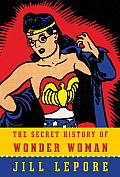
In articles derived from her new book, The Secret History of Wonder Woman, Jill Lepore has been talking up that comic-book heroine’s place in superhero history.

In Smithsonian:
Wonder Woman is the most popular female comic-book superhero of all time. Aside from Superman and Batman, no other comic-book character has lasted as long.
In The New Yorker:
Superman débuted in 1938, Batman in 1939, Wonder Woman in 1941.
Who’s missing from this discussion? “The Sensational Character Find of 1940,” of course.

Dick Grayson has appeared in stories for nearly three-quarters of a century, about a year and a half longer than Wonder Woman. He’s been a major character in two movie serials, a television series, and two feature films. Plus, half a dozen television cartoons have featured some version of Robin.

I suspect Robin is a pop-culture reference as recognizable as Wonder Woman. In fact, the name “Dick Grayson” might be better known than Wonder Woman’s occasional alias, “Diana Prince.”

Of course, Robin has always been a sidekick to Batman, and thus a supporting character or one in an ensemble instead of a lead. Though he appeared on more comic-book covers in the 1940s than Batman, not until the 1990s was there a comic book with the Robin name in its official title. In contrast, there’s been a Wonder Woman magazine since 1942 (with a yearlong break in 1986-87), and she’s usually worked on her own as well as with the Justice Society and Justice League.

So I’m not arguing that Wonder Woman is less prominent than Robin, just that he qualifies as a famous, long-lasting comic-book crime-fighter on the same level.

(And I won’t even mention that Archie Andrews made his debut in comic books in the same month as Wonder Woman, so those two comic-book characters have lasted the same time.)

05 November 2014

Before Frank Quitely Was Quite Quitely

Frank Quitely is one of the most respected artists working in superhero comics today, known for his distinctive drawing style, dynamic compositions, and willingness to experiment with form.

Which makes his statements in this interview at Comics Beat more interesting:
When I started out, I didn’t know a lot about storytelling because I never got a formal training in comics. It ended up being kind of intuitive and my main thing was about trying to make it clear and interesting. You know, I wasn’t really thinking in terms of narrative flow, it was more just about clarity and trying to make it as good as possible. Gradually, over the years, I just became more interested in storytelling.

There was a DC editor I worked with named Dan Raspler – the Lobo editor amongst other things. He was my editor on JLA: Earth 2 and before I did JLA, I did a short Lobo story for them and it was the first mainstream DC thing I’d done; I’d been working for [the imprints] Vertigo and Paradox for a couple years.

I sent him the pencils and it was the best thing I’d done up to that point and I thought “he’s going to phone me back and tell me how good this is” and he didn’t phone for a week. I was really panicking by the time he phoned; he started the conversation with “dude, I don’t know how to tell you this…”

Basically what he said was my drawings were really lovely, but my storytelling was really boring. He went through and told me what I should be thinking about and that was kind of a real milestone. As it was, that book never came out for different reasons. For JLA: Earth 2, he made me fax a rough for every page because he wanted to see that I could do art that makes sense in rough with a sharpie, then I could do it properly. . . . That was a big leap for me.
DC Comics published JLA: Earth 2 back in 2000. That was one of many collaborations between Quitely and scripter and fellow Glaswegian Grant Morrison.

As for the “short Lobo story” that Quitely mentioned, that was Lobo: The Hand-to-Hand Job, also subtitled It’s a Man’s World, scripted by another Scotsman, Alan Grant. It was never printed. This webpage on unpublished comics says, “Although the publisher has never commented publicly on the comic, the disappearance of the project could be chalked up to the reported nakedness of Lobo for at least half the issue, as well as a scene involving sexual self-gratification by a league of asteroid miners.” Yes, that would do it.

02 November 2014

“That history will always be in the background”?

In an interview with Comic Book Resources, Grayson co-scripter Tom King spoke of his particular fondness for the character of Dick Grayson:
You’ve said a few places that Dick was always your favorite DC character thanks to his accessibility. With that in mind, what were the big stories that first brought you into his world? Are any of them the kind of thing you’ll look to fold into the background of this book?

I came into DC comics with Tim being Robin and Dick being the ex-Robin, the man who had gone through that uniquely frightening experience and emerged as someone uniquely brave. I remember buying my first trade, A Lonely Place of Dying, and obsessing over the Tim/Dick/Batman interaction. There was this essential question there about how do you leave childhood without losing who you were as a child. I read that thing to pulp. The first time I got to write my own complete script for the series, I titled it “Only a Place for Dying,” as a tribute to that experience.

Some of my other favorite Grayson stories are:

Birds of Prey #8 (the Barbara/Dick date issue), which is where Agent 8 from Grayson #3 gets her name; Batman #156 (“Robin Dies at Dawn”), which will play a role in an upcoming issue; and, probably my favorite Dick Grayson story of all time, Secret Origins Annual #3, which I haven’t yet figured out how to squeeze story out of — but I will! Dick Grayson has a 74-year history, and though Grayson is a book solidly set in the New 52 featuring a very modern take on the hero, that history will always be in the background and will always haunt and elevate our hero.
That’s almost sad. Secret Origins Annual, #3, was a story scripted by George Pérez in 1989 which synthesized the whole history of the Titans up to that point, both pre- and post-Crisis on Infinite Earths. It sought to build coherence and depth from the illogical late-1960s storylines of Bob Haney, revealing a series of villains to be one foe in different guises trying to undermine Dick Grayson.

That story also restored a version of Betty Kane, the first Bat-Girl, who had been abandoned with the “New Look” back in 1964. It reestablished the basics of Titans history as written in the 1960s, 1970s, and early 1980s within DC’s new continuity. And in doing all that, it reflected the importance of Nightwing and his team to the company at that time.

In contrast, the “New 52” reboot of the DC Universe that King and his co-writer Tim Seeley are working within wrote off Dick Grayson’s version of the Titans, and most of the characters and relationships that Pérez’s story stitched together. Grayson has left the character even more alone within the DC Universe. The scripts might contain slight allusions to beloved older stories for long-time fans, but I don’t see how this Dick Grayson can be haunted by a history that he never had.

19 October 2014

Loeb’s Untraveled Road

This month John Siuntres’s Word Balloon podcast reran excerpts from some past years’ interviews with Batman story creators. Starting about 54 minutes into the recording, scripter Jeph Loeb described a story of the Dynamic Duo that never got off the ground:
My pitch on the original All-Star Batman and Robin, which is a book that I was writing when I left for Marvel and then got replaced by Frank Miller—and if you've got to get replaced by somebody, that's not a bad choice—…was going to be Jim [Lee’s] and my return to the character. . . .

At the beginning we really didn’t understand what All-Star was. The first time it was pitched, it was, “Take these characters as though it’s 1968, that’s the continuity you’re using.” And I was like, “So, basically, what you’re saying is that Barbara Gordon hasn’t been shot. I mean, is there anything different?” Because I really thought it all should have been Year One, and you should take it from there, and that way you could do whatever you wanted. And then I didn’t know how much you could change stuff around. I never had any idea they were going to change things as much as they were, like, you know, the Black Canary playing such an important role in Batman’s world. . . .

The story that I wanted to tell was that Jason was the first Robin, and that he’d been killed, and that Batman…hid the fact that Jason had died, and then met Dick in the same way that he always met Dick. And decided that there was a way that all the mistakes that he had made with Jason he could rectify with Dick. Which is a little bit more like what he did with Tim Drake, having failed with Jason.

But what I liked about this story was that the only two people who knew what he had done were Gordon and Superman, both of whom came to Bruce and said, “What the hell are you doing? Like you’ve already gotten one child killed, why would you do this again?” And then you really saw Batman’s arrogance about it, that he thought that he could make up for the death of this child by making it right with another child.

But that was not a story that ever got told.
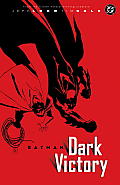
That apparently would have been Loeb’s second take on how Dick Grayson came to be Robin, following Dark Victory. Then again, considering that All-Star Batman and Robin the Boy Wonder fans are still waiting for Lee to finish the issues Miller mapped out years ago, it might be more accurate to say it would have Loeb’s take one-and-a-half.

28 September 2014

Beyond Batman Beyond

It’s interesting to watch what DC Comics has done with its Batman Beyond storyline this year, reflecting changes in its target audience.

Batman Beyond was a spin-off of the very successful 1990s Batman TV cartoons of the 1990s. Les Daniels’s Batman history states, “a new show was requested that might skew toward younger viewers.” The resulting cartoon was set in the future when the world has more advanced technology and Bruce Wayne is a goddamn octagenarian. The new Batman was a hot-tempered teenager named Terry McGinnnis.

This show was an extension of the DC Animated Universe, thus not tied to the publisher’s main comic-book continuity. There was an accompanying comic book in 1999-2001, but readers were supposed to keep it separate in their minds from the main Batman titles of the time.

In this version of the future, Barbara Gordon has long ago retired as Batgirl and now holds her father’s old job as police commissioner. She was romantically involved with Dick Grayson when they were college-age, then later with Bruce Wayne for some unspecified period, and is now married to someone else. Dick himself, having established himself in the DCAU as Nightwing, has left Bruce’s team and is nowhere to be seen.

Batman Beyond lasted for 52 episodes plus a TV movie—a respectable but not sterling run. Nevertheless, it made a strong impression on a lot of viewers, including Kyle Higgins. He told Comics Alliance:
I was such a huge fan of the show. The DC Animated continuity was my introduction to DC Comics growing up. So I know that stuff inside and out, and I actually know it better than the books.
Higgins’s fondness for the cartoon is also evident in how he spoke about it on Kevin Smith’s podcast and in other interviews.

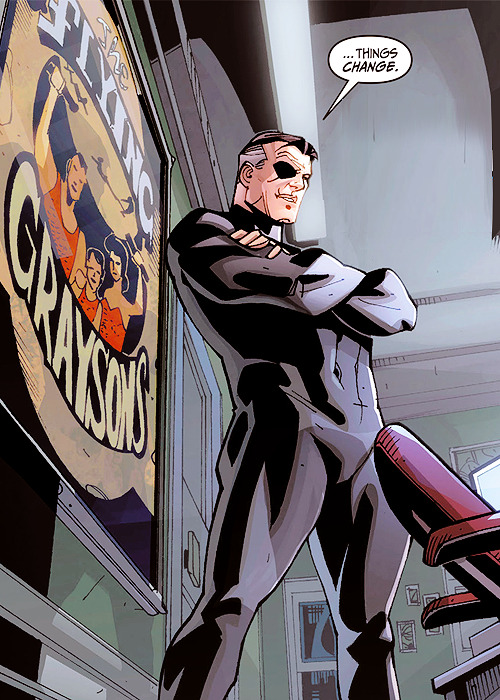
In 2010, DC launched a series of new Batman Beyond runs scripted by Adam Beechen. One of his mandates was to tie the world of the TV cartoon more closely to the DC comics (though those were about to go through some sudden changes themselves). Beechen brought back Dick Grayson, revealing that he’d stepped away from crime-fighting and from Bruce Wayne after losing one of his eyes in a fight.

That was the history Higgins inherited when he took over DC’s digital-first Batman Beyond series in 2013. His series was subtitled “2.0” because it showed Terry McGinnis breaking away from Bruce as mentor and working instead with Dick. Higgins was thus writing two different versions of Dick Grayson as he finished his Nightwing run and started this series.

In a story titled “Mark of the Phantasm” (digital issues #25-31), Higgins and co-writer Alec Siegel dug deeper into the relationships among Barbara, Bruce, and Dick. Craig Rousseau provided the art for the scenes set in the future, adhering to the standard Batman Beyond style. Phil Hester penciled scenes set in the past, following the style of the earlier Batman: The Animated Series cartoon and its spin-off comics.

Issue #28 shows Barbara and Dick telling Terry how they broke with Bruce. In their early twenties they had started to rekindle their relationship and Dick was ready to propose, only for Barbara to discover she’d become pregnant by Bruce—only for Barbara to miscarry after intervening in a mugging.

Remember, this story appeared in a continuity created to “skew toward younger viewers.” But that was back in 1999. Those same viewers have aged fifteen years and are ready for plot twists based on sexual relationships and spontaneous abortion. They got that more adult story even within the nostalgic visual style that Hester provided.

In another sign of the DCAU’s hold on today’s comics readers, the main DC Comics continuity is being disrupted by a crossover story called “Future’s End,” and Terry McGinnis as a next-generation Batman is in the middle of it all. While he still represents only one possible future for the company’s main continuity, he’s also what the company thinks its present-day readers want to see.

24 September 2014

Carol Tilley on “When Comics Almost Died”

On Monday night I had the pleasure of attending a lecture by Carol Tilley of the University of Illinois on Dr. Fredric Wertham’s crusade against comics in the late 1940s and early 1950s.

I knew that basic story well from Jules Feiffer’s Greatest Comic Book Heroes and more recent books. In fact, I remember finding a copy of Wertham’s Seduction of the Innocent in a library during a high-school summer and wondering at its form of argumentation.

Tilley’s research has filled out that picture in several ways. One was, as I noted back here, to document how Wertham edited his notes on counseling sessions when he wrote his book, making his young patients say what fit his thesis and leaving out significant evidence that would undercut it.

Another, and for me this was a highlight of Tilley’s talk, was to collect and display the letters from young comic-book readers to Wertham arguing against his conclusions. They pointed out, sometimes eloquently, that they were more representative of kids who enjoyed comics than the juvenile delinquents and troubled youth he saw in his psychiatric practice.

Tilley had also found those teens’ yearbook photos and interviewed them so she could put (perfectly ordinary) faces up on the screen beside their names and words. Evidently Wertham read through their letters, marking grammar, punctuation, or spelling mistakes, before filing them away and never answering.

After Prof. Tilley’s talk, the question came up about how Wertham, a very progressive child psychiatrist who set up a practice in Harlem and provided evidence for the plaintiffs in Brown v. Board of Education, could be so oppressive when it came to comics. My view was that all those actions came from the same crusading desire to protect vulnerable children. These days most book challenges in America seem to come from the political right, but the anti-comics critics were all over the political spectrum.

Afterwards, a bunch of us went out for dinner and had a lot of laughs, so I should start calling Prof. Tilley “Carol” now. If you get a chance to see her “When Comics Almost Died” lecture, take it.

24 August 2014

Roy Harper, the Anti-Dick Grayson

Just as DC Comics had to separate Green Arrow from Batman, its storytellers had to figure out a way to make Green Arrow’s young sidekick Speedy different from Robin, the Boy Wonder.

For decades the two characters existed in parallel—helping their mentors in fighting crime, providing useful sounding boards, and expressing the emotions of young readers. Dick Grayson was a teen orphan living with Bruce Wayne. Roy Harper was a teen orphan living with Oliver Queen. And their paths never crossed.

In 1964 Robin began working with Aqualad, Kid Flash, and Wonder Girl as the Teen Titans. But Speedy was notably absent. Fans wrote in, asking why the line’s other long-time kid sidekick was being left out.

So Teen Titans, #4 and #11, featured guest appearances by Speedy. And in issue #19 he became an official member of the team—and also managed to score a date with Wonder Girl, thus distinguishing him from all the other teammates who had crushes on her. But not by much.

The real differentiation began in 1971 when Neal Adams and Dennis O’Neil used the character of Roy Harper to explore the issue of drug use—a breakthrough for DC. Green Arrow discovered that his sidekick had become addicted to heroin. Not so badly that he couldn’t kick the habit within two issues, but enough to suggest a new direction for Speedy.

The Teen Titans series, aimed at a younger audience, never mentioned Speedy’s heroin troubles through the 1970s. Its writers tried sought other ways to set him apart from Robin: he and Wonder Girl remained a casual couple, and he was a bit more hot-headed. There was enough space between the characters for the series’ last issue to retroactively establish Speedy as a founding member of the team.

In the early 1980s Marv Wolfman and George Pérez brought Roy Harper back for occasional appearances in the New Teen Titans magazine, this time referencing his troubled past. Now working for a government agency, he joined the Titans in attacks on drug dealers. Those issues also portrayed him as an incorrigible ladies’ man just as Dick Grayson was entering a serious (and sexual) relationship with Koriand’r.

Finally, after Crisis on Infinite Earths Wolfman and Pérez added another layer to Roy Harper’s character. New Teen Titans, vol. 2, #21, revealed that he’d gone undercover [!] and had an affair with an international assassin named Cheshire. They’d even had a child together. Dick (now Nightwing) and Kory were having sex, but Roy was having unprotected sex with a villain!

That provided such a distinction between Dick Grayson and Roy Harper that Wolfman could write a story in Action Comics Weekly of their adventures together looking for Roy’s daughter. Where once Robin and Speedy couldn’t be on the same team, now Nightwing and Speedy could play off each other for several issues on end.

Roy Harper had become DC Comics’s anti-Dick Grayson. Dick was charming, respectful, and monogamous. Roy hit on almost any woman he met, especially when he was on duty. Dick became the one member of the original Titans who never married or had kids. Roy did the kids part first and muddled through as a single dad.

Nightwing was the young hero who did everything more beautifully than anyone else, whom everyone trusted. Roy was the character who managed to screw up most of the time. He bounced among among crime-fighting identities: Speedy to Agent Harper to Arsenal to Red Arrow and back to Arsenal. He owed his co-workers money. He took over the Titans, and the team fell apart. He formed the Outsiders for Dick to lead, and made a stupid fundamental error from the start. Nonetheless, he kept going. The result was a far more compelling character, a favorite for some readers.

While not all of Roy Harper’s background gets transferred into other versions of the DC Universe, his definition as the anti-Dick Grayson does. When the Teen Titans television cartoon introduced Speedy in a later season, producer David Slack explained, “we were looking for someone to mirror Robin.” In the sillier Teen Titans Go, the producers even have actor Scott Menville provide both rival characters’ voices (and of course make in-jokes about that).

DC’s “New 52” universe wiped out the Titans’ past and left little time for Roy Harper to have worked with the new Oliver Queen. Nonetheless, it reintroduced Roy as “the worst former sidekick ever” in Red Hood and the Outlaws. That may not be the best treatment for him, but at least it’s better than the Cry for Justice/Rise of Arsenal miniseries of 2010, which were so poorly received they were quickly written out of continuity. And it does preserve Roy Harper’s distinct role in the DC Universe.