Showing posts with label pastiche. Show all posts

02 September 2014

Did The Economist Solve a Winkie Con Mystery?

The Prospero blog on The Economist’s website filed a report on this month’s Winkie Convention last month, taking note of the extensive schedule of panel discussions that I helped to put together and other activities.
This year, propelled by the publicity for the anniversary of the MGM film, Winkie Con moved from the mid-California Monterey peninsula down to San Diego. The relocation was due in part to San Diego’s proximity to neighbouring resort town, Coronado, where [L. Frank] Baum wintered and wrote several novels. It was also the first year the usually humble Winkie Con expanded to offer a broad conference-style schedule, with concurrent panels discussing subjects such as the strong feminist characters in Baum's books and the rise of fantasy and sci-fi fan culture. Attendance spiked to over 350; many attendees were newer fans, who had found their way down the yellow brick road via the musical "Wicked" or "Oz the Great and Powerful", the new Oz film released in 2013.

Prospero, a first-time festivalgoer, was shown plenty of “ozpitality” and welcomed into many exclusive but never exclusionary events. On the opening day, Aljean Harmetz, a journalist and historian whose mother worked in the MGM costume department for 20 years, screened "The Wizardry of Oz", a 1979 documentary follow-up to her exhaustively detailed book, "The Making of the Wizard of Oz". On the second afternoon, a tightly packed audience strained to hear a Q&A with Priscilla Montgomery Clark, one of the munchkins in the MGM film, who is now in her 80s. A family reunion-style slideshow gave regular Winkie Con organisers and participants a chance to reminisce about the years of lighter programming and more intimate festivities. “There’s Dan again,” someone murmured as the slides shuttered past. “He was a marvellous Dorothy.”

Nearly two-dozen of Baum’s The Wizard of Oz books are in the public domain in America, as is the 1925 film. This makes for a rich ecosystem of Oz-related fan culture that continues to snatch up new graphic novels and support reinterpretations of the original characters. At the swap table, a Winkie Con tradition, one could pick up or drop off gently used books and artwork, or borrow stapled short stories from a stack of unpublished fan-fiction.
Oh ho! In fact, one was not supposed to borrow those short stories but to read them in that room. My story “Post-Transformative Stress” disappeared for several hours during the convention, prompting some anxious “no questions asked” announcements. Eventually it reappeared on the table with no questions answered. Had Prospero mistakenly taken it for a closer read?

No harm done. This year’s contest judges had already done their work and chosen which essays, stories, and artwork should win prizes. “Post-Transformative Stress” came away with one. It throws together Dr. Pipt from Baum’s Patchwork Girl of Oz (shown above) and Iva the kitchen boy from Ruth Plumly Thompson’s The Wishing Horse of Oz. No wonder it might have been so compelling.

20 July 2013

Back to Slumberland

The good news from Comic-Con: IDW will publish new adventures of Winsor McCay’s little Nemo in Slumberland by top comics talent.

The great news: One of those creators is Eric Shanower.

The baffling news: He’s doing scripts, not art.

I've seen Eric’s McCay homages, most prominently in Promethea. I can’t imagine anyone doing them better. The other guy had better be good.

09 May 2013

The Tie That Binds

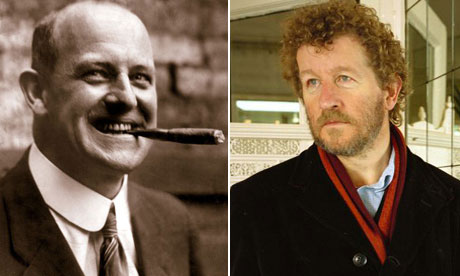
Speaking of British publishing’s fanfiction, this autumn will bring the first authorized revival of P. G. Wodehouse’s Jeeves and Bertie series, as The Independent reported in March. Hutchinson will publish Jeeves and the Wedding Bells in Britain, and St. Martin’s will publish it in the US.

The authorized author is Sebastian Faulks, a respected British novelist (Birdsong, A Week in December) who already wrote a well received pastiche of Ian Fleming’s James Bond novels in Devil May Care.

In The New Statesman, Michael Moran wrote:
I don’t describe Wodehouse as inimitable because I like his stuff. I describe Wodehouse as inimitable because he cannot be imitated. One might imagine Craig Brown or Hugo Rifkind making a decent fist of a Wodehouse knockoff for a page or so but a whole novel? This is hubris. We already have in the 11 Jeeves novels and 35 short stories an ample supply of Wodehouse's wit. We have no need of ersatz Plum.
And Wodehouse biographer Robert McCrum told The Guardian:
Wodehouse is a much tougher egg than Fleming and 007/Bond. For a PG Wodehouse fan to write a new Jeeves novel is a bit like asking a devout Christian to come up with a fifth gospel. . . . It looks perilously like Mission Impossible to me, but I wish Faulks the very best of luck. If anyone can pull it off, he can.
McCrum was himself authorized by the Wodehouse estate to write that biography, but it’s no hagiography.

08 May 2013

When Fanfiction Took Over British Children’s Publishing

The Horn Book just published Caroline Fraser’s excoriation of how Penguin has recently exploited Beatrix Potter’s Peter Rabbit with an aggressive copyright claim, broad product licensing, spin-off titles, and, most recently, commissioning sequels from actress and writer Emma Thompson.

British publishing seems to be crazy about such latter-day sequels lately. Such books have always been with us, of course, but the latest wave is distinguished by a couple of features:

  • Many of the intellectual properties involved are still under copyright, meaning the new books were authorized or commissioned by the companies or trusts controlling those properties.
  • The authors of those latter-day books aren’t work-for-hire hacks or even solid writers without a recent hit (like David Benedictus, author of Return to the Hundred Acre Wood) but well-known authors who could get reasonably well paid for their own original work.
Thus we have Oscar-winner Thompson writing about rabbits (though not, as Sutton says, with the zoological precision of Potter). Penguin can thus benefit from the Peter Rabbit brand name and good will, Thompson’s celebrity, and the now-increasingly-common media story of a new sequel to a beloved classic.

Likewise, we have Carnegie Medal winner Geraldine McCaughrean writing an authorized sequel to Peter Pan, and competing in the marketplace with the not-originally-authorized American titles from Ridley Pearson and Dave Barry. Dame Jacqueline Wilson was commissioned to extend E. Nesbit’s Psammead trilogy. Former British poet laureate Andrew Motion penned a sequel to Treasure Island.

In other worlds, it appears the British children’s literature establishment has turned to fanfiction.

16 April 2013

Oz-Stravaganza’s Call for Short Oz Fiction

The Syracuse Post-Standard reports that the International Wizard of Oz Club is co-sponsoring an Oz fiction writing contest as part of the annual Oz-Stravaganza festival in Chittenango, New York, boyhood home of L. Frank Baum.

As the story and contest brochure (PDF) explain, there are four grade categories. The stories from grades 3-8 can be 500 words long, 25% longer than the stories from writers in grades 9-12 and above. But we all know that writing short is harder than writing long.

Entries in each category have to include certain words. For writers in ninth grade and above (including adults), those words are:
1. Magic 2. Forest 3. Courage 4. Hourglass 5. Danger 6. Rescue 7. Castle 8. Home 9. Soldiers 10. Wish 11. Crystal 12. Cyclone 13. Wizard 14. Witch 15. Escape
Entries must be submitted by mail before 8 May. Check out the article and booklet for all the rules and the requisite registration form. First-place winners in each category will be published in the Post-Standard as part of the June festival.

14 April 2013

Dick Grayson’s Uncle in the Young Justice Universe

The fictional universe of the Young Justice TV cartoon isn’t exactly like any other version of the DC Comics continuity. And in presenting the origin of Robin in issue #6 of the comic book, the creators of that universe added a significant new detail.

In every version of the DC Universe that I recall, going back to 1940, the Flying Graysons are a three-person act: John, Mary, and young Richard. But in the Young Justice cartoon universe, as shown in issue #6 of the comic, there are six relatives up on the trapeze platform together.

In September 2011 a fan asked Greg Weisman, one of the TV series’s creators, about that uncle. His reply revealed additional information:
Dick's father's name was John. His mother was Mary. And, yes, Cousin John was named after Dick's father. Dick's uncle is named Richard - Rick for short. (Dick was named for his own uncle, obviously - the two elder Grayson brothers were very close.) Dick's aunt was named Karla.
Some of that information never appeared in the cartoon or comic books, but coming from Weisman made it “canonical.”

The larger population of Graysons makes it harder for the creators of the magazine—Art Baltazar and Franco on the script, Christopher Jones on pencils—to explain how everybody but Dick fell to the arena floor when Tony Zucco’s men sabotaged their equipment. The answer, as shown at right, was an elaborate trick involving five Graysons at once.

At the bottom of this panel is the net, lying loose on the ground. In real life, big-top circus flyers always perform with a net. Sometimes they even incorporate that net into their acrobatics. Highwire acts often work without nets, which is why so many members of the Great Wallendas died or got badly hurt in falls. (Which makes it a bit gruesome that they eventually changed the name of their act to the Flying Wallendas.)

(Another notable detail about this panel is the missing “of” in the first caption box. This Young Justice run shows signs of being assembled and published in a hurry.)

After the accident, Dick as narrator describes his new family situation: “My mother and father dead, my aunt and cousin dead, my uncle alive but paralyzed for the rest of his life.” A living uncle!

In September 2011 and again in November, fans asked Weisman for more information on this Uncle Rick. “Is he comatose, mostly paralyzed, something else?” “Will we be seeing more of Dick Grayson's uncle Rick in the YJ series?” Both times, Weisman refused to comment, his way of preserving possible future plot twists from disclosure.

As I’ve written before, Weisman and his colleagues were playing the long game with Young Justice. They set up details that wouldn’t be explained until months later. They skipped five years between seasons and let viewers figure out what had happened in the meantime. And it appears that they included Uncle Rick as a potential complication for the future.

In this universe, Uncle Rick might show up at any time and want custody of Dick, or money from Bruce Wayne. He might recognize the masked hero Robin as moving like a Flying Grayson, just as circus owner Jack Haly does. Uncle Rick might thus be much more formidable than Dick’s Aunt Harriet, who appeared out of nowhere in the 1960s, moved into Wayne Manor, and moved out years later, still clueless.

But the cancellation of the Young Justice TV show and comic means we’ll probably never see that story and know what the continuity’s creators had in mind. Fanfiction writers are offering their own versions, which seem to lean toward the sentimental rather than the dangerous.

26 February 2013

Reimagining Oz Today

Today is the official publication date of Oz Reimagined, an anthology edited by John Joseph Adams and Douglas Cohen. As io9 reported last month, the individual stories in this collection will also be on sale as Kindle Singles.

Among the contributors, Jane Yolen wrote “Blown Away,” which has the sell line: “What if Toto was dead and stuffed, Ozma was a circus freak, and everything you thought you knew as Oz was really right here in Kansas?” Way to sell the magic, Jane!

Dale Bailey’s “City So Bright” is summarized as “Marxism comes to the Emerald City.” Didn’t it already?

More controversial, perhaps, is Orson Scott Card’s “Off to See the Emperor.” Not because of its approach to reimagining Oz—“Frank Baum’s son has the real experiences that his father later fictionalized.”—but because Card has become increasingly notorious for his homophobic writing and activism. Some Superman fans are dismayed that he’s scripting a story for DC Comics. Will Oz fans want to buy a book that includes Card’s work?

18 February 2013

The Artful Dodger’s Back. And This Time It’s Personal

Toward the end of Oliver Twist, the police arrest Jack Dawkins, alias the Artful Dodger, for stealing a silver snuffbox from a gentleman’s pocket. One of his colleagues, Charley Bates, comments: “To think of Jack Dawkins—lummy Jack—the Dodger—the Artful Dodger—going abroad for a common twopenny-halfpenny sneeze-box!”

“Going abroad” refers to a sentence of transportation to one of Britain’s penal colonies, most likely Australia. Charles Dickens never actually shows the Dodger’s sentencing, but his youth makes him an unlikely candidate for hanging (yet). Instead, we can imagine Jack Dawkins starting a new life in the antipodes, perhaps even becoming the gentleman he’s always styled himself to be.

But the Guardian reports a movie studio is imagining a different future for the Dodger:
Titled Dodge and Twist, studio Sony's revisionist take follows…a more comedic approach and is based on an original screenplay by Cole Haddon, writer of the forthcoming US TV series Dracula. The film will portray the two characters as rivals on opposite sides of the law in Victorian London during an episode in which someone tries to steal the crown jewels. The script is based on an original idea by producer Ahmet Zappa, son of rock legend Frank, which is said to be influenced by the success of Guy Ritchie's Sherlock Holmes films.
This isn’t the first time imaginative dramatists have invented new fates for the Dodger. In the 1968 Oliver!, of course, he and Fagin escape arrest and enjoy the movie’s final number.

More to the point, in 1980 British television came up with The Further Adventures of Oliver Twist, in which the title character goes off to a posh boarding school and there finds Jack Dawkins, of all people. The two boys end up back on the dark streets of London. That story also appeared as a paperback novel and a comic.

Australian television gave us Escape of the Artful Dodger in 2001. That story transported the Dodger to Australia, but also sent Oliver there in more respectable fashion. Once again, Oliver ends up on the wrong side of the law, and the Dodger helps him out.

Those latter-day sequels, like Dodge and Twist, recognize that Oliver without the Victorian underworld to threaten him is a bourgeois nonentity. At the same time, the Dodger’s class-conscious thievery isn’t that endearing unless he’s got a little mate to reluctantly look after. It’s a natural buddy movie.

In fact, British writer Tony Lee worked on a story called Dodge & Twist for years, first as a graphic novel with Paul Peart-Smith (PDF download of preview from 2007) and then as a self-published prose novel (two-chapter preview from 2011). It shows Oliver, having lost his money, meeting Jack, back from Australia—and we’re right back in Dickens’s world.

Zappa’s story is set twenty years after Dickens’s novel; Lee’s is set twelve years after. Zappa’s story uses the crown jewels as the maguffin; Lee’s uses the Koh-i-noor diamond. The Hollywood Reporter said Lee’s take was “more serious.” Lee said he discussed his idea with Zappa a few years back. Isn’t the public domain delightful?

25 November 2012

Never Work with Children or Animals

The second installment of Dustin Nguyen and Derek Fridolf’s Li’l Gotham digital comics appeared this month, pegged to Thanksgiving. It established that Bruce Wayne is the Batman in this version of the mythos. (I thought the first installment was ambiguous on that question.)

This story also shows Nightwing’s chest stripe as blue, Barbara Gordon in a wheelchair, and Cassandra Cain in existence. In other words, Li’l Gotham definitely takes off of the DC Universe that was the publisher’s main “continuity” until last year.

But this is also a universe in which the entire “Bat family” (except, of course, for Stephanie Brown) gathers for an uninterrupted Thanksgiving dinner. Damian has his little friend Colin over, though in the comics Damian was keeping that comradeship a secret. Even Wayne family black sheep Jason Todd is there, though no one has saved him a seat.

Li’l Gotham thus takes place in a world akin to a lot of Bat-family fanfiction, in which reconciliation, togetherness, and cuteness are more important than that usual staple of superhero comics, kicking other people in the face. In both this episode and last month’s Halloween tale, all the action happens early, followed by many more pages of what we’d normally consider comic relief and a festive dinner at the climax.

Both stories also revolve around Damian Wayne, but not the troubled Damian of the main comics. In the current DC Universe, he deliberately killed one of the bat-cave’s bats and had trouble warming up to the Great Dane that his father bought him. In contrast, many fans had decided, based on one Grant Morrison story showing a possible future Damian with a cat he’d named Alfred, that Damian loves kittens. He really, really loves kittens. And the Li’l Gotham Damian gets to lead a parade of turkeys and bring one home with him and name it Jerry and keep it for his very own.

Those fan-created stories and illustrations aren’t necessarily any worse than the traditional type, including some officially published. But resolving foundational conflicts doesn’t leave much space for the next story, as serial publishers desire. And making everyone happy can wash out the distinctiveness of characters. Once Jason is back at Wayne Manor, what’s distinct about him? Once Damian actually has a pal his own age to invite over and trade baseball cards with, is he Damian anymore?

11 November 2012

The Exaggerations of Dick Grayson’s Love Life

A couple of weeks ago, the weekly Robin discussed how in 1984 Dick Grayson was the first hero DC Comics clearly showed having a sex life—and outside of marriage yet! However, his relationship with fellow Titan Koriand’r was always presented as a long-term commitment.

Indeed, for the rest of the 1980s that relationship was one of the tent poles of the Titans franchise—which meant Marv Wolfman and his artists were constantly shaking it to make readers worry. Kory contracted a political marriage for the sake of her home planet, and Dick couldn’t handle it. Teammate Raven had sexual fantasies about Dick, and Kory could handle it. A freedom fighter from an alternate future disguised herself as Kory to have sex with Dick.

The relationship endured until New Titans, #100, when Dick and Kory tried to get married and everything went horribly, horribly wrong. Dick and Kory broke up, and that Titans team itself went separate ways—which just shows how much of a tent pole it was.

That left Dick Grayson unattached for the first time in years. He kept busy being Batman for a while, but then DC’s writers happily seized the chance to use “Dick has a new girlfriend” as the starting-point for stories.

Meanwhile, the internet enabled fanfiction to spread, and that area of writing has never been bound by what official continuities say about heroes’ love lives. As a result, Dick Grayson became a “fandom bicycle” on which everyone got a ride. TV Tropes lists him as DC’s top “Launcher of a Thousand ’Ships,” saying: “It's a running gag in the DC Universe that virtually every female that comes in contact with Nightwing falls in love with him.” In fanfiction, that group expands to include every male.

Despite Dick being a symbol of sexual appeal, however, his romantic/sexual activity within the comics was exaggerated. Here’s a conversation on the topic between Dick and Tim Drake, his successor as Robin, in Nightwing, #25 (dated October 1998, script by Chuck Dixon, art by Scott McDaniel). The boys are, naturally, standing on the back of a freight train while blindfolded—Dick’s told Tim this is good training. Tim manages to say the only thing that can throw Dick off balance.
Dick asks Tim if perhaps he could choose a girlfriend who’s not an “Afterschool Special,” knowing that won’t happen. Tim responds by showing off how much of a Dick Grayson fan he is.
Tim lists six women whom Dick has had a relationship with since Crisis on Infinite Earths. But in fact that list is exaggerated, even more than Dick’s response in the following panel lets on.

His relationship with Koriand’r was more than “a need…for affection”—it was a multi-year, live-in relationship that came close to marriage. It was precisely the opposite of casual.

As Dick reminds Tim, he and Donna Troy never “really dated.” They never dated at all. Wolfman did propose to “have very slowly had Dick and Donna get together,” “if only for them to see that they were too similar to be together.” But that never happened.

Miggie Webster appeared in the Nightwing miniseries by Dennis O’Neil and Greg Land. Dick was apparently depressed at the time—or maybe just weighed down by his hair. In any event, he became briefly infatuated with Miggie because he thought she represented a normal, happy family life—only to see her kill her abusive father. And as far as I can tell, they never even went on a date.

Emily Washburn married Dick in Nightwing Annual, #1 (cover shown above). That was part of a 1997 DC tribute to pulp fiction, and the story was a James M. Cain-style take on a murderous marriage. Dick married Emily as part of his investigation. After he identified the killer, he offered to remain her husband and help raise her son—again with the monogamous values!—but she declined. It’s unclear whether the marriage was consummated, but given scripter Devin Grayson’s take on Dick as a very physical and open person, it probably was.

Meanwhile, in 1996 DC launched the Nightwing series written by Dixon. Among its subplots was Dick’s friendship—or would it be something more?—with the superintendent of his apartment building in Blüdhaven, Bridget Clancy. Dixon was a master at playing out conflicts over many issues, but this relationship never reached the level of dating.

Instead, at the time of this train-top conversation, Dixon was gradually moving Dick toward a second serious, multi-year relationship: with Barbara Gordon, daughter of the Gotham police commissioner, former Batgirl, and at that time Oracle. Dick had shown interest in her in the 1970s, but fans then pointed out that she was several years older than he. At the time of this issue, Nightwing, #25, it was still unclear whether they would become an item.

Thus, of the six women Tim reeled off, Dick had actually had serious and/or sexual relationships with only two, and in one of those (Emily Washburn) he was working on a case. That exchange thus leaves a misleading impression.
Of course, I have to acknowledge a seventh relationship that Tim, despite his snooping, doesn’t know about until Dick reveals it. Dick is just coming off the 1998 Nightwing/Huntress miniseries, once again scripted by Devin Grayson and drawn by Land. That shows his brief affair with Helena Bertinelli, the Huntress. It’s clearly sexual. (“Tunnel”!)

But in that miniseries Dick is looking for something long-lasting. (He’s evidently drawn to strong women who need rescuing.) The story ends with Helena seeing the chemistry between him and Barbara and chuckling that they don’t notice it themselves. In other words, even this example of Dick having a sexual fling points to him as a man seeking a committed love.

From the No Man’s Land crossover (1999) through Infinite Crisis (2006), Dick and Barbara were usually a couple. Since then, each new regular Nightwing scripter came up with a new love interest: a fashion designer, a criminal who lured a teen-aged Dick away from Wayne Manor, a librarian. Judd Winick has put him back in bed with Kory a couple of times. But only the unfortunate Nightwing Annual, #2, portrayed him as anything other than a one-woman man.

27 August 2012

What Happens to Hawkins?

Another example of British publishing’s current infatuation with latter-day sequels is Andrew Motion’s new Silver: Return to Treasure Island. Liesl Schillinger’s review in the New York Times Book Review explains the set-up:
In “Silver,” which is set some 35 years after “Treasure Island,” Motion introduces us to the son of Jim Hawkins, the original boy adventurer. Decades after making his adolescent splash, Hawkins père has washed up in a gloomy, rum-soaked middle age, running an inn on the Thames.

Jim Jr., serving as narrator, explains that his father had spent a decade in London, squandering his pirate booty on high living, before settling down to innkeeping and marriage with a woman who died giving birth to their child. Since then, the widower’s only joy has lain in endless retellings of his swashbuckling glory days.
No, no, no, no, no! Jim Hawkins is not the type to lead a dissipated life. He’s seen too much. And, frankly, he’s too greedy.

No, Jim Hawkins uses his wealth to buy a small but solid estate in the north of England. After his mother passes away, he invests in some of the new ventures with steam engines, canals, and the like, thus growing his fortune. In time Squire Hawkins develops a reputation for being a hard bargainer, a demanding boss, and a strict landlord. A reputation that’s a bit at odds with how he chose to hire a washed-up one-legged cook who hobbled onto his estate one year.

21 August 2012

Ozma, the Birthday Girl

Though L. Frank Baum probably never intended to convey this information, today is the birthday of Ozma, fairy queen of Oz. Some passages in The Road to Oz mention that her birthday is on the 21st of the month. Another passage says that the month is August. So there we go.

One of Baum’s longest descriptions of Ozma comes in The Magic of Oz, his penultimate novel:
Ozma, the beautiful girl Ruler of the Fairyland of Oz, was a real fairy, and so sweet and gentle in caring for her people that she was greatly beloved by them all. She lived in the most magnificent palace in the most magnificent city in the world, but that did not prevent her from being the friend of the most humble person in her dominions. She would mount her Wooden Sawhorse, and ride out to a farm house and sit in the kitchen to talk with the good wife of the farmer while she did her family baking; or she would play with the children and give them rides on her famous wooden steed; or she would stop in a forest to speak to a charcoal burner and ask if he was happy or desired anything to make him more content; or she would teach young girls how to sew and plan pretty dresses, or enter the shops where the jewelers and craftsmen were busy and watch them at their work, giving to each and all a cheering word or sunny smile.

And then Ozma would sit in her jeweled throne, with her chosen courtiers all about her, and listen patiently to any complaint brought to her by her subjects, striving to accord equal justice to all. Knowing she was fair in her decisions, the Oz people never murmured at her judgments, but agreed, if Ozma decided against them, she was right and they wrong.

When Dorothy and Trot and Betsy Bobbin and Ozma were together, one would think they were all about of an age, and the fairy Ruler no older and no more “grown up” than the other three. She would laugh and romp with them in regular girlish fashion, yet there was an air of quiet dignity about Ozma, even in her merriest moods, that, in a manner, distinguished her from the others. The three girls loved her devotedly, but they were never able to quite forget that Ozma was the Royal Ruler of the wonderful Fairyland of Oz, and by birth belonged to a powerful race.
Ozma is clearly devoted first to her ideals and second to the protection and rule of her country. I think those priorities present a challenge for people who want to write adventures for her. Ozma leaves her capital for extended periods in order to carry out what she sees as important duties (e.g., Glinda of Oz, The Magical Mimics of Oz), she can be kidnapped (e.g., The Lost Princess of Oz, Grampa in Oz, Kabumpo in Oz, The Hungry Tiger of Oz), and she can even suffer amnesia about her duties (e.g., The Forbidden Fountain of Oz). But I don’t see it as in her character to “go off on an adventure” the way Dorothy does. She’s got things to do.

15 August 2012

Play It Again, Psammead

The success of various latter-day sequels to classic (i.e., public-domain or licensed-by-heirs) children’s novels prompted Puffin to invite Jacqueline Wilson to write such a book. After initially declining, she chose to follow on a childhood favorite, E. Nesbit’s Five Children and It, as she described in the Guardian. Her column answers many of the questions I had about this project last year.

Wilson also found that she couldn’t write in the same mode as the original book.
Nesbit had written her book in the third person [in fact, as a delightfully intrusive narrator], but I much prefer writing in the first person, and I thought it would be easier and more involving for my readers if I chose a child narrator again. I invented Rosalind, a quiet, shy, intense girl. She's a very keen reader – and so, naturally enough, when the story opens she's been reading Five Children and It. She has a younger brother, Robbie, a delicate, timid boy who loves playing with his toy zoo animals. Their parents have divorced – no surprise there, this is a Jacqueline Wilson novel.

The children have gone to spend part of their summer holiday with their dad, while their mum goes to an Open University summer school. He is now married to Alice, and they have a toddler called Maudie. Alice also has a daughter from a former relationship. She's named Samantha, but she's always called Smash. She’s a fierce, opinionated, streetwise child, who’s a royal pain most of the time. Smash is staying with her mother for the holidays because her dad is on honeymoon with his new young wife.

So I have a very modern jigsaw family. But this isn’t a dark, angst-ridden book about emotionally neglected children. It’s a fantasy story – and as soon as the children dig up the Psammead in the sandpit at Oxshott Woods, the fun starts.

I knew that one of the first wishes would be the obvious one: Smash wants them all to be rich and famous. I had great fun with this one. I let Rosalind be a bestselling child author, turned Robbie into a mini TV chef, and had Maudie as the star of a sitcom. Smash herself is like a little Lady Gaga, with a sell-out gig at the O2 Arena.

I think the most challenging wish for me was when bookish Rosalind asks if they can meet all the Edwardian children in Five Children and It. I had to work hard to get Cyril, Anthea, Robert and Jane to sound natural, and not just silly caricatures. The Edwardian children seem very immature to my modern children and yet they boss the family’s adult servants around without a second thought. They also have extraordinary freedom, roaming about the countryside on a whim.
Wilson’s article also makes one mention of Nesbit’s own sequels, The Phoenix and the Carpet and The Story of the Amulet, and one of another latter-day continuation, Helen Cresswell’s 1992 The Return of the Psammead.

07 August 2012

The Power of Extraterrestrial Oz

Yesterday author Mary Robinette Kowal blogged about Dorothy Gale and Mars:

I just sold a story to RIPOFFs, which is an audio anthology edited by Gardner Dozois for Audible. . . . The idea of the anthology is that each story starts with the first line of a classic novel.  It’s sort of a punchcard punk homage to Ray Bradbury and L. Frank Baum. Here’s how mine opens.

And I swear to God, I didn’t know where Curiousity was landing.
The Lady Astronaut of Mars

by Mary Robinette Kowal

Dorothy lived in the midst of the great Kansas prairies, with Uncle Henry, who was a farmer, and Aunt Em, who was the farmer’s wife. She went on to say that she’d met me, when I was working next door to their farm under the shadow of the rocket gantry for the First Mars Expedition.
Where did the Curiosity rover land? Coincidentally, in Gale Crater.
Now Gale Crater is actually named after Walter Frederick Gale, who…thought Mars had canals full of water. He was observing in the 19th century, so can be cut some slack for inadequate instruments but those canals gave rise to a whole slew of science fiction. Wells, Burroughs, Bradbury… Without the idea that maybe, maybe there was once civilization on Mars how many of them would have written those stories? Hard to tell, but the space between what Mr. Gale discovered and what they wrote is where Science Fiction lives. It lives in the possibilities present in the best science of the day.
Back in 1904, when L. Frank Baum’s newspaper syndicate was promoting his comic page Queer Visitors from the Marvelous Land of Oz, a publicity mailing spoke of the Scarecrow, Tin Woodman, and other visitors approaching Earth from outer space. It’s unclear whether Baum had any role in or say over that publicity, and in his Oz books he never claims that Oz is extraterrestrial. Nonetheless, it shows how a century ago such possibilities were in the air (or above it).

22 July 2012

Dick Grayson’s First Kiss

Batman, #107 (Apr 1957) contained a story from Bill Finger and Sheldon Moldoff titled “Robin Falls in Love.” According to the Batman volume of the Encyclopedia of Comic Book Heroes, this was the first time Robin the Boy Wonder developed a crush on a girl.

Robin rescues Vera Lovely, a fourteen-year-old figure skater. She kisses him; I haven’t seen the panel in question, but I assume it was an unreciprocated kiss on the cheek. [ADDENDUM: The Robin Appreciation Group on Facebook have kindly posted that panel, confirming my hunch.] Nonetheless, for a while he’s gaga, with little red hearts orbiting around his head.

But at the end of the story, Robin and Vera agree to be just good friends, and the situation returns to the status quo ante.

In seven stories of the early 1960s, Betty Kane comes to Gotham and takes up the mantle of Bat-Girl, mostly because she has a crush on the dreamy Boy Wonder. For a long time he doesn’t return her feelings.
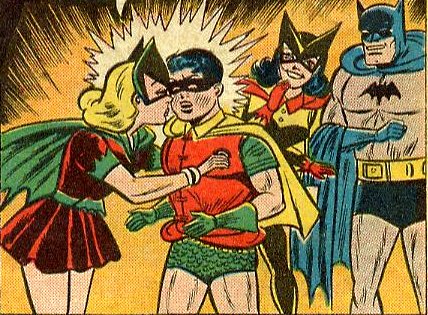
In “Prisoners of Three Worlds” (Batman, #153, Feb 1963), Finger and Moldoff showed Bat-Girl finally getting her wish. The teen crime-fighters share a full-on, lip-to-lip kiss. At the end of the story the young masked couple even goes off together, presumably to do some more necking.

But that’s the pre-“New Look” Dick Grayson. It’s not the Dick Grayson of the 1986-2011 DC Universe. His first kiss appears in the story “Grimm” in Batman: Legends of the Dark Knight, #149-53. (Since that magazine told stories outside the concurrent Batman continuity, it’s possible that this was yet another version of Dick Grayson, but I’m assuming not.)

In this story, Dick is eleven years old. It’s about a month after he started to patrol Gotham City as Robin the Boy Wonder, about two months after he became Bruce Wayne’s ward. (So much for years of careful training.) Batman and Robin are still struggling to trust themselves as a team and a family.

One night Robin chases down a young teen thief called Wily Wendi. She nearly kisses him, as shown in the panel at top, and slips away. After that, Dick can’t get Wendi out of his mind.
He sits in his oddly cluttered room “thinking about The Girl” and puzzling over “such a strange feeling rippling through me.”

In the adventure that follows, Robin leaves Wayne Manor to go into the underground world of Mother Grimm, where Wendi and other orphaned children live. There are various completely unbelievable twists, spectacularly illustrated by Trevor Von Eeden and José Luis Garcia-López. Von Eeden’s website discusses the background of the story and displays some of the line art.

Mother Grimm’s haven catches on fire. Batman and Robin manage to rescue all the children, with Robin carrying Wendi from a burning hospital. And at last they really kiss.
How do we know that’s this Dick Grayson’s first kiss? Because he tells us (even if he doesn’t admit as much to Wendi).
The story ends with Mother Grimm and her twin sister, both murderous loons, disappearing down a raging river, and Batman having to find new homes for all of the orphans. The whole experience cements Dick’s relationship to Bruce, and his confidence as Robin.

And what about Wendi? Dick, narrating the story in his third Nightwing costume and thus in his mid-twenties, tells us she’s “getting a master’s in journalism.” The art shows us that he keeps tabs on her through the bat-computer. The caption says she’s “just as…memorable” for him as before.

But are they still in touch in any way? Might he run into her in Gotham City, as either Dick Grayson or Nightwing? J. M. DeMatteis’s script leaves a loose thread just perfect for fanfiction, but I couldn’t Google up a single story about Wily Wendi.

How long will it take now before such a story appears?

30 May 2012

Reconciling with the Wizard of Oz

Yesterday I described a review of a latter-day Oz book by Hugh Pendexter III. Among Oz fans he’s best known for his short book Oz and the Three Witches, published in 1977. It was inspired by two contradictory passages that L. Frank Baum left us about the Wizard of Oz, the evil witch Mombi, and the baby princess Ozma.

First, near the end of The Marvelous Land of Oz (1904), Baum narrated Glinda the Good’s interrogation of Mombi this way:
“I will ask my first question: Why did the Wizard pay you three visits?”

“Because I would not come to him,” answered Mombi.

“That is no answer,” said Glinda, sternly. “Tell me the truth.” . . .

Mombi now saw how useless it was to try to deceive the Sorceress; so she said, meanwhile scowling at her defeat:

“The Wizard brought to me the girl Ozma, who was then no more than a baby, and begged me to conceal the child.”

“That is what I thought,” declared Glinda, calmly. ”What did he give you for thus serving him?”

“He taught me all the magical tricks he knew. Some were good tricks, and some were only frauds; but I have remained faithful to my promise [to hide] the Princess Ozma—the child brought to me by the Wizard who stole her father’s throne.“
Baum wrote that book because of the popularity of the 1902 stage extravaganza adapted from The Wonderful Wizard of Oz. That show used the Wizard as an antagonist, a charlatan and mountebank who had stolen the rightful king’s throne, and the book reflected that characterization.

But in Dorothy and the Wizard in Oz (1908), Baum brought the Wizard back as a capable and reliable protector for Dorothy. What happened when they reached the Emerald City and the Wizard met up with its new ruler, Princess Ozma? She asks him about his first arrival in Oz.
“At that time,” continued the Wizard, busily eating his soup while talking, “there were four separate countries in this Land, each one of the four being ruled by a Witch. But the people thought my power was greater than that of the Witches; and perhaps the Witches thought so too, for they never dared oppose me. I ordered the Emerald City to be built just where the four countries cornered together, and when it was completed I announced myself the Ruler of the Land of Oz. . . .”

“That is quite a history,” said Ozma; “but there is a little more history about the Land of Oz that you do not seem to understand—”
Aha—the J’accuse moment when Ozma confronts the Wizard with his misdeeds: “Do you remember the child you handed over to an evil crone? I, sir, was that little baby you sold into slavery!”

But no. She continues:
“Many years before you came here this Land was united under one Ruler, as it is now, and the Ruler’s name was always ‘Oz,’ which means in our language ‘Great and Good’; or, if the Ruler happened to be a woman, her name was always ‘Ozma.’ But once upon a time four Witches leagued together to depose the king and rule the four parts of the kingdom themselves; so when the Ruler, my grandfather, was hunting one day, one Wicked Witch named Mombi stole him and carried him away, keeping him a close prisoner. Then the Witches divided up the kingdom, and ruled the four parts of it until you came here. That was why the people were so glad to see you, and why they thought from your initials that you were their rightful ruler.”

“But, at that time,” said the Wizard, thoughtfully, “there were two Good Witches and two Wicked Witches ruling in the land.”

“Yes,” replied Ozma, “because a good Witch had conquered Mombi in the North and Glinda the Good had conquered the evil Witch in the South. But Mombi was still my grandfather’s jailor, and afterward my father’s jailor. When I was born she transformed me into a boy, hoping that no one would ever recognize me and know that I was the rightful Princess of the Land of Oz. But I escaped from her and am now the Ruler of my people.”

“I am very glad of that,” said the Wizard, “and hope you will consider me one of your most faithful and devoted subjects.”
And nothing more is said of kidnapping and baby-selling and other disagreeable subjects.

Ruth Plumly Thompson explored the history of Ozma’s father and Mombi in The Lost King of Oz (1925), but many gaps and inconsistencies remained. (Indeed, we haven’t even touched Baum’s later statement that Ozma was really a fairy left by a fairy queen in the far distant past.)

Pendexter’s Oz and the Three Witches picks up after the second conversation above as Glinda comes to the Emerald City to quiz the Wizard about the whole Ozma matter. The result is a lively little tale of the Wizard trying to fend off the Wicked Witches of East and West through his humbug illusions while navigating the tricky politics of pre-Dorothean Oz. He doesn’t realize who Mombi is, and he’s very, very sorry. All in all, it’s about as good a reconciliation of Baum’s contradictory statements as possible.

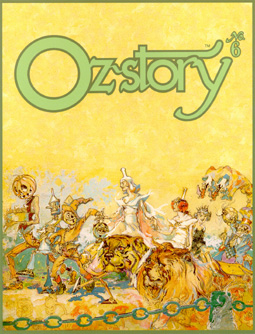
First published in 1977, Oz and the Three Witches was reprinted in its entirety with Patricia Ambrose’s quite competent illustrations in Oz-Story, #6.

29 May 2012

A Crochety Review of Oz

Last week my mother alerted me to an intersection of the far reaches of two orthogonal hobbies: crochet and Oz fanfiction.

Chain Link is the newsletter of the Crochet Guild of America. It’s eight pages, two-color printing, bound inside subscriber copies of the guild’s Crochet! magazine. I assume that it’s not included in copies of the magazine sold in stores.

The summer 2012 issue of Chain Link includes Karen C. K. Ballard’s review of The Crocheted Cat in Oz, by Hugh Pendexter III. Published in 1991, this is one of the many latter-day Oz stories written by fans for other fans.

In her review Ballard quickly and accurately catches readers up on much that came out of The Wonderful Wizard of Oz, including the authorized series, significant differences between book and movie, and even the end of Gregory Maguire’s series. Nonetheless, it’s a “plumber’s review,” paying close attention to matters of needlework, from the Patchwork Girl to lace on costumes in the Wicked traveling show.

Pendexter’s book attracted Ballard only because it was about a crocheted character. She’s probably correct in suspecting that the title character was a favorite toy of the author’s granddaughter. That’s the problem with the intersection of fandoms: the number of people entralled by both is small.

TOMORROW: The mystery L. Frank Baum left us.

09 January 2012

A Westernized Easternized Cinematized Oz

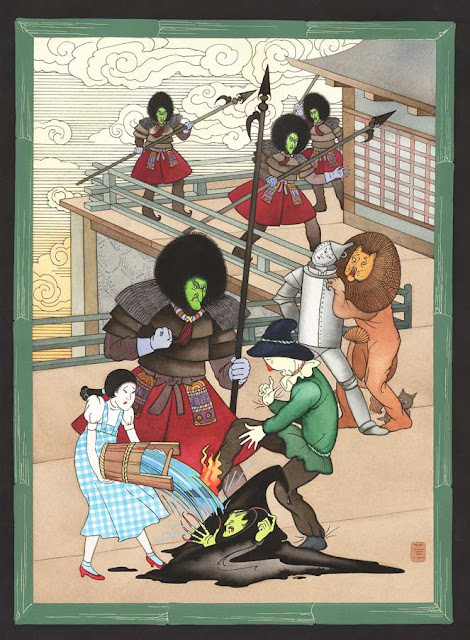
Once Upon a Blog features Cathy Pavia’s illustrations for The Zen of Oz: Ten Spiritual Lessons from Over the Rainbow, by Joey Green. They meld the characterizations of the MGM movie (which steers Green’s understanding of the story) with classical Japanese art.

(Hat tip to Charlotte’s Library.)

31 December 2011

The End of Lord Peter Wimsey

I read the Lord Peter Wimsey novels as a boy, spurred by my mother’s fondness for them and by Ian Carmichael’s portrayal of the character on Masterpiece Theater. Like any good fuddy-duddy, I was therefore a little wary of Jill Paton Walsh’s sequels to Dorothy L. Sayers’s originals.

The first, titled Thrones, Dominations, grew out of notes that Sayers left behind, and her name appears on the cover before Walsh’s. For the second, A Presumption of Death, Walsh had only some fictional letters that Sayers had published as propaganda during the Battle of Britain, showing how her characters were coping with the Blitz. On that book, Walsh’s name came first.

For the third, The Attenbury Emeralds, Walsh had no unpublished Sayers material to draw from, simply allusions and remarks. She is sole author.

The Attenbury Emeralds tries to bookend Lord Peter’s career. The first half recounts a couple of his earliest cases as a detective, with Lord Peter and Bunter recounting the events at great length to Harriet. The narrative thus takes the form of a three-way conversation, interrupted by family business and daily life. It’s an awkward read, though more believable than those Conrad novels in which a narrator supposedly speaks for hours on end.

Naturally, this early case comes back in the book’s second half. That mystery involves a murderer who’s mad (mad, I say!), so I found that plot less than fully satisfying. On the other hand, the mystery of Thrones, Dominations depended on details of the proper dress for royal mourning after the death of George V, so it wasn’t good for the fashion-blind.

I found A Presumption of Death to be the most satisfying of this trilogy, with its interesting wartime setting and good roles for children. It has much the same feel as Sayers’s short story “Talboys,” her only glimpse of Peter and Harriet as parents. There are priceless moments with Harriet and Bunter.

What was truly satisfying, however, was how Walsh drew the whole Lord Peter saga to a close. Sayers left his nephew the Viscount St. George in the RAF during the Battle of Britain, and acknowledged that the young man probably didn’t survive the war.

I remember reading that factoid in a book about the series back around 1980, and realizing that would make Lord Peter heir apparent to his older brother, the Duke of Denver. The duchess was clearly past the age to have another child, even if she and her husband still got along, so the only way that succession would change is if she died, Denver remarried, and the new wife quickly had a male child. Which was, I suppose, what Peter would hope for.

The Attenbury Emeralds explores that situation. It’s set in 1951 as new tax rates and social rules are spreading peers’ inheritances and privileges more widely around the English nation. Peter and Harriet’s boys are at Eton and other public schools, as is Bunter’s son, clearly on the rise. And by the end of the book, Lord Peter is no more.

Which is not to say he’s dead. If in future he does any more mystery-solving, perhaps under another author’s pen, he’ll do it under a different name.

07 December 2011

Looking for Evrob

The detail above comes from one of the panels of the Marvel Comics adaptation of Ozma of Oz, drawn by Skottie Young. It shows the royal family of Ev soon after they’ve been disenchanted.

The big lunk in the lower left, with the single curly hair atop his dome, appears to be future king Evardo. At least that’s who is looking for cake in the royal pantry several pages later, as L. Frank Baum described.

However, an earlier page had the label “Evardo” on the smaller adolescent with the purple mantle and the even worse haircut. Either way, it’s quite a shift from John R. Neill’s portrait of a conventional young adolescent.

As in Baum’s novel, the prince we see most in this comic is Evring, the little prince whom Dorothy rescues. He’s also the most normal-looking of the boys that Young draws. Evring wears gloves on his spindly arms; since he’s not trained for manual labor like Tip in Young’s Marvelous Land of Oz art, the effect is to make him look more like a—gasp!—character in a cartoon.

Baum wrote that Evring is the baby of the family. I’m guessing that detail didn’t make it into Eric Shanower’s script because Young drew three other siblings as infants.

I’ve spent an abnormal amount of time thinking about the royal family of Ev because a few years back I wrote a story called “Evrob & the Nomes,” about one little prince’s second visit underground. It was published by the International Wizard of Oz Club in Oziana 2004; Sam A. Milazzo reviewed the story here.

That story required filling in more details about the royal family of Ev while staying close (in my mind) to those left by Baum and Neill. I liked the idea of the family as somewhat impoverished royals from the Edwardian period, wearing the medieval-style dress on the most formal occasions but early-twentieth-century military uniforms at other public events and early-twentieth-century bathing suits at the beach.

I kept Evring as the baby, but tried to show him through the next oldest boy’s eyes: as a mewling focus of resentment. I tried to paint King Evardo as an uptight adolescent stumbling his way through family responsibilities. The rest of the siblings were blank enough that I didn’t worry so much about being true to Baum.

One common element of the upper-class lifestyle of that time was domestic servants from colonized people: Indian and Chinese amahs, Southern mammies. So I gave the royal family of Ev an aged nanny from their country’s ethnic minority, the Wheelers.

In some ways I meant that story to upend readers’ assumptions about adventures in the Oz world, particularly Dorothy’s role in putting everything right. Like Young’s cartoons of the royal family of Ev, it’s an aggressively new look at an old tradition.