Showing posts with label MOVIE He Walked by Night. Show all posts

07 November 2019

The Real Legacy of He Walked by Night
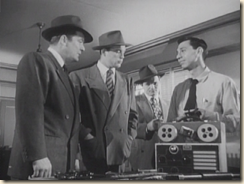
He Walked by Night didn’t influence The Third Man, but it definitely did influence American popular entertainment.

To start with, it appears to be the first movie that includes a scene of self-surgery. The bad guy stitches himself up after being shot, using a mirror and a lot of grit. I’ve seen variations of that scene in The Terminator, Ronin, and Master and Commander, but this might be the original.

Even more clearly, He Walked by Night gave birth to the most visible and long-lasting form of the dramatized police procedural. It even starts with an announcement that the story was based on real crimes, and that “names have been changed to protect the innocent.”

One of the supporting characters in the movie is a police lab technician played by Jack Webb. He’s young and almost winsome in the role.

At the time, Webb’s most prominent parts were as the star of the radio dramas Pat Novak, for Hire, about an unlicensed investigator who works at a pier, and Johnny Madero, Pier 23, about a pier manager who undertakes investigations. As was standard in hard-boiled mysteries, the cops in those stories were at best a rival for the hero, at worst a hindrance.

While working on He Walked by Night, Webb met the movie’s technical advisor, Detective Sergeant Marty Wynn of the Los Angeles Police Department. Their conversations and the movie’s format gave Webb the idea of creating a radio drama about a police detective, inspired by real crimes and portraying realistic law-enforcement techniques.

The LAPD also loved that idea and got behind it. Dragnet premiered in June 1949 with Webb in the starring role of Sgt. Joe Friday. It ran for more than eight years on radio. For most of those years, a version also ran on television for nine years, and there was a movie adaptation as well. Then the TV show was revived in 1966 with a TV movie and more than four more years of episodes. Webb expanded the procedural franchise in the 1970s by producing Adam-12 and Emergency!

Dragnet made Webb’s Joe Friday character a national icon, cementing his image as an actor and even his politics. That means it’s very striking to see him play a different personality in He Walked by Night, or to hear him as a cornet player during Prohibition in the fine radio drama Pete Kelly’s Blues.

06 November 2019

Going Deep for a Climactic Chase

He Walked by Night is a 1948 police procedural that gets better as it goes along, largely because the original director, journeyman Alfred L. Werker, left the project and the up-and-coming Anthony Mann took over.

The cinematographer, John Alton, stayed the same, so the whole movie has the same look. It’s a noir docudrama. Many of the opening scenes have no more zip than an educational film. But scenes with the bad guy, played by Richard Basehart, are strong, and the climax is terrific. The police chase the killer through the Los Angeles sewer drain system. Mann and Alton used light and dark, angles and shapes, tracking shots, and sound with no music to build up tension.

The sewer chase immediately brings up a comparison with The Third Man, directed by Carol Reed and released the following year. Did a B movie produced by a British-American distribution company that had just got into production influence that prestige project filmed in Europe with an international cast of stars? The similarity is striking, but it’s just a coincidence.

Producer Alexander Korda recruited Graham Greene to write a new screenplay for Reed after they had worked together well on The Fallen Idol. Korda had the idea of setting a story in Vienna, its policing divided among the Allied powers. Greene had one sentence in an old notebook about someone spotting an old friend a week after attending his funeral.

In early 1948, Greene traveled to Vienna to research and come up with more. Discussions with various people gave him two ideas: black-market penicillin and patrols of the city’s old sewer system. Greene went to Rome and drafted a novella incorporating all those elements, then adapted his prose into a screenplay. Filming on The Third Man began in October.

Meanwhile, Eagle-Lion Films was making He Walked by Night, inspired by the case of murderer Erwin Walker. In April 1946, after a shootout with police, Walker had escaped through Los Angeles’s storm drains. He did the same thing the following month. Walker was finally arrested in December 1946 in his apartment, the police having received a tip-off.

According to The Crime Films of Anthony Mann, the original scenario for He Walked by Night didn’t include scenes of the killer in the sewer. Instead, the climax was a chase at the Los Angeles Coliseum, which Werker probably filmed in the spring of 1948. When Mann took over, he reworked the screenplay. He and his chosen writer, John C. Higgins, changed the climax to be an extended capture in the storm drains. Those scenes were a technical challenge, but Alton and Mann captured that footage in reshoots in July 1948.

In November, Eagle-Lion released He Walked by Night in Los Angeles. That same month, Orson Welles arrived in Vienna and performed in a few shots of The Third Man. One of those involved going down into the sewer. But Welles famously balked at filming underground surrounded by actual drain water. The company had to build sewer sets in London and film the movie’s climax months later. Still, that timing shows how the sewer scenes of The Third Man were already mapped out by the time He Walked by Night was released.

Thus, the two movies’ chase scenes through drainage systems developed independently, each based on real events. Both scenes take advantage of the darkness and watery reflections of underground drainage tunnels. But they end up offering a strong visual contrast that reflects the two cities above. LA’s drains are all modern concrete, with smooth surfaces and sharp angles and arcs. Vienna’s Old World tunnels (or the studio reproduction of them) are bumpy brick and stone, filmed at vertiginous tilted angles. And both scenes are excellent.