Showing posts with label COMIC Green Arrow. Show all posts

24 August 2014

Roy Harper, the Anti-Dick Grayson

Just as DC Comics had to separate Green Arrow from Batman, its storytellers had to figure out a way to make Green Arrow’s young sidekick Speedy different from Robin, the Boy Wonder.

For decades the two characters existed in parallel—helping their mentors in fighting crime, providing useful sounding boards, and expressing the emotions of young readers. Dick Grayson was a teen orphan living with Bruce Wayne. Roy Harper was a teen orphan living with Oliver Queen. And their paths never crossed.

In 1964 Robin began working with Aqualad, Kid Flash, and Wonder Girl as the Teen Titans. But Speedy was notably absent. Fans wrote in, asking why the line’s other long-time kid sidekick was being left out.

So Teen Titans, #4 and #11, featured guest appearances by Speedy. And in issue #19 he became an official member of the team—and also managed to score a date with Wonder Girl, thus distinguishing him from all the other teammates who had crushes on her. But not by much.

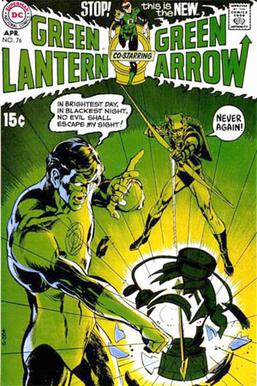
The real differentiation began in 1971 when Neal Adams and Dennis O’Neil used the character of Roy Harper to explore the issue of drug use—a breakthrough for DC. Green Arrow discovered that his sidekick had become addicted to heroin. Not so badly that he couldn’t kick the habit within two issues, but enough to suggest a new direction for Speedy.

The Teen Titans series, aimed at a younger audience, never mentioned Speedy’s heroin troubles through the 1970s. Its writers tried sought other ways to set him apart from Robin: he and Wonder Girl remained a casual couple, and he was a bit more hot-headed. There was enough space between the characters for the series’ last issue to retroactively establish Speedy as a founding member of the team.

In the early 1980s Marv Wolfman and George Pérez brought Roy Harper back for occasional appearances in the New Teen Titans magazine, this time referencing his troubled past. Now working for a government agency, he joined the Titans in attacks on drug dealers. Those issues also portrayed him as an incorrigible ladies’ man just as Dick Grayson was entering a serious (and sexual) relationship with Koriand’r.

Finally, after Crisis on Infinite Earths Wolfman and Pérez added another layer to Roy Harper’s character. New Teen Titans, vol. 2, #21, revealed that he’d gone undercover [!] and had an affair with an international assassin named Cheshire. They’d even had a child together. Dick (now Nightwing) and Kory were having sex, but Roy was having unprotected sex with a villain!

That provided such a distinction between Dick Grayson and Roy Harper that Wolfman could write a story in Action Comics Weekly of their adventures together looking for Roy’s daughter. Where once Robin and Speedy couldn’t be on the same team, now Nightwing and Speedy could play off each other for several issues on end.

Roy Harper had become DC Comics’s anti-Dick Grayson. Dick was charming, respectful, and monogamous. Roy hit on almost any woman he met, especially when he was on duty. Dick became the one member of the original Titans who never married or had kids. Roy did the kids part first and muddled through as a single dad.

Nightwing was the young hero who did everything more beautifully than anyone else, whom everyone trusted. Roy was the character who managed to screw up most of the time. He bounced among among crime-fighting identities: Speedy to Agent Harper to Arsenal to Red Arrow and back to Arsenal. He owed his co-workers money. He took over the Titans, and the team fell apart. He formed the Outsiders for Dick to lead, and made a stupid fundamental error from the start. Nonetheless, he kept going. The result was a far more compelling character, a favorite for some readers.

While not all of Roy Harper’s background gets transferred into other versions of the DC Universe, his definition as the anti-Dick Grayson does. When the Teen Titans television cartoon introduced Speedy in a later season, producer David Slack explained, “we were looking for someone to mirror Robin.” In the sillier Teen Titans Go, the producers even have actor Scott Menville provide both rival characters’ voices (and of course make in-jokes about that).

DC’s “New 52” universe wiped out the Titans’ past and left little time for Roy Harper to have worked with the new Oliver Queen. Nonetheless, it reintroduced Roy as “the worst former sidekick ever” in Red Hood and the Outlaws. That may not be the best treatment for him, but at least it’s better than the Cry for Justice/Rise of Arsenal miniseries of 2010, which were so poorly received they were quickly written out of continuity. And it does preserve Roy Harper’s distinct role in the DC Universe.

23 August 2014

Putting Distance between Green Arrow and Batman

As I described on Thursday, DC Comics’s syncretism meant the company sometimes ended up owning two quite similar characters/trademarks. That pushed its staffers to come up with creative ways to distinguish them, expanding the bounds of its superhero stories.

Thus, in 1986 the company put Superman and his most successful equivalent from another publisher, Captain Marvel, in the same universe. And the editors and writers started emphasizing what made them different.

The fact that Captain Marvel is really a kid named Billy Batson—i.e., even more of a naïf than Kansas farmboy Clark Kent—became the defining aspect of his character. Storytellers also found more significance in how Captain Marvel’s powers arose from some form of magic (rather than, like Superman’s, through science).

Wonder Woman didn’t present such problems because no other company had such a powerful female hero. Instead, DC had to struggle with America’s changing picture of the ideal woman—and that’s another story.

As for Batman’s equivalents, it’s important to note what defined that character for most of his 75-year history. It wasn’t being dark and brooding and driven by vengeance. In fact, from the early 1940s through the mid-1980s, Batman was a cheery special independent agent of the Gotham police who just happened to dress as a bat. What defined him was:
  • He had no special powers beyond being a very smart, very athletic man.
  • He wore a mask to preserve his real identity.
  • He was an immensely rich socialite.
  • He had a lot of cool bat-themed gadgets and vehicles to deploy in a fight.
  • He worked with a teen-aged assistant.
That formula proved so popular that in 1941 DC’s sibling company, All-American Publications, created its own version: Green Arrow. He, too, wore a mask to disguise his life as Oliver Queen, an immensely rich bachelor. He used trick arrows, an Arrow Car, an Arrow Plane, an Arrow Signal, and even an Arrow Cave. And of course Green Arrow had his own kid sidekick, Speedy.

For a long time, DC kept Batman and Green Arrow apart. While Batman was an occasional member of the Justice Society of America, Green Arrow was relegated to a lesser hero team, the Seven Soldiers of Victory. Stories about him and Speedy appeared in World’s Finest after Batman and Robin’s, but the heroes never met. Green Arrow survived in backup stories through the early-1950s crash of superhero comics, probably because DC editor Mort Weisinger had co-created him, but he never had his own magazine.

When DC launched the Justice League of America, first in The Brave and the Bold and then in its own title, Batman made brief appearances. But Green Arrow didn’t show up at all, prompting fans to ask why he was left out. The problem, I suspect, was that he seemed too similar to Batman—why would the team need them both?

After popular demand, Green Arrow finally joined that group in Justice League of America, #4. Batman then stopped appearing so often, and it wasn’t until issue #10 that both characters showed up on the same cover.

Eventually the proximity of two similar characters prompted a new generation of creative minds to come up with ways to distinguish them—and to take superhero comics in a new direction. In 1969 artist Neal Adams gave Green Arrow a new look with a Van Dyke beard (at a time when facial hair had a politic meaning). Writer Dennis O’Neil made radical changes in the character of Oliver Queen. He lost all his money—no longer a millionaire with an unending supply of gadgets. He started a romance with an independent crime-fighting colleague, Black Canary.

While Bruce Wayne was then showing a new sort of social conscience with the Wayne Foundation, O’Neil had Oliver Queen start speaking loudly for political justice and change. Now the character stood out in Justice League meetings—in fact, he came to alienate some members of the group. It wasn’t just his politics but his temper and attitude. Green Arrow thus became one of DC’s first examples of a superhero who wasn’t a paragon in every way.
As a result, Green Arrow became an interesting character, perhaps for the first time. O’Neil and Adams partnered him with Green Lantern in a series of stories exploring social issues in America. Those highly regarded tales didn’t sell well enough to keep the Green Lantern magazine from cancellation in 1972, but they did cement the new character of Oliver Queen for readers. As a result, it became possible for him to be a foil for Bruce Wayne/Batman in subsequent decades rather than a pale green copy.

A similar process occurred in the late 1980s after DC introduced the Charlton character of Ted Kord, the Blue Beetle, into its main line. He, too, was a masked man without powers but with a lot of gadgets and smarts. He ended up on the Justice League with Batman. But that was the start of the grim, antisocial Batman we know today, and the magazine’s creators moved that Blue Beetle in the opposite direction, toward comedy.

With the “New 52,” DC brought Wildstorm Comics’s Batman equivalent, Midnighter, into its standard universe. Already Midnighter had been established as gay and happily partnered with the Wildstorm equivalent of Superman, providing more distance from the Caped Crusader. Now Midnighter is showing up in Grayson, actually offering storytelling value in how the character is a version of Batman.

20 March 2014

Crisis on Multiple Podcasts

This week comic-book writer and editor Dennis O’Neil showed up on two of my podcasts.

I’d expected to hear his voice on Fat Man on Batman because Kevin Smith had promised a multi-part interview about O’Neil’s career in comics, particularly as writer and editor of the Batman magazines.

But I was surprised to also hear O’Neil pop up on Back Story, the best radio show/podcast about American history. The St. Patrick’s Day theme was “green,” and producer Andrew Parsons interviewed O’Neil about the Green Lantern/Green Arrow series starting in 1970.

That series was also a big part of Smith’s interview, which is longer and more detailed. It’s a milestone in “relevant” superhero comics, marred only by the fact that it didn’t win over enough readers at the time to keep the Green Lantern magazine from being canceled within two years.