15 November 2015

“A depth that other superhero comics didn’t have”

A few months back, as McFarland sent out the first copies of Dick Grayson, Boy Wonder, editor Kristen L. Geaman asked all of us contributors to describe what our essays were about.

Here’s how I summed up my essay “Success in Stasis: Dick Grayson’s Thirty Years as a Boy Wonder” for the project’s Tumblr page:

The first chapter of the book looks at the first thirty years of stories about Dick Grayson, from his debut in 1940 until he leaves Wayne Manor in 1969. That was a period of stasis for the character, with no growth and no rifts with Batman that weren’t solved by the end of a story. Yet it was also the period that established Robin the Boy Wonder as a household name.

This chapter argues that the partnership of Batman and Robin was crucial to how those characters survived in the late 1940s when almost all other costumed superheroes stopped being published. The emotional bond between Dick Grayson and Bruce Wayne, explored most often in stories written by Bill Finger, gave their adventures a depth that other superhero comics didn’t have.

Robin thus became DC Comics’s preeminent symbol of youth, and the 1960s produced a roiling youth culture that forced the company to make changes in Dick Grayson’s life. After thirty years in his early to mid-teens, he had to grow up.
That highlights the hypothesis I arrived at while preparing that essay: that the emotional bond between Bruce Wayne/Batman and Dick Grayson/Robin was the crucial ingredient that made their series survive when most superheroes faded away. And Bill Finger, co-creator of the characters, was the storyteller who did the most to establish and explore that bond.

14 November 2015

Planetary Copyright

Here’s an interesting wrinkle about international copyright protections:
The classic novella “The Little Prince” fell into the public domain this year in much of the world but remains under copyright in France because of an exception that grants a 30-year extension to authors who died during military service in World War I and II.
There’s a logic to that provision, I suppose. If a society bases copyright terms on an author’s life, but an author dies before his or her time while fighting for the society, then the society extends the copyright term to about what it would otherwise have been. Still, I wonder what specific cases gave rise to this exception.

That passage comes from a New York Times story on a dispute over the copyright of Anne Frank’s diary as originally published. That copyright is the main asset of a foundation, which wishes to extend its term by calling Anne’s father a coauthor of the text. Other institutions, hoping to make the diary more widely accessible and/or mindful of Holocaust deniers’ claims that Otto Frank invented the story to begin with, are resisting that move.

By the logic of the French law, the term of Anne Frank’s copyright could be extended based on what her natural lifespan would have been—meaning even longer protection than basing the term on her father’s lifespan. Of course, few countries follow France’s example.

Meanwhile, the foundation already authorized the editing and publication of a more complete version of Anne Frank’s diary, which has its own copyright term based on the life of the scholarly editor.

12 November 2015

Kryptonian Babysitting Service

There’s a lot to like in the new Supergirl television series, but there’s one detail in the introductory voiceover that I don’t like at all.

That line repeats a detail from the pilot, which shows Kara’s family sending her from Krypton to Earth. Her mother is a judge, showing how Kryptonian women could exercise authority.

In those scenes, Kara is about thirteen years old. Her cousin Kal-El is still a little baby. And their parents know that when the kids arrive on Earth they’ll have extraordinary powers—the yellow sun, you know.

But the women don’t tell Kara that she’ll have to be careful not to hurt the natives, or that she can be a hero. They say her job is “to look after your baby cousin, Kal-El.”

Kara replies, “I won’t fail Kal-El, or you.”

The grown-ups don’t tell Kara that she should do this “because you’re older, and he’s just a baby.” They don’t say she should do this “until he can look after himself.” They present this as her one and only mission in life.

The credits go on to explain that Kara’s spaceship was knocked off course, causing her not to arrive on Earth until her cousin has already grown up and become Superman. But she’s still in her teens. The series picks up a few years later when she’s in her early twenties. (Most comic-book versions of Supergirl are in their teens, but there is some precedent for a twentysomething.)

At first Kara says, “I didn’t have a mission anymore. But even though I had all the same powers he did, I decided the best thing I could do was fit in. After all, Earth didn’t need another hero.” Over the first couple of episodes, she decides to discard that attitude and be a superhero as good as her cousin.

Comics writers have gotten a lot of stories out of Supergirl’s wish to match her older, established cousin’s heroism. I have no problem with that being a big theme in this series. But here that theme is tied onto the notion that her job was to look after the family’s sole surviving male.

11 November 2015

Appropriate and Appropriation

Smart analysis from Timothy Burke, history professor at Swarthmore College:

What’s being called appropriation in some of the current activist discourses is how culture works. It’s the engine of cultural history, it’s the driver of human creativity. No culture is a natural, bounded, intrinsic and unchanging thing. A strong prohibition against appropriation is death to every ideal of human community except for a rigidly purified and exclusionary vision of identity and membership.

Even a weak prohibition against appropriation risks constant misapplication and misunderstanding by people who are trying to systematically apply the concept as polite dogma. To see one example of that, look to the New York Times article, which describes at one point a University of Washington advice video that counsels people to avoid wearing a karate costume unless you’re part of the real culture of karate. But karate as an institutional culture of art and sport is already thoroughly appropriated from its origins in Okinawa, and it was in turn an appropriation of sorts from Chinese martial arts–and no martial arts form in the world today is anything even remotely like its antecedents in practice, form or purpose. Trying to forbid karate costuming to anyone but a truly authentic “owner” of the costume is a tragic misunderstanding of the history of the thing being regulated. It’s also a gesture that almost certainly forbids the wearing of a costume that has a referent that is not wholly imaginary. If a karate outfit is appropriation for anyone but a genuine Okinawan with a black belt, then so also are firefighters, police, soldiers, nurses, doctors, astronauts and so on. Even imaginary characters are usually appropriations of some kind of another, drawn out of history and memory.

It is precisely these kinds of discourses about appropriation that are used by reactionaries to protest Idris Elba being cast as Heimdall, or to assert that a tradition of a particular character or cultural type being white or male or straight means it must always be so. It might be possible to configure a critique so that appropriation from below is always ok and appropriation from above is never ok, but that kind of categorical distinction itself rests on the illusion of power being rigid, binary and fixed rather than fluid, performative and situational.

What I think many activists mean to forbid is not appropriation but disrespect, not borrowing but hostile mockery. The use of costumes as weapons, as tools of discrimination. But it’s important to say precisely that and no more, and not let the word appropriation stand in for a much more specific situational critique of specific acts of harmful expression and representation. “Appropriation” is being used essentially to anticipate, to draw a comprehensive line proactively in order to avoid having to sort out with painful specificity which costumes and parties are offensive and which are not after the fact of their expression.
I’ve been trying to remember Halloween costumes from my years at Yale. I don’t remember the types of costume that the administration felt compelled to warn students against this year. In fact, I have a hard time imagining anyone in that period thinking variations on blackface would ever be appropriate—and I do remember clear moments of racism and other bigotry. But maybe I just didn’t go to those parties.

10 November 2015

The Emerald City in the Gutter

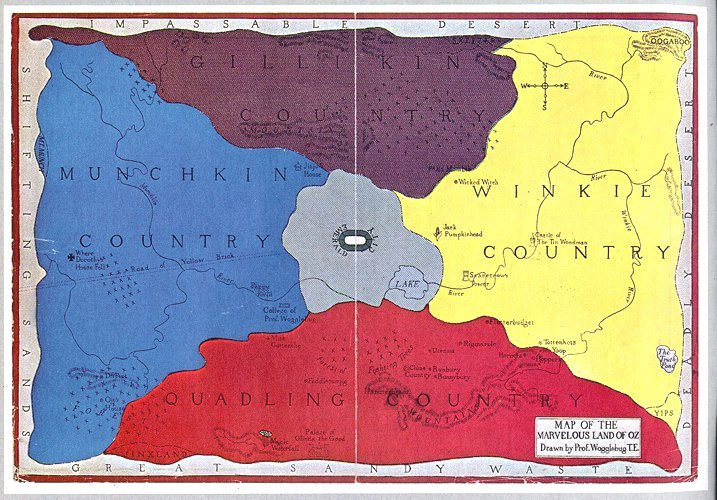
Here’s another view of the map of Oz as issued by Reilly & Lee. Can you spot two big differences between it and the map shown last week, from David Maxine’s Hungry Tiger Talk blog?

One difference is that this is a later reprinting of the map that first appeared in Tik-Tok of Oz (1914). As David discussed, the compass rose originally put east on the left and west on the right, contrary to the usual approach. At some point in subsequent decades, the publisher changed the labels so “E” was on the right as usual.

Of course, that change also meant the map showed the Winkie Country to be east of the Emerald City instead of west, as all of L. Frank Baum’s books described it. But his successors Ruth Plumly Thompson and John R. Neill started to state that the Winkies lived to the east, conforming to the reprinted map and its conventional compass.

Another difference is that the version of the map above is a broadside while the image David showed was scanned from an early copy of Tik-Tok of Oz, where it served as the endpapers. And that highlights a feature I find really interesting from the perspective of book design.

This map had to look good both as endpapers, when a thin strip of its middle would be concealed in the book’s binding, and as a poster or broadside lying flat. The artist accomplished that by making sure that almost no sites and no lettering fell within that central strip. Some large labels bridge the strip, such as the word “GILLIKIN” in the top quadrant—but there’s a little extra space between the second I and the K that could disappear into the binding.

The Emerald City was a challenge because Baum was clear that it’s in the middle of Oz—and thus in the middle of this map. How to keep it from vanishing into the gutter? The artist’s solution was to depict the city as a horizontal oval, with the word “Emerald” on the left and “City” on the right. (David Hulan once pointed out that the oval approximates an “emerald cut” in jewelry.) Then when the central strip of the map is hidden (look back on David’s map), the city appears as a circle and its full name remains legible.

On the accompanying map of Oz and surrounding countries, shown below, the Emerald City is safely off-center. And it appears as a circle, as it would appear in the endpapers form of the Oz map. This time the artist tried to keep other labels and locations out of the central strip. In the image from Wikipedia below, you can see where that got tough.

08 November 2015

“Some outstanding work” in Dick Grayson, Boy Wonder

Here are nice quotes from reviews of Dick Grayson, Boy Wonder, edited by Kristen L. Geaman and published this year by McFarland.

John DeNardo, Kirkus Reviews:

“Dick Grayson, aka. Robin, Batman’s young sidekick, [has] been around nearly as long as the caped crusader but rarely sees any media attention. That is, until now, with this collection of scholarly essays. Dick Grayson, Boy Wonder: Scholars and Creators on 75 Years of Robin, Nightwing and Batman is an interesting collection that features critical analyses and essays about the most overshadowed sidekick in comics. Also included are interviews with the Boy Wonder’s past and current creators Chuck Dixon, Devin Grayson and Marv Wolfman. Collectively, these essays examine Robin’s place in comics and his evolution across the decades—all within various contexts like trauma, friendship, feminism and masculinity.”
Nick Smith, ICv2 (4 Stars out of 5):
“Some outstanding work . . . for anyone who wants insights into the detailed history of Dick Grayson, as Robin and as Nightwing, and into the creative processes that have guided the character over such a long time, this is a valuable work, well worth reading. It should also be of interest to anyone interested in writing any company-owned character, because the history and interviews may prevent career-threatening pitfalls. Its price may keep it out of the hands of some fans, but it belongs in most libraries, at the least.”
As I wrote last week, the preview function on Barnes and Noble and Amazon websites offers an overview of the book and a good chunk of the first essay, by me.

04 November 2015

A Golden Time for a New Golden Compass?

The news that there’s a deal for a television adaptation of Philip Pullman’s His Dark Materials series is very intriguing for us fans. It also shows how the economics of special-effects adventure dramas have changed in recent years.

In 2007, New Line’s adaptation of The Golden Compass cost an estimated $180 million to make. But that movie just didn’t capture the books’ magic, earning only $70 million in the US. That was so little that New Line’s parent corporation restructured the division the next year, bringing it under the control of Warner Bros. (The film made more overseas, but most of that money went to distributors, not the studio.)

Now television shows like Supergirl can afford digital visual effects on the same level, despite having a lower budget. And miniseries have become quite lucrative. So it’s possible to conceive of a His Dark Materials adaptation that’s not only visually stunning but tells the complete story of the three books.

Philip Pullman is part of this new deal. So is New Line, perhaps because it still holds the dramatic rights, and Scholastic. The production company, Bad Wolf, is new, without any completed projects, but its founders have brought on the BBC, their former employer. They also have ties to HBO, which would be a prime customer for the series in the US. All that makes me feel a little more hope than usual that this announced deal will lead to an actual show.

03 November 2015

zO fo paM suoiretsyM ehT

At the Hungry Tiger Talk blog, David Maxine has been presenting his research into the many maps of Oz. In his latest, he shares information about the map that appeared in Tik-Tok of Oz (1914), as shown above.

David quotes material showing that L. Frank Baum:
  • sketched a map of Oz for a young reader while working on the musical that became Tik-Tok of Oz, according to his composer, Louis F. Gottschalk.
  • sketched a supplemental map depicting the adventure in The Lost Princess of Oz (1917) based on the first.
He thus reaches the convincing conclusion that Baum himself sketched the preliminary version of the Tik-Tok map.

The main mystery of that map is why its compass is reversed, with east shown on the left and west on the right. Baum’s texts are consistent about east and west—the Winkie Country is always to the west of the Emerald City, for example, and traveling west in the Winkie Country takes one to the edge of Oz. Likewise, the Lost Princess map is consistent with the earlier Tik-Tok map, with west on the right. But if one were to hover in the air over Oz in a balloon facing north, would it look like that map?

For David, the consistency suggests that Baum actually pictured Oz that way, with east to the left and west to the right. I'm not so sure that’s the only explanation.

Even in its early years, the Reilly & Britton publishing firm seems to have been a bit slapdash in how it assembled the Oz books. A couple of years ago I wrote an article about the art program for The Patchwork Girl of Oz, which included reusing many of John R. Neill’s illustrations, including at least one that Baum had rejected.

I therefore think there’s a possibility the Tik-Tok map ended up with a reverse compass because no one noticed that mistake till all the hand-lettering was done. Then, with the book ready to go to the printers, everyone (including Baum) just decided to live with the oddity. As for the Lost Princess map, Baum clearly based that off the earlier one, and it would have been much easier for him to maintain its orientation than to redraw the borders in reverse.

Unfortunately, correspondence between Baum and his publisher during the time when the map was created appears to be lost. We therefore don’t know what Baum asked for or settled for. But it’s clear that he accepted the map as published, with its unorthodox orientation.

02 November 2015

“What’s New” with Wondermore, 7 Nov.

On Saturday, 7 November, I’m going to moderate a panel of new children’s-book authors at Wondermore’s “What’s New in Children’s Books” conference at Lesley University in Cambridge.

The panelists are:
We’re going to talk about their paths of publication, favorite childhood reading, and advice for young creators.

This conference is designed for teachers, librarians, and other professionals who help kids learn to read and enjoy books. Other speakers include author-editor Anita Silvey, author-illustrator Rebecca Bond, bookseller Terri Schmitz, and school librarian Christian Porter. The presentations start at 9:00, and are scheduled to finish in early afternoon.

(Wondermore used to be known as the Foundation for Children’s Books. It’s now focused on bringing books and book creators to urban schools.)

01 November 2015

A Robin Reader

Dick Grayson, Boy Wonder is a collection of serious essays about the sensational character find of 1940, published on the occasion of his 75th anniversary.

The book’s editor is Kristen L. Geaman, a medievalist, and many of the other contributors are also academics. Most don’t specialize in comic books or popular culture but are long-time fans of Dick Grayson in his various roles in the DC Universe. They combine rigorous scholarship with affection for the character. And one of those contributors is me.

In fact, my essay is the first in the book because I volunteered to cover the first thirty years of Dick Grayson stories, from his debut in 1940 to his departure for college in late 1969. I discuss the storytelling advantages of a sidekick, the emotional depth that Dick brought to the Batman saga, and Dr. Fredric Wertham’s complaints about the Dynamic Duo’s relationship.

On both Amazon and Barnes & Noble’s website, it’s possible to read a good chunk of my essay through the preview feature. Check it out and see if you want a copy of the whole book in print or digital form.

(Dick Grayson, Boy Wonder doesn’t contain any illustrations from the comics, and it wasn’t authorized by DC Comics—hence the non-trademark-conforming costume on the cover.)