Comics and Non-Comics, Manuscript and Script
 In June I featured COMICS WEEK, with every posting about comic books or comics in other forms. In September I launched NON-COMICS WEEK, about books that have something to do with comics, but aren't comics. But today Oz and Ends starts something totally new: COMICS AND NON-COMICS WEEK!
Which is to say, I'm going to post thoughts on what makes comics different from other illustrated books. Some of these differences have to do with form, and thus may be inherent to the different storytelling media. Some involve the way that the different types of books are created, and thus may be more related to organizational cultures and traditions than the artistic forms. I base these comments on analysis rather than much experience with creating either of those types of books, so I welcome comments and rebuttals from people in the fields.
My first observation began several years ago when I drafted a comics script about Button-Bright and submitted it to the world's leading Oz comics creator. (What the heck?) I hadn't found any books about writing comics scripts, so I followed the only rules for to-be-illustrated manuscripts that I knew: the rules for picture books.
Those rules are:
In one of my writing groups, an author had sold a picture-book manuscript about canoeing on the Charles River with her son. When it was published, the artist had decided to portray the mother and child as Native American. That's how that picture-book publishing works. Editors explain that this is necessary to give the artist enough creative input.
I've heard some experienced authors speak of exceptions to the rules. Stephen Krensky has noted in his manuscript what image should go on the wordless last page of a picture book. Joanna Cole and Robie Harris both insisted that they had to work closely with their illustrators--Bruce Degen and Michael Emberley, respectively--given the nature of the Magic School Bus and It's [Sensible Information about the Human Body] series. But those authors know that they're exceptional. They were all established, and two even had in-house editorial experience, before they broke the rules above. Newcomers don't have the same freedom.
So back to my Button-Bright comic. I carefully wrote out a manuscript that included only the words that would appear on the page, with the barest possible description of the action. No breakdown by pages or panels, no descriptions of characters, no commentary on mood. I had ideas on all those things, but was scrupulous about keeping them to myself.
The artist sent back a polite note gently telling me that's not how comics scripts work. Over the past year I've gotten around to looking at Dennis O'Neil's DC Comics Guide to Writing Comics and several other books that include scripts, either in full or as part of the DVD-like extras that DC and Marvel include in their "graphic novel" editions.
And sure enough, though there are many styles to creating a comics script, the writer has the freedom and responsibility to break the action down into pages and panels, to describe characters' actions and emotions, often even to suggest the shapes of panels and viewpoints from which they should be drawn. Paradoxically, even though a comics artist creates many more drawings per story than a picture-book artist, he or she is expected to have less control over the interaction of art and text.
Sometimes this can cause anxiety. In the extras added to Identity Crisis, penciller Rags Morales recalls complaining to his wife that Brad Meltzer's script was too detailed and controlling, that he couldn't do the job. But gradually Morales realized what Meltzer had in mind, and how all those details would add up. To be sure, the same material and interviews highlight places where Morales suggested changes from Meltzer's instructions which both agree were better. But clearly the scripter was deeply involved in creating the visuals of this book.
Among other award-winning comics scripters, Neil Gaiman's texts are casually conversational: Well, hi Kelley, Malcolm, Todd, Steve, Tom, Karen...
Alan Moore's seem erudite and freakishly detailed:
Here we are at the third part of Season of Mists. We last saw the Sandman watching Lucifer walking away into the mists, having been given the key to Hell. This episode begins a few hours later.
Now, the last issue was pretty low on characters - it was basically just Lucifer and the Sandman, with a couple of cameos. This issue has a cast of thousands. Well, hundreds. Well, lots. FIRSTLY, SINCE I’M NOT ENTIRELY SURE HOW THESE GRAPHIC NOVELS ARE SET OUT, MIGHT I SUGGEST THAT IF THERE ARE END-PAPERS OF ANY KIND THEY MIGHT BE DESIGNED SO AS TO FLOW INTO AND OUT OF THE FIRST AND LAST PANELS OF THE STORY. SINCE BOTH THE FIRST AND LAST PANELS CONTAIN A SIMPLE CLOSE-UP IMAGE OF THE SURFACE OF A PUDDLE RIPPLED BY RAIN, THEN MAYBE A SIMPLE ENLARGEMENT OF A BLACK AND WHITE RIPPLE EFFECT TO THE POINT WHERE IT BECOMES HUGE AND ABSTRACT WOULD BE IN ORDER?
All I can say to picture-book authors is: Do not try this! If your manuscript includes chatty commentary for your editorial and illustration team or detailed suggestions about the endpapers, for goodness' sake, you will brand yourself as the worst type of control freak: the type who doesn't know what the heck she's doing.




 Some Oz and Readers might have assumed (or hoped) that PUNCTUATION WEEK would mean skipping a
 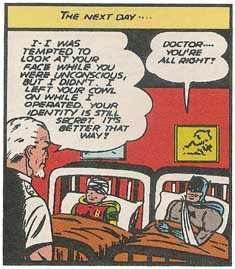 The panel on the right shows a rather unusual use of punctuation in a superhero comic dating from the "Golden Age" or early "Silver Age." Indeed, that usage probably shows up in this panel only because it was created in 1943, when the standard style was still being developed. Can you spot the detail?
 Instead, most remarks in speech balloons became exclamations! Everything was dramatic! Even the most mundane remarks!
 And what about those two hyphens? It's almost impossible to find an
  On the left,
 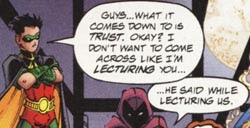 Nevertheless, neither the interrobang nor the juxtaposition of question mark and exclamation point fits in standard prose. They belong only in the most informal or experimental writing. To include them in a book manuscript is to risk being perceived as someone who hasn't read enough books to pick up the rules.