The Pictures and the Prose
 When the National Book Award nominations were announced earlier in the fall, Gene Yang's American Born Chinese received extra attention because it was the first graphic novel to receive that honor. Not all that attention was favorable, and Wired's "Luddite" columnist Tony Long complained:
...as literature, the comic book does not deserve equal status with real novels, or short stories. It's apples and oranges.
I have tried writing "a real novel" or two or seventeen in my time, and I've tried writing and drawing a couple of "real comic books." They are indeed two very different media. But if the level of difficulty is the criterion for judging their value, I'm taking the easy road by sticking to prose.
If you've ever tried writing a real novel, you'll know where I'm coming from. To do it, and especially to do it well enough to be nominated for this award,...is exceedingly difficult.
In a most classy move, Yang replied on his publisher's First Second blog with praise for...another nominee! (And yesterday's eventual winner, Octavian Nothing, by M. T Anderson). Yang wrote:One of the most intriguing aspects of the book (for me, at least) is Anderson's use of visual storytelling devices. For example, Anderson uses different fonts and font styles to communicate time, place, and emotion.
My only quibble with this argument is that, while "modern printing technology" makes the mix of prose and art much more cheap and flexible than it's been in times past, that novelistic technique is about as old as Anderson's Octavian character, if not older.
There are other, more striking, examples. In an early chapter, the protagonist opens the door to a forbidden room and is startled by a sign hanging on the wall, a sign that reveals the secret behind the peculiarities of his existence. That sign is DRAWN in the middle page. It slaps you in the face on the page turn, much as it does Octavian when he opens the door.
Toward the end of the book (here comes a spoiler, so go away until you've actually read it), after Octavian suffers a gruesome personal tragedy, entire passages of the book are scribbled out with what looks to be a crow quill pen. The pages of angry lines and ink splotches communicate as much or more about Octavian's state of mind as the paragraphs that came before.
No one would argue that M.T. Anderson's book is not a novel, but does Anderson's inclusion of graphic devices diminish the "novel-ness" of Octavian Nothing? Does it make Anderson less of a "novelist"?
Not to me. To me, it shows that he committed to the telling of his story above all else, and that he is willing to use whatever devices modern printing technology affords to communicate effectively.
As this online exhibit from the Glasgow University Library shows, Laurence Sterne interrupted what little story there was in his Tristram Shandy with such devices as a marbled page, a black page, and a crooked line like this: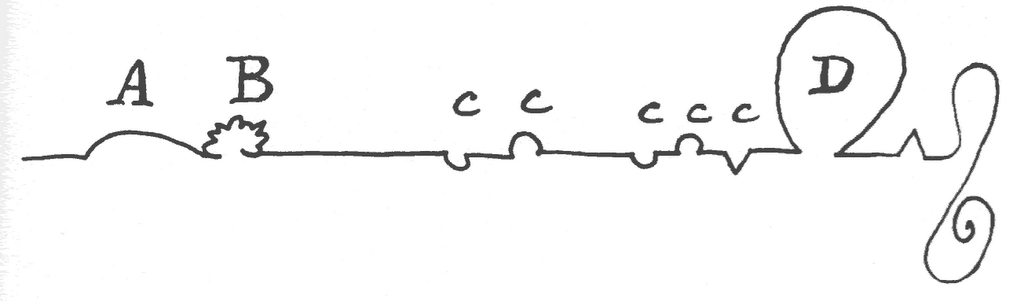 And how about that stately, plump S at the start of James Joyce's Ulysses? I'm pretty sure Tristram Shandy and Ulysses are "real novels" within the English literary tradition. But they're not plain prose.