27 November 2015

Turkey in the Straw Poll

This week Public Policy Polling released the results of a Thanksgiving survey (PDF download) which provided new evidence of OIP Derangement Syndrome among self-identified conservatives and Republicans.

The questions were all Thanksgiving-themed, such as respondents’ favorite pies, whether stuffing should be called dressing, and which Presidential candidates people might and might not like as Thanksgiving guests.

And then there was this question:
Do you approve or disapprove of President Obama’s executive action last year to pardon 2 turkeys rather than the customary one turkey at Thanksgiving?
Choices were approval, disapproval, and “not sure,” which we should assume includes “don’t give a darn.”

The results were quite widely split by party affiliation and political leaning. As PPP reported, “Only 11% of Republicans support the President’s executive order last year to 38% who are opposed—that's a pretty clear sign that if you put Obama’s name on something GOP voters are going to oppose it pretty much no matter what. Overall there’s 35/22 support for the pardon of Macaroni and Cheese thanks to 59/11 support from Democrats and 28/21 from independents.”

But what’s really telling (though not told by PPP) is that Presidents started “formally” pardoning turkeys each year back in 1989, and there have always been two turkeys involved. The breeders provide a matched pair in case one doesn’t look like it can handle the ceremony. Here, for example, is the report on President George W. Bush pardoning two turkeys in 2007.
In other words, 38% of Republicans opposed the current President pardoning two turkeys even though they’d seen his predecessor do that same thing eight times, simply because PPP’s question presented them with a chance to express disapproval of “executive action,” doing something other than “customary,” and “President Obama.”

25 November 2015

An Update to Parrotfish for This Historical Moment

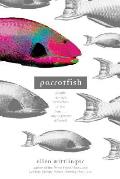
Ellen Wittlinger’s article in The Horn Book about updating her novel Parrotfish (published in 2007) is testimony to changes in society and in language.

Wittlinger’s novel is considered the first modern young adult novel with a transgender protagonist. In writing it, she consulted with Toby, a twentysomething friend of one of her children who was female-to-male transgender. That was only ten years ago, but the first edition’s language was already out of date.

Wittlinger writes:
In the ALAN Review interview, and often in the original edition of the book, I used the word transgendered. This usage is no longer correct. If you say, for example, that paper has “yellowed,” something has happened to the paper to make it yellow. But “yellow paper” has always been yellow, just as transgender people have always been who they are — nothing has acted upon them to make them transgender. As the GLAAD Reference Guide points out, “You would not say that Elton John is ‘gayed’ or Ellen DeGeneres is ‘lesbianed,’ therefore you would not say Chaz Bono is ‘transgendered.’” Scratch the “-ed” ending.

But the word that bothered me — and critics — most was tranny. A decade ago, Toby felt it was a word that transgender people would use amongst themselves or to refer to themselves, and that’s how I used it in the book. But the word has evolved to be defamatory. GLAAD’s entry says, “Please note that while some transgender people may use ‘tranny’ to describe themselves, others find it profoundly offensive.”
In this age of digital publishing, it’s relatively easy to make such changes in electronic books and new printings. The existing paper copies of Parrotfish will, of course, remain the same. Wittlinger also states that 2007 remains the novel’s “historical moment” even with the terminology changes.

She also expects further change in this area of language. When GLAAD issued the ninth edition of its Media Reference Guide in 2014, it stated it had been publishing that reference for “over 15 years.” At 66 pages, with a lot of white space in the design, it’s not a hefty text. Nonetheless, at the pace it’s been revised so far, that ninth edition will need replacement in 2016.

Given how sensitive we are these days about language and other signifiers, I wonder how soon there may be complaints about print copies of Parrotfish being not just of its historical moment, but insensitive. It took only three days after Wittlinger’s essay appeared for a pseudonymous commenter to take issue with its spelling of “cis-gender”—a very new word that’s appeared in three different forms (“cisgender,” “cis-gender,” and “cis gender”) in news stories this month.

24 November 2015

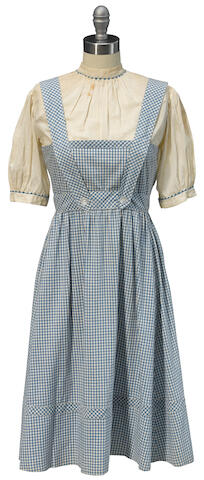
“It was gingham, with checks of white and blue”

Yesterday Bonhams sold a dress for $1,565,000. It was made for a Kansas farmgirl in the early 20th century.

Now that sum’s only about half of the price of the Cowardly Lion costume Bonhams sold last year, but it’s still high enough to place this outfit fourth on this list of most expensive Hollywood costumes.

Two other garments on that list are also dresses made for Dorothy Gale, one used for only a couple of weeks of filming before the director was replaced.

This dress had an excellent provenance, starting with labels inside that identify its wearer as “Judy Garland” rather than a stand-in. As for after it left the studio, “This blouse and pinafore were retained by Kent Warner, the costume collector employed by David Weisz Co. to help organize the 1970 MGM Auction who subsequently cherry-picked many of the best pieces for himself.” It was last sold at a Christie’s New York auction in 1981.

23 November 2015

Giddap

I was impressed by Brooklyn artist Adrian Landon’s mechanical horse.

Click on the picture to see a video.

I was a little disappointed to read that it’s powered by a small electric motor rather than by the wind. I guess the Strandbeests have spoiled me.

22 November 2015

Sam Hamm’s Plan for Robin, part 3

Way back here, I was sharing excerpts of Sam Hamm’s early screenplay for the 1989 Batman movie, a version that featured Robin. Here’s more.

At this point, Dick Grayson’s parents have been killed during their trapeze act—not by Boss Zucco ’s enforcers but by the Joker. Dick wants to go after that villain. Bruce wants him to stay safe in stately Wayne Manor. They fight. In losing the fight, Dick figures out that Bruce is Batman.
INT. BATCAVE - EVENING

TIGHT ON a tiny electronic device: two cylindrical steel casings bracketed together, topped by a DIGITAL TIMER.

BRUCE watches the TIMER tick off seconds: 30. 29. 28. At 25 seconds, BRUCE kills the countdown and CLAPS THE DEVICE into an empty packet on his utility belt.

He stands up wearily. Behind him, hanging back discreetly in the shadows, is his loyal butler ALFRED.

BRUCE
Where's the boy?

ALFRED
Upstairs. He's quite docile.

BRUCE
I know the feeling. It won't last.
(sighing)
He's a long way ahead of where I was at his age.

ALFRED
Respectfully, sir... there'll never be another one like you.

BRUCE smiles sadly. He takes a moment to survey the Batcave as ALFRED looks on tremulously.

BRUCE
How long's it been, Alfred? A quarter of a century?
(beat)
It seems like yesterday. I guess we ended up doing more harm than good.

ALFRED
Don't ever say that, sir. Don't ever believe it.

BRUCE
If not for you I never would've made it. You know that. My own parents couldn't have...
(taking Alfred's shoulders)
... The boy, Alfred. You'll both be provided for. Don't let all this go to waste.

Their eyes lock for a long moment. ALFRED is unable to speak. Finally BRUCE turns and starts slowly up the long circular stairway which leads from the Batcave to Wayne Manor.
After some foofaraw, Batman goes out to confront the Joker, armed with nothing but an advanced fighter plane equipped with missiles.
EXT. STREET - ON JOKER

He LAUGHS INSANELY as the BATWING bears down. At the last instant he hoists a SUBMACHINE GUN. BULLETS pepper the dome of the cockpit.

BATMAN'S MISSILE goes wide right, EXPLODING on the sidewalk. The JOKER drops to the street, unharmed, as the BATWING swoops past. The rear stabilizer wing is trailing THICK BLACK SMOKE.

INT. BATWING - MOVING - THAT MOMENT

BATMAN knows he's in trouble. He buckles a parachute around his chest, finds a button on the control panel. THE COCKPIT DOME flies free of the BATWING, leaving BATMAN exposed to the buffeting wind.

EXT. STREET - ON JOKER

He's scored a hit. He HOWLS IN TRIUMPH. But his maniacal glee is short-lived.

Standing not twenty feet away, in the clearing smoke from the rocket explosion, is an ominous figure in a RED-AND-GREEN GYMNAST'S SUIT.
This is obviously some new usage of the word “ominous.”
DICK GRAYSON -- eager for the kill -- sets out in pursuit of the JOKER.

INT. BATWING - MOVING - THAT MOMENT

BATMAN is losing altitude. HIS CAPE billows wildly around him as he reaches for a SECOND BUTTON -- this one labelled 'EJECT.'

He punches the button. His SEAT disengages. But Batman finds himself suddenly JERKED BACK INTO THE COCKPIT.

HIS CAPE HAS SNAGGED ON THE EJECTION MECHANISM!!! He clutches frantically at this throat as the plane plummets to earth!

EXT. STREET - THAT MOMENT - NIGHT

THE JOKER, on the lam, darts around a parade float. DICK vaults onto the float, LAUNCHES HIMSELF into the air, and DROPS the JOKER with a flying tackle.

But before he can strike... A RESOUNDING CRASH shakes the street.

ANGLE ON BATWING

The plane lies in pieces on the pavement. FLAMES ERUPT. BATMAN's been thrown free, but he's PINNED BY THE WRECKAGE. It's a matter of seconds until the gasoline tank goes up.

EXT. STREET - ON DICK AND JOKER

DICK watches in shock. On one side, the killer of his parents. On the other, BATMAN -- who will surely die unless someone pulls him free.

There's only one choice, and they both know it. DICK glares at the JOKER for the merest of seconds, then TURNS HIM LOOSE. MAD LAUGHTER echoes in the streets as the JOKER escapes -- and DICK races off to BATMAN's aid.

EXT. STREET - A MOMENT LATER - NIGHT

BATMAN grimaces in agony as DICK struggles to free him. His right leg -- shattered -- is like rubber beneath him. His ribs are crushed. He's barely alive.

BATMAN
How did you...

DICK
I hitched. MOVE IT!

DICK drags BATMAN to safety as the remnants of the Batwing BLOWS UP.

BATMAN
The Joker. Is he -- ?

DICK spots an abandoned .38 on the pavement -- left there by one of the JOKER'S GOONS.

DICK
Forget it. Relax.
(reaching for the gun)
... He's mine now.

BATMAN
DICK!

THE BATMAN tries to pull himself erect. The pain is unendurable. His body has finally failed him.

He collapses on the pavement, powerless to intervene, as DICK races off with murder in his eyes.
Okay, now it’s a teenager in a red-and-green gymnast’s suit with a gun. Because that’s what the Batman mythos is all about.

But it’s interesting that Hamm was decades ahead of The Incredibles in warning about the danger of capes and aircraft.

21 November 2015

The G-Man Retcon

Chris Giarrusso created his comic G-Man in bits and pieces: short stories, backup features, comic strips, half-parodies of other superhero sagas.

As the Image Comics webpage for the first volume says, G-Man: Learning to Fly “Collects the origin of G-Man and Great Man, the G-Man Christmas Story, Mean Brother/Idiot Brother adventures, and a complete collection of the original G-Man comic strips that started it all.”

Because that book is a grab bag, its pieces come in different sizes and lengths. Some were obviously designed for different sizes, and they have different storytelling rhythms. It’s still a fun read. We see Mikey and his big brother Dave gaining their powers from the family’s magic cape. Several of their (male) friends already have superpowers, with no explanation. It’s just a fact of life at their school.

Two G-Man miniseries/graphic novels followed, each with a wider focus showing more of the brothers’ universe. There’s more explanation of the magic cape in Cape Crisis, the best of the volumes. We meet the Color Guardians, female classmates who are one unfathomable mass to the boys, and the Suntroopers and Thunderfriends teams of grown-up heroes.

The latest G-Man installment comes from another publisher and takes another form: an illustrated middle-grade novel written as a daily journal, like Jeff Kinney’s Diary of a Wimpy Kid and Rachel Renee Russell’s Dork Diaries. Most of the pictures, supposedly by young Mikey, are in a simpler, line-art style which Giarrusso is also using for a weekly online comic strip. There are occasional full-color pin-up pages as well, in the guise of photos taped into the journal.

In addition, The G-Man Super Journal: Awesome Origins is a prequel, going back not only to before Mikey gained his powers but before all his friends had theirs. It folds in characters who first appeared in the graphic novels, such as the Color Guardians, Cool Wraps, and that annoying kid Tony. And it offers explanations for how all the kids got their powers. Actually, several explanations for each: alien birth, divine descent, freak accidents, top-secret website in Japan, and so on. As a result, G-Man: Super Journal is now the most complete introduction to the G brothers’ saga.

Whereas Learning to Fly’s big scenes are mostly at home and Cape Crisis on the playground, Awesome Origins is driven by events at school: Mikey’s struggle with a teacher who doesn’t like superheroes, tests to join the Suntroopers, and most especially that annoying kid Tony. The illustrations have a deadpan sarcasm that (along with the superpowers, of course) distinguishes this series from its diaristic forebears.

I still prefer the G-Man comics, but a mostly-new G-Man story in illustrated prose form is still a lot of fun. And its publisher’s wider distribution might bring new readers to all the volumes.

20 November 2015

Weighing the Woes of White Americans

Janell Ross in the Washington Post this week:

In a new poll released by the Public Religion Research Institute (PRRI) on Tuesday [PDF download], a whopping 43 percent of Americans told researchers that discrimination against whites has become as large a problem as discrimination against blacks and other minority groups.
To be precise, half of all white Americans feel that way. Less than 30% of blacks and Hispanics agree. Ross continues:
White Americans feel put-upon and mistreated — and large shares of non-white Americans do not seem to have any knowledge of the challenges that white Americans say they face.

Of course, there are always aspects of other people's lives that we do not or cannot understand. But the sheer size of the racial/ethnic gap concerning perceived discrimination against white Americans is particularly interesting because there is very little in the way of objective evidence of this discrimination and the disadvantage that typically follows. On just about every measure of social or economic well-being, white Americans fare better than any other group.

That's true of housing and neighborhood quality and homeownership. That's true of overall health, health insurance coverage rates, quality of health care received, life expectancy and infant mortality. That's true when it comes to median household earnings, wealth (assets minus debt), retirement savings and even who has a bank account. . . .

White Americans are, as a group, born healthier and live longer and get better health care, jobs, education and housing in the years in between. Yet half of white Americans believe that discrimination against them is as big a problem in their lives as it is for those of people of color. But there's just no evidence to back that up.

What does exist is ample evidence of continued-but-shrinking racial and ethnic inequality in many arenas and utter stagnation and backsliding in others. Basically, what's changed since the 1950s — outside of technological innovations such as this here Internet — is that white Americans no longer have an exclusive or almost-exclusive hold on the best housing, jobs, schools or the ballot box.
The question on the latest PRRI American Values Survey was “Just your impression, in the United States today, is there a lot of discrimination against any of the following groups or not?”

In past polls, the most comparable question has been whether respondents agree with the statement “We have gone too far in pushing equal rights in this country.” Agreement hovered between 38% and 49% from 1987 to 2012. So the perception that, despite empirical evidence, whites suffer from discrimination as much or more than non-whites doesn’t appear to be new, nor growing, in that period.

The new survey also notes that the perception of anti-white discrimination among whites is much higher within the “working class” (60%) than among people with college degrees (36%). A recent analysis of American mortality rates from 1999 to 2013 by Anne Case and Angus Deaton also found that educational difference was a significant dividing line among middle-aged white non-Hispanic Americans. People who had any college education died at a slightly smaller rate over that period. But mortality for people who had no college had gone up so much as to produce a strikingly higher mortality rate for the entire age/race cohort.

Thus, white Americans without college education might well be justified in perceiving a more difficult life than they expected. But they’re more likely to blame that on “discrimination” against whites rather than, say, a changing economy.

19 November 2015

When Nate Wright Met Greg Heffley

Yesterday’s post left aspiring comic-strip artist Jeff Kinney working at an online “edutainment” company while corresponding with full-time comic-strip artist Lincoln Peirce.

As I described back here, Kinney’s employer saw some potential in a middle-grade novel in diary form that he was working on. At his boss’s suggestion, he added more illustrations and shared the novel day by day on the company’s website.

That story found a young online audience quickly, a book deal only after a couple of years. That was the start of the huge Diary of a Wimpy Kid phenomenon, now stronger than ever.

Kinney continued to work at that company until relatively recently, overseeing the launch of Poptropica. That online videogame platform is built around “islands,” each having its own game and style. Kinney asked his friend Peirce if he was interested in licensing the Big Nate comic strip to the site.

In 2010 the Washington Post reported what happened:
On Valentine's Day last year, Poptropica launched "Big Nate Island," the interactive world of sixth-grader Nate Wright and his adventures as a "self-described genius" and "all-time record-holder for detentions in school history."

Kids went wild. "All I remember is that Jeff called me after the first 48 hours and said: 'You crashed the server,' " Peirce recalls. "It was their biggest launch by 20 percent."

The sudden online popularity of "Big Nate" led to Peirce's long-sought major book deal, with no less than HarperCollins. "Big Nate: In a Class by Himself" just spent 11 straight weeks on the New York Times bestseller list.
That first Big Nate book series is one of many modeled on Diary of a Wimpy Kid: prose with lots of line art, paper-over-board covers, humorous slice-of-life stories, and so on. Its success prompted the comic strip’s syndicate to finally issue Big Nate comics collections. Meaning that after years of having no books and a daily deadline, Lincoln Peirce had two fast-selling book series and an audience beyond newsprint.

And all because he’d been nice enough to write back to an aspiring young college artist. It’s almost as if this publishing story has a moral.

18 November 2015

Big Nate in a Small Pond

One of the minor pleasures of visiting my dad in the Washington, DC, area is the Washington Post comics page. For some reason it’s unusually large. (Perhaps the Rev. Sun Myung Moon, founder and major owner of the rival Washington Times, didn’t like comics?)

Among the comic strips I enjoyed there, years before it came to the Boston Globe, is Big Nate by Lincoln Peirce. Given its quality and longevity, and its appeal to kids, I assumed that there were Big Nate collections like the bestselling collections of Peanuts, Garfield, and Calvin and Hobbes when I was young. But with fewer and fewer children reading newspapers, that ready market no longer existed.

Lincoln Peirce kept plugging away, the way daily-strip artists have to do. He also generously offered advice to a hopeful artist eight years younger. This Washington Post story from five years ago tells that story:
It was the early '90s, and [Jeff] Kinney was an aspiring cartoonist at the University of Maryland, as well as a big fan of the comic strip "Big Nate," which he read in The Post. Kinney wanted advice on how to break into the business, so he wrote several cartoonists, including Peirce, creator of the recently syndicated "Big Nate."

Up in New Hampshire, Peirce was struck by Kinney's outreach. "His letter was so different from other letters," Peirce recalls. "And not just because it was five to six pages long. Even early on, he was very talented and very ambitious."

Instead of eyeing him warily, Peirce did the professionally generous thing: "I wrote him back."

Kinney the college cartoonist was thrilled. "It was a handwritten letter, which included many drawings that provided guidance on how I could improve my prospects," he recounts.

For more than two years, mentor and student exchanged handwritten and hand-drawn insights into their craft.
Meanwhile, the world wide web grew, and the newspaper business shrank. It was not a good time to start a career as a daily newspaper cartoonist. Kinney ended up working as a designer for an online “edutainment” company.

TOMORROW: Returning the favor.

(Thanks to Karen Jordan Allen for the link.)

17 November 2015

When Maps Came to Oz

The Oz stories that L. Frank Baum wrote up through 1914 shaped the maps that he and his publishing team included in that year’s novel, Tik-Tok of Oz. That stands to reason.

Less obviously, those maps shaped the Oz stories that Baum told afterward. None of the Oz novels up through Tik-Tok mentioned maps at all. (In the Little Wizard Stories collection, “Jack Pumpkinhead and the Sawhorse” describes Ozma drawing an impromptu map for Jack to follow to save two lost children.)

In contrast, every Oz novel that followed Tik-Tok included some mention of a map, often an “in-universe” map known to the people of Oz themselves.

The Scarecrow of Oz:
“I’ve been to the Land of Oz before,” said Button-Bright, “but I’ve never been here.”

“Did you ever hear of Jinxland before?” asked Trot.

“No,” said Button-Bright.

“It is on the Map of Oz, though,” asserted the woman, “and it’s a fine country, I assure you. If only," she added, and then paused to look around her with a frightened expression. “If only—” here she stopped again, as if not daring to go on with her speech.
Rinkitink in Oz begins this way:
If you have a map of the Land of Oz handy, you will find that the great Nonestic Ocean washes the shores of the Kingdom of Rinkitink, between which and the Land of Oz lies a strip of the country of the Nome King and a Sandy Desert.
The Lost Princess of Oz doesn’t include the word “map,” but there are extended passages about Oz geography, and Baum sketched a map to appear in the book, as David Maxine discussed at Hungry Tiger Talk.

The Tin Woodman of Oz:
“I have a map of Oz in my pocket,” persisted the boy, “and it shows that the Winkie Country, where we now are, is at the west of Oz, and the Munchkin Country at the east, while directly between them lies the Emerald City.”
The Magic of Oz:
In the central western part of the Gillikin Country is a great tangle of trees called Gugu Forest. It is the biggest forest in all Oz and stretches miles and miles in every direction—north, south, east and west. Adjoining it on the east side is a range of rugged mountains covered with underbrush and small twisted trees. You can find this place by looking at the Map of the Land of Oz.
Glinda of Oz:
“This is funny!” she exclaimed. “Did you know, Ozma, that there were people in your Land of Oz called Skeezers?”

“Yes,” replied Ozma, coming to her side, “I know that on Professor Wogglebug’s Map of the Land of Oz there is a place marked ‘Skeezer,’ but what the Skeezers are like I do not know. No one I know has ever seen them or heard of them. The Skeezer Country is ’way at the upper edge of the Gillikin Country, with the sandy, impassable desert on one side and the mountains of Oogaboo on another side. That is a part of the Land of Oz of which I know very little.”
The Tik-Tok maps are, after all, credited to Prof. Wogglebug.