22 August 2012

Baked-in Resentment from Sendak

I was struck by this quotation from Jonathan Cott’s interview with Maurice Sendak in Pipers at the Gates of Dawn (1983), about the inspiration for In the Night Kitchen:

When I was a child, there was an advertisement which I remember very clearly. It was for the Sunshine bakers, and it read: “We Bake While You Sleep!” It seemed to me the most sadistic thing in the world because all I wanted to do was stay up and watch . . . It seemed so absurdly cruel and arbitrary of them to do it while I slept. And also for them to think I would think that was terrific stuff on their part, and would eat their product on top of that. It bothered me a good deal, and I remember I used to save the coupons showing the three fat little Sunshine bakers going off to this magic place at night, wherever it was, to have their fun, while I had to go to bed. This book was a sort of vendetta book to get back at them and to say that I am now old enough to stay up at night and know what’s happening in the Night Kitchen!
A similar Chicago Tribune article says Sendak saw that slogan when his sister left him in the Uneeda Biscuit exhibit at the 1939 World’s Fair.

Sunshine Biscuits and Uneeda (from Nabisco) were rival products, and it looks like the real story might be a blend of those memories. As shown above, Sunshine Biscuits ran ads as early as 1936 depicting miniature bakers at work on its products. At the 1939 World’s Fair the company evoked those scenes with little people dressed as bakers, as shown in the postcard at right. Sendak, who turned eleven that year, might well have seen the little bakers at work.

However, I haven’t found any Sunshine Biscuits ads proclaiming something like “We Bake While You Sleep!” The company could have used that line, of course. Bakers have long been known for getting up early to produce fresh bread for the day. Merita Breads, a brand centered in the South, used “Baked while you sleep” as one of its slogans. The Carmel Bakery, in business in Monterey County since 1906, proclaims, “We bake while you sleep.”

What’s most striking to me about Sendak’s story of inspiration is its emotional dimension. Many children might be intrigued by the thought of bakers (especially little bakers) working all night for them. But Sendak declared that arrangement was “sadistic,” “absurdly cruel and arbitrary” to himself, and used it to fuel “a sort of vendetta book.” But he talked like that a lot in middle age.

TOMORROW: The legends of Mickey’s diaper and penis.

21 August 2012

Ozma, the Birthday Girl

Though L. Frank Baum probably never intended to convey this information, today is the birthday of Ozma, fairy queen of Oz. Some passages in The Road to Oz mention that her birthday is on the 21st of the month. Another passage says that the month is August. So there we go.

One of Baum’s longest descriptions of Ozma comes in The Magic of Oz, his penultimate novel:
Ozma, the beautiful girl Ruler of the Fairyland of Oz, was a real fairy, and so sweet and gentle in caring for her people that she was greatly beloved by them all. She lived in the most magnificent palace in the most magnificent city in the world, but that did not prevent her from being the friend of the most humble person in her dominions. She would mount her Wooden Sawhorse, and ride out to a farm house and sit in the kitchen to talk with the good wife of the farmer while she did her family baking; or she would play with the children and give them rides on her famous wooden steed; or she would stop in a forest to speak to a charcoal burner and ask if he was happy or desired anything to make him more content; or she would teach young girls how to sew and plan pretty dresses, or enter the shops where the jewelers and craftsmen were busy and watch them at their work, giving to each and all a cheering word or sunny smile.

And then Ozma would sit in her jeweled throne, with her chosen courtiers all about her, and listen patiently to any complaint brought to her by her subjects, striving to accord equal justice to all. Knowing she was fair in her decisions, the Oz people never murmured at her judgments, but agreed, if Ozma decided against them, she was right and they wrong.

When Dorothy and Trot and Betsy Bobbin and Ozma were together, one would think they were all about of an age, and the fairy Ruler no older and no more “grown up” than the other three. She would laugh and romp with them in regular girlish fashion, yet there was an air of quiet dignity about Ozma, even in her merriest moods, that, in a manner, distinguished her from the others. The three girls loved her devotedly, but they were never able to quite forget that Ozma was the Royal Ruler of the wonderful Fairyland of Oz, and by birth belonged to a powerful race.
Ozma is clearly devoted first to her ideals and second to the protection and rule of her country. I think those priorities present a challenge for people who want to write adventures for her. Ozma leaves her capital for extended periods in order to carry out what she sees as important duties (e.g., Glinda of Oz, The Magical Mimics of Oz), she can be kidnapped (e.g., The Lost Princess of Oz, Grampa in Oz, Kabumpo in Oz, The Hungry Tiger of Oz), and she can even suffer amnesia about her duties (e.g., The Forbidden Fountain of Oz). But I don’t see it as in her character to “go off on an adventure” the way Dorothy does. She’s got things to do.

20 August 2012

You Had to Be There

Right-handed comics creator Jesse Lonergan is gave his left hand a workout sketching people at the Boston Comics Roundtable meeting. The results are sort of like the spot illustrations in British mid-twentieth-century reprints of classic novels.

Last among the recognizable faces on that page is Ben Prager, whose webcomic is Bazzelwaki.

19 August 2012

A Full Look at Detective Comics, #38

Comixology’s Nightwing 101 sale (ending this evening) offered me a 99¢ look at the whole of Detective Comics, #38, the magazine which introduced Robin as the Sensational Character Find of 1940.

As I’ve written previously, this was Whitney Ellsworth’s first issue as chief editor, and he replaced the story originally slated for this issue with Robin’s debut. Within a short time, Ellsworth instituted new rules about guns and killing in Batman tales.

But the Batman cover feature was only the first of several stories in that issue of Detective. At twelve pages it was the longest, but the whole magazine contained 58 pages of comics and a couple of prose items (not included in the Comixology download).

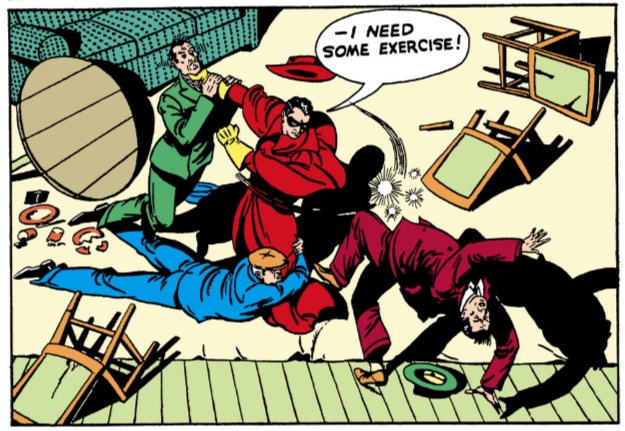
The other graphic features were episodes of “Spy” and “Slam Bradley,” both written by Jerry Siegel; “Red Logan,” an American reporter in London; “The Crimson Avenger,” a Green Hornet knock-off; “Cliff Crosby,” a “Terry and the Pirates” knock-off; “Speed Saunders, Ace Investigator”; and “Steve Malone, District Attorney.” The Crimson Avenger had preceded Batman as a masked hero, but the rest of the magazine’s heroes were square-jawed young white men in suits. (Well, Cliff Crosby wears flying gear and spends an unusual amount of time shirtless at the North Pole.)
Aside from Dick Grayson and the newsboys he encounters, the magazine shows only two recognizable children: a girl and “crippled boy” whom Slam Bradley and his grotesque sidekick rescue from a fire. Within a year, boy sidekicks and heroes would proliferate as the success of Captain Marvel and Robin sent the industry chasing after its main readership. Cliff Crosby was soon dubbed “Young America’s Hero” rather than “Famous Explorer.”

Another striking aspect of the magazine is that the Batman and Robin story is much better than the rest. Granted, scripter Bill Finger had more pages to work with, but a lot of the other tales make little sense, relying on coincidences, leaps of logic, and ludicrous action sequences.

In contrast, Batman and Robin’s drive to shut down Boss Zucco’s protection racket proceeds rationally, building to a night-time battle on the skeleton of an unfinished building. For that fight Jerry Robinson designed pages of dark panels alternating with light, full moon in the background.

Bob Kane and Robinson’s draftsmanship wasn’t as good as that of some other artists in this early comic, but their composition was much better. Only Jack Lehti’s work on the Crimson Avenger finds as much depth and variety in the panels. (Kane and his crew were working with a varied three-tier page structure. Fred Guardineer used a more uniform three tiers in “Speed Saunders,” and all the other stories are told in four tiers, like Kane’s original, six-page Batman tale.)
The coloring on most pages is awful. There was a limited palette, and the colorists deployed it poorly. One page of “Speed Saunders” shows three different women in red tops and green skirts, making it easy to confuse them; on another, two planes keep switching colors. In “Cliff Crosby,” the polar bears are brown. And this is supposed to be an English village landscape at night from “Red Logan.”
With that baseline, Robin’s costume of red, green, and yellow doesn’t seem so unusual.

18 August 2012

The Ancient Games

I may have mentioned that Godson and Godson’s Brother live in London. Where they just had the Olympics. In fact, some bicycle race passed two blocks away from their house. Their back yard looked out onto ceremonies on the Thames. And the family had tickets to a number of events.

So I asked the lads:

  • What was your favorite thing that you saw at the Olympics?
  • Was it more or less cool than this would be?
Godson wrote back:
My Favorite thing was the fencing (Aka hitting people with sticks made of metal) which was great as I fence myself…
Godson’s Brother said:
I liked the Taekwondo and the Handball…
But they agreed on one thing:
G: …however it did not involve the fencers riding dinosaurs!

GB: …but it was less cool.
So there you have it. For eleven-year-old boys, dinosaur walking through mall trumps Olympics. Dinosaur even trumps hitting people with sticks made of metal.

17 August 2012

A Full Spectrum of OIP Derangement Symptoms

This week the Republican leadership displayed the full spectrum of symptoms of OIP Derangement Syndrome.

1) Blaming President Barack Obama for things he can’t be responsible for. On Monday, House Speaker John Boehner’s office issued a statement responding to disagreements over the farm bill by stating:

The president continues to blame anyone and everyone for the drought but himself.
On most days it would be obvious that the President is not responsible for the weather—so obvious that no one would write or approve a public statement suggesting that he is. But when your psyche wants to blame Barack Obama for everything, that sort of sentence slips through. It took hours of ridicule before Boehner’s office revised his words.

2) Double standards. Buzzfeed reported:
Mitt Romney often attacks President Obama for his lack of business experience, but his own running mate has spent his life in government as a Congressional staffer and Congressman since graduating college. At a May event in Las Vegas, Romney enthusiastically told the story of man who proposed amending the Constitution to require all presidents have three years of business experience, a criteria that would disqualify his own running mate.
Obama worked for a year after college at Business International Corporation, and later was an associate of the Davis, Miner, Barnhill & Galland law firm. Ryan’s only post-collegiate stretch not on a government or political payroll was a brief period as a “marketing consultant” for his own family’s construction firm in 1997 while he prepared to run for Congress.

3) Demeaning language. Rep. Joe Walsh (R-Ill.) told a gathering about Tea Party sentiment:
“I think it’s going to overtake the political class. I think it’s going to respectfully pick this president up and pat him on the head and say, son, son, son, Mr. President, you were never ready to be president, now go home and work for somebody and find out how the real world works.”
Calling a man in his fifties “son”? Saying he has to “work for somebody”? Walsh’s racism is showing.

4) False statements about President Obama. As the Boston Globe reported, the Mitt Romney campaign has run three ads about welfare policy that lie about the Obama administration’s policy, gloss over Romney’s requests as governor, and edit video of Obama to omit statements that contradict those ads’ claims. The paper reminds us, “Romney’s first welfare ad received a ‘pants on fire’ rating from PolitiFact and ‘four ­Pinocchios’ from the Washington Post’s Fact Checker blog.” As with Walsh’s statement, there’s a malodorous undertone in how much Republicans like Romney and Newt Gingrich harp on welfare when speaking of President Obama.

16 August 2012

My First and Last Radio Interview about Videogames

This week WBUR, a leading public radio station here in Boston, invited me on the air to talk about a videogame.

Given my vast ignorance of that entertainment form, I must explain that the game was the upcoming Assassin’s Creed III, and the station asked me how accurately it depicted pre-Revolutionary Boston.

You can listen to the well-edited conversation here while enjoying the preview video from UbiSoft that we refer to.

15 August 2012

Play It Again, Psammead

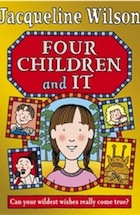
The success of various latter-day sequels to classic (i.e., public-domain or licensed-by-heirs) children’s novels prompted Puffin to invite Jacqueline Wilson to write such a book. After initially declining, she chose to follow on a childhood favorite, E. Nesbit’s Five Children and It, as she described in the Guardian. Her column answers many of the questions I had about this project last year.

Wilson also found that she couldn’t write in the same mode as the original book.
Nesbit had written her book in the third person [in fact, as a delightfully intrusive narrator], but I much prefer writing in the first person, and I thought it would be easier and more involving for my readers if I chose a child narrator again. I invented Rosalind, a quiet, shy, intense girl. She's a very keen reader – and so, naturally enough, when the story opens she's been reading Five Children and It. She has a younger brother, Robbie, a delicate, timid boy who loves playing with his toy zoo animals. Their parents have divorced – no surprise there, this is a Jacqueline Wilson novel.

The children have gone to spend part of their summer holiday with their dad, while their mum goes to an Open University summer school. He is now married to Alice, and they have a toddler called Maudie. Alice also has a daughter from a former relationship. She's named Samantha, but she's always called Smash. She’s a fierce, opinionated, streetwise child, who’s a royal pain most of the time. Smash is staying with her mother for the holidays because her dad is on honeymoon with his new young wife.

So I have a very modern jigsaw family. But this isn’t a dark, angst-ridden book about emotionally neglected children. It’s a fantasy story – and as soon as the children dig up the Psammead in the sandpit at Oxshott Woods, the fun starts.

I knew that one of the first wishes would be the obvious one: Smash wants them all to be rich and famous. I had great fun with this one. I let Rosalind be a bestselling child author, turned Robbie into a mini TV chef, and had Maudie as the star of a sitcom. Smash herself is like a little Lady Gaga, with a sell-out gig at the O2 Arena.

I think the most challenging wish for me was when bookish Rosalind asks if they can meet all the Edwardian children in Five Children and It. I had to work hard to get Cyril, Anthea, Robert and Jane to sound natural, and not just silly caricatures. The Edwardian children seem very immature to my modern children and yet they boss the family’s adult servants around without a second thought. They also have extraordinary freedom, roaming about the countryside on a whim.
Wilson’s article also makes one mention of Nesbit’s own sequels, The Phoenix and the Carpet and The Story of the Amulet, and one of another latter-day continuation, Helen Cresswell’s 1992 The Return of the Psammead.

14 August 2012

Critical Study of an American Myth

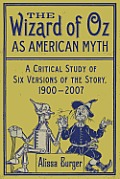
On his Tales from the Bookworm’s Lair blog, J. Andrew Byers just reviewed The Wizard of Oz as American Myth: A Critical Study of Six Versions of the Story, 1900-2007, by Alissa Burger, just published by McFarland.

Burger examined six versions of the story originally created by L. Frank Baum. In chronological order, they are:
The end of that sequence almost defines “anti-climax,” doesn’t it?

Burger’s book appears to hit on a lot of the current concerns of academia: gender, race, and adaptation and influence, as well as Baum’s overt themes of the value of “home” and the role of magic. Not that there’s anything wrong with those concerns, but in other times I might expect an academic critique to address economic classes, nature versus civilization, or stylistic tropes.

Byers writes:
Burger says she wants to examine gender in Oz. Fine and dandy. But as a historian of masculinity (among other things), I am particularly sensitive to “gender” being merely a code phrase for “women” or “femininity.” What we’re lacking here in Burger’s analysis is a look at masculinity in Oz. Men do, after all, possess gender, just as women do.

This is a significant omission, since all of the male characters in the story suffer from significant “lacks” (brains, heart, courage, magic) that the women in the story possess in abundance. None of them is what we might think of as a “traditional” male figure, in Baum’s time or our own. In other words, this is a clear area for further study and represents a missed opportunity in this one.

There are also a few additional areas I’d have liked to see Burger tackle. For example, in her discussion of magic, there’s almost no mention of the pivotal character of the Wizard in any of the texts/productions. He’s a self-proclaimed “humbug” without any access to real magic (at least in the first book), but everyone thinks he’s intensely magical. When coupled with the fact that he’s also the only male magical practitioner we encounter in Oz, I think there’s room for an interesting discussion here.
Byers notes that Burger doesn’t discuss Baum’s sequels, and his parenthetical remark reminds us that he knows those books show the Wizard learning real magic. He remains subordinate to Glinda, his tutor, and Ozma, his ruler, but also appears to be more ingenious than either. Because he’s older? Because he’s male? Because he had to get by for years without magic? Because he’s American? Or perhaps just because of the characters’ individual personalities? More grist for the analytical mill.

13 August 2012

Batman Goes Goth (Again)

I’ve written before about how the Batman: From the ’30s to the ’70s collection was my first sustained exposure to superhero comics. And a selective exposure it was, I’ve since realized.

E. Nelson Bridwell’s introduction described the “New Look” and television-show period of Batman comics (1964-68), but the anthology omitted nearly all stories from those years. Its 1960s section showcased the Caped Crusader’s science-fiction adventures at the start of that decade. That section included three of the seven tales that ever featured Betty Kane as Bat-Girl, leaving me with an outsized impression of her place in the overall saga.

Bridwell presented the 1970s as “the reappeance of the dark, avening figure of mystery called The Batman!!” That section started with “One Bullet Too Many” from December 1969, which showed Dick Grayson heading off to college and Bruce Wayne using forensic science to solve a murder mystery with no costumed criminals. Bruce and Alfred also moved into the headquarters of the Wayne Foundation, beginning a period of overt social activism that would culminate in a brief appointment to the US Senate. The 1970s Batman comics thus promised to become more deeply rooted in the real world.

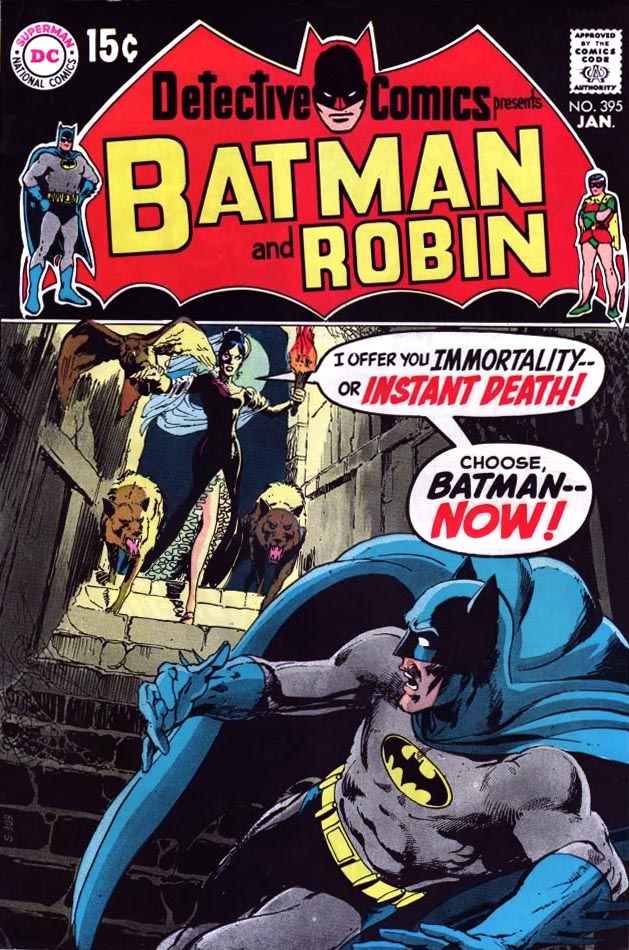
Yet that section of the book also included the highly regarded “Secret of the Waiting Graves,” by Dennis O’Neil and Neal Adams; “Man or Bat?” introducing Man-Bat, by Frank Robbins and Adams; and “The Demon of Gothos Mansion,” by O’Neil and Irv Novick. Those are all Gothic tales of monsters, ghosts, and other spooky things. Though Man-Bat is a creation of science gone wrong, the other two tales clearly rest on the supernatural.

Which left little me confused. If the Batman comics had redeemed themselves from camp by returning him to his roots as a crime-solving detective, why was this volume showing me ghost stories? Mysteries are all about ratiocination, but the “Waiting Graves” and “Gothos Mansion” stories end with Batman realizing the limits of his deductive powers to make sense of the world.

I’ve since learned that Batman’s roots lie just as deep in Gothic horror as in detective stories. Bruce Wayne is dressed as a giant bat, after all. Among the character’s earliest adventures were fights against vampires, monsters, and other supernatural creatures. Those villains flourished again in the 1970s, and in 1982 Gerry Conway even brought the vampirical Monk and Dala from 1939 back to life. But I still prefer the detective stories.