17 July 2012

Queen by the Color of Her Skin

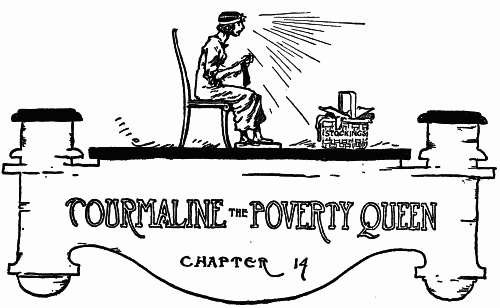
A week ago, I quoted the passage from Sky Island in which L. Frank Baum revealed how the Queen of the Pink Country must live in poverty in exchange for her authority. But how does one become queen?

A later chapter explores that aspect of the country’s governance. As the Pinkies plan to toss our heroes off the island because “They do not harmonize with our color scheme,” Polychrome the Rainbow’s Daughter (introduced in The Road to Oz) arrives and starts to research their laws:

Polychrome began turning over the leaves, while the others all watched her anxiously and in silence. “Here,” she said presently, “is a Law which reads as follows: ‘Everyone in the Pink Country is entitled to the protection of the Ruler and to a house and a good living, except only the Blueskins. If any of the natives of the Blue Country should ever break through the Fog Bank, they must be driven back with sharp sticks.’ Have you read this Law, Tourmaline?”

“Yes,” said the Queen, “but how does that apply to these strangers?”

“Why, being in the Pink Country, as they surely are, and not being Blueskins, they are by this Law entitled to protection, to a home and good living. The Law does not say ‘Pinkies,’ it says any who are in the Pink Country.” . . .

“I am indeed relieved to have you interpret the Law in this way,” declared Tourmaline. “I knew it was cruel to throw these poor people over the edge, but that seemed to us the only thing to be done.”

“It was cruel and unjust,” answered Polychrome as sternly as her sweet voice could speak. “But here,” she added, for she had still continued to turn the leaves of the Great Book, “is another Law which you have also overlooked. It says, ‘The person, whether man or woman, boy or girl, living in the Pink Country who has the lightest skin shall be the Ruler—King or Queen—as long as he or she lives, unless someone of a lighter skin is found, and this Ruler’s commands all the people must obey.’ Do you know this Law?”

“Oh yes,” replied Tourmaline. “That is why I am the Queen. You will notice my complexion is of a lighter pink than that of any other of my people.”

“Yes,” remarked Polychrome, looking at her critically, “when you were made Queen without doubt you had the lightest-colored skin in all the Pink Country. But now you are no longer Queen of the Pinkies, Tourmaline.”

Those assembled were so startled by this statement that they gazed at the Rainbow’s Daughter in astonishment for a time. Then Tourmaline asked, “Why not, your Highness?”

“Because here is one lighter in color than yourself,” pointing to Trot. “This girl is, by the Law of the Great Book, the rightful Queen of the Pinkies, and as loyal citizens you are all obliged to obey her commands. Give me that circlet from your brow, Tourmaline.” Without hesitation Tourmaline removed the rose-gold circlet with its glittering jewel and handed it to Polychrome, who turned and placed it upon Trot's brow. Then she called in a loud, imperative voice, “Greet your new Queen, Pinkies!”
Trot Griffith thus follows Dorothy Gale in overturning the governments of about half the countries she visits. And she becomes queen herself, not simply putting one of her companions on the throne.

But, as last week’s extract showed, it’s a hard life being Queen of the Pinkies.

COMING UP: Queen Trot’s reforms.

(Incidentally, Baum’s incomplete sentence in the last paragraph above was itself mistranscribed in the electronic text of Sky Island that circulated since at least 2003 and is the basis of some reprints. The line is corrected in the latest Project Gutenberg text released on 15 Mar 2012.)

16 July 2012

Avoiding Research as a Spur for Creativity

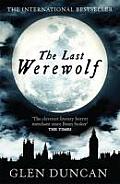
I doubt I’ll get to horror author Glen Duncan’s novels soon, but I enjoyed John Williams’s interview with him for the New York Times:
Did commercial considerations play a prominent role in these books?

Yes. I wasn’t making enough money. My original plan was to write a Victorian serial killer novel, “Oliver Twist” meets “The Silence of the Lambs” (which someone reading this will now write and clean up with), but the research was a drag. Nineteenth-century English literature I know; 19th-century sewage systems not so much.

Then, on New Year’s Eve 2009, a friend asked me what I was “hoping to achieve” in the next 12 months. Resisting the urge to break a bottle over his head, I said — for no reason I can now remember — that I was going to write a novel about the last surviving werewolf. Agreement that this was a good idea was slurred but unanimous. Moreover, it still seemed a good idea when I woke up the next morning.
In my workshop at the SCBWI New England conference last spring, I asked the attendees, “How do you kill a vampire?” After we accumulated a bunch of replies, I gave my answer: “Since vampires aren’t real, you can kill them any way you want.”

Of course, you have to acknowledge your readers’ expectations in some way and establish the rules of your vampire early in the story.

Williams’s continued curiosity about research led Duncan to talk about how he put that rule (or lack of a hard rule) into practice:
What kind of research did you do for these novels? How did you balance loyalty to the details of the vampire and werewolf myths with making them your own?

No research at all. The balance was determined partly according to taste (death by silver is cool; I was definitely keeping that) and partly according to thematic utility. Some versions of the myth allow for voluntary [werewolf] metamorphosis, but that doesn’t present the same dilemma of conscience. The lunar enslavement forces a choice between murder and death — a much richer moral quandary.
As long as the choices serve the story, an author can get away with nearly anything.

15 July 2012

Don’t You Hate When This Happens?


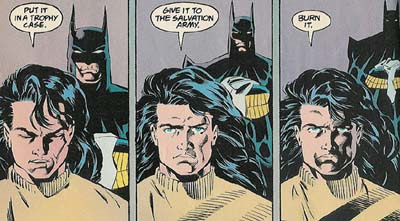
These panels are from Batman: Legends of the Dark Knight, #150. Pencils by Trevor Von Eeden, inks by José Luis García-López, script by J. M. DeMatteis. Note the fine use of shifting light sources in the first two panels and the multiple balloons pacing the query in the third. And of course the classic millionaire playboy’s dressing-gown.

More about kids sneaking out of windows here.

14 July 2012

How Teen Boat! Was Launched

Adolescence is a period of change, but in our culture we paradoxically view it as a period of change into what you really are the whole time. Almost all popular-media stories about teens consciously trying to change themselves end with some level of failure for not being honest about their true selves. Instead, our modern stories emphasize self-acceptance, recognizing the value of what you are all along. Whether that’s a purely Good Thing is another matter.

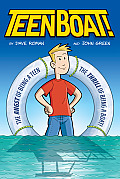
Which, by a roundabout course, brings me to Teen Boat!, a new collection of comics adventures by writer Dave Roman and artist John Green. Little Willow’s interview with Roman at Bildungsroman dredges up the start of this tale:
…the inspiration came to us while we were on a bus. Long trips can often lead to loopy thoughts, especially for comic creators. One minute John Green and I are discussing ’80s cartoons and the spectrum of cool vs. less-cool transformation powers, then we’re talking about imaginary boardroom meetings gone wrong, and before long we were pitching tag lines like “The ANGST of being a teen, the THRILL of being a boat.”

It easily could have stayed a joke amongst ourselves, but we felt compelled to share our idea of a teenager who transforms into a yacht with all our cartoonists friends. The more they laughed, the more John and I were motivated to turn the silly premise into something real. And one of the many beautiful things about comics is there's very little stopping you from making that happen.

Our first Teen Boat! books were printed on a black and white photocopier, hand stapled, and hand sold for 50 cents each at indie comic shows. Ten years later, it’s a full-color hardcover book sold in bookstores everywhere and endorsed by the Junior Library Guild!
Specifically, Teen Boat! appears to have been inspired by Turbo Teen, a 1984 animated cartoon about a boy who makes temperature-sensitive shifts to and from being a car. Hard to imagine why that show lasted only twelve episodes.

Teen Boat! began as a series of black-and-white minicomics parodying such adventures through a adolescent hero who can change into a small yacht. It grew into a substantial (though unfinished) collection of stories from Clarion, now fully colored (by a team that included Braden Lamb).

Mercifully, the collection doesn’t include an origin story. We have no idea how Teen Boat came to be both a boy and a boat. (In one flashback panel he has a mom.) Nor does he have a secret identity—his name is Teen Boat. But we don’t need those elements of the classic superhero narrative. All that matters for these stories is that our hero is stuck/blessed with being both a boat and a teenager.

Beyond that premise, Teen Boat! floats on an ocean of North American teen-comedy-adventure stories from cartoons, sitcoms, and comics. We see the rich and jockish bully, the pretty exchange student, the inveterate rule-breaker, and other familiar high-school types. Teen Boat’s best friend climbs in through his bedroom window as on Clarissa Explains It All or Doogie Howser, M.D. Stories revolve around the class trip, the big dance, the school election, the driving test, the mystery that only a teen-aged amateur sleuth can solve, and other common rites of passage.

Yet Teen Boat! goes deeper than parody. As other have noted, including the AV Club and Hal Johnson at Paste Magazine, these stories has real heart. Just because the situations that teenagers find themselves in can easily be parodied doesn’t mean the underlying emotions aren’t real.

Teen Boat’s everyboat quality makes him an appealing hero. While young readers may laugh at the parodic touches, they may also recognize their own concerns in him. And when they see that even Teen Boat worries about skin blemishes or how to buy “nautical accessories,” might that offer a little more perspective on their own angst?

13 July 2012

We Interrupt This Interview with the President…

On Super Bowl Sunday in 2011, President Barack Obama sat down for an interview with Bill O’Reilly. Five years earlier, O’Reilly had interviewed President George W. Bush.

Those two broadcasts provided Ryan Witt at Political Examiner.com with the data to compare how O’Reilly had behaved toward the two successive Presidents. Witt’s findings:
Both interviews were a little over 14 minutes long. . . . In the entire 14-minute interview of Obama in 2011 the President's longest answer was 51 seconds long. President Bush's first answer to O'Reilly's question lasts 69 seconds. Later in the interview Bush is allowed to speak for two minutes straight, something President Obama could have only dreamed of 2011. While O'Reilly does interrupt Bush a number of times in 2006, the nature of the interview is much less combative, and President Bush is generally given the right to finish what he is saying.

As documented in an earlier post, President Obama was interrupted 22 times in his interview with O'Reilly and given an average of 26 seconds to respond. In contrast, President Bush was given an average of 34 seconds to respond, and Bush is generally known as a man of less words than President Obama.

In 2006 everything was presented as a question to President Bush. Frequently O'Reilly would ask Bush about a criticism from Democrats like Hillary Clinton, and then ask Bush to give his rebuttal. In the 2011 interview, O'Reilly often would not ask a question but simply make a statement of fact. For example, after President Obama argued for the individual mandate in health care reform O'Reilly stated, "but you understand that a lot of Americans feel that you are a big government liberal who wants to intrude on their personal freedom." When Obama tried to respond that charge he was again interrupted and redirected by O'Reilly.
Other observers noticed the same pattern, using different metrics. Wonkette counted O’Reilly breaking into President Obama’s remarks 48 times, though he didn’t always succeed in derailing the sentence.

I looked at the transcriptions, which usually indicate interruptions only when they stop a sentence before it’s complete. FOX posted its transcript of O’Reilly’s Bush interview in three parts. All told, I count six times that Bush’s answers end in an incomplete sentence or request to finish a point.

FOX doesn’t appear to have archived O’Reilly’s interview with President Obama the same way, but Politics Daily has a transcript. I count nineteen times Obama’s answers end with a dash or ellipses mark, indicating that O’Reilly successfully interrupted the President’s statement.

As much as Bill O’Reilly likes to hear his own voice, he was largely able to curtail that desire when speaking to President Bush. But not when speaking to President Obama. Either he doesn’t respect this President as much as his predecessor, or he can’t stand to listen to generally intelligent, perceptive, and well-argued remarks from a man like Barack Obama. Either way, the videotapes and transcripts preserve clear signs of O’Reilly’s OIP Derangement Syndrome.

12 July 2012

Another Hellbound II Review

At High-Low, Rob Clough had some nice things to say about my contribution to Hellbound II:
JL Bell and Andy Wong's "RobMeBlind.com" takes a clever idea (a website that compiles facebook and twitter statuses indicating that someone is going out of town so that people can rob them) and gives it a horror twist. The initial idea is interesting enough on its own to follow through on, even as the reader knows that the robbers will not meet a kind end.
Hough also praises Caitlin Plovnick’s “Eye Contact,” Joshua D. Hoaglund’s “Mt. Auburn Night,” Ansis Purins’s “Slappy,” and (Ms.) Gabriel Robinson’s “The Red Calf,” plus the art in Patrick Flaherty and E.J. Barnes’s “The Plague” and Clayton McCormack’s “The Breath of Life.”

11 July 2012

And Then the Boy and the Balloon Soared Away to Seize Kamchatka

Top of this week’s list of Things I’m Having Trouble Getting My Head Around—

Albert Lamorisse (1922-1970) wrote and directed The Red Balloon (1956) and White Mane (1952), two beautifully photographed movies about young French boys, their unicolor companions, and how together they run away from this cruel world.

Both movies won prizes at Cannes, the Oscars, and elsewhere, and remain popular and admired. (I grew up with the picture-book adaptation of The Red Balloon, which was less scary because I could take it at my own pace.)

And here’s the Thing: Lamorisse was also the creator of the cut-throat strategy board game Risk. Its original name in 1957 was the, frankly, more accurate La Conquête du Monde.

10 July 2012

What We Can Learn from Tourmaline the Poverty Queen

L. Frank Baum’s 1912 fantasy novel Sky Island is one of the themes of the Winkie Convention taking place in California later this month. In that book, Baum continued his pattern of cheekily examining how nations organize themselves politically. As usual, he presented the governors of those nations as monarchs, simplifying the world to match how most children experience it. But he discarded the west’s traditional hereditary way of choosing rulers.

On the blue side of the island, the Boolooroo is supposed to rule for only 300 years, and is further be term-limited by the 600-year ceiling on his life. And on the pink side of the island:

The Queen gazed upon our friends with evident interest. She smiled—a little sadly—at Trot, seemed to approve Button-Bright’s open, frank face, and was quite surprised because Cap’n Bill was so much bigger than her own people. “Are you a giant?” she asked the sailor in a soft, sweet voice.

“No, your Majesty,” he replied, “I’m only—“

“Majesty!” she exclaimed, flushing a deeper pink. “Are you addressing that word to me?”

“O’ course, ma’am,” answered Cap’n Bill. “I’m told that’s the proper way to speak to a Queen.”

“Perhaps you are trying to ridicule me,” she continued, regarding the sailor’s face closely. “There is nothing majestic about me, as you know very well. Coralie, do you consider ‘majesty’ a proper word to use when addressing a Queen?” she added, appealing to the Pinky woman.

“By no means,” was the prompt reply.

“What shall I call her, then?” inquired Cap’n Bill.

“Just Tourmaline. That is her name, and it is sufficient,” said the woman.

“The Ruler of a country ought to be treated with great respec’,” declared Trot a little indignantly, for she thought the pretty little queen was not being properly deferred to.

“Why?” asked Tourmaline curiously.

“Because the Ruler is the mos’ ’risticratic person in any land,” explained the little girl. “Even in America ever’body bows low to our President, an’ the Blueskins are so ’fraid o’ their Boolooroo that they tremble whenever they go near him.”

“But surely that is all wrong,” said Tourmaline gravely. “The Ruler is appointed to protect and serve the people, and here in the Pink Country I have the full power to carry out the laws. I even decree death when such a punishment is merited. Therefore I am a mere agent to direct the laws, which are the Will of the People, and am only a public servant obliged constantly to guard the welfare of my subjects.”

“In that case,” said Button-Bright, “you’re entitled to the best there is to pay for your trouble. A powerful ruler ought to be rich and to live in a splendid palace. Your folks ought to treat you with great respect, as Trot says.”

“Oh no,” responded Tourmaline quickly. “That would indeed be very wrong. Too much should never be given to anyone. If, with my great power, conferred upon me by the people, I also possessed great wealth, I might be tempted to be cruel and overbearing. In that case my subjects would justly grow envious of my superior station. If I lived as luxuriously as my people do and had servants and costly gowns, the good Pinkies would say that their Queen had more than they themselves, and it would be true. No, our way is best. The Ruler, be it king or queen, has absolute power to rule, but no riches, no high station, no false adulation. The people have the wealth and honor, for it is their due. The Queen has nothing but the power to execute the laws, to adjust grievances and to compel order.”

“What pays you, then, for all your bother?” asked Trot.

“I have one great privilege. After my death a pink marble statue of me will be set up in the Grand Court, with the statues of the other Kings and Queens who have ruled this land, and all the Pinkies in ages to come will then honor me as having been a just and upright queen. That is my reward.”

“I’m sorry for you, ma’am,“ said Cap’n Bill. “Your pay for bein’ a queen is sort o’ like a life-insurance. If don't come due till after you’re dead, an’ then you can’t get much fun out o’ it."
Ironically, the Americans—particularly the little girl Trot—want to treat Queen Tourmaline with more deference than her own society accords her.

American society in Baum’s lifetime had struggled with the Pinkies’ problem of how to motivate government employees to work for the good of the people, resisting the temptation to work for themselves. The solution—the federal civil service system—was instituted in 1871. It promised protection from political shifts in exchange for salaries less volatile than in the private sector, pensions to reduce the motivation to amass money, and respect.

Currently a lot of American governments are cutting back on compensation and breaking contracts to public workers. I fear we’ve forgotten the original reasoning behind that social compact. Civil service systems aren’t perfect and can be exploited, but they’re one of those flawed arrangements that’s nonetheless better than anything else we’ve come up with. As Baum went on to explore, the Pinkies’ solution of an impoverished ruler with no respect until death had its own problems.

COMING UP: Choosing the Queen of the Pink Country.

09 July 2012

James Treadwell: “Teenagers are basically fantastical beings”

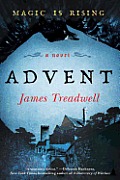
My conversation with James Treadwell about his new novel, Advent, wraps up with a question about the book’s young protagonists.

Advent’s main character is Gavin, a teen-aged boy. Horace and Marina, two other important characters, are younger adolescents. Did you conceive of the book as for readers of that age or a little younger, or is adolescence just a good period of life for a transformative fantasy?

This is another great question, and I don’t think there’s much hope of responding briefly, but I’ll do my best.

To take the second part of the question first: yes. Yes it is.

Which is brief, but not very helpful …

I think it’s because teenagers are basically fantastical beings. They don’t quite live in the real world. They’re intensely aware of the inadequacy of things as they are, they’re intensely resistant to the idea that the world has to be the way adults say it is. They also have a strange and wonderful mix of freedom and unfreedom. They can’t choose their own course in the world, they don’t have their own houses and incomes and they can’t decide what to do with their time; but at the same time they’re not caught up in the web of obligations and necessities which makes adults unfree. Someone else deals with bank accounts and dentists and bills and wills and the possibility of being fired or going hungry or having to move to Peoria.

(Of course there are all sorts of social and economic and ideological determinants that affect children massively; but their relationship with those forces is much more oblique than it is for adults. Anyway, if we’re going to have even slightly brief answers I’m going to have to generalise …) I suppose what I mean is that teenagers are unplaced, as it were. Their lives haven’t dried hard yet. They’re closer to being seven-year-olds than we (or they) think. So where an adult might just dismiss fantasy as a distraction or a delusion or a nice-idea-but-we-all-know-things-don’t-work-like-that, a teenager might hear it speaking to them directly, honestly, intriguingly.

As for the first part of the question: I have a distant memory of wanting to write specifically for YA readers, just because my own reading experiences between about twelve and eighteen don’t seem to be going away no matter how much older I get or how much other (and, sometimes, better) stuff I read.

The difficulty, for me, is that “writing for an age group” actually means “writing the way books for a certain age group are supposed to be written, according to current commercial requirements.” Publishers’ ideas of what a book for (say) fourteen year-olds ought to look like were very different in the 1970s from the way they are now, and very different again in the 1920s, and the 1870s, and so on. It’s a marketing issue, essentially. For all their differences, if you think about what Harry Potter and Percy Jackson and the Hunger Games have in common — imagine a sort of stylistic Venn diagram — then I’d say you’d have a good idea of the minimum current requirements for something to count as YA fiction.

Alas, whether I’d like it to or not, my pen just won’t write that way.

The simple answer is that I didn’t write Advent for any age group. Of course, I didn’t write it against any age group either; I very much hope readers of Gavin’s age (fifteen) will enjoy it. But all I could do was tell the story the way I felt it wanted to be told.


Thanks, James! This photo by Arthur Ka Wai Jenkins shows me with Godson, Godson’s Brother, and their dad (James) during a hike a few years ago. In just two more years, we’ll see exactly how fantastical teenagers are!

08 July 2012

Why Dick Grayson as Batman Reached a Dead End

If we can interpret the sagas of, say, Wally West and Stephanie Brown in the 1986-2011 DC Comics universe as successful and complete coming-of-age stories, can we do the same for their contemporaries Dick Grayson and Tim Drake? And what does that mean for the new manifestations of those characters in the company’s new continuity?

Although DC’s editors have promised fans that little had changed in the Batman saga, there were significant changes to both Dick and Tim in the transition. Ironically, Tim underwent more outward changes than Dick, but his overall character storyline has remained much the same while Dick’s shifted significantly.

The last issues of the old Red Robin and Teen Titans magazines left Tim as Red Robin, a step away from his first crime-fighting identity as Robin but not yet fully his own man. He was back living in Wayne Manor; indeed, he was more involved with Bruce Wayne’s business than any other adopted son.

As usual, Tim was smart, serious, and fretful about living up to the challenge at hand. Since his first appearance in 1989, he’s been unusually mature for his age, preserving his father figures from their faults. But he remained an adolescent.

Indeed, when Bruce Wayne appeared to be dead, Tim alone rejected that idea. He turned out to be right, of course, but that also showed how he wasn’t ready to go on without his father-figure, that in his saga he didn’t come of age yet. To the premature end, Tim was still working through the issues of being an adolescent hero. His unresolvable foundational conflict was still trying to grow up without becoming too dark.

The new continuity’s Tim Drake has a new costume, a new Titans team, and, it now appears, a new past. Teaser copy for Teen Titans, #0, describes him as a “would be Olympic star and computer genius.” The Tim Drake introduced in 1989 was more interested in Olympus camera lenses than the Olympic Games; his athletic history was limited to some karate lessons. (Will this change affect his appeal to comics readers?)

Despite those changes, Tim’s overall story is still about coming of age. He’s still worried about maintaining the best parts of the bat-tradition without becoming cruel. As founder of this universe’s first Teen Titans, he’s at the center of its symbolic generational struggle.

In contrast, in the 1986-2011 DC Universe, Dick Grayson did come of age. He became Batman, not just temporarily but permanently (at least as he and most characters believed). The “man” in that crime-fighting name signaled his fully mature status.

Unfortunately, that transition left Dick without an unresolvable foundational conflict. Once he confirmed his ability to be Batman without losing himself, that conflict was resolved. And that left no clear way for the character to develop.

Some of the stories told in the last couple of years of that universe, such as Scott Snyder’s Black Mirror, are quite good. But they didn’t grow from Dick’s individual history and qualities. Nor did the company make major changes to that character’s life, such as marriage or another relationship, injury, revelation of secret identity, loss of fortune, move to another city, and so on, which could produce a new overarching challenge. While successful in both fictive life and sales, the character of Dick Grayson had reached a dead end. On top of that, the return of Bruce Wayne from the past meant the company had two Batmen at once, and that was confusing for everyone.

The last time that Dick stepped back after being Batman, in the 1994 issues collected in Prodigal, he told Bruce that he felt he’d failed as a hero and was ready to give up costumes and retire.

This attitude seems uncharacteristic, and of course it didn’t last. But from a creative standpoint that moment reveals the difficulty of shifting Dick back to the role he adopted as an older adolescent without acknowledging that it looks like a step backward.

So this time DC simply skipped that transition. The new universe’s Dick Grayson was introduced younger than before and back in a Nightwing costume. Though he’s stood in for Batman at least once, that history seems to a minor part of his past. The stories once again focus on Dick figuring out his role in life, just as they have since the 1980s. Once more, he’s coming of age.

Thus, we can read the Dick Grayson saga from 1986 to 2010 as a successful coming-of-age, but one that left a lot more unanswered questions that Wally West’s growth to a family man or Stephanie Brown’s achievement of respect. And the new Dick Grayson saga dialed back to odometer and started that story again, with the same foundational conflict as before. Does that feel like a loss to the characters’ fans? Probably so, but it’s also a restoration of the character that attracted us in the first place. Because, although we root for Dick Grayson to grow up successfully, he’s not as interesting if he does.