14 July 2011

Heil Ozma

The Daily Ozmapolitan unearthed this story from the Hays (Kansas) Daily Times about a new novel: Adolf Hitler in Oz, by Sam Sackett.
"It is an Oz Book, so it is a children's book, but it isn't for children," Sackett said. "It doesn't have sex or anything in it, but it deals with philosophical themes, political themes and psychological themes. All of this could be completely lost on a kid."

In the book, Hitler rallies portions of the Oz population to his side. After becoming the Reichschancellor of Oogaboo, he turns its people into a military unit. He incorporates the people of Runnymead, who like to run, into his Panzer unit and incorporates the winged monkeys into his Luftwaffe division.

"He has a pretty formidable army for Oz by the time he gets to the Emerald City," Sackett said.
The fictional Hitler’s minions also include Laurel and Hardy.

Is this the work of some juvenile whippersnapper who doesn’t understand Hitler’s symbolic weight (not to mention Laurel and Hardy’s)? Actually, Sackett is a retired professor. His article “The Utopia of Oz,” published in The Georgia Review in 1960, was one of the earliest academic studies of the Oz mythos.

Sackett has built his story on L. Frank Baum’s Oz books, not the MGM movie. He published through Xlibris, so the sample chapter is our best clue to the book’s entertainment value.

12 July 2011

“Oz Comics Today” Two Days Ago

Last weekend I traveled to the Monterey Peninsula for the 2011 Winkie Convention, a gathering of Wizard of Oz fans from the western US and elsewhere. One attendee came from Australia, so my cross-country journey wasn’t the longest.

At the convention I moderated a panel discussion on “Oz Comics Today,” shown above. The panelists were three writers of comic books being published now:
Since I think comics discussions work best with both words and pictures, I used the screen behind us to show pages from the panelists’ work. Each writer then explained how he had conceived those pages and how they had developed.

We then discussed many parts of the intersection of Oz and comics, from the first Oz comics people remember and what sort of clothes Button-Bright should wear to whether a grown-up Dorothy Gale should wear any clothes at all (i.e., Alan Moore and Melinda Gebbie’s Lost Girls). Great panelists, good audience, lots of fun.

10 July 2011

Weekly Robin Robinson Edition

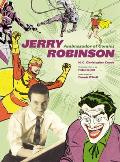
This spring the National Cartoonists Society was in town, and Jerry Robinson, principal creator of Robin, did a signing at Comicopia. I got his autograph in a copy of Batman: From the ’30s to the ’70s, the book where I first saw his art (uncredited, of course), and in N. Christopher Crouch’s illustrated biography, Jerry Robinson: Ambassador of Comics.

I’ve written about how at Oz conventions I ask men who played Munchkins in the MGM Wizard of Oz about their experience of World War II. The surviving performers were in their teens or early twenties back in 1938 during filming, and thus of military age during the war. But their height made them ineligible for military service. That question has prompted stories of piloting planes for the Civil Air Patrol, putting one’s small size to work repairing planes, and working on a farm.

I knew that when Jerry Robinson met Bob Kane in 1939, he was about to start college, meaning he was the same age as those former Munchkins. So I asked Robinson about his wartime experience. He shared an anecdote that isn’t in the book, so I’m setting it down in pixels for posterity’s sake.

Robinson was in Florida when he received an invitation from his draft board back in New York City to report for a physical. Not the sort of invitation a man could ignore. And since he’d already had two exams and been rejected for low weight and poor vision, Robinson figured things might be looking desperate for the Allies.

He found a plane headed back to New York. During the war, he said, it was tough to find regular flights, but a lot of small operators jumped in to fill the gaps—guys who might own one airplane.

Without other options, Robinson got on a plane with seats for six passengers. But his seat wasn’t in the cabin. The pilot asked him to sit in the co-pilot’s seat and hold the maps, looking out the window for landmarks to keep the flight on course.

After several hours Robinson landed, having had a rare perspective on America’s East Coast. He reported to his draft board for his third physical—only to be rejected for bad vision.

Of course, Robinson was then making his living as a visual artist, and had just managed to navigate from Florida to New York by sight. But the ocular requirements for a rifleman must have been tougher.

The doctor told Robinson (and this punch line is in the book), “Look, son, we’ll call you when the Nazis get to Fourteenth Street.”

09 July 2011

Call for Responses to “Crisis and Response”

Red Sun Press in Boston has issued a call for entries in “Crisis and Response,” a juried exhibition mounted for Jamaica Plain Open Studios on 24-25 September 2011.

The call says:
In the midst of unprecedented and grave problems in the world around us, artists and communities are responding with new, urgent energy. Whether raging out loud or searching deeply inward, our muses are rising to the challenge of turbulent geopolitical, economic, and environmental crises. Red Sun Press invites submissions of work for a show addressing the critical problems of our day and how we perceive, confront, rationalize or reject them.
Submit up to 5 pieces for consideration. Two-dimensional work only. Maximum size: 3' in either dimension. Email to mosborn@redsunpress.com. Please keep file size to 1 MB each. Emails must include:
  • Artist’s name, address, phone and email.
  • A brief artist statement on the political significance of the work.
  • A list of digital images submitted. List titles, mediums and sizes of work.
The deadline for submissions is Thursday, 1 September, at 5:00 pm. “All accepted entrants will receive a quantity of free printed postcards of their artwork from the exhibit.”

06 July 2011

Oh, This Will Go Well

See the whole story from J. Caleb Mozzocco at Every Day Is Like Wednesday.

05 July 2011

“They don’t feel smart enough to be on our panels”

From Rose Fox at Genreville:

I’ve been putting together the program for Readercon, and I was entirely shocked when two women we invited told me they don’t feel smart enough to be on our panels. I’ve never heard anything like that from a man. [EDIT: A woman has emailed me to say she heard a man once say "Readercon is where I go to feel stupid"--though I wouldn't classify that the same way as withdrawing from the program.]

I’m also pretty sure I received more “may I be on your program?” requests from men than from women (I’ll try to remember to keep statistics next year). It’s pretty well known that that sort of behavior is socially gendered.

I would not be at all surprised if female authors are more likely to self-sabotage by saying “I’m not good enough to be in this anthology” or “I don’t have anything that works for this” or “I can’t write in that genre”, while men might be more likely to send in a story that’s a little off-topic, or send something unsolicited even if the anthology is supposedly closed to submissions.
This particular discussion involves the world of science fiction, and its awards and anthologies. The situation is probably different in other literary genres; as one example, as Fox quotes Liz Williams, “in urban fantasy…women do seem to be on strong ground.” (According to Library Journal in 2008, “Contemporary urban fantasy started as an offshoot of horror fiction rather than sf/fantasy but has blended with other genres, most notably romance and mystery.”)

04 July 2011

The First Avenger Overseas

The New York Times reported somewhat surprising news about the marketing of the new Captain America movie:
Marvel and Paramount Pictures, which is distributing "Captain America: The First Avenger," figured they would simply release the film as the truncated "The First Avenger" in foreign countries. But in a surprise, Paramount's overseas operation objected, arguing that Captain America had too much brand value, even in spots like France that are leery of embracing Team America too readily. . . .

In the end, the studios decided that Captain America would keep his name in all but three countries: Russia, Ukraine and South Korea. 
Ironically, this movie is set during World War 2, when the US and USSR were allies. There are tales of Captain America fighting against the Nazis alongside the Soviet Army. Of course, the 1950s version of the character was anti-communist, but those years were officially written out of Steve Rogers’s life story when Stan Lee and Jack Kirby revived the character in early 1964.

Since that resurrection, Captain America has usually represented the struggle between America’s high ideals and the realities of our culture and foreign policy. He’s not just chest-beating; sometimes he’s proud and sometimes he’s embarrassed for us all. I suspect Europe respected that idealism.

I’m still surprised about South Korea, though.

03 July 2011

Inheritance and the Edges of Fanfiction

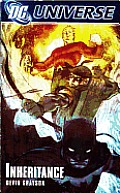
Inheritance, by Devin Grayson, is a novel about the relationships among three older DC heroes—Batman, Green Arrow, and Aquaman—and their three grown-up sidekicks—Nightwing (formerly Robin), Arsenal (formerly Speedy), and Tempest (formerly Aqualad).

It’s not a very good novel. The prose is pulpy in the way that some comics writers fall into when they can finally stretch out in prose after years of minimizing their word count, but forget they don’t have to spell out emotions and symbolism. The ending is hurried, hinting that a deadline or maximum length suddenly reared up. And of course the story can’t really resolve the issues it brings up because they’re the fuel for further stories about the same characters.

What makes Inheritance stand out from DC Comics’s other prose publications is how it acknowledges its characters’ potential sexuality, the subtext that writers and readers of “slash” fanfiction like to highlight. Oh, all right, one little taste:
A few paces ahead, Aquaman had caught up with Green Arrow.

“Your boy’s looking good,” he commented, both because it was true and because he was making an effort to honor the role he had assumed as Green Arrow’s chief entertainment.

“Yeah, he is, isn’t he?” Ollie sounded pleased. “That kid’s always been a looker. They all are. No wonder people like to speculate.”

Arthur frowned slightly as Ollie laughed. “I meant he looked healthy,” Arthur clarified.

“Oh, yeah.” Ollie was undaunted. “I meant the hero-sidekick thing, how everyone assumes we’re doing dirty things with these gorgeous kids in the—”

Arthur used his most regally authoritative voice to cut his friend off. “I know what you meant.”

“You never got that as much. Guess the whole breathing underwater thing is freaky enough. But Bats, man! Well, look at that kid, no wonder.”
(Oh, I itch to edit that passage. To move Arthur’s interruption to right after the em-dash where it belongs, for starters. But I digress.)

Soon after Inheritance was published in 2006, Graeme McMillan at Newsarama noted the surfaced subtext, and GalleyCat interviewed Grayson about the story behind the story.
she’s careful to point out that Inheritance is about father/son dynamics, not gay culture. “But are the characters in Inheritance aware of gay culture?” she asks rhetorically. “Sure. And they get to joke about it, just like I, as the narrator, get to joke about it. I’m joking with the reader, the characters are joking with each other.”

Grayson says DC knows her well enough by now to know what she’s doing, “and they seem to enjoy it.” They’ve asked for changes in previous stories, but Inheritance went through without any complications.
The book continues to produce a strange reaction from fans of its characters. Some of those readers simply aren’t “slash” fans. But others are. One widely noted reaction came from Maelithil:
I'm on page 60 and have had to leave the room to scream into a pillow. Repeatedly. . . .

I've reached the phase wherein I'm too embarrassed to continue, and too curious to stop. It's too rich to be subtextual porn, it's too laden with innuendo to be textual and serious.
And that from a blogger whose userpic says, “Batman was only defeated once and that was by Dick Grayson’s thighs.”

Recently Discowing’s postings on Tumblr hinted at the same open-mouthed shock, despite his being quite comfortable with “slash” art.

Inheritance is far less sexual than many stories (and I use that term loosely) we could read on the internet anytime. So why does it produce such gasps and squeals? It’s not the content, I think; it’s the origin of the object. This book comes from DC Comics itself. It’s “official,” and that carries certain expectations and standards.

The fan reaction reminds me of how teenagers can take pride in talking dirty to each other, but feel incredibly embarrassed at the thought of their own parents having sex.

01 July 2011

Reviewing the Revolution in New Children’s Books

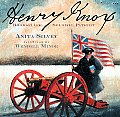
Over at Boston 1775, I detailed my disappointment in the picture-book biography Henry Knox: Bookseller, Soldier, Patriot, by Anita Silvey and Wendell Minor.

All of Minor’s paintings are handsome and evocative. But I can’t recommend the book because the text contains too many errors and exaggerations. Some of those mistakes appear in popular biographies of Knox, such as the notion that the heavy cannon from Fort Ticonderoga were “all the working artillery of the Continental Army.” But others I can’t find any support for.
I also took note of how Steve Sheinkin’s The Notorious Benedict Arnold: A True Story of Adventure, Heroism, and Treachery, which I haven’t read yet, has won a Boston Globe/Horn Book Award.

Peeking in on Kirby and Lee

HiLoBrow just published Rob Steibel’s analysis of an original page from Fantastic Four, #63, that preserves handwritten notes and revisions by Jack Kirby and Stan Lee.

I was especially interested by Steibel’s comments on changes made after Kirby had drawn the page, Lee had scripted the dialogue, Sam Rosen had lettered the balloons and captions, and Joe Sinnott had inked the art. The page came back to Lee as editor-in-chief, and he ordered further changes in house.

About one panel Steibel writes:
look closely at the word balloon in the top left corner — you can see all the dialogue has been covered in white-out, and replaced with the text written in the small circle right above the change. Those notes are in Stan Lee’s handwriting. This is obviously a change made at the very end of the process.
Lee must have rethought that bit of dialogue, though it’s not clear why.

There’s a more subtle change in another panel: Lee asked for more space between two word balloons coming from the same character. As Steibel suggests, “Lee may have felt there was too much blank space above the character Blastaar, and this revision made the image more balanced.” I think Lee also wanted more space to symbolize a gap in time between the speeches in the two balloons; that gap offers Blastaar the opening to do his blasting.

Lee also had an in-house artist fix how Blastaar shot explosions from his fingertips. Steibel notes:
Lee writes in the margins in the second circle, “More speed lines,” which you can clearly see were added to the image because they are fairly shaky, once again, much different than Sinnott’s impeccable line-work.
This documentary record bears out Lee’s recent testimony about how he worked with Kirby, which in turn is consistent with his past statements. He cultivated the image of a blowhard, but he was an honest blowhard.