07 January 2009

False Witness

From today's New York Times:

Neale Donald Walsch, author of the best-selling series “Conversations With God,” recently posted a personal Christmas essay on the spiritual Web site Beliefnet.com about his son’s kindergarten winter pageant. . . .

Mr. Walsch’s story was nearly identical to an essay by a writer named Candy Chand, which was originally published 10 years ago in Clarity, a spiritual magazine, and has been circulating on the Web ever since. Mr. Walsch now says he made a mistake in believing the story was something that had actually come from his personal experience.
I have that same problem all the time!

I keep having to remind myself that I wasn't actually carried off in my house by a cyclone after seeing my parents die because of a sabotaged trapeze. It's a lifelong struggle.

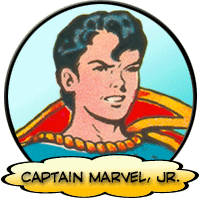
The Elvis Presley-Captain Marvel, Jr., Meme

If you've Googled the names "Elvis Presley" and "Captain Marvel, Jr." together--and who am I to say how you should spend your time?--you've found links to hundreds of webpages repeating the belief that Presley modeled his appearance on that young superhero. The most thorough discussion I've seen is this four-part series at Dial B for Blog.

However, in all those words about Presley and the Shazam! comics, there's no real evidence of a connection between him and Captain Marvel, Jr. Instead, Dial B writer Robby Reed repeats the conclusions of Elaine Dundy's book, Elvis and Gladys (1985). Among Presley biographies, Dundy's is considered one of the more insightful and less exploitative, though still a long way from Peter Guralnick's Last Train to Memphis.

Dundy refers to Captain Marvel, Jr., a lot in her book. Chapter 1 is named after the character. And she makes statements like these:

  • “Elvis was already immersed in the adventures of the Lone Ranger, Hopalong Cassidy, Tarzan, Batman, and Superman when his secret life suddenly took a dramatic new turn. He discovered Freddy Freeman in the comic book series Captain Marvel’s Adventures. There, on page 267, young Freddy made his entrance--and very nearly his exit--fishing off a boat with his grandpa...” [page 3]
  • “Freddy/Marvel, Jr.,...has been obviously and sensitively copied from a most appealing adolescent life-model. He looks in fact exactly like Elvis, from adolescence to the end of his life, strove to make himself look.” [5]
  • “But the Captain Marvel series, and in particular, Captain Marvel, Jr., was Elvis’ unquestioned favorite. Adding greatly to the popularity of the series were the characters that derived and that sprang up from the stories. . . . Elvis’ twin-fusion with Freddy/Captain Marvel, Jr., was total and it was from reading his adventures that the young Elvis secretly began to create himself.” [69]
  • “It was Captain Marvel, Jr., who styled Elvis’ glistening hair, side-parted with the forelock falling over his brow, the sideburns, the hair growing down his neck. Much later would come Elvis’ Captain Marvel, Jr., cape and lightning bolt emblems on the TCB (Taking Care of Business) and TLC (Tender Loving Care) jewelry he would give to his special friends.” [69-70]
But Dundy never cites any interviews or documents as evidence for that connection. She interviewed two of Presley's childhood friends--Wayne Earnest [cited on page 3] and Harold Lloyd [68]--who testified to his love for comic books. But neither of them said anything about Presley's particular fondness for Captain Marvel, Jr.

Dundy quotes Presley's own words, from a 1970s interview: “I was the hero of every comic book I ever read.” [68] He said something similar in a 1970 acceptance speech, quoted at the official Graceland site: “When I was a child, ladies and gentlemen, I was a dreamer. I read comic books, and I was the hero of the comic book.” But those statements don't single out the hero nicknamed Junior. In fact, they imply that Presley had no special favorite.

Lloyd recalled Presley preserving his comic books with unusual care for the 1940s (well before bags and boards). But Dundy doesn't point to any Captain Marvel magazines surviving in his estate. Yes, there are such comics now on display in some museums devoted to him, but they've been put there since Dundy's book was published.

TOMORROW: So what evidence led Dundy to focus on Captain Marvel, Jr.?

06 January 2009

The Most Interesting Street in America

Sampsonia Way in Pittsburgh.

At least it's interesting after the "first-ever artistic intervention in Google Street View."

My favorite tableau is "Narrow Escape."

The Boston Roots of Superman and Batman?

There's a series called "Comic Book Urban Legends Revealed" at Comics Should Be Good! because the comic-book culture seems to pass on legends as freely as old Hollywood publicists.

I plan to spend a few days raising my own questions about some widely accepted lore that's gathered around classic comic books. But first I'll commend other folks' debunkings.

I'll start with Boston's claim to be the birthplace of both Superman and Batman. "What??!!!" you say, in true comics fashion. "Didn't Jerry Siegel and Joe Shuster create Superman while living in Cleveland, as described in Marc Tyler Nodelman's Boys of Steel? Weren't Bob Kane and Bill Finger, the creators of Batman, working in New York when they set out to create another costumed hero?"

Well, yes. But men from Boston have disputed those claims and offered evidence for us to weigh.

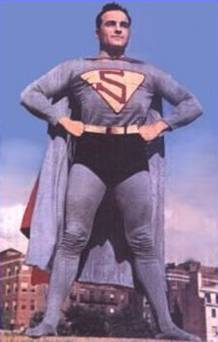
About 1970 and again about 1997, a man named Mayo Kaan (1914-2002) promoted himself as the inspiration and model for Superman in 1936, two years before the character debuted in Action Comics, #1. He claimed Siegel and Shuster traveled to Boston in that year to sketch him. Kaan showed and sold photos of himself dressed in an unmistakable tight blue costume, such as the one here, courtesy of the Superman Super site.

However, as that site also points out, Kaan's photographs proved to be his debunking. Because some of them show him standing in front of Boston's Hatch Shell, the semihemispherical stage where the Boston Pops perform each Fourth of July. And the Hatch Shell wasn't built until 1940.

When challenged by DC Comics and people looking out for Siegel and Shuster, Kaan passed up the opportunity to explain that as Superman he'd been able to fly into the future. In fact, he apparently didn't offer any explanation at all. But he maintained his claim until he died, and in 2005 his family was still insisting on his role in comic-book history, according to this Boston Globe article.

As for Batman, in 1975 a man named Frank D. Foster II (1909-1995) went to a law firm to set down his recollections of creating Batman. Foster grew up in Arlington and went to art school in Boston before moving to Greenwich Village in the early 1930s. His son has offered a look at that interview and a set of his father's sketches bearing the date 1932 at OriginalBatman.com.

Here I'm relying on Cash Gorman's Hero Goggles blog, which gets this year's special recognition for Batman research from Oz and Ends. In addition to analyzing the Foster claim, Gorman also describes published precursors to Batman, including a rich man dressing up as a bat to take revenge on criminals in 1899. So the notion of a bat-themed crime-fighter wasn't that original to begin with.

Gorman points out how in the 1975 interview Foster spoke of being inspired by comic strips featuring

heroes of the day--such as, flying through the sky during the day and doing good deeds and so forth and so on--and I thought, well why couldn’t that be done at night? Have a good guy do stuff at night.
Foster dated that recollection to the late 1920s. The lawyers weren't able to elicit an explanation for the later date on the sketches.

Whether it was the 1920s or 1932, Foster recalled his creation occurred well before Batman's debut in 1939. But that was also before Superman appeared in 1938, or even Flash Gordon in 1934. Which raises the question of what comics heroes Foster saw “flying through the sky...doing good deeds and so forth.”

The details of Foster's recollection are so vague that it's impossible to disprove them, unlike Kaan's photos. But the fact that he was trying to emulate published comics with a man in a mask and skintight costume suggests that he really created his sketches in the late 1930s, when a lot of other artists were also trying to break into the newly hot comic-book industry.

TOMORROW: Captain Marvel, Jr., and the King.

05 January 2009

I Need to Go Lie Down Now

At the barber's this morning, I heard a deejay talking about trying to buy a chaise longue. That term means, of course, "long chair" in French, and is properly pronounced shezz long.

For quite a while, however, English speakers and spellers have transposed a couple of letters and turned the phrase into "chaise lounge," pronounced shezz lownj. Which makes some intellectual sense, as a piece of furniture one lounges on. And it's common enough I've gotten used to that.

But this deejay was talking about a chayz lownj. Over and over.

And that's one reason I left the barber without getting my hair cut.

(Above, a "car chaise," crafted in 2004 by Jonathan Smith of the Urbanoia Design Group and Ryan Hagan of the University of Texas "from padded glove-box covers from Detroit autos of the 70s and 80s.")

Cybils Middle-Grade Fiction Nominees

So here's a list of the middle-grade novels I'll soon read as a judge in this category of the Cybils Awards. And here are all the lists of finalists.

Alvin Ho
written by Lenore Look
Schwartz and Wade Books

Alvin Ho is brave (as long as he has his Personal Disaster Kit), a gentleman (in training), a good friend (but NOT to girls), and an interesting kid (who doesn't talk in public). It's just that he's allergic to everything: girls, substitute teachers, airplanes, escalators ... and anything else that's even remotely scary (like leaving the house). However, he loves explosions, his dog Lucy, Plastic Man, Wonder Woman, the Green Lantern, Aquaman, King V, and all the superheroes in the world.
Oh, dear. Will I be able to relate?
Diamond Willow
written by Helen Frost
Farrar, Strauss & Giroux

Helen Frost tells the story of Willow, a young girl living in a remote Alaskan town. When Willow gets her first chance to mush the family dogs, everything changes. Told in a series of diamond-shaped poems, with sporadic prose every few chapters, Frost has woven a beautiful coming-of-age story fraught with realism and magic. Braiding the stories of Willow, her family, the dogs, and her family's ancestors, the story is simple and middle-grade students will easily connect with Willow and her family.

“Sporadic prose”--what a selling point.

Every Soul a Star
written by Wendy Mass
Little, Brown

Three middle school students are brought together along with thousands of eclipse-chasers to witness a rare full solar eclipse. Told in the three voices of Ally, Bree & Jack, the alternating narrations are beautifully written and increasingly weave together. Ally (short for Alpha) and her family own the Moon Shadow campground, and have been preparing for their eclipse-chasing guests for years. Bree's parents have bought the Moon Shadow and are dragging her from city life to try running a campground. Jack is along for the ride as his science teacher's assistant in an amateur astronomy experiment they plan to run during the eclipse.

Shooting the Moon
written by Frances O'Roark Dowell
Atheneum

Both the characters and the setting are fully fleshed out and believable in this Vietnam era novel. Born and raised in a career army family, 12-year-old Jamie explores her changing feelings as her brother enlists in the army and is sent far away to fight. While offering no easy answers, this is a thought-provoking page-turner that will have lots of appeal for kids.

Not one but two astronomically-themed titles!

The London Eye Mystery
written by Siobhan Dowd
David Fickling Books

This story has Ted and Kat searching for a cousin who disappears from the London Eye Ferris wheel. The two siblings must work together to solve the mystery. What's unique about this tale is how Ted's Asberger's doesn't stand in the way of him being active in solving his cousin's disappearance.

Which reminds me, I should post some of my dad's photos of our "flight" on the London Eye last summer.

04 January 2009

Teen Titans Decompressed

The superhero world loves origin stories. That may seem obvious now, but comics creators didn't originally know it. The first appearances of Superman and Batman said nothing about how those heroes had come to be, and the earliest explanations of their powers and missions were cursory. But soon Kal-El's escape from Krypton and the murder of Bruce Wayne's parents became touchstones of their characters.

After the first Crisis in the DC Comics universe, the publisher took the opportunity to modernize aspects of its most lucrative trademarks' lives. George Pérez relaunched the saga of Wonder Woman from her start on Paradise Island. Under the pen of John Byrne, Superman's adoptive parents were suddenly alive again.

The company's editors didn't think the Batman myth needed any tweaking, but its milieu needed more grit and realism. Frank Miller and David Mazzucchelli's Batman: Year One, published in 1987, is widely seen as a masterpiece in the superhero genre. It established a more realistic tone for the Batman series, as well as opening the door to more stylized renderings of superhero stories. That story arc, collected in a paperback, remains the model for DC's other Year One retrospectives.

One of the best Year One volumes retells Barbara Gordon's early outings as Batgirl. It reestablishes that character in Batman's post-Crisis history, adds depth to her personality, and fills out her relationships with other characters, particularly Dick Grayson as Robin. Less crucial but still interesting are Robin: Year One and Nightwing: Year One, about Dick's passages.

The latest volume of this sort is Teen Titans: Year One. It appeared in six magazines over the past year, followed by a paperback. The script is by Amy Wolfram, new to comics but the writer of some of the most popular episodes of the Teen Titans TV cartoon. The main artist is Karl Kerschl, whose style leans away from what Douglas Wolk calls the "default style of the superhero mainstream" toward a half-cartoony look.

The volume retells a handful of tales from the Teen Titans' pre-Crisis years. The first three chapters recount the team's origin: the young sidekicks must rescue their mentors from possession by a extradimensional monster called the Antithesis. (Confusingly, that story first appeared in Teen Titans, #53, the last issue of the original comic book, as a flashback.) Then there are three more chapters about the new Titans adjusting to fame, hormones, and the fact that Batman is the Worst Dad in the World. Each of those stories also reworks one of the team's adventures from the 1960s.

How does it all play out? Well, that brings me to another development in superhero comics since the early 1980s, when I last read them: "decompressed storytelling." This is an industry euphemism for spreading out a plot over more panels, pages, and issues of a magazine. The creative advantages of the decompression can include:

  • More space to develop characters and mood through more realistic pacing, dialogue, and character reactions.
  • Bigger panels to show off more detailed artwork.
But those are advantages only when the story becomes deeper, not just longer. Otherwise, decompression just lets the air out of a story and leaves it flat.

Wolfram's best use of the decompressed space is humorous interaction among the Titans. Aqualad was always a challenge for the comic's writers, for three reasons:
  • His only established powers were being able to live underwater and communicate telepathically with marine life.
  • He couldn't survive outside water for more than about an hour at a time.
  • There are only so many ways a writer can justify having the group work near water so Aqualad can join in.
Not surprisingly, Aqualad was the first charter member of the Titans to be written out of the group.

In Teen Titans: Year One, Aqualad finally has a clear role to play. Unfortunately for him, he's comic relief, particularly when paired with Kid Flash. Still, that personality's not entirely out of line with how other writers have portrayed Aqualad. (Dissenting opinion from Tegan at Bloggity-Blog-Blog-Blog.)

But I was disappointed at the lack of new facets to the other characters, and the number of questions left unresolved, even unaddressed. We see Kid Flash wishing he could be in charge of the Titans, but nothing comes of that--nor can I connect it to what I've seen of Wally West's adult personality. Some panels note the contrast between his all-American middle-class upbringing and Robin's life with a billionaire, but nothing comes of that, either.

We see Wonder Girl and Speedy go on a first date that ends poorly. But we never see any fallout from that night. Is that why Speedy doesn't stick around in the group? Does that lead to his falling-out with the Green Arrow and, eventually, his heroin addiction? The drawn-out pages offer no clues. And Wolfram steers clear of Wonder Girl's incredibly confused origin.

As in many other Teen Titans tales, one unmistakable theme is that Robin's the most dangerous one of all. He takes down Wonder Woman with no help but the distraction Kid Flash and Aqualad provide by bickering. He puts on scuba gear and wrestles Aquaman's octopus to a standstill. He defeats a villain named the Ant who's beat up all his teammates handily.

But we see only one other side of Robin's personality: bat-whipped. In contrast, Robin: Year One shows a fun-loving kid learning that there's a deadly serious side to dressing up and fighting crime, and a deadly serious crime-fighter adjusting to having a boisterous adolescent in his life. In this volume, Robin has no fun when he's with Batman, but no fun with the Titans, either. Aside from getting to be the boss, it's not clear why he likes this team.

In the final story, Robin pulls his teammates out of a graveyard in his mind, then leads the on a charge against the Antithesis. They first sound their alliterative but not-particularly-easy-to-yell battle cry, "Titans Together!" And then...nothing. No images of the fight. No signs that they've learned how to work together. No examples of how Aqualad can actually be useful. Instead, the scene shifts to Batman trying to tell Robin that he's proud, screwing up with IM, and giving up.

So what does this volume tell us about the Titans' first year? Basically, that most fourteen-year-old boys are pathetic creatures: immature, boastful, competitive, shallow. They're scared of intense feelings, prone to burping contests, and more concerned with cars than with girls. The one possible exception is, of course, Robin. And for that we needed a whole paperback?

03 January 2009

The Quiet of a Manual Typewriter

From the New York Times obituary for Donald E. Westlake, the talented writer of mysteries, thrillers, caper novels, and a lot of other genre fiction published since 1960:

Mr. Westlake resisted computers and typed his manuscripts on manual typewriters. “They came in perfectly typed,” Mr. [Laurence] Kirshbaum said [as his agent]. “You felt like it was almost written by hand.”

Otto Penzler, a longtime friend of Mr. Westlake’s and the owner of the Mysterious Bookshop in TriBeCa, said, “He hated the idea of an electric typewriter because, he said, ‘I don’t want to sit there while I am thinking and have something hum at me.’”

Mr. Westlake kept four or five typewriters and cannibalized their parts when any one broke, as the typewriter model was no longer manufactured, his friends said.

“He lived in fear that he wouldn’t have his little portable typewriter,” said Mr. Penzler, who once gave him a similar typewriter that he had found in a secondhand store.
(Penzler is also a mystery editor, and in 2000 he and Westlake co-edited a collection of Best American Mystery Stories of the year.)

The Times item is accompanied by a photo by David Jennings showing Westlake with two of his beloved machines in 2001.

A detail found not in the obituary but on Westlake's website: In 1970, the Signet paperback imprint published Comfort Station, by J. Morgan Cunningham, who was aiming to please the fans of Arthur Hailey. Westlake supplied a blurb for that previously unknown author: "I wish I had written this book!" In fact, he had--Cunningham was one of the many pseudonyms Westlake used over the years, and he was having a little fun.

02 January 2009

The Belgian Boy Reporter

Last month The Economist published a detailed discussion of Tintin's place in European culture, in anticipation of a big-budget Hollywood adaptation.

Much of the article is about why Tintin books are supposedly unpopular in the USA. Not just less popular than in Europe, but practically unknown. Which just hasn't been my experience--I've seen Tintin books in American stores for decades.

I've already written about the comic's roots in the anti-Communist Belgian right wing, and how it reflects a colonialist outlook. The Economist article discusses another dimension of bandes dessinées politics, a couple of decades after Tintin's debut:

In 1949 France banned children’s books and comic strips from presenting cowardice in a “favourable” light, on pain of up to a year in prison for errant publishers. It was equally forbidden to make laziness or lying seem attractive. The law created an oversight committee to watch for positive depictions of these ills, along with crime, theft, hatred, debauchery and acts “liable to undermine morality” among the young.

Taken literally, the law suggests that an ideal comic-book hero would resemble an overgrown boy scout, whose adventures involve pluck, fair play, restrained violence and no sex. That is a pretty accurate description of Tintin, the Belgian boy reporter who enjoyed spectacular success in post-war Europe.
Given that Tintin books had been popular for years in neighboring, French-speaking Belgium, I suspect the character was already successful in France before that law. But the new content requirements may indeed have given him a boost by weakening competition.

Those 1949 restrictions came from all over the French political spectrum, the magazine says.
For all the talk about morality, France’s 1949 law on children’s books had ideological roots. It was pushed by an odd alliance of Communists, Catholic conservatives and jobless French cartoonists, determined that French children should be reading works imbued with “national” values. Pascal Ory, a historian at the Sorbonne university (author of “Mickey Go Home. The de-Americanisation of the cartoon strip”), writes that the main aim of the law—which, remarkably, remains in force today, tweaked in the 1950s to add a ban on incitement of ethnic prejudice--was to block comics from America.
Of course, around the time that France enacted this law, comics were becoming a political issue in America as well. In 1954 Sens. Robert Hendrickson and Estes Kefauver held their subcommitte hearings on the comic-book industry. Here too the result was strict guidelines on how mainstream comics depicted of crime, "debauchery," and heroism. But, as usual in America, the censorious authority wasn't the government but the industry regulating itself to preserve its market standing.

01 January 2009

Kamitsuki versus Chomp

A helpful quote from Art of Drawing Manga, by Sergi Càmara and Vanessa Durán:

In Western comics sound effects are often seen accompanying sudden sounds, such as shots or explosions, or sounds that add something to the story, such as slowly opening doors, footsteps, and so on. In manga, sound effects are used, not only to represent all these sounds, but also for imperceptible sounds like breathing blinking, or smiling.

Sometimes, the definition of the action itself is used as a sound effect, so if one character bites another the word kamitsuki, which is "bite" in Japanese, is written instead of the classic sound effect "chomp," which we would use in English.
Showing the worldwide reach and cross-fertilization of comics, Càmara and Durán's guide to Japanese-style comics was written and published in Spain. (The US edition was translated by Michael Brunelle and Beatriz Cartabarria for Sterling.) And my "toss" example comes from Robot Dreams, by Sara Varon of Brooklyn.