10 February 2008

For a Guy Without Super-Powers

Last month, one of my weekly Robin postings discussed how Batman's sidekick Robin was almost always the littlest guy in the fight, a kid up late in the adult world. Thus, although he's a Boy Wonder--physically, mentally, and constitutionally superior to almost all his readers--Robin remained an underdog.

Even when Robin gets together with other crime-fighting teenagers, he's at an apparent disadvantage because he has no special powers. That was a major theme of Dick Grayson's first team-up with Kid Flash and Aqualad in The Brave and the Bold, #54, published in 1964.

That comic book's cover shows the villain of the hour sneering to Robin, "If Kid Flash and Aqualad couldn't stop my fire-storm with their super-powers, what chance do you have?" At the time, the other boys are unconscious, and Robin is struggling just to carry them out of harm's way. Within the story, the villain tells himself, "Without super-powers, he can't harm me!" And, as the panel above shows, Robin's own companions aren't much more complimentary about his strengths.

But that's the whole point. Robin does save his friends and does disarm the villain. He shows himself to be a natural tactician and leader. By the end of this story, Robin's superpowered friends realize the error of their ways.

That team-up led to another, and eventually to the launch of the first Teen Titans comic book series in 1965. Those stories are almost embarrassing, with the period's usual silly plots given an extra coating of kitsch from writer Bob Haney's attempts to appeal to youth through a desperate concoction of fads and slang. The series faded away, returned, then faded again, only to be resurrected in glorious form in 1980 by Marv Wolfman and George Pérez.

It's telling that when Wolfman and Pérez offered readers a sneak preview of the new series in DC Presents, #26, they did so by following Robin. He was not only the most identifiable of DC's teenaged heroes, but also the one easiest for readers without superpowers to identify with.

Indeed, when restarting Teen Titans yet again in 2003, writer Geoff Johns recalled:

I knew immediately that the Teen Titans had to have a few things: They had to have a Robin.
Five years later, that group has undergone lots of changes, but Tim Drake as Robin remains. The Titans need a Robin.

09 February 2008

Highmore on Highmore as Jared and Simon

Newsarama posted an interview with Freddie Highmore about his experiences making the imminent movie version of The Spiderwick Chronicles.

As Oz and Ends reported a year and a half back, the producers originally looked for American twins to play Simon and Jared, but finally decided the movie would work better with one British actor playing two American boys. Which doesn't say much for American twin actors.

Highmore addressed that acting challenge in this interview:

NRAMA: Which twin did you relate to more?

FH: I guess a mixture between the two. Jared smashes holes in walls and I wouldn't do that. But I do sort of have the drive that he's got to push himself on - and to help his family. When he's in a dangerous situation, he takes control and gives it his best shot.

NRAMA: How did you manage to make the two characters seem so different?

FH: Jared's the squeaky wheel. He's always running around showing off his anger in quite an extroverted way. Simon is still hurt by his parents splitting up too. He's just more internal, perhaps.

NRAMA: How long did it take you to switch between the two characters?

FH: I was quick. I was like a Ferrari. After they shot me [as?] one twin, I'd run away, change in this little tent and I'd be back out again 29 seconds later.


08 February 2008

Sonnet to My Lady’s Eye

Since it's Friday, and Poetry Friday eases the need for blogging inspiration, I'm sharing one of the verses from L. Frank Baum's By the Candelabra’s Glare, recently reissued by Pumpernickel Pickle Press.

A SONNET TO MY LADY’S EYE

If inspiration comes, I’ll try
A sonnet to my lady’s eye--
Her black eye.

And yet, there seems a woeful lack
Of proper words to rhyme with “black,”
And black eyes savor of attack--
I’d best abandon black.

I’ll start again, and this time try
A sonnet to my lady’s eye--
Her gray eye.

And yet, what color does convey
So passionless a sense as gray?
And tigers’ eyes are gray, they say–
My lady’s can’t be gray.

Ah, now the idea comes! I’ll try
A sonnet to my lady’s eye--
Her violet eye.

And yet, unless I much forget,
No lady’s eye was violet
Since time began; so, with regret,
Adieu to violet!

And so at last I’m forced to try
A sonnet to my lady’s eye--
Her blue eye.

And yet, what can I say that’s new?
The whole world knows blue eyes are true;
Besides, I must confess to you
My lady's eyes are blue.
Technically, this isn't a sonnet. But then the difficulty of writing a poem is what this poem is all about.

07 February 2008

How Do Audiobook Editors Decide?

Toward the end of last year, Big A little a asked:

Why do some publishing houses (Random House) have their audio up and ready when the book is released? And, why do others wait and wait and wait[?] . . . Does anyone know which questions are at play here in deciding which books will have audio and which will not?
As I pointed out in the comments to Kelly’s posting, Random House owns Doubleday, the imprint that published the book she was hoping to find in audio form. So it can't be a matter of Doubleday not having an audio publishing partner available.

Rather, the audiobook field seems to be driven by print publishing. Books that have proven themselves in print are recorded, but the only new titles produced as audiobooks at the same time as their print editions seem to be those guaranteed big sellers from established authors with eager fans.

But is print success not just the primary but the only criterion for what makes a viable audiobook? Are there borderline cases, in which a book with marginal sales is recorded because it would be exceptionally good as an audio book, or set aside because it just wouldn't work in that medium? I looked for online interviews with audiobook editors to see if they answer this question, but came up empty. So does anyone have insider insights to share?

The current popularity of audio editions, boosted by MP3 players and online downloads, is at odds with another trend: increasing use of graphics in novels for kids. I'm not talking about comics, but full prose novels that incorporate illustrations into their storytelling. Those don't translate well into audio form.

As I wrote back here, I first took in Jules Feiffer's The Man in the Ceiling in audiobook form, but that book should not be in audio without more careful adaptation. The end of the book is incomprehensible without a visual dimension.

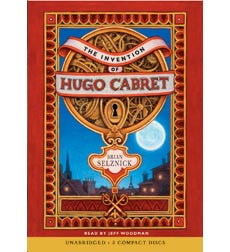
Last month, Scholastic issued an audiobook of another truly graphic novel, Brian Selznick’s Invention of Hugo Cabret, which required so much special treatment that it merited its own press release. The publisher boasts of "translating the more than three hundred pages of original black and white illustrations in the novel using vivid sound design." Still, the book is so visual that Scholastic also includes "an exclusive behind-the-scenes bonus DVD" for listeners to watch.

06 February 2008

Randall Rereads Redwall

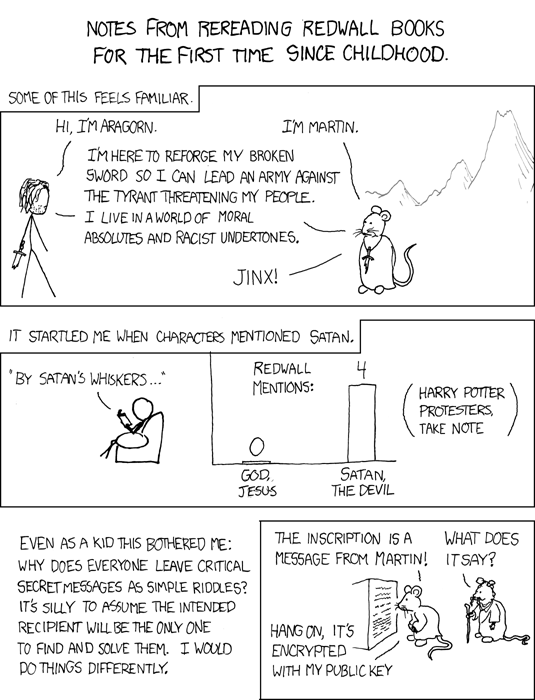
Randall Munroe at the xkcd cartoon looks back at the Redwall series:


I didn't read Redwall until I was an adult, so I don't have youthful memories to reconsider. Brian Jacques's storytelling style in Castaways of the Flying Dutchman made me reconsider something else: my belief that the only rule that successful fiction writers absolutely have to follow is, "Show, don't tell." In that book Jacques both showed and told everything with the subtlety of a pair of sledgehammers approaching one's head from either side, and I stopped listening.

05 February 2008

When Superman Was a Leftist

On this Super Tuesday, Oz and Ends takes a look at super-politics: the politics of Superman in Jerry Siegel and Joe Shuster's earliest comic-book stories. In those months, Superman was not only opposed to criminals, he was also fighting against heartless capitalists and lending his hand to social reforms.

The Superman story from the third issue of Action Comics #3, dated August 1938, starts with the caped hero racing to the scene of a mine disaster. The next day, Clark Kent interviews an injured worker. That man has poor English and a foreign name, but, remarkably for popular literature of the time, he's not a comic or villainous figure. He's the sympathetic victim of the mine's managers.
That evening Superman takes the guise of a miner and visits the mine's owner, who has the upper-class name Thornton Blakely. He's hosting a swell society party, and decides that nothing could be more entertaining than to have his beefy worker escort him and his guests underground to explore the mine.
Once underground, Superman triggers an accident, trapping the celebrants. Blakely finds that he's let the mine's safety device rust away. He and his rich friends dig for their lives, but collapse. Finally, Superman brings the socialites back to the surface, and Blakely promises to improve working conditions at all his mines.

It's hard to escape the class-consciousness of this story, especially with awkward but meaningful phrasing like "sable-and-evening-clothes-clad party-goers."

That attitude toward the rich makes a particularly strong contrast to the Batman comics that DC started to publish shortly afterward. Not only was Bruce Wayne a lazy socialite, but he spent a lot of his time as Batman rescuing threatened investors and thwarting jewel thieves--i.e., looking out for the upper class.

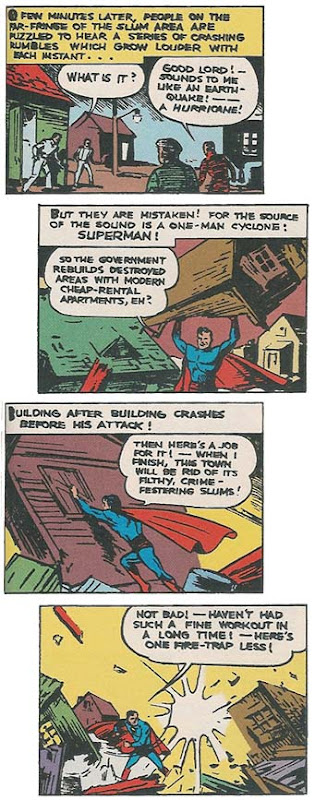
There's more super-politics in Action #8, dated January 1939. After meeting and trying to scare some juvenile delinquents away from crime, Superman decides that they're the product of an unhealthy environment. So he destroys their homes.
This Superman has complete faith in New Deal-style urban renewal: "So the government rebuilds destroyed areas with modern cheap-rental apartments, eh?"

(When DC returned to this scene in an early-1960s recap of Superman's career, the writers made sure to add that he was working for the government and rebuilt the homes himself.)

The early Action comics aren't explicit about Superman's creed, but the animated cartoons launched in 1941 said that he fought "a never-ending battle for truth and justice." After the US entered World War 2, the Superman radio show expanded that phrase to "truth, justice, and the American way." (A 1948 movie serial showed Clark Kent's father urging him to fight for the liberal postwar values of "truth, tolerance, and justice.")

At least at the very beginning, Superman's "justice" included social justice, not just criminal justice.

04 February 2008

A Genre Novel—What Was She Sniffing?

Charles McGrath's article in Sunday's New York Times, headlined "Great Literature? Depends Whodunit," offers an amusing incident from British letters and a succinct definition of what sets genre fiction apart from other storytelling forms. McGrath wrote:

In a British court recently, an author said, in effect, that glue-sniffing had made her write a thriller. The author, Joan Brady, is a 68-year-old American who has lived in England for the last several decades and in 1993 became the first woman to win the Whitbread book prize. She received a £115,000 out-of-court settlement after arguing that fumes from the glue and solvents used in the Conker shoe factory next door to her home in Totnes had poisoned the air and made her sick. She suffered nerve damage, she said, and a loss of concentration that caused her to abandon the literary novel she was working on, Cool Wind From the Future, and instead crank out a potboiler called Bleedout. . . .

You also have to conclude that Conker or its lawyers don’t know much about the publishing business--that is, if they really believed that Ms. Brady had suffered from turning to thrillerdom. . . . [Bleedout] has done pretty well, selling some 50,000 copies in Britain alone since it came out in 2005. An author seeking damages would do better, one would have thought, by claiming to have become so addled that she had decided to forsake a certain payday for the vain hope of literary success. . . .

But what’s behind the Brady controversy, of course, is the assumption that genre fiction--mysteries, thrillers, romances, horror stories--is a form of literary slumming. These kinds of books are easier to read, we tend to think, and so they must be easier to write, and to the degree that they’re entertaining, they can’t possibly be “serious.”
McGrath goes on to describe the genre writer's "implicit contract with the reader, which is to deliver on the promise that a particular genre entails--whether it’s a murder solved, a cold war plot thwarted, a horror unmasked, a love requited." He concludes:
Such books are reassuring in a way that some other novels are not.

Does that make them lesser, or just different? Probably both on occasion. But it doesn’t necessarily make them easier or less worthwhile to write.
Now here's a question for the children's-lit field. There are, of course, genre books for young readers: mysteries, science-fiction adventures, sports books, going-to-camp books. But are there children's novels that come with no implicit contracts and expectations to fulfill?

Even the most serious and literary fiction for children is expected to leave readers with a "sense of hope." The young protagonist is supposed to grow and learn valuable lessons about life, at least a little. Does that recurring pattern make children's novels as a whole a sort of genre?

03 February 2008

World's Finest Friendship

Since this is a "Super" Sunday, today's weekly Robin addresses the early portrayal of friendship between Robin the Boy Wonder and Superman, the Man of Steel.

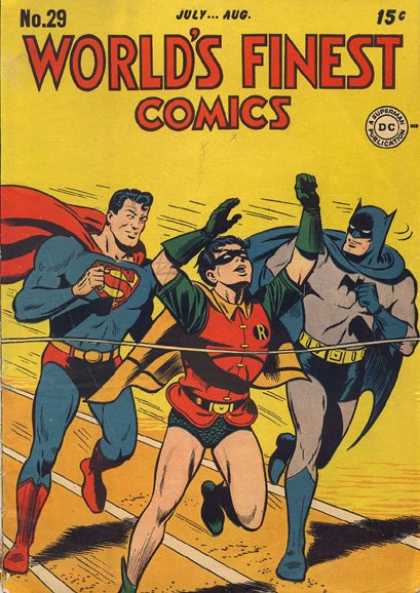
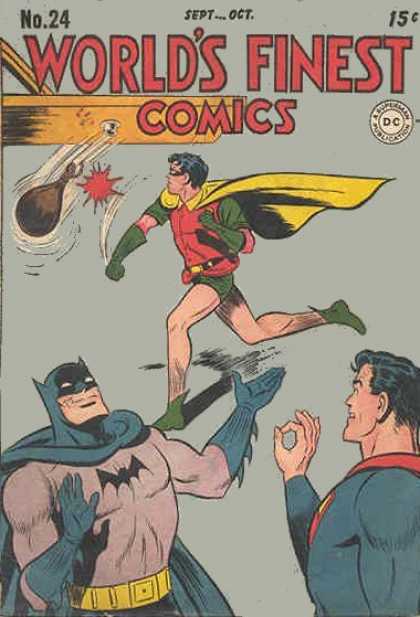
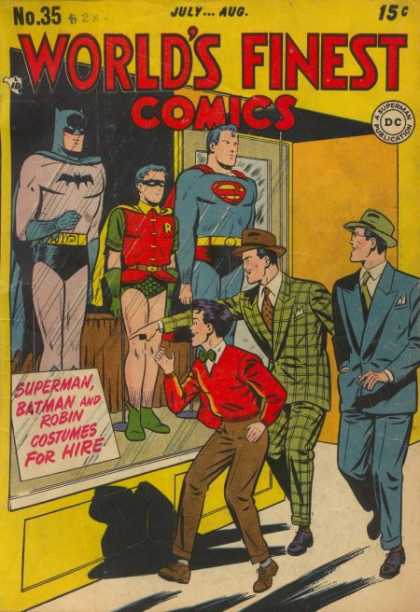
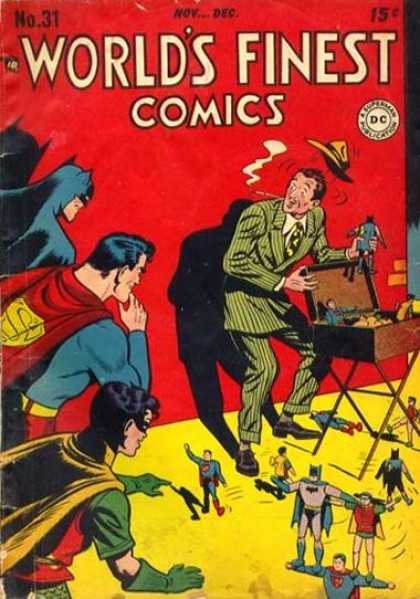
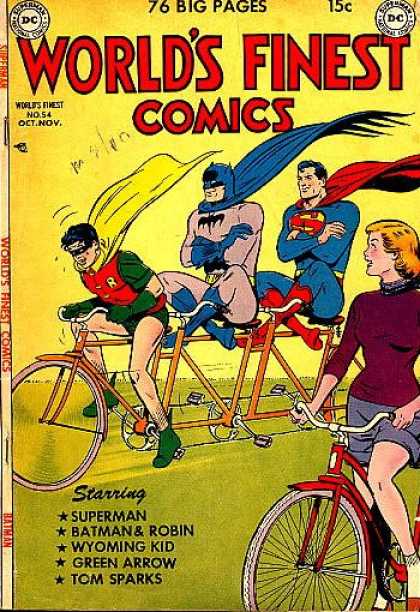
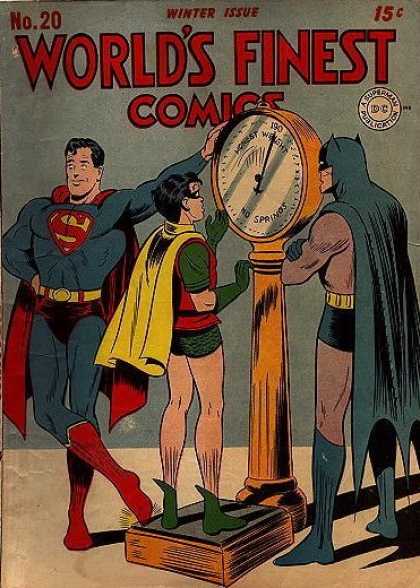
In 1939, DC Comics (never lax in chasing marketing opportunities) issued a couple of issues of World's Fair Comics, tied to the New York World's Fair. Those magazines featured new adventures of Superman, Batman, and the company's other top characters. After the fair ended, the anthology magazine continued under the name World's Finest. It always had Superman, Batman, and Robin on the cover since they were DC's biggest brand names.

Not until 1954 did the magazine's editors have the idea of teaming up Superman and Batman (and Robin) in a single adventure. Thereafter World's Finest usually featured such a team-up.

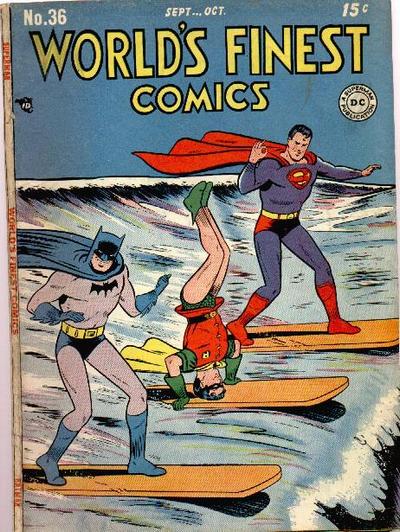
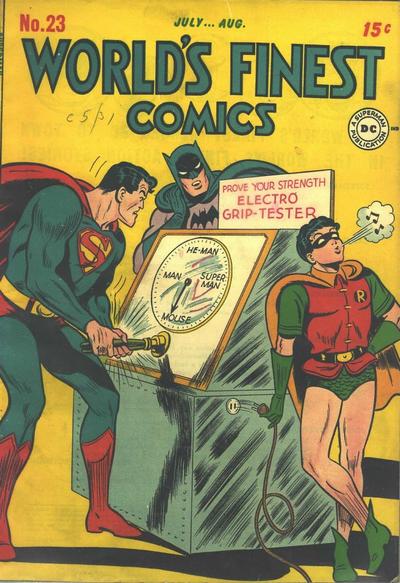
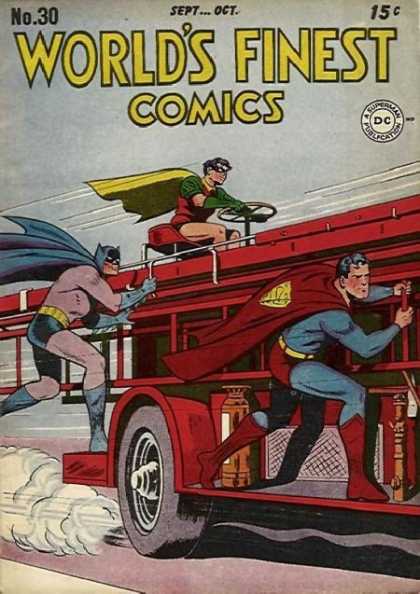
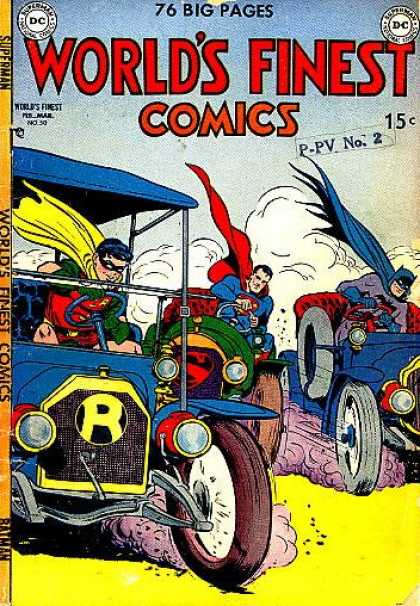
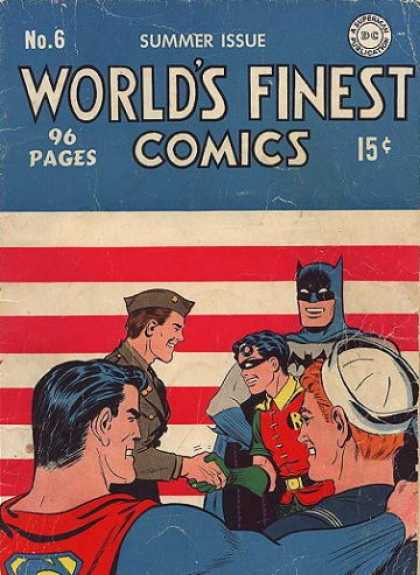
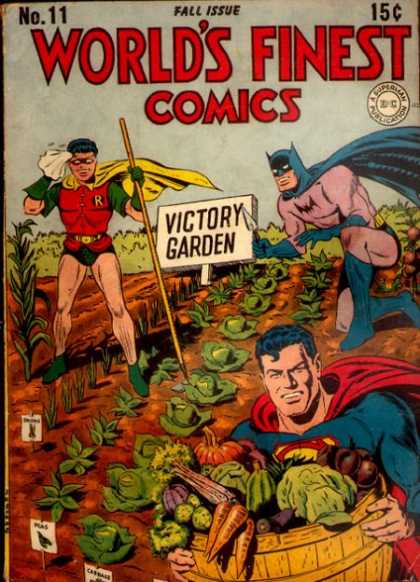
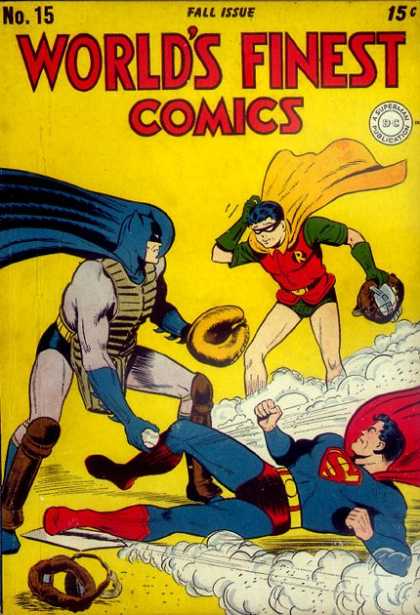
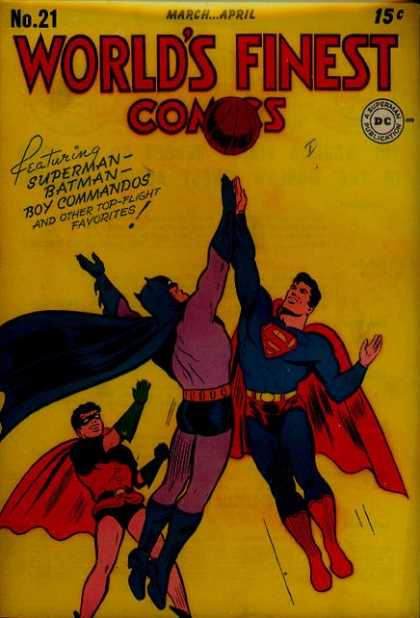
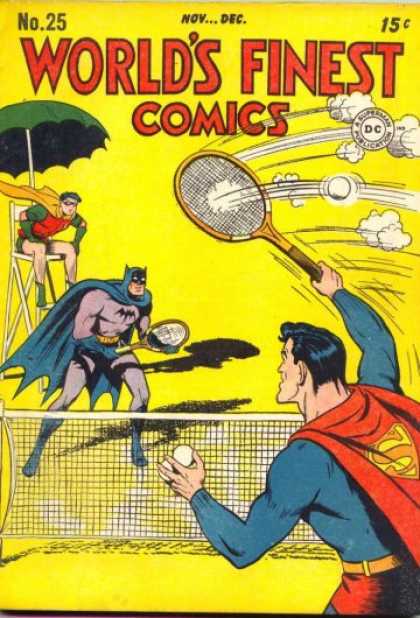
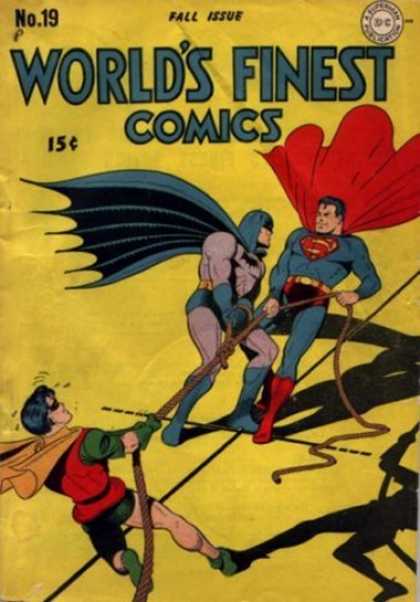
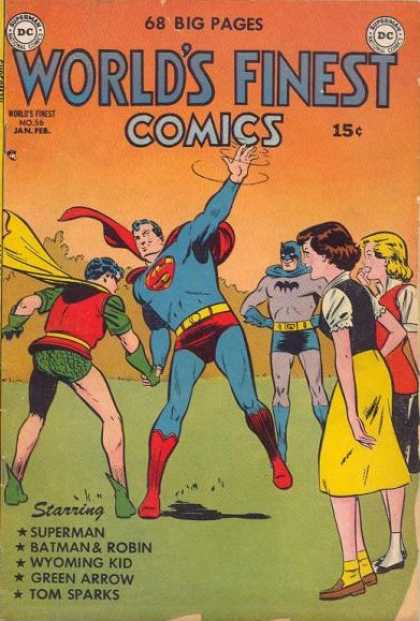
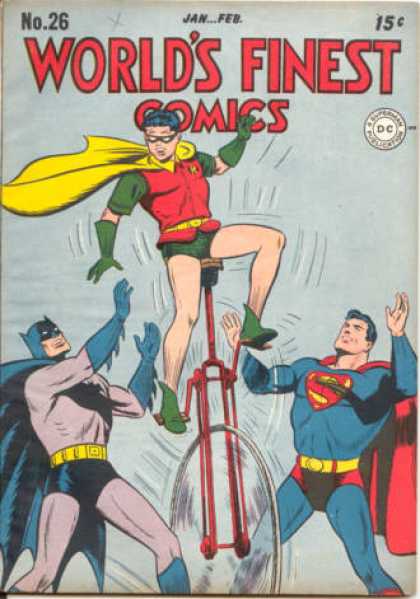
Since the beginning, however, the magazine's covers had depicted Superman, Batman, and Robin as friends. Not just friends--pals! Until 1954, those covers had nothing to do with the stories inside. They rarely showed the three characters fighting crooks or rescuing people from imminent doom, as the regular Superman and Batman magazines did. Instead, World's Finest showed the three heroes having fun.

Superman, Batman, and Robin rode fire engines and raced jalopies. They congratulated servicemen and tended Victory Gardens. They played baseball, basketball, and other sports. They went surfing--in 1948!

Several covers showed Batman and Superman letting Robin win at footraces, tug-of-war, or other competitions. In others, the two men were supporting or praising the Boy Wonder's abilities. In those scenes Robin appears delighted at having the two coolest older brothers ever.

Some covers goofed on the heroes' popularity, as they discovered costumes or dolls modeled after them. In others, they played pranks on each other. I particularly like this cover from 1946, which has a Homer Price vibe.
All Golden Age World's Finest covers can be visited through Cover Browser.

02 February 2008

Orphans 'R' Us

I was struck by this quote from a Publishers Weekly interview with the venerable Lois Lowry, on the occasion of her new book, The Willoughbys:

Lowry: I was in love with orphans when I was a kid, but that doesn’t seem to be very popular in today’s books. It’s become politically incorrect to do away with parents. We send kids to camp instead, to get away from their parents. So it began with orphans.
Wha'? No orphans in today's books? Heck, we're knee-deep in orphans these days!

What about a certain hero named Potter? Or the Grimm sisters? Or the Baudelaire children?
Lowry: I haven’t read Lemony Snicket, I’m afraid.
Ah.

The title characters of Lowry's Willoughbys are, PW says, "a quartet of old-fashioned kids who aren’t orphans--but who long to be." So it seems she's unwittingly come up with a parody of the recent trend of parentlessness in popular children's literature, as well as the previous trend of same. Still, it seems wise to know what you're parodying before you launch into it.

01 February 2008

The Way of the Kurds

Here's another recent article from the Boston Globe about a writing-group colleague, in this case storyteller Diane Edgecomb, who has just published an unusual collection, A Fire in My Heart: Kurdish Tales. The paper discusses her research travels:

Edgecomb met some Kurdish refugees in 1999 and was impressed by their strong oral history. With politics and modernization threatening to render the old ways obsolete, Edgecomb set out to record their stories, doing most of her work in Turkey between 2005 and last year.

Accompanied by a guide and translator, Edgecomb spent hours listening to and filming the tradition bearers. "This isn't just a project to create a book," said Edgecomb. "I'm documenting the tellers and creating an archive." The book, released this month, is the first volume of Kurdish tales published in English, and also includes recipes, games, and color photos. . . .

"We found one teller whose family for generations had been in the mountains," said Edgecomb. "A nomadic family, and only in the last year had they come down to the cities." The man related epic tales of Rusteme Zal, a legendary figure of Kurdish folklore. "He went on for two hours with just one story and then he told me that was only the outline," Edgecomb said.

Of the pieces she's collected, a yarn about why the moon has dirty spots on its face is a favorite. There are also humorous themes. "They love telling stories about the fox . . . tricking people and tricking other animals," said Edgecomb. "Those are very funny stories. Also beautiful fairy tales, wonderful wonder stories, which go on and on and on."
Kurdistan seems to edge closer to de facto independent status each year, though perhaps pushing for de jure nationhood would wipe out some of those gains. Not that the current administration is facing the hard choices of that situation. I quote from Jeffrey Goldberg's cover story "After Iraq" in the current Atlantic Monthly:
At a conference in 2004, National Security Advisor Condoleezza Rice stated, “What has been impressive to me so far is that Iraqis--whether Kurds or Shia or Sunni or the many other ethnic groups in Iraq--have demonstrated that they really want to live as one in a unified Iraq.”

As Peter Galbraith, a former American diplomat and an advocate for Kurdish independence, has observed, Rice’s statement was disconnected from observable reality--shortly before she spoke, 80 percent of all Iraqi Kurdish adults had signed a petition calling for a vote on independence.