11 July 2006

Carnival of Children's Lit & Akkordeonspieler

I'm new to blogging, and carnivals are one aspect of the culture I'm still puzzling out. It's not that I imagine blog carnivals to be as raucous as, say, a German kid playing an accordion in a tent.

I get the idea of aggregations of above-average blog entries. I enjoy exploring the links in the carnival entries I've seen, and am very glad someone's gone to the trouble.

I just don't get the process yet. Who is that someone? What are the criteria for links? What defines each carnival's theme? Why does hosting circulate? Such sites as Blog Carnival have been designed to fill a perceived need, but they don't answer those questions. Perhaps there are as many different combinations of answers as there are carnivals. Perhaps part of the appeal of blog communities, like other communities, is insider status: like finding your way here in greater Boston, if you don't already know where you are, you don't belong there.

In any event, the past Carnivals of Children's Literature are swell. Big A little a will host a new one on 23 July. Entry deadline is 15 July. And what happens in between those dates? I really don't know.

So I've decided to institute the Oz and Ends blog carnival of German kids playing accordions in tents to find out. It's open for entries through the end of July.

10 July 2006

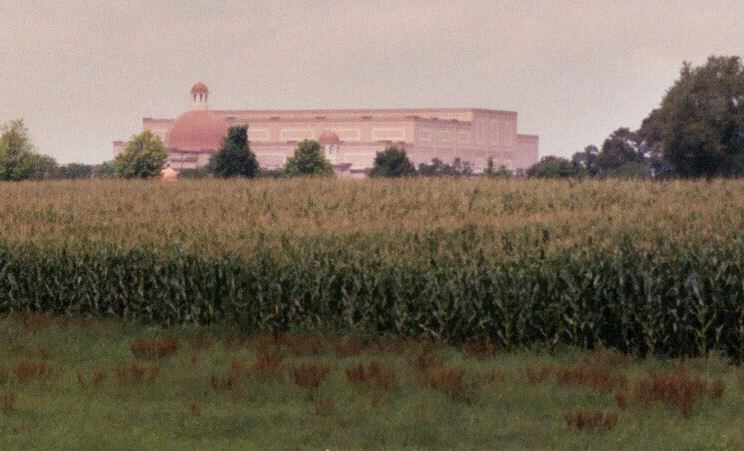
Spotting Glinda's castle in the distance

I'm starting to prepare for the Munchkin Convention next month. Last year, this annual convention moved from Harrisburg to Princeton, New Jersey, a fine college town that happens to be (a) where I have dear relatives, and (b) closer to my home. So I'm very happy with the locale.

The one drawback is that when I attended in Harrisburg, I enjoyed visiting the rural parts of Lancaster County as I drove to Philadelphia to visit my grandparents. And on a certain road I know, when the weather is right, you can see Glinda's castle, much as Dorothy and her companions did in The Wonderful Wizard of Oz:

The Monkeys had set them down near a farmhouse, and the four travelers walked up to it and knocked at the door. It was opened by the farmer's wife, and when Dorothy asked for something to eat the woman gave them all a good dinner, with three kinds of cake and four kinds of cookies, and a bowl of milk for Toto.

"How far is it to the Castle of Glinda?" asked the child.

"It is not a great way," answered the farmer's wife. "Take the road to the South and you will soon reach it.

Thanking the good woman, they started afresh and walked by the fields and across the pretty bridges until they saw before them a very beautiful Castle.

08 July 2006

School district trying not to "arouse a child's imagination"

Have you followed the silly but dismaying saga of the Vista San Gabriel Elementary School library? It's taking place out in the dry inland exurb of southern California ironically named Lake Los Angeles.

In 2000, one local newspaper, the Antelope Valley Press, quoted Wilsona School District board member Sharon Toyne saying about the Harry Potter series:

"The book's wizards and magic all falls in the line of witchcraft. . . . In our district we are trying to promote character with programs like Character Counts, and I don't see how the book promotes that. I think [the books] could arouse a child's imagination and curiosity of the unknown, of the dark side."
(Not "imagination and curiosity of the unknown"! We must keep children curious and imaginative only about the known, I suppose.)

In 2002, the school district board voted 3-2 to start having religious invocations at the start of its monthly meetings. The Antelope Valley Press reported that the "prayer of entreaty and call for divine presence...would be nonsectarian," according to proponents. But the first prayer offered "invoked Jesus Christ...and asked the Lord to look down upon the people's wickedness and sought forgiveness for banning prayer in public schools."

Sharon Toyne is now president of the district school board and "honorary mayor" of Lake Los Angeles. In February 2006, she led the board in removing 23 titles from a list of 68 recommended for the Vista San Gabriel Elementary School library by a committee of parents and teachers. You can read the full Antelope Valley Daily News report captured at Susan Ohanian's website and GirafNetwork, and reactions at As If!, Read Roger, and the School Library Journal censorship roundup for May. This time Toyne was quoted as saying (obviously extemporaneously):
"There were several of the books on there that board members felt were not appropriate for the children. . . . I think basically because for the last eight or nine years, we've been pushing character education in our school district. There are so many issues changing in the society we are living in. With this ever-changing society, we have to just stick back to the traditional thing of what kids are supposed to be learning."
Another board member and retired teacher, Marlene Olivarez, said that Harry Potter and the Half-Blood Prince was dropped because it's fantasy; "We want books to be things that children would be able to relate to in real life." Others dropped titles that fall into the fantasy category included some Clifford the Red Dog books (but only, apparently, bilingual editions), a couple of Artemis Fowl titles, and Disney's Christmas Storybook. I haven't found any report on the 45 titles that were approved.

The Antelope Valley Daily News quoted the school's principal and librarian and a parent expressing surprise and dismay over the board's decision--the first top-down intervention on book choices in at least five years. The Antelope Valley Press editorialized against the decision. (That essay is ironically captured on the blog of a conservative homeschooler who supported the board's restrictions as long as government stays out of education, or something like that. And it seems odd that this homeschooler apparently doesn't care that more students' parents were involved in creating the original list than in cutting it down.)

This week the district school board issued new guidelines, written by Toyne, board member Patricia Greene, and school superintendent Ned McNabb. (Thanks to Bookshelves of Doom for the news.) The Antelope Valley Daily News reported them like this:
Books now cannot depict drinking alcohol, smoking, drugs, sex, including "negative sexuality," implied or explicit nudity, cursing, violent crime or weapons, gambling, foul humor and "dark content."

"In selected instances, an occasional inappropriate word may be deleted with white-out rather than rejecting the entire book," the policy said.
. . .
Revisions included adding the words "socially appropriate" to one criteria [sic]. It now states books should have a "Fair balanced socially appropriate portrayal of people with regard to race, creed, color, national origin, sex and disability."

The guidelines also now state that all books must comply with a section of state education law, titled the "Hate Violence Prevention Act," which states, "Each teacher shall endeavor to impress upon the minds of the pupils the principles of morality, truth, justice, patriotism, and a true comprehension of the rights, duties, and dignity of American citizenship, and the meaning of equality and human dignity, including the promotion of harmonious relations, kindness toward domestic pets and the humane treatment of living creatures, to teach them to avoid idleness, profanity, and falsehood, and to instruct them in manners and morals and the principles of a free government."
(Clifford obviously can't show kids anything about "kindness toward domestic pets," could he? These guidelines on values remind me of those Florida just mandated for history.)

Here's another wrinkle in this story that I picked up through Google:
  • In March 2006, the Associated Press reported, the Wilsona School District was "sanctioned under the California's Immediate Intervention/Underperforming Schools Program" for failing "to improve student achievement for at least two consecutive years."
  • Such sanctions sometimes make a school board look for new leadership. But in late June, the Wilsona School District board extended McNabb's contract for three years. Obviously, the board liked the approach and priorities he was demonstrating.
  • One week later, McNabb, Toyne, and the board unveiled their new guidelines for school library choices.

07 July 2006

another British Invasion?

Fuse #8 and Children's Music That Rocks offer detailed reports with photos on a performance by Harry and the Potters, with opening act Draco and the Malfoys. Actually, the two groups seem to have some overlap.

Here in Boston, we were serenaded last month by the Remus Lupins, whose CD is Spells from a Broken Wand and whose MySpace motto is: "Fight Evil. Read Books." As with the Potters and Malfoys, this "group" presents a puzzle. It seems to consist of a single singer-songwriter-guitarist, Alex Carpenter; more about him/them from Boston's Weekly Dig. But of course Remus Lupin always had identity issues of his own.

Forbes reported on these groups and the genre of "wizard rock" last summer. Other bands that have gotten as far as a CD include the Mud Bloods, the Hermione Crookshanks Experience [I don't want to know], and the Whomping Willows.

So here's my question: Is "wizard rock" primarily an American phenomenon? The Frappr chart of self-proclaimed fans shows many more upside-down orange raindrops in the US than in the UK. The movement's MySpace page declares its home is Hogsmeade, but the group founder identifies herself as a Texan.

I tried Googling "wizard rock" and "site:.uk," and found only about 100 hits, compared to 26,000+ with the .com suffix. Many of those UK hits were clearly unrelated to J. K. Rowling's creation. Indeed, the top link was a BBC 6 story titled "Harry Potter-themed 'Wizard Rock'--is MySpace to blame?" Harry Potter's home country doesn't seem too excited about this odd form of homage.

06 July 2006

Dorothy gets angry, Dorothy gets mad

Last week I posted a message about TCM's Oz film festival, adding a tart remark about the movie Glinda's decision not to tell Dorothy that the ruby slippers can take her home. (Indeed, that Glinda deceives Dorothy by implying she doesn't know the slippers' power.)

Since then, two fellow Oz fans have sent me this link to the YouTube version of a Mad TV sketch. I was saving it for a future post, but to keep my in-box only mildly out of control, I figured I'd pass it now on with thanks to Atticus Gannaway and Marc Berezin. Before the sketch devolves into the easy yuks of catfighting and homophobia, it does a fine job of portraying how angry Dorothy might feel at realizing what Glinda has done.

The real Dorothy certainly wouldn't have stood for such treatment. Baum told us as much in "Little Dorothy and Toto," one of the short tales published in The Little Wizard Stories of Oz in 1913. In Baum's first version of this story, Dorothy was kidnapped by a giant who (in a poor tactical move) shrank himself down into a very small man, whereupon Toto jumped on him and killed him. Baum's publisher thought that was too violent, and suggested a different ending. In the published story, the giant turns out to be the Wizard; he has disguised himself as the giant, carried off Dorothy, and set her to washing dishes in order to teach her a lesson about wandering around Oz on her own. You know, "she had to learn it for herself."

And the real Dorothy's response? It goes like this:

"Come on, Toto," said Dorothy; "let's go back to the Emerald City. You've given me a good scare, Wizard," she added, with dignity, "and p'raps I'll forgive you, by 'n' by; but just now I'm mad to think how easily you fooled me."

05 July 2006

Long life ahead for Zen Shorts

Over at Fuse #8, reader response has put Jon J. Muth's Zen Shorts close to the top of a purely unscientific list of the top American picture books of the past 25 years. I think this is a fine choice.

Muth's earlier book in the same mode, The Three Questions, struck me as ill-conceived from the start, on the other hand. It put abstract questions into the mouth of a young boy: "What is the best time to do things? Who is the most important one? What is the right thing to do?" Picture-book readers don't usually have trouble answering those questions. The most important person? Well, that would be me. The best time? How about NOW!

Of course little kids consider big ethical questions. But they consider them in concrete terms. They think about rules rather than philosophical principles. The Three Questions's Tolstoyan lessons on living in the present don't offer much enlightenment to children who are struggling to learn patience.

Zen Shorts works the other way: from the concrete (bringing too many bath toys to fit into the wading pool, for instance) to the abstract (worrying less about material things). The "real" story of three children getting to know their big new neighbor is augmented with that fellow's parables, illustrated in a different style to make them distinct.

And to humans, Stillwater the Panda will always be cuter than Leo the Turtle. Round furry creatures with what look like big eyes are inherently more appealing to our primate minds than wrinkly green lizards with sharp beaks.

04 July 2006

John Dough celebrates the Fourth

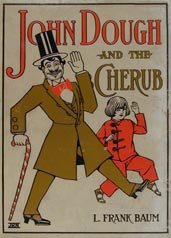
John Dough and the Cherub was written by L. Frank Baum, illustrated by John R. Neill, and published (in 1906) by Reilly & Britton, but (unlike all the other books that fit those criteria) it wasn't an Oz book. Then in The Road to Oz (1909), Baum made the John Dough story part of his Oz universe by bringing John and companions to Oz to celebrate Ozma's birthday party. This would later be called "cross-selling."

John is a giant gingerbread man, about the size of an adolescent boy (and drawn larger than that). He's one of several characters whom Baum portrayed being brought to life and then struggling to adjust to the world. More famous examples are the Scarecrow, Jack Pumpkinhead, and the Patchwork Girl.

John differs from those Ozzy examples in that he magically comes to life in America, not a fairyland. In fact, he's animated on the Fourth of July, and he experiences America's national holiday like this:

As he hurried along he met with few people on the streets; and these, in the dark, paid little attention to the gingerbread man. . . . By and by he heard a strange popping and hissing coming from the direction of the square in the center of the town, and then he saw red and green lights illuminating the houses, and fiery comets go sailing into the sky to break into dozens of beautiful colored stars.

The people were having their Fourth of July fireworks, and John Dough became curious to witness the display from near by. So, forgetting his fears, he ran through the streets until he came to a big crowd of people, who were too busy watching the fireworks to notice that a gingerbread man stood beside them.

John Dough pressed forward until he was quite in the front row, and just behind the men who were firing the rockets.

For a time he watched the rush of the colored fires with much pleasure, and thoroughly enjoyed the sputtering of a big wheel that refused to go around, merely sending out weak and listless spurts of green and red sparks, as is the manner of such wheels.

But now the event of the evening was to occur. Two men brought out an enormous rocket, fully fifteen feet tall and filled with a tremendous charge of powder. This they leaned against a wooden trough that stood upright; but the rocket was too tall to stay in place, and swayed from side to side awkwardly.

"Here! Hold that stick!" cried one of the men, and John Dough stepped forward and grasped the stick of the big rocket firmly, not knowing there was any danger in doing so.

Then the man ran to get a piece of rope to tie the rocket in place; but the other man, being excited and thinking the rocket was ready to fire, touched off the fuse without noticing that John Dough was clinging fast to the stick.

There was a sudden shriek, a rush of fire, and then--slowly at first, but with ever-increasing speed--the huge rocket mounted far into the sky, carrying with it the form of the gingerbread man!
John Dough thus became one of the earliest examples of someone traveling from America to fairyland by rocket.

03 July 2006

Facial scrub

After about a month and a half of dispatches, I stole the time to list the blogs I visit most regularly and the websites I find most pertinent (or refreshingly impertinent).

I don't claim that these are comprehensive lists, even of my own likes. I managed to leave E. Nesbit out of my profile's roll of favorite authors even though I read her books regularly and blogged about her multiple times in my first month.

I've listed blogs alphabetically by title, but sites alphabetically by what I in my hurried wisdom decided were the key words (usually an author's last name). I expect these lists will evolve like germs.

My only other feeble attempt at organization on this blog involves the placement of images. If I find a book cover or other visual item to illustrate an entry, it goes on the upper right if the posting is about "Oz," on the upper left if it's about, er, "Ends."

02 July 2006

Hunting for that crucial "sense of hope"

If I ever need a "sense of hope," I know where to hunt for it: in children's books. If you listen to lots of authors and illustrators talking about their work, it seems like no book can go without.

Author Jane Kurtz:

"So I'm happy if readers take away a sense of hope--and a better understanding of what life is like in different time periods and different places from the ones they themselves inhabit."
Author-illustrator Jan Brett:
"She tries to impart a sense of hope and a sense that children are capable of triumphing over problems."
Author Marty Kaminsky:
"Looking to instill a sense of hope in America's youth, Kaminsky chronicles the lives of 15 athletes who overcame adversity to achieve their goals."
Author Janet Lee Carey:
"The trick is to face the story problem head on and still give the reader a sense of hope."
Author Jenny Robson:
"Jenny believes that a children's book 'must give a sense of hope, of some faith in the future, some belief in some basic goodness'."
Does anyone look for a "sense of hope" with more avidity than children's writers and artists? Of course! Reviewers, critics, and those all-important award committees seem to emphasize that quality even more.

Newbery committee head Susan Faust on Cynthia Kadohat's Kira-Kira:
"What's really compelling here is the quietude of the book, in that there's both pathos and humor, and I think the book kind of radiates a sense of hope from the inside out."
School Library Journal on Karen Hesse's Letters from Rifka:
"Countering the misery and uncertainty are the main character's courage, determination, and sense of hope as well as the happy ending."
Education World on Rodman Philbrick's The Last Book in the Universe:
"It is worth noting that despite the dismal world of the Urb to which Spaz returns, there is a sense of hope at the end of the book."
Resource Library Magazine on illustrator David Diaz:
"Two themes appear consistently in books illustrated and/or written by David Diaz: a sense of hope--even when dealing with social issues fraught with controversy--and a strong and kind mother figure."
Publishers Weekly on author Sharon Flake:
"Sharon Flake raises important issues about self-awareness for African Americans and leaves readers with a sense of hope."
The Governor-General's Award committee on Tim Wynne-Jones's The Maestro:
"This sensitive, imaginative young man has tremendous, strength which invests the conclusion with a tangible sense of hope."
Leonard S. Marcus on author-illustrator Ezra Jack Keats:
"His work has a core of honesty, always leaving children with a sense of hope."
Kirkus on Julie A. Swanson's Going for the Record:
"...this intense story portrays a father’s death in painful detail, balanced with a sense of hope."
The ALAN Review on author John H. Ritter:
"So, what memories, experiences, and events serve as a backdrop for John H. Ritter as he paints literary images that later become powerfully written novels? Novels that not only address our human imperfections, but also leave readers with a sense of hope."
CM Archive on Monica Hughes's A Handful of Seeds:
"Hughes, an experienced story-teller, gently leads the reader through the story, imparting a sense of hope to the younger reader newly faced with this ugly side of the world."
Disability Studies Quarterly takes issue with one book, Jan Needles's My Mate Shafiq, for not offering young readers enough hopefulness :
"...the ending of Needle's novel shows 'hope' at a low premium. 'Realism' is identifiable with sadness. The sense of hope is lacking in this novel: the children 'cope,' but as regards disability there is no sense of any greater understanding, inner growth or liberation. The disabled mothers are a 'problem,' although sympathetically viewed."
(How, I wonder, is having a mentally disabled mother not a "problem" for a young child?)

Myself, I got nothing against hope. I like it. There's probably a "sense" of it in most of the fiction I write, too. So why do I bring up this pattern?

First, I never see the "sense of hope" yardstick being applied to literary fiction for adults. People don't say that Graham Greene or Margaret Atwood or Ralph Ellison should always leave their readers with a sense of hope. What if you were M. T. Anderson and you want to express the attitude: "Yes, I do have hope. Not for the human race--we're doomed--but for the Insect Overlords who will follow us"? (This is from Anderson's Boston Globe/Horn Book Honor acceptance speech for Feed. I quote the version of Ayelle's journal, which is a pretty good match for my own memory of the event. In a better world, this speech would be on YouTube.)

Second, I question whether it's an appropriate goal for so many stories--indeed, the way some people address it, for the entire field of children's literature. For example, i
n 2003 Gary D. Schmidt questioned whether the "sense of hope" approach is appropriate for books about the Holocaust. His review essay in The Lion & the Unicorn says--
"When a child reads a book about the Holocaust--particularly in a pedagogical setting--the adults around that child may assume certain purposes are at play. . . . There is the context of a hopeful ending, even if not a conventionally happy ending--the narrator or protagonist may experience hell, but will survive, and may emerge triumphant, or even still naively innocent. . . . Is a hopeful ending appropriate, even given the audience, or does such an ending almost mock the choicelessness of the victims?"

As we consider those hopeless questions, I invite people to report more spottings of the wandering sense of hope in the world of children's literature.

01 July 2006

Harry Potter fill in the blanks

This is an unauthorized mash-up of two powerful brands: Mad Libs and the Harry Potter books. ®®®®®!

In the following passage, fill in the blanks with adverbs (if the blanks end in “ly”) or with adjectives or nouns that signal basic emotions and facial expressions. Then check page 458 of Harry Potter and the Order of the Phoenix (U.S. edition) to see how many you guessed.

“Did you kiss?” asked Hermione ________ly.

Ron sat up so fast that he sent his ink bottle flying all over the rug. Disregarding this _________ly he stared _________ly at Harry.

“Well?” he demanded.

Harry looked from Ron’s expression of mingled ________ and ________ to Hermione’s slight _____, and nodded.

“HA!”

Ron made a __________ gesture with his fist and went into a raucous peal of _______ that made several _____-looking second years over beside the window jump. A ________ ____ spread over Harry’s face as he watched Ron rolling around on the hearthrug. Hermione gave Ron a look of deep ________ and returned to her letter.

“Well?” Ron said _______ly, looking up at Harry. “How was it?”

Harry considered for a moment.

“Wet,” he said ________ly.

Ron made a noise that might have indicated __________ or _________, it was hard to tell.

“Because she was crying,” Harry continued __________ly.

“Oh,” said Ron, his ______ fading ________ly. “Are you that bad at kissing?”

“Dunno,” said Harry, who hadn’t considered this, and _________ly felt rather worried. “Maybe I am.”

“Of course you’re not,” said Hermione _______ly, still scribbling away at her letter.

“How do you know?” said Ron in a ______ voice.

“Because Cho spends half her time crying these days,” said Hermione ______ly. “She does it at mealtimes, in the loos, all over the place.”

“You’d think a bit of kissing would cheer her up, said Ron, grinning.

“Ron,” said Hermione in a ________ voice, dipping the point of her

My guess is that most readers will score pretty well. Not because we’ve all memorized HP5 by now, but because most of the missing adverbs and identifiers of emotions aren’t necessary for understanding the conversation. As I’ve written before about this same page, it’s a nice dramatic scene with a good feeling for adolescent psychology.

Now try to play the reverse game with pages 96-7 of Harry Potter and the Sorcerer’s Stone (the first U.S edition, as you can tell by the title). Circle all adverbs. There are only three! Underline all identifications of emotion. You’ll find only two, and in one case the character is clearly acting, trying to make the emotion obvious. And that’s over two pages, not just one.

What’s more, that scene in HP1 is a complex writing challenge. It’s Harry’s first experience with the Weasleys, overhearing them on the train platform. Rowling introduces a whole passel of characters at once. Her point-of-view character doesn’t know their names. He can’t see them clearly. The scene is almost all dialogue. And yet it works on the page. It works damn well.

In contrast, the HP5 scene involves the three main characters of the series. We know them intimately--if not from the first four books, then from the preceding 450 pages. But Rowling had apparently lost the confidence or the desire to cut unneeded adverbs and change some verb-adverb combinations into stronger verbs.

As the passage from HP1 shows, Rowling and her editorial team can do this. And now that the promotional juggernaut for the final book has started, let’s hope they do.