30 September 2013

Always in Moderation

This photograph by Carl Tsui captures me moderating one of the panels at the Massachusetts Independent Comics Expo in Cambridge this past weekend.

This was the panel on “Reinterpretations of Classics.” The previous day I’d emceed a discussion of “Educating with Comics,” which was really about communicating science topics in comics form. (I don’t have photos of that one.)

I think discussions of comics benefit tremendously from visual content—comics are a combination of words and pictures, after all. So I prepared brief PowerPoint introductions for all eight panelists showing samples of their work and their book covers.

I’m also proud of the trick shown below: ending each slide show with the panelists’ names and a representative or recent book cover to hover over their heads. That let audience members who came in late or lost track of the intros identify the panelists, and gave their books an extra push. And of course it gave me the authority to tell the panelists where to sit.

29 September 2013

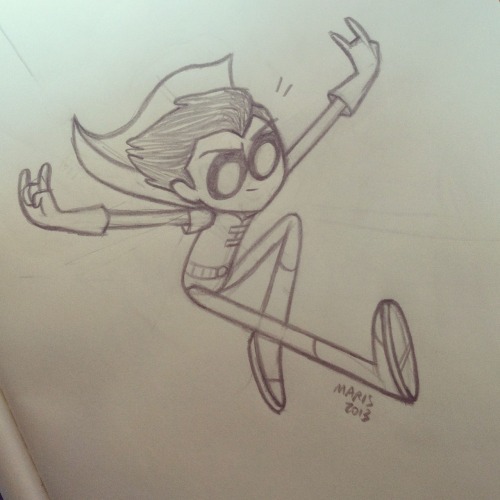
Once a Flying Grayson

I’m featuring this sketch by Maris Wicks in honor of the panel that I moderated at yesterday’s Massachusetts Independent Comics Expo, featuring her, E. J. Barnes, Kriota Willberg, and Rosemary Mosco.

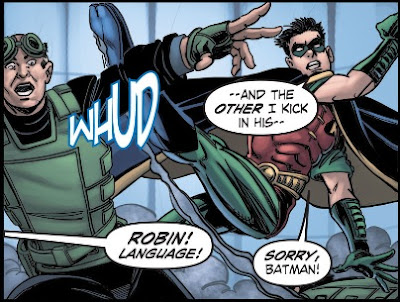
Maris and her sidekick Joe Quinones (his 2008 version of the TV Teen Titans Robin back here) recently collaborated on a story in the first issue of the Batman Black and White magazine. No Robins appear in their Harley-and-Ivy tale, but Dick Grayson had a fine New Frontier-style showcase in Chip Kidd and Michael Cho’s story earlier in the same magazine.

Today at MICE I’m moderating another panel, this one featuring R. Sikoryak, whose version of Robin provided the moral center of his version of Crime and Punishment.

24 September 2013

Looking in on St. Nicholas

If I were in Manhattan Friday afternoon, instead of getting ready for MICE, I’d try to attend this lecture at the New York Public Library: “St. Nicholas Magazine: a Portable Art Museum”:
In November 1873, American publisher Scribner and Company published the first issue of a new illustrated monthly magazine for children, St. Nicholas Magazine: Scribner’s Illustrated Magazine for Girls and Boys. Contributing to its success was the editorial vision of its first and most influential editor, Mary Mapes Dodge, who was to create a new kind of magazine for children, one in which illustration and art education were important foci.

The greatest expression of St. Nicholas’ art education program is seen in its many reproductions of fine art and architecture from Antiquity, the Old Masters, and contemporary academic artists. These reproductions accompanied art historical information, illustrated fictional stories, or stood alone for the reader to contemplate.

St. Nicholas also contained the work of trade illustrators who would become famous through the distribution of illustrated magazines, including Howard Pyle, Jessie McDermott and Reginald Birch. Contained between the two heavy, matte paper covers were innovative and artistic layouts, typography, and decorative designs that consciously paralleled the styles of the predominate artistic movements, such as those associated with the American Renaissance and English Aestheticism, that were popular among elite, genteel Victorian Americas.
The speaker is Mary F. Zawadzi, an art historian and writer in residence in the Library’s Wertheim Study.

The picture above, courtesy of The Oz Enthusiast, is a poster advertising the publication of L. Frank Baum’s fantasy originally called “The Magic Cloak,” a titled that gradually changed into Queen Zixi of Ix. It probably underwent more rigorous editing at St. Nicholas than any other Baum fantasy; he usually worked with small publishers where he was a big fish and got a fair amount of deference. As a result, it’s one of his best.

23 September 2013

Me and the Massachusetts Independent Comics Expo, 28-29 Sept.

This weekend brings the Massachusetts Independent Comics Expo in Cambridge’s Porter Square, a free show featuring independent and small-press comics from the region’s top creators.

See new mini-comics, original art, and fine graphic novels. Special events for the kids! Hands-on workshops!

And if that’s not enough to get you interested, I’ll be moderator for two panels.

Saturday, 11am to 12 noon
Educating with Comics
A conversation with artists who create comics that entertain and inform, on topics including anthropology, primatology, astronomy and zoology. What are the approaches and techniques that cartoonists use to translate fact into fun? Featuring:
Sunday, 2:30pm to 3:30pm
Reinterpretations of Classics
Comics provides infinite opportunities to adapt, re-vamp and update classic texts, for readers of all ages, from the reverent to the ridiculous. A panel of writer-artists and editors talk about their work in this area, including adapations of Shakespeare, fairy tales, myths and the great works of literature. Featuring:
In addition, I’ll be the volunteer designated to help out at this panel, to be moderated by Brigid Alverson (which is my way of making sure I won’t miss it).

Sunday, 11:30am to 12:30pm
Why YA Comics?
The challenge of creating graphic novels for teens and tweens is finding an authentic voice—one that comes from within rather than above. How have independent creators managed to connect with teens at their own level? What sorts of stories resonate with then? And can anyone over 20 really be trusted? Featuring:
How could you plan to be anywhere else?

22 September 2013

The Good Old Days with Mike W. Barr

Comics Alliance has run a wide-ranging conversation between columnist Chris Sims and Mike W. Barr, who scripted many Batman and Robin stories in the 1980s and recently returned to those characters with a story for DC’s digital-first, out-of-continuity Legends of the Dark Knight series.

As I discussed back here, that story reads like a throwback to the pre-Crisis Batman, perhaps even to the 1960s television Batman. Indeed, Barr says he was aiming for a retro feel, even inventing a new villain who seems to be a very old one. As for Robin:

I’d written the first episode with basically the Jason Todd Robin, and [artist] Tom [Lyle] obviously feels more comfortable with the Tim Drake Robin, which is fine, because he co-created the character. I said “Sure, I have no problem with that whatsoever, whatever Tom is comfortable with,” so we used Tim Drake for the rest of the story. And it worked out fine. As [editor] Hank [Kanalz] pointed out, there are some differences between the personalities of the characters, which we were able to use in the second chapter. Tim is a different character than Jason, and that’s reflected in the story.
But that’s also why the Robin in the first of the three installment reads like smart-mouthed Jason, and why the verbal clues indicating he’s Tim don’t show up until the later installments.

Another striking aspect of the interview is how much freedom Dennis O’Neil allowed his writers and artists when he was editing DC’s Batman line from 1986 to 2000. Early in that period Max Allan Collins and Jim Starlin were making Jason Todd an angrier character with a grittier background, but Barr continued to write Jason as a happy young sidekick facing off against old Batman villains. “Denny O’Neil was always open to those kinds of stories, as long as you set up what was going on,” says Barr.

Furthermore, when it came to Son of the Demon, Barr’s graphic novel with Jerry Bingham:
MWB: The graphic novel took a fair amount of time to come about, because it was such a long story. Denny O’Neil was actually not involved in that as the editor. Dick Giordano was the editor, and it was in the pipe by the time Denny and I were doing Detective, I believe. I always told Denny, “You should look into this because I guarantee you’re going to want to know what’s happening in this story,” but I don’t think he ever did until someone pretty much handed him a Xeroxed copy of the finished book and what was in there.

CA: What was his reaction?

MWB: I don’t know, because he never told me. I have heard stories, and this is hearsay, I’ll admit, but I’ve heard it from a number of sources, that Denny very much disapproved of what I’d done with Batman and Talia. Not only getting them married, which was done as a sequel to one of his stories, but also having a child, which he had absolutely forbidden.
Evidently O’Neil kept himself from criticizing Barr’s story (and his mentor Giordano’s work as editor) even when he “very much disapproved” of how it had used Talia, a character he had co-created. O’Neil would have had the company on his side; according to Barr, “Warner executives” disliked Batman having a child with one of his villains so much that:
[DC publisher] Jenette Kahn herself called me and told me that if that child ever appeared again in a story, she would be fired. I don’t know how much of that I believe, even to this day, but basically we were told to never use that child ever again, he does not exist in continuity anymore.
(Almost two decades later, Barr’s story was the inspiration for Grant Morrison’s saga of Damian Wayne.)

Even today, it appears, Denny O’Neil still hasn’t told Barr that he shouldn’t have told the story he wanted to tell. As an editor, his philosophy was to give his creators room to create, and the results include some of the most popular modern Batman sagas, such as Knightfall and No Man’s Land. Given all the stories coming out of DC Comics today about the in-house staff vetoing storylines in the works, O’Neil’s editorial example seems even more striking.

17 September 2013

“A thing of many interesting gadgets”

The New Republic website preserves Otis Ferguson’s review of the MGM Wizard of Oz:

The Wizard of Oz was intended to hit the same audience as Snow White, and won’t fail for lack of trying. It has dwarfs, music, technicolor, freak characters and Judy Garland. It can’t be expected to have a sense of humor as well—and as for the light touch of fantasy, it weighs like a pound of fruitcake soaking wet. Children will not object to it, especially as it is a thing of many interesting gadgets; but it will be delightful for children mostly to their mothers, and any kid tall enough to reach up to a ticket window will be found at the Tarzan film down the street. The story of course has some lovely and wild ideas—men of straw and tin, a cowardly lion, a wizard who isn’t a very good wizard—but the picture doesn’t know what to do with them, except to be painfully literal and elaborate about everything—Cecil B. DeMille and the Seven Thousand Dwarfs by Actual Count.

The things I liked best were the design for a witches’ castle, the air-raid of the Things with Wings, the control-room in which Frank Morgan is discovered controlling the light and sound effects that make the Wizard. Morgan in fact is the only unaffected trouper in the bunch; the rest either try too hard or are Judy Garland. It isn’t that this little slip of a miss spoils the fantasy so much as that her thumping, overgrown gambols are characteristic of its treatment here: when she is merry the house shakes, and everybody gets wet when she is lorn.
Evidently this review keeps the movie out of a 100% positive rating from critics at Rotten Tomatoes. And while we meet argue with Ferguson’s judgment, he clearly saw the same movie as the rest of us.

16 September 2013

Tim Drake’s “happy personal life”?

As part of a sometimes heated internet discussion on DC Comics’s decision not to approve a storyline about Batwoman getting married, Gavin Jasper quoted the company’s co-publisher this way:
As it turns out, this is what Dan Didio had to say at Baltimore Comic-Con the other day. “Heroes shouldn’t have happy personal lives. They are committed to being that person and committed to defending others at the sacrifice of their own personal interests. That’s very important and something we reinforced. People in the Bat family, their personal lives basically suck. . . . It’s wonderful that they try to establish personal lives, but it’s equally important that they set them aside. That is our mandate, that is our edict and that is our stand.”
In response, Jasper wrote that “Tim Drake was able to make ‘having a family’ work for fifteen years.” And I suspect that Jasper became a fan during that period, perhaps while he was twelve. Not that there’s anything wrong with that, but we do tend to like the superhero stories we grew up with.

J. Caleb Mozzocco picked up on the same point:
…it is interesting to look back to the character’s creation and realize that various editors and writers decided not to make him an orphan right off the bat (sorry; that really was unintentional), but used the ways his life and background varied from Bruce Wayne’s (and Robins I and II) not only to differentiate the character from those others, but as a source of drama (Trying to be a 15-year-old crime-fighting vigilante while keeping it secret from your dad and step-mom, for example).
To be exact, writer Chuck Dixon has said that he argued long and hard against the company’s initial plan and kept Tim’s father alive through the 1990s. He took as his model the Amazing Spider-Man of the 1960s, with Peter Parker as a teenager hiding his arachnid activities from Aunt May.

Dixon’s approach worked and, as Jasper and Mozzocco note, made Tim Drake different from the other characters around him. But it’s also important to note that Tim didn’t have a happy personal life as a result. He had a reasonably happy family that caused him no end of low-level trouble—especially from his clueless, distant, yet often overbearing dad. Tim also had girl trouble, friend trouble, school trouble, and so on.
That provided the right level of drama for the stories Dixon wrote about Tim because it matched the audience, or at least the sensibility, those stories were aimed at. They symbolically explored American adolescence, with Tim feeling capable of acting like an adult and yet held back by his father—just as many teens feel. After years of stasis in that situation, DC moved Tim to a higher level of independence, which involved killing his father and breaking ties with his stepmother.

Batwoman offers a different story. Its hero, Kate Kane, was drummed out of the US military for being gay and took up costumed vigilanteism as a way to make use of her skills. The book is suffused with an apocalyptic Gothic vibe, playing to its artists’ strengths. That means the stakes of its stories have to be higher than Tim’s 1990s worries about his high-school friends.

What would happen if Kate Kane and Maggie Sawyer got married? There would be a big wedding issue. And then there would be trouble. As DiDio said (and Leo Tolstoy hinted before him), there’s not a lot of drama in a happy household. Most likely, Maggie would be put in danger and/or killed so Kate would have a big reason to react—and of course the internet would have a big reason to react, too. That’s the way modern superhero stories work.

TOMORROW: And who bears responsibility for that approach?

13 September 2013

Putting One’s Foot Down about OIP Derangement Syndrome

People with OIP Derangement Syndrome can’t admit to why images of President Barack Obama working in the Oval Office make them so uncomfortable, so they come up with ludicrous explanations.

Back in February 2009 (i.e., before Obama had been in office a full month), Andy Card, former chief of staff in the Bush-Cheney administration, complained that the new President didn’t always wear his jacket on in the Oval Office. Of course, the President whom Card had worked for didn’t always wear a jacket there either. Neither did several of his immediate predecessors. So something else must have bothered Card, something he couldn’t acknowledge and therefore pinned to a jacket.

This month, for the second time, the American right wing erupted over photographs of President Obama with his feet on his desk while speaking on the phone. Back in 2009, conservatives echoed a writer in the Israeli newspaper Haaretz linking the President’s posture to him supposedly being “an enthusiast of Muslim culture.”

According to those 2009 complaints, speaking with his feet on his desk was how Obama showed disrespect for the Israeli prime minister on the other end of the phone. According to this month’s complaints, however, the same posture meant Obama might be choosing to show “disdain and disregard for all things traditionally American.”

The only disrespect in these incidents comes from bigots unable to stomach the sight of President Obama exercising power and trying to justify their visceral dislike by complaining about behavior that didn’t bother them during other Presidencies. Incidentally, the man on the left of the following photograph is Andy Card.

11 September 2013

A Shirt Is a Terrible Thing to Waist

Yesterday I quoted L. Frank Baum’s description in The Patchwork Girl of Oz of a Munchkin boy wearing “a blue ruffled waist.” When I first read that book, I must have glossed over the phrase because:

  • John R. Neill’s pictures show Ojo wearing a white shirt with a ruff around his neck.
  • I had no idea what a “ruffled waist” might be.
This year, thanks to Google Books, I solved that mystery for myself. In 1897, the American Home Magazine published this picture of a ruffled waist.
Elsewhere in the magazine are examples of a shirt waist, blouse waist, silk waist, Norfolk waist, tucked waist, full waist, draped waist, and military waist.

The magazine also used “waist” to mean a person’s midriff or its circumference, as we still use the term (and once in a metaphor for how “the Chesapeake, like a great arm, reaches up and entwines itself about the waist of Maryland”). But obviously turn-of-that-century readers understood that the word could mean a garment of the sort we’d call a shirt.

Thus, Baum described Ojo wearing a blue ruffled shirt, perhaps with vertical ruffles like this lady. And Neill chose instead to draw Ojo with a ruff around his neck and a plainly sewn, if floppy, white shirt.

Baum used “waist” in similar ways in his other fantasy novels. In Sky Island he described the boy Button-Bright this way: “He wore a blouse waist, a short jacket, and knickerbockers.” And in The Scarecrow of Oz, Button-Bright looks like this: “He was dressed in a brown velvet jacket and knickerbockers, with brown stockings, buckled shoes and a blue shirt-waist that had frills down its front.”

Baum always portrayed Button-Bright as an upper-class, fairly precious (though indestructible) little American boy. His mother or governess (he had both) therefore dressed him in loose, frilly shirts. Or, as his contemporaries would say, waists.

10 September 2013

Ojo’s “Ruffled Waist”?

This is the cover of The Patchwork Girl of Oz as redesigned and redrawn by Dick Martin, based on John R. Neill’s art for the first edition’s dust jacket. (See David Maxine’s masterful dissection of this edition at the Hungry Tiger Press.) This is the cover art of the edition I read as a boy.

In chapter two, L. Frank Baum described the young Munchkin hero Ojo’s appearance this way:
He wore blue silk stockings, blue knee pants with gold buckles, a blue ruffled waist and a jacket of bright blue braided with gold. . . .
I don’t recall being held up by the phrase “blue ruffled waist,” though if I’d thought about it, it wouldn’t have made any sense to me. I could see in the illustrations that Ojo wore an elaborate ruff around his neck, not his waist. In fact, how could anyone wear a “waist” since that’s part of the body?

TOMORROW: What a waist was.