29 April 2010

The 99’s Name Is Legion

The Atlantic Monthly is devoting a lot of pixels and ink to The 99, a comic book about young Muslim superheroes. In addition to the print article, there’s a slide show of characters and an interview with creator Dr. Naif al-Mutawa.

The 99’s website offers a free download of the series’s “Origins” issue, written by Mutawa and Fabian Nicieza (who has once again taken up the mantle of writing former Robin Tim Drake for DC Comics). That issue also shows the emergence of one young hero, but eventually the series promises ninety-nine, each with a distinct power.

Which makes me think that Dr. Al-Muttawa has basically reinvented DC’s Legion of Super Heroes. Originally conceived for a Superboy story, this is a group of young people from the future who develop various powers and band together to fight…well, that varies somewhat depending on which “continuity” one reads. As does the lineup of heroes, beyond a core handful.

The 99 offers some innovations, to be sure. One character appears to be a superpowered grant writer. And the kid with circuit lines on his face? He’s not green like Brainiac 5. Most significant to its launch, all of the 99 are Muslim; each is supposed to represent a different Islamic virtue. Though those virtues look very much like the virtues of other belief systems.

In one way, this approach is a good fit for the symbolic nature of modern superheroes, as Douglas Wolk discusses in Reading Comics. Each character offers a chance to explore what his or her defining power and virtue mean. In practice, however, The 99 faces some big storytelling challenges.

One is that such a large group presents too many heroes for most readers to track. The Legion of Super Heroes has the same problem. Some fans argue that its characters are simple to keep straight since their professional names state their powers: Lightning Lad, Triplicate Girl, Invisible Kid, Bouncing Boy, Shadow Lass, and so on. That worked fine back when the comics showed them addressing each other by those names every other balloon. Now, in the cause of realism, stories show more of the characters’ private lives, and they address each other by their given names. For most readers a new Legion issue is like tuning into a long-running soap opera they’ve never watched before.

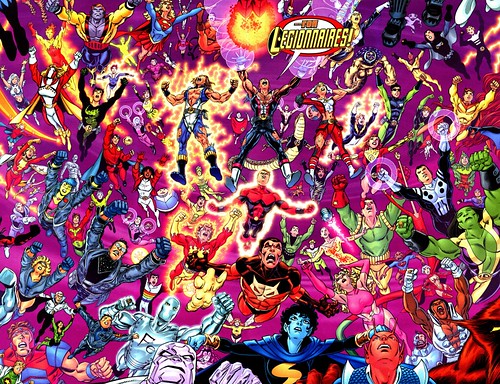
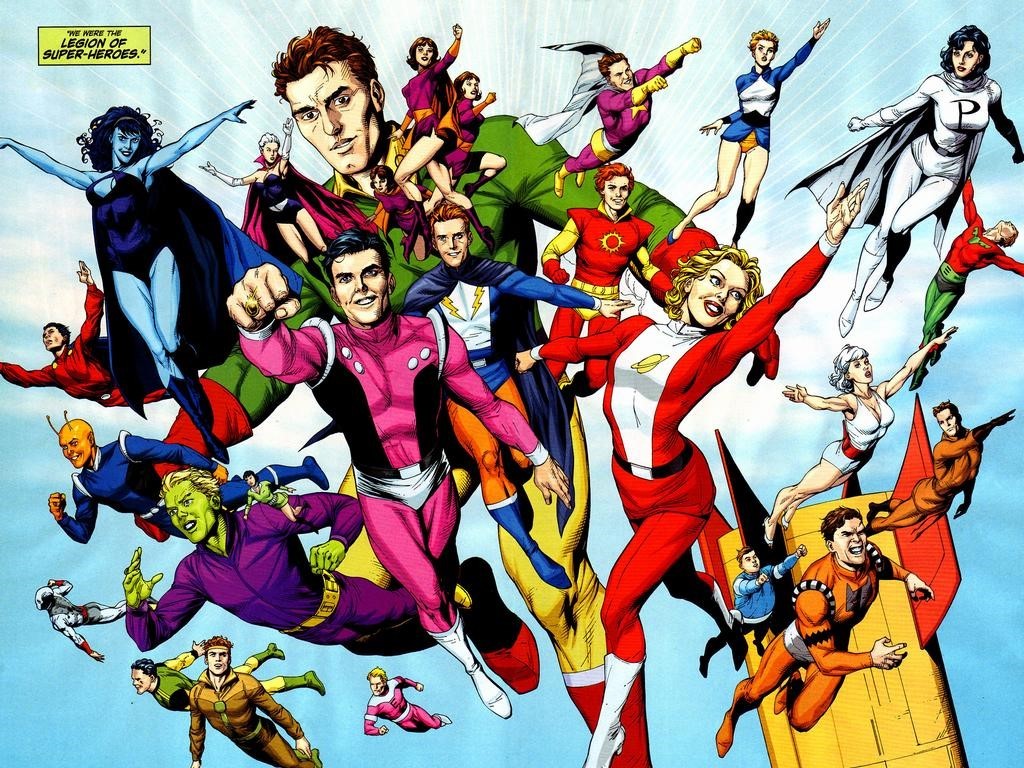
For its established fans, in fact, the Legion’s size appears to be a plus. They apparently go gaga over pictures of the whole group, judging by the number of images available. Can The 99 build to that level of following without half a century of gradual growth?

The second challenge is the tension between collective and individual heroism. Al-Muttawa is trying to make a point about worldwide unity. He sends his characters out on adventures in teams of three or four. (Batch-processing seems inevitable when you’ve got ninety-nine heroes to introduce.) Though readers might identify with favorites, they’re supposed to follow the entire group.

But superhero fans the world over might be seeking a different sort of story. The Atlantic found a “a 36-year-old [Muslim] filmmaker, photographer, and comic-book enthusiast” who said he’s looking for something else:

“I like the image Dr. Naif is bringing with The 99, but unfortunately it’s not very successful here,” he said. Al-Duwaisan still preferred his Batmans to The 99—and not because of too little Islamic subtext, but too much. Al-Duwaisan felt that groups of heroes working collectively missed the very point of the Western comics he adores: the triumph of the individual.

“In the West, there’s one hero,” he said with visible longing. “If there are too many of them, you can’t idolize anyone. I don’t feel the heroism. I am reading Batman because I see part of myself in it.”

27 April 2010

Still Trying to Pin Down Mary Sues

Liz B. at the Tea Cozy pointed me to Laura Miller’s interesting Slate essay on the danger of “Mary Sue” characters. Along with the usual warnings about how annoying such characters can be, Miller writes:

Because genre fiction tends to trade in wish fulfillment to begin with, you’re far more likely to find shameless Mary Sues in mediocre mysteries, science fiction and romance novels. Even in the most routine series fiction, however, there’s a distinction between the kind of character who embodies the fantasies of readers—Nancy Drew, for example—and a character who’s really only working for the author.
The focus on literary wish-fulfillment does indeed help to explain where Mary Sues congregate. And genre fiction does offer easier wish-fulfillment since it tends to offer clearer stakes and resolutions: solving the mystery, finding true love, winning the big game, escaping the zombie,…

At the same time, if the acid test is reader response, that means that no character is a Mary Sue until the story is published and read. And then it’s too late. Miller’s definition seems tautological:
The Mary Sues of literary fiction are seldom as flat-out perfect as the ones found in fan or genre fiction, but they do share the defining quality of Mary Sues everywhere: They irritate readers. Not all readers, maybe, but most of them, which is why there are so few true Mary Sues in literary classics; great writers don’t do Mary Sues.
So characters that irritate most readers are Mary Sues, and Mary Sues are bad because they irritate readers. Literary authors can create stand-in or autobiographical characters because they’re such great writers that they don’t irritate most readers.

So how do folks feel about Levin in Anna Karenina?

And are there genre writers getting their jollies through their characters but skilled enough not to irritate their readers?

26 April 2010

Seeking Clues to the Future of Storytelling

Earlier this month, Publishers Weekly reported on the ashbound London Book Fair’s panel discussion on digital books for children, and I was particularly interested in the comments of author Naomi Alderman:

Alderman suggested that the industry really needs new nomenclature for this digital medium. Neither “book” nor “game” is quite apt to describe something like Alderman’s The Winter House, an online short story, with visuals by Jey Biddulph, that is both linear and interactive. Trying to pigeonhole evolving technological developments doesn’t do justice to the work or honor the medium it is being lumped in with, Alderman reasoned.

For Alderman, new media is exciting, not something that compromises traditional and beloved forms of storytelling. “I hear a lot of fear from writers and publishers, but there are a lot of amazing things you can do onscreen that you can’t do on the page,” she said. Digitized books create new roles between writers, designers, illustrators, and publishers—all of these parties want to tell stories, and with this shared desire at the heart, their collaboration can have compelling results thanks to the fusion of different skills, she added.

Alderman feels that the best use of these new methodologies is “something native to the format,” saying that to attempt a transposition of what already exists won’t do it justice outside of the way it was conceived. Adapting traditional imagery is not always possible onscreen, she said, or even necessarily desirable. Digital books are still in an interim period where creativity can be stretched, but a balance between what is commercially viable with what experimental methods could bring has yet to be established.
I visited The Winter House, and three things struck me:
  • Though the story has undeniable graphic and sonic dimensions, words are the crucial, driving element.
  • The tale has quite a feminist underpinning.
  • I had to restart twice because the animation got stuck at different places, and could find no way to jump in at a particular spot (though I could avoid unnecessary loops in the algorithm).
For the “Divided by a Common Language” category, I note that the “About” section of the website suggests students can try to create their “own Cluedo-inspired board game.” In North America, we call that game Clue.

(The picture above shows a ”modernised” Cluedo layout by the DKPM design firm.)

25 April 2010

Grant Morrison on His Robin

DC Comics has just published the first hardcover collection of Grant Morrison’s Batman and Robin comic book, with art penciled by Frank Quitely and Philip Tan, and is also promoting the simultaneous climax of that sixteen-issue magazine and the Return of Bruce Wayne miniseries. So naturally Morrison’s been doing interviews with comic-book and pop-culture websites.

Even more than many other storytelling forms, adventure comics depend on unexpected plot twists. In promotional interviews, therefore, creators and publishers have to conceal most of what’s coming up while piquing readers’ interest. This game is fairly transparent, yet so many fans don’t seem to see through it—nor to acknowledge that if we actually did know all about what will happen next, reading those stories wouldn’t be nearly as much fun.

The value in such interviews for me is their review of the recent past, the storylines that have been played out and are safe to talk about. Creators can discuss their thinking, working methods, abandoned paths, and serendipitous ideas. In Morrison’s recent interviews, he opened up more about his creation Damian Wayne. For example, he told Comics Alliance:

one of the first ideas I had was “Batman R.I.P.” when I got the “Batman” job back in 2005... all that stuff was there to begin with, the whole Dr. Hurt plotline and Black Glove plotline were there. And as it progressed, as with most of these things, when you get into the work and you start to understand the things that you’re doing, it takes on a life of its own and starts to expand. There are certain things that seem to make sense at the time like making Damian a little bastard and killing him off…
Morrison thus originally planned Damian Wayne as a short-term character, not a permanent addition to the bat-cave. He told Topless Robot of the source for that inspiration:
I always liked those old “Bat-Boy” stories where you would see another kid coming in and taking Robin’s place and Robin would sob in the background, that kind of thing. I wanted to do that story where suddenly Robin was confronted with a very real threat to what he was. So it was the idea of taking the various kind of versions of Batman’s child that we’d seen before, and doing a new one, a real one. . . .
I found that we were able to give him a son and that doesn't really mess up his mythology too much; it seemed like something Batman could have done and still stay true to the integrity of the character. I was quite surprised it worked, because we planned to kill Damian off in the first four issues, and then he seemed too full of potential. . . .

I knew I’d be doing RIP, but I kind of figured that was the end of the line for my story, and then the idea for Batman and Robin came along and the team just seemed such a great dynamic that I had to keep on with it. So no, it wasn’t planned. As I mentioned, we originally intended to kill Damian and do a poignant four-part storyline where he starts out as a really bad kid and ends up as a good kid but dies tragically.
In other words, Morrison intended to write his version of “Punish Not My Evil Son,” a Batman/Teen Titans crossover from 1969 written by Bob Haney and illustrated by Neal Adams.

In that tale, Bruce Wayne gains a new foster son, Lance Bruner, who’s, well, evil. He does things like fake his own kidnapping. Dick Grayson takes some of the blame for the kid’s misdeeds, to the disgust of his superpowered buddies. In the end, Lance is inspired by Robin’s heroism, puts on the red and green costume to help Batman, and gets fatally shot. And that’s all in one issue!

Despite that initial plan, Morrison and DC quickly saw enough potential in Damian Wayne to make him survive that first story arc (Batman and Son), reappear in another (The Resurrection of Ra’s al Ghul), and finally take over the role of Robin.

As I discussed back when the Batman and Robin series began, it reverses the usual dynamic of the Dynamic Duo, especially as exaggerated in Frank Miller’s All-Star Batman and Robin the Boy Wonder. Morrison spelled out that reversal once again in an MTV web interview:
It’s the opposite of the traditional Batman and Robin, because in this case, Batman is a little more happy-go-lucky, a bit more of a lighthearted, upbeat guy, and Robin’s a little bad-ass, scowling monster. We kind of reversed the dynamic, which makes it quite interesting.

I didn’t expect to be doing it, but once I got into it, it became so much fun. It’s really fresh, because these two characters can get involved in stories that might not suit Bruce Wayne, or had a lighter touch, a stranger touch, or some psychedelia. . . .

Dick Grayson makes a great Batman because he’s been developed over the years as this consummate superhero. He was Batman’s original partner, so he’s been trained by the best. So we kind of knew what he would be like, but to throw Damian into the mix and suddenly have Batman’s evil 10-year-old son as the new Robin really created the dynamic that makes the bit work.
It’s notable that Morrison continues to use the term “evil” for Damian, but no surprise. That given name has one overwhelming connotation for us guys who grew up in the 1970s: the devil-spawn in The Omen. All along Morrison’s character has been a test of what the Robin role can accommodate, and conversely whether this boy, even with all his physical talents and training, is up to the job. Because, as I’ve been exploring, Robin isn’t evil.

24 April 2010

Where That Number Came From

On Thursday I posted an analysis of the rumors about recent US Presidents and presidential candidates catalogued on Snopes.com, and how there are many more rumors and false rumors about President Barack Obama than his predecessor. To my surprise, Salon picked that up for its readers.

The folks at Salon were concerned about this statement: “the Secret Service reported a 400% increase in threats to the President when Barack Obama took office.”

They substituted another sentence with a link I supplied: “there was a disturbing spike in death threats to the president in the months after President Barack Obama took office.” Which works just as well.

I decided to revisit the 400% statistic in more detail. It appeared in Ronald Kessler’s book In the President’s Secret Service, published in the summer of 2009. Kessler had the cooperation of the agency and (off the record) past and present agents. He’d written many similar books on Washington doings, including a flattering election-year profile of the George W. Bush White House and an authorized biography of Laura Bush. He blogs for the right-wing news service Newsmax. Politically, Kessler has no reason to overstate violence or threats from the American right.

Three of Kessler’s points made the most news:

  • “There were about 3,000 threats a year under President Bush and now there are about 12,000,” as Kessler told CNN in October 2009.
  • The agency was “cutting corners” on security because of budget limitations.
  • Agents occasionally saw the President sneaking a cigarette.
This article from the London Telegraph shows the worldwide attention that In the President’s Secret Service received.

When Kessler spoke about his book with CBS News, the agency issued a statement denying some of what he had written:
Any suggestion that the Secret Service has “cut corners” in carrying our protective mission is just false. It is always difficult to defend your record against anonymous sources. However, it should be noted that we currently dedicate more personnel, funding and technical assets to our protective mission than at any time in our history and our protective measures and methods continue to increase in scope and complexity, not diminish.
So far as I can tell, the agency didn’t then address the 400% figure, only the “cutting corners” suggestion. Indeed, at that point the Secret Service said it had put more people and resources into protection than ever, implying there were indeed more threats to protect against.

Kessler’s reporting matches what other journalists wrote about the same period when Obama took office. In November 2008, the Associated Press reported:
Threats against a new president historically spike right after an election, but from Maine to Idaho law enforcement officials are seeing more against Barack Obama than ever before.

The Secret Service would not comment or provide the number of cases they are investigating. But since the Nov. 4 election, law enforcement officials have seen more potentially threatening writings, Internet postings and other activity directed at Obama than has been seen with any past president-elect, said officials aware of the situation who spoke on condition of anonymity because the issue of a president's security is so sensitive.
In the same month that Kessler’s book came out, the Congressional Research Service issued a report on the Secret Service, which the Boston Globe described in October 2009:
The domestic threat is also growing, fueled in part by Obama’s election as the nation’s first black president, according to specialists who study homegrown radical movements.

Obama, who was given Secret Service protection 18 months before the election - the earliest ever for a presidential candidate - has been the target of more threats since his inauguration than his predecessors.
Like Kessler’s book, that report also said that the agency was under strain because of its mission was expanding faster than its budget.

We should expect the agency to have a mixed reaction to such reports. On the one hand, its managers want Congress and the American people to recognize its importance and provide a budget that can cover all its responsibilities. On the other hand, they don’t want to appear inadequate or rash, they don’t want responsibilities taken away from them, and when testifying before Congress they’re obligated (like the managers of other federal departments) to support the executive branch’s budget requests.

Secret Service head Mark Sullivan went before a House committee on 3 Dec 2009, and Rep. Eleanor Holmes Norton (D-DC) asked him particularly about the level of threats against the President. Sullivan’s response was quite interesting:
NORTON: Given death threats to this president, was there any attempt to increase the security at this event, yes or no?

SULLIVAN: Ma’am, I can’t talk about that. I would be more—number one, I will address the threats. I have heard a number out there that the threat is up by 400 percent. I’m not sure where that number...

NORTON: Is it up at all? We’re not asking for the threat number.

SULLIVAN: Well, I would—I think it can answer you, ma’am. It isn’t at 400 percent. And I’m not sure where that number came from, but I can... [CROSSTALK]

NORTON: Please don’t assign to me a number in my question. I just asked you if the threats were up. Are the threats up or not, Mr. Sullivan?

SULLIVAN: They are not. The threats right now in the inappropriate interest that we’re seeing is the same level as it has been for the previous two presidents at this point.
Sullivan was obviously eager to put the “400 percent” number into the record (while insisting he didn’t know its source) so that he could deny it was accurate. And Norton, who knows how this game is played, was eager to have Sullivan answer the basic question of whether President Obama had received more threats than his predecessors. Sullivan said no—but qualified his statement with the words “right now” and “at this point.”

Some media outlets interpreted Sullivan’s carefully chosen “It isn’t at 400 percent” to mean that Kessler’s figure had never been correct. But more questioning from journalists revealed that Sullivan’s answer downplayed the number of threats seen just a few months earlier. In December 2009 the New York Times reported:
[There was] a spike of threats against Mr. Obama before his inauguration and in the early months of his presidency, raising deep concerns inside the Secret Service and at the White House.

The threats have leveled off in recent months, officials said, and Mr. Obama now receives about the same as his two most recent predecessors. But several officials said they took no solace that the volume of reports had receded because it was the nature of the threats that concern them and because the factors behind the increase remain — Mr. Obama’s race prime among them.
So as I see the situation, Kessler confirmed the 400% figure as he completed his book during the transition into the new administration and its early months. Or, as I wrote, “when Barack Obama took office.” Kessler’s sources were anonymous but apparently solid: he claims to have spoken to people at two agencies. Other journalists reported before and since that there was an alarmingly high level of threats against Obama at that time. And the Secret Service has issued only the most carefully worded denials of the statistic without providing a different number.

I therefore suspect 400% is reasonably accurate, though only for that period; later months were average. Of course, arithmetically that means the average over the entire year was up. I may have been too bold in writing that “the Secret Service reported” the 400% number, however, because it never issued a formal statement to that effect.

More accurate would be: Secret Service personnel, when cooperating with an established Washington journalist on what they expected to be a favorable book that would reinforce their agency’s importance, anonymously confirmed a 400% increase in threats to the President in the period when Barack Obama took office. After the book proved to be more gossipy than they’d hoped, and not to provide a good picture of the agency’s discretion, Secret Service managers have worked to undercut that figure—without ever explicitly denying it.

23 April 2010

Learning Something New Every Day

Number of children’s books that sold more than a million copies in 2009, according to Publishers Weekly: 20.

Number written by Stephenie Meyer, or based on her novels: 10.

Number written by Jeff Kinney: 5.

Number written by Rick Riordan: 2.

Number written by J. K. Rowling: 1.

Number written by Maurice Sendak: 1.

Number I hadn’t heard of: 1.

So I found the publisher’s synopsis for Tempted: House of Night:

In the sixth installment of the Casts’ [P. C. Cast and Kristin Cast] award-winning, “New York Times”-bestselling teen vampyre series, Zoey Redbird, High Priestess-in-training, finds herself juggling three guys—one of which is so into protecting her that he can sense her emotions.
Teens, vampires, stalking, multiple male leads. It sure sounds familiar. Where did this idea come from? According to an interview with Mama Cast:
Well, it started out with my agent saying “vampire finishing school”…at the [RWA National] Conference in Reno [July 2005, three months before Meyer’s Twilight appeared]. . . .

We were drinking, and she says, “Hey hey hey, I have an idea for a series I need to give you.”

I said, “Okay.”

She’s like, “Vampire finishing school.”

I had been reading a lot of young adult, and I was thinking I would really like to write a young adult series. She was thinking bondage and like college co-eds. I was like, “Meredith, no. No.” I could write that, that would be fine, but I talked her into young adult. It’s made my career. These books have put me in a completely different place.
Indeed.

22 April 2010

The Party of No Credibility

American right-wing leaders are responding to complaints about their adherents’ insults, threats, and acts of violence by claiming that such problems occur on the left as well. Of course, they don’t dare to compare and quantify such behavior. That would mean acknowledging that, for example, Congressional historians find no precedent for Rep. Joe Wilson shouting at the President during a joint session of Congress. Or that the Secret Service reported a 400% increase in threats to the President when Barack Obama took office.

To keep on top of urban myths of all kinds, I subscribe to the Snopes.com update list, and I noticed a pattern there that I thought deserved to be examined more arithmetically. It struck me I was seeing a lot more rumors about President Obama, and a lot more false rumors, than I remembered from earlier years. So I ran the numbers, as of this week.

After eight years in the White House (with Snopes.com around all that time), George W. Bush has been the subject of 47 internet rumors. After less than two years in office, Barack Obama has been the subject of 87, or nearly twice as many.

Even more telling is the relative accuracy of those stories. For Bush, 20 rumors, or 43%, are true. Only 17, or 36%, are false. The remainder are of mixed veracity (4), undetermined (4), or unclassifiable (2).

In contrast, for Obama only 8 of the 87 rumors, or 9%, are true, and a whopping 59, or 68%, are whoppers. There are 16 of mixed veracity and 3 undetermined.

I delved down to the stories that the site designates as a mixture of truth and falsehood. For Obama, in most cases the truth is innocuous while the lie reflects poorly on the President, particularly photographs that are misrepresented or show behavior that produced no complaints when his predecessors did the same. In contrast, in this mixture of truth and falsehood about George W. Bush praying with an injured soldier, the lie reflected well on that President from the perspective of the religious person spreading it.

I looked on Snopes’s Politics page for another pair of politicians in parallel situations, and found the losing candidates of the last two presidential elections. Snopes’s page on John Kerry lists 22 rumors, and only 3 are true (14%). Its page for John McCain lists only 11 rumors, and 4 are true (36%). There are far more rumors about the Democratic candidate, and fewer true ones.

This evidence accumulated over ten years shows a shameful but undeniable fact of American politics: our right wing now contains a lot more liars, and a lot more folks who spread lies out of gullibility or wishfulness, than our left wing.

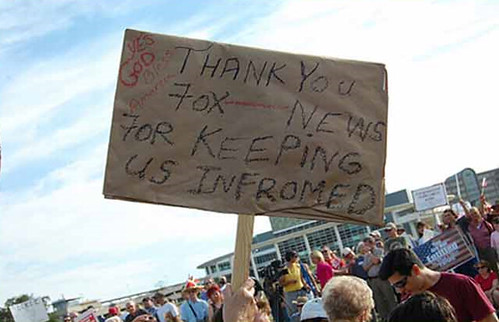
(Image above from the Teabonics Flickr set.)

21 April 2010

Exploring New Themes in Oz

From the Winkie Convention email update comes news of a new Oz comic: The Royal Historian of Oz, by Tommy Kovac and Andy Hirsch. The publisher’s copy:

Frank Fizzle wishes his father would have just a single original idea, instead the Jasper Fizzle sees himself as the new “Royal Historian of Oz” as he insists on writing new Oz stories.

When the failed writer discovers that Oz really exists, he makes an error in judgment that brands him a criminal in two worlds. Frank, may be doomed to pay for the “sins of the father” at the hands of the axe-wielding Tin-Man and the ghost of the Wicked Witch. Can Frank save the day and redeem the Fizzle family name, or will the drizzly ghost of the Wicked Witch of the West destroy them all?
That description suggests this comic will bring a couple of themes to Oz that are notably absent from the original novels. The first is a postmodern discussion of storytelling within the story itself. L. Frank Baum portrayed his fairyland as either a real place or a setting he’d invented to entertain young readers, but not both.

The second is familial tension. Such conflicts drive a lot of old European fairy tales: Hansel and Gretel, Cinderella, Snow White, and so on. But it’s largely absent from the official Oz series. None of the American children who travel to Oz appears to have any siblings until Twink and Tom in Jack Snow’s The Shaggy Man of Oz (1949), and those twins travel together.

Many of those kids are missing parents, but they appear to have good relationships with the relatives who care for them. (One comes out of an orphanage.) The single possible exception is Baum’s little girl Trot, whose mother when she first appears in Sea Fairies (1912) is a short-tempered scold, but who basically vanishes from the page when Trot enters the Oz series in The Scarecrow of Oz (1915).

Nor are Baum’s young heroes from inside Oz having problems with their parents. They’re orphans or young people out on their own. The one exception to prove this rule is Kiki Aru, antihero of The Magic of Oz (1919), and his biggest problem is that when he’s in an adolescent snit and refuses to attend a community picnic, his parents sigh and leave him at home. (So annoying!)

20 April 2010

Divided by a Common Language in The Ghost Writer

As someone who’s ridden the Lake Champlain ferry annually for the past few years, I found the opening sequence of The Ghost Writer to be very evocative: the crew of a big ferry tries to unload cars, but one SUV won’t move. Gradually the car bay empties out around that empty vehicle, leaving it to be towed away. And soon we hear that its driver jumped off the ferry during its voyage.

The movie is set off the coast of Massachusetts, but because its director, Roman Polanski, was a fugitive from justice in the US, it was shot in Europe. Every so often, that fact leaked through. Not because of the landscape, but because of quotidian details.

When the title character drives onto that ferry later, the ticket seller asks him, “Single or return?” instead of “One-way or round trip?”

And when he spends the night in a sleepy, off-season hotel, his bed is equipped with a duvet instead of blankets and sheet tucked severely under the foot of the mattress. That rarely happens in the US, alas.

18 April 2010

Dig This Now

I had drafted a weekly Robin posting continuing my thoughts on the 1980s symbolic distancing of Batman and Robin, but then I read the lead story in World’s Finest Comics, #195, and it was all I could think about.

As you see, this magazine shows Superman and Batman forcing Robin and Jimmy Olson to dig their own graves. Furthermore, Batman is threatening to shoot the young men with a machine gun. This image is so incongruous that Dr. Wagner has written:

The best thing about the covers to WF was they were all lies. They would show you Superman running down Batman in steamroller and then in the story NOTHING like that would happen. . . . I don't even know what really happens in this comic, but I bet that this particular scene never takes place!
And yet it does. This is actually one of the more accurate comic-book covers of its period. The only non-verbal detail missing from the scene inside is the machine gun; there Batman carries a pistol with a silencer.

Indeed, I wonder if DC Comics came up with this arresting image first, then assigned Bob Haney to write a story around it. Because the story sure doesn’t make sense on its own.

The narrative begins in the previous issue of World’s Finest. Superman has infiltrated a mafia gang by posing as a bald man named Scarns. The boss, with the unstereotypical name of Lukaz, requires Scarns to prove his loyalty by killing one of the underworld’s enemies—lazy playboy millionaire Bruce Wayne! Actually, in 1970, when this magazine appeared, DC had made Bruce Wayne a socially conscious, activist millionaire, so that murder might have made a little sense. The two crimefighters concoct a way to make Scarns appear to kill Wayne in a horse-riding accident, which in no way now brings on thoughts of Christopher Reeve’s paralyzing injury.

Lukaz then shows Scarns that he’s keeping evidence of that murder to ensure his new underling’s loyalty. Superman sets out to retrieve that evidence in order to…protect a fake identity from being accused of a fake murder. Even with X-ray vision, he can’t find the hidden material, so he and Batman capture the mafia boss and—
  • Take Lukaz to jail for attempting to instigate the murder of Bruce Wayne?
  • Scare Lukaz until he divulges his secrets?
  • Stash Lukaz in Superman’s Fortress of Solitude while Batman disguises himself as the boss and infiltrates the gang that Superman’s already infiltrated?
Naturally, Haney’s plot follows the third path.

But that riding accident has given Bruce Wayne a very unusual brain injury. He starts to believe that he actually is the mafia boss he’s disguised as. Yet he also remembers that Scarns is Superman. Lukaz-Batman exposes Scarns-Superman to green kryptonite, rendering him so weak that the only way Superman can save himself is to—
  • yank Batman’s disguise off, thus endangering them both but shocking the rest of the gang?
  • call his superdog Krypto to his rescue?
  • use ventriloquism to make it sound as if Krypto is hovering outside the window, causing the whole gang to rush out, even though the kryptonite would work just as well against the dog?
Once again, we go through door number three.

Superman then acts as if the kryptonite has produced a very unusual brain injury: he pretends to have lost his memory. The mafia boss, who’s still the amnesiac Batman, tells Superman that he’s Scarns and has been fortunate enough to develop superpowers. (Don’t you love when that happens to you?)

Superman fakes being able to crush a crystal of kryptonite, which should tell any mob boss—let alone one who’s actually the world’s finest detective—that something fishy is happening. But instead Boss-Batman remains convinced that Superman now actually believes he’s a mob underling with superpowers.

To recap: Superman thinks that Batman thinks that Superman thinks that Superman’s an underling in the mob that Batman thinks he’s leading. Boss-Batman secretly knows that his underling is actually Superman while Scarns-Superman secretly knows that his boss is actually Batman—but Batman doesn’t know that.

Batman then has Superman (pretending to be Scarns pretending to be Superman) summon Robin and Jimmy to Metropolis and orders them to dig their own graves. This seems fair since World’s Finest, #141, a mere six years before, showed Robin and Jimmy faking their own deaths to fool their adult pals. That tale (written by Edmond Hamilton) involved intelligent, mind-controlling gemstones that simply wanted to return to their home planet and used the young men to raise funds for them. But I digress.

Having completed his grave, Robin tells the man he thinks is Lukaz:
Let Batman know…I died thinking of him! He taught me to live bravely…and to face death the same way! I love him as I loved my own father!
This expression of filial love snaps Batman out of his amnesia. He pulls off his Lukaz mask and puts back on his Batman mask.

But it’s too late! The real Lukaz suddenly appears with real underlings holding real machine guns. He explains that up in the Fortress of Solitude, one of Superman’s robot servants became loyal to him after falling and suffering a very unusual processing injury.

Lukaz then—
  • realizes that having a superpowered, completely loyal robotic servant means he doesn’t need human underlings?
  • recognizes that shooting Batman, Robin, and Jimmy Olson would mean there would be nothing left to stop Superman from grabbing the whole gang?
  • accepts Superman’s offer to kill Jimmy and Robin with his heat vision?
I don’t want to spoil the entire story for you, so I’ll let you figure out that last one on your own. I’ll just say the dénouement involves wax dummies, picking a lock with superbreath, and a lucite box containing charred organs labeled:
Hearts of Robin and Jimmy Olson Killed by Alonzo Scarns
Because that’s the only way Superman can think to make Lukaz think that Superman still thinks he’s Scarns.