06 October 2009

Wizard of Oz Back on Bestseller List

This time it’s the graphic novel adaptation by Eric Shanower and Skottie Young.

The original novel appeared before modern book bestseller lists, but it was clearly the children’s-book hit of 1900. The musical extravaganza adapted from it for Broadway in 1903 was the boffo stage show of that time. The 1939 movie, often said to have been a money-loser, was the second biggest grosser of that year, (way) behind only Gone With the Wind.

More recently, in the last few years the second edition of Michael Patrick Hearn’s Annotated Wizard of Oz and Robert Sabuda’s pop-up adaptation both made the New York Times Book Review lists. And now the Marvel comics adaptation is on the graphic-novel bestseller list, most recently #3.

I’ll quote from the perceptive review (i.e., I agree with its points) from The Graphic Classroom:

Shanower took care in this adaptation by giving us details that have – for most people anyway – been lost because of the celluloid translation. In fact, so many details were left out of the movie that many parts of this book give the reader new insight – new teeth – with which to chomp into this new-old story. From the green goggles worn in the Emerald City to Dorothy’s magic kiss, to the fact that Oz sees each of the four individually (and always in a different form), or the fact that the flying monkeys only did the Wicked Witch’s bidding because they were forced to, it is to the reader’s delight that the old story is fresh.
And another from Sequential Tart, which looks at comics from female fans’ perspectives:
Best of all, Dorothy maintains her status as an ‘every’ girl, brave and kind, to whom all children can relate. It is Young’s portrayal of her that brings the visual realism to the story. If we can believe in Dorothy, then we can believe in Oz, the Munchkins, and a talking Lion!
And of course we can believe in Dorothy Gale.

05 October 2009

At Last It Can Be Told

I once again volunteered to be a judge for the Cybils Awards. In past years I was part of the process for Fantasy and Science Fiction, Graphic Novels, and Middle-Grade Novels. This year I decided to mix it up with Nonfiction Picture Books, and my fellow mixers are:

And me.

The nominations period lasts through 15 October.

04 October 2009

A Return to Carrie Kelley

Last month the weekly Robin examined a couple of times in the early 1980s and ’90s when Batman creators considered making Robin a black teenaged boy. In that same period, writer-artist Frank Miller did what many fans found even more radical: he made Robin a girl.

Of course, readers didn’t have to accept that portrayal as real. Miller’s The Dark Knight Returns miniseries depicted one possible future for Bruce Wayne, after he and his fellow superheroes have been driven underground or coopted by an authoritarian US government.

Gotham remains crime-ridden, and an acrobatic, hero-seeking teenaged girl named Carrie Kelley spends two weeks of lunch money to make herself a Robin costume, then finds herself rescuing the aging caped crusader and becoming his sidekick.

An Oz and Ends reader named Raius spontaneously sent me an essay on Carrie Kelley, perhaps not realizing how hungry a daily blogger is for material. So I asked if he’d share those thoughts with the world, and here they are.


The first time I read Dark Knight Returns, Carrie Kelley was one of my least favorite elements. I didn’t like Robin being a girl, I didn’t like her lack of really obvious talents or skills, and I didn’t like the way she talked.

I was a lot younger then. I recently re-read the book. All I could think as I read it was, “This is exactly what Batman’s dynamic with Robin should be like.” I loved all the little nuances of how he sees her, why he lets her join, and why he likes having her around despite Alfred’s protests and the cries of child endangerment from virtually everyone else.

To Bruce, kids are serious business. He took himself seriously as an eight-year-old with murdered parents, and he sees himself in all children. He likes having a kid around because it keeps that part of him alive. He likes their hope, their naïveté, their sincerity, their openness to teaching, their recklessness, their devotion, and their simplistic view of right and wrong, so close to his own.

With Carrie, we see all of this. Batman revels in mentorship. When she complains about waiting on ledges, he enjoys teaching her about patience, something he probably wishes he’d been able to learn earlier. He likes her pluckiness, the way she just states she’s Robin, and he accepts the assertion. He enjoys her ingenuity, when she changes the controls on the helicopter to help him out, even in defiance of his orders. He admires her bravery as she starts to fall to what could easily be her death and notes that she doesn’t make a sound. As a much older man at this point, he envies her youth and potential, as he watches her learn to ride and grow. He empathizes with her loss of innocence as she sees a man who was trying to kill her fall to his death, even as he relies on her resilience in dealing with such things and her continuing support of him and his war, contending with threats that are really years beyond her.

She embodies everything that gives him hope, that makes the mission about more than his own demons. Last but not least, he just seems to enjoy having someone out there with him, someone to share the night with.

Also, all of these things are implied about his earlier relationships with Dick and Jason, to one degree or another. He remembers Dick as his “little monkey wrench”—that little x-factor that skewed bad situations in his favor.

In some ways, I feel like he even sort of preferred Jason because the age difference between them was greater, he was more of a fixer-upper, and possibly even more of a son to Bruce. Dick was almost more like a little brother, who’d already had his own strong parental figures, and eventually becomes his own man, with his own views and such (not quite so positively in the Millerverse, but I tend to ignore The Dark Knight Strikes Again). I always loved that line about Jason. “I will NEVER forget Jason. He was a Good Soldier. He HONORED me. But the WAR goes on.” Just got me right here, ya know? He had so much to teach Jason, who had so much life left to learn it in, and then he died a hero’s death. No wonder Batman retired in Miller’s ’verse. His hope died with Jason.

So anyway, I came away with a much more charitable view of Carrie Kelley, if only because she works as such a wonderful foil for Bruce, someone to bounce things off of that we wouldn’t see otherwise, which is of course one of the original “Reasons for Robin.” She’s still not my favorite, but I think portrayals of other Robins could maybe learn something from her dynamic with Batman.


Thanks, Raius!

All the pictures in this posting come from The Dark Knight Returns, which offered the darkest portrayal of Batman until then. As you can see, Carrie Kelley with her light red hair, her green sunglasses instead of a mask, and her traditional Robin costume with turned-up toes is the lightest, most colorful Robin to date. The Dynamic Duo’s visual contrast thus became even more striking.

The Dark Knight Returns remains only one potential future for Batman, and Carrie thus remains only a potential Robin. But of course symbolically any Robin is all about potential.

02 October 2009

Me So Horn Booky

I’m just home from the Boston Globe/Horn Book Awards at the Boston Athenaeum. (All winners listed here.)

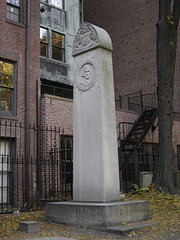
Since I grabbed the chance to do a little Boston 1775 research before the ceremony, I came down the elevator and stepped right into the VIP gathering. Before I could get too uncomfortable, though, Roger Sutton called M. T. Anderson and me over to tell Candace Fleming about folks next door in the Old Granary Burying Ground. Ben Franklin’s parents! Paul Revere! John Hancock (remembered at left)! John Hancock’s slave Frank!

Candlewick continues to do well at this awards show, having Honor Books in all three categories. HarperCollins, with its bigger list, also took in three. All the thank-you speeches were good, with Terry Pratchett’s (delivered by his US editor, Anne Hoppe) the stand-out. Neil Gaiman sent both the text of a speech to be read and a video, but the video part didn’t work so we got to hear only his disembodied voice—quite appropriate, really.

I remain astonished by the cheeses that the Athenaeum obtains for its receptions. They’re even drier than the crackers and the wine. On one tray was a half-keg of what looked like a light and fluffy Camembert, but you literally had to chip shards off it with the little round knife.

01 October 2009

Cybils Nomination Season Begins!

The call has gone out for nominations for the 2009 Cybils Awards! The invitation reads:

All kids books published in English between Oct. 16, 2008 and the close of this year’s nominations are eligible. Nominations close at 11:59 p.m. on October 15th. . . .

First, some important advice:
  1. Brush and floss daily.
  2. Nominate only one book per genre.
  3. Pick a book you’re passionate about.
  4. See rule #3 above.
I mean, geez, if you’re kinda iffy on a book, why would you want to inflict it on us? We want to read books you think we shouldn’t miss.
This year there’s a handy nomination form, for which you’ll need your nominee’s 13-digit ISBN.

“Sometimes the Voice Works, and Sometimes It Doesn’t”

From Publishers Weekly’s recent long interview with Richard Peck:

You often write in the first person. Why?

I was a teacher once, and as a teacher I was painfully aware of how long students would listen to me, as opposed to each other. Writing in the first person keeps me—the alien adult—off the page and off the stage. It also provides a healthy control on language. If I wrote in the third person, too many multi-syllabic words and adult locutions would steal in. First person controls that, and it increases the intimacy of the experience, as if one young person is saying to another, “Let me tell you a story.”

What is one of the biggest challenges for you in writing a novel?

Finding that young voice which will be the right one to tell the next story. Will it be a boy or girl? Now or then? Urban or rural? I have to do casting calls—sit down and start writing in a particular voice. Sometimes the voice works and sometimes it doesn’t, and I have to know when it doesn’t.
This interview comes on the occasion of Peck’s A Season of Gifts.

30 September 2009

Boston 1775 Travels the Road to Revolution!

Over at Boston 1775, I’ve been exploring Road to Revolution!, a graphic novel for kids by Stan Mack and Susan Champlin published by Bloomsbury just in time for the new school year.

This comic novel (in both meanings of the term) uses a lively fictional story with dual protagonists—boy and girl—to relate the outbreak of the Revolutionary War.

My posts included:

And along the way there was a look at Paul Revere’s word balloons.

I hear Mack and Champlin will be based in New York for the rest of the year, and are ready to talk at schools and libraries about researching history and drawing comics.

29 September 2009

The Psychological Distance of Noninteractive Media

Seth Schiesel sat down to review a slam-bang-punch-’em-out videogame for the New York Times. He ended up having to consider the differences in how stories differ from interactive entertainment in the psychological distance they offer consumers.

Schiesel’s review lays out the premise of the game Marvel: Ultimate Alliance 2:

In a panic, Congress passes and the president signs the Superhero Registration Act, requiring all heroes to submit to government oversight and monitoring. The fearful public approves.

And so the heroes are split between the pro-registration loyalists led by Iron Man, who believe that submitting to the government will increase security, and the anti-registration rebels led by Captain America, who believe that the act is fundamentally, uh, un-American.

You, the player, must choose a side. . . .

This story arc, known as Civil War, was first explored in a series of print Marvel comic books written by Mark Millar a few years ago. I’m not a comic-book expert, but after playing Ultimate Alliance 2 I read the main Civil War books. What I found was a nuanced, probing examination of the interplay between freedom and security that has always defined Americans’ discussion of civil liberties. . . .

Noninteractive media like books and movies allow the viewer some psychological distance from the characters. That sense of remove is a big part of how linear media can explore complex topics of morality: by depicting characters you are not expected to agree with, but merely understand. Great tragedies, after all, are propelled by characters who believe they are doing the right thing, not those trying to be villains.

For instance, a depiction of the psychological struggle of a Nazi soldier as he tries to reconcile his genuine patriotism with a realization that he is serving an evil regime could make a great novel. Books and films are filled with poignant characters who believe they have to do the wrong thing for the right reason. In a civil liberties plot like Marvel’s Civil War, the noninteractivity of print may allow readers to empathize more easily with the motivations of a character they disagree with.

But a game forces the player to occupy a character. That psychological distance is eliminated. And so the other side must be reduced merely to the Enemy. The story of that Nazi soldier would make a culturally uncomfortable, and politically impossible, video game because the player would probably have not merely to witness but also to act out the killing of Allied soldiers and possibly civilians.
One of the benefits of reading fiction, critics have long said, is that it allows us to experience other people’s lives for a time, increasing our understanding and empathy. But can there be too much empathy? Is that effect overwhelming when we’re not simply reading about someone, even reading that someone’s thoughts, but actually making decisions for him?

28 September 2009

Neal Adams and the New Fall Colors

Yesterday I showed the cover of DC Universe Illustrated by Neal Adams, vol. 1. That frantic artwork isn’t the only new material created for this volume. Adams’s studio also extensively reworked the interior pages starting from his line art. I’d read fans’ debates over what changed from the initial publication in magazine form, but the whole point of comics is that artwork conveys information that words can’t, so I went looking for some actual visual examples.

The following are panels from a larger selection posted by AussieStu at these two pages. First, a look at Ralph and Sue Dibny from Adams’s first superhero assignment. The coloring is obviously improved from an aesthetic point of view. Ralph’s face stands out better from Sue’s sweater, as do other details. The background looks more realistic. Sue’s hair isn’t cut off by the word balloon at top.

Most significantly, modern digital coloring allows for the characters’ faces and other curved surfaces to be “modeled” with shadows and a gradation of flesh tones. Previously, comic-book coloring was basically paint by numbers. The draftsmanship of the time was designed around the limits of the coloring method.

Though Adams wasn’t involved in coloring his drawings then, he had strong feelings about the process. He recalled badgering DC into expanding its palette, for example. So he no doubt was delighted to have the chance to use more sophisticated methods (and, it’s clear from comments on his website, to have DC pay for the new work).

However, sometimes those revisions have come at a cost. Here’s another example from the same book, in a tale of Clark Kent babysitting. The coloring pops more, and the curves of the little boy’s body are softer. But in these panels we can see a bigger change, starting with the word balloons.

Perhaps because the collection has a smaller trim size than the original magazines, perhaps because fanboys’ eyes are aging, Adams’s studio appears to have scanned the lettering and reproduced it slightly bigger, relative to the panel size. That produced new, clumsier line breaks and spacing and, with long speeches, larger balloons. In this panel, the top balloon is so big that it’s crowded Adams’s artwork off the bottom of the panel.

Here’s another comparison from that Clark Kent story. The new coloring is more dramatic. The new lettering is more horsy. There are other changes evident in the DC Universe Illustrated volume. Some sound effects have obviously been recreated digitally. One tale features dinosaurs, and their skin looks like the modern conception of those animals; I suspect the original publication rendered them quite differently, according to the 1960s science.

In sum, this collection doesn’t show Neal Adams’s work as it originally appeared, in the form that made his reputation as a leading comic-book artist. But apparently it shows his artwork as he’d prefer it to be preserved. Which is the definitive version? Well, we can have that debate about lots of artists and writers.

Here are more eye-opening examples of comics that have been recolored:

27 September 2009

The Legend of Jericho and the Teen Titans

This is one of the more dramatic and less flattering Robin images of recent years, drawn specially for the cover of DC Universe Illustrated by Neal Adams, vol. 1, the latest in a series of hardcover reprints of Adams’s artwork for DC Comics in the late 1960s and 1970s.

Earlier volumes covered Adams’s ground-breaking work on Green Lantern/Green Arrow, Deadman, and Batman (including the Batman/Teen Titans crossover, “Punish Not My Evil Son!”, a precursor to today’s storyline of Bruce Wayne suddenly acquiring a son of questionable morals).

In this volume DC leaves no barrel unscraped by assembling a miscellany of Adams’s superhero and war stories, including three issues from the Teen Titans in 1969. The story behind those issues is actually more interesting than the story they tell. The backstage drama appears in Adams’s introduction to this book and in the interviews in The Titans Companion, volume 1, by Glen Cadigan.

At the time, Adams was among the younger creators at DC Comics, pushing the company to make its magazines both technically better and more socially relevant. People came to see him as a mentor and advocate of a couple of even younger writers, Marv Wolfman and Len Wein.

In late 1968 they scripted an issue of Teen Titans that team introduced a not unsympathetic Soviet superhero—a daring move at the time. And they had an even more daring idea for their next assignment.

As Marv Wolfman told Cadigan:

We met with [editor] Dick Giordano, and told him our idea of a gang, a black super-hero, and of a fairly straightforward type of story, closer to what we were seeing in Spider-Man, but with the Teen Titans. We came up with a black character because DC didn't have any at the time. . . .

Dick liked the story concept, but knew that there could be some problems because of the time period, and brought us into Irwin Donenfeld’s [office], who I guess was the Vice-President; I forget the exact title. We met with Irwin for maybe fifteen minutes at most. Irwin said he really wanted us to try to do this, try to make it a multi-parter—which, in itself, was incredibly exciting—to really be powerful and very street and very authentic, and try to get down and dirty, get a lot grittier. . . .

A couple of weeks later we came back, and at that point Irwin had left and there was a new person in charge. Whatever the reasons were, because there are so many differences of opinions on this, the story got dropped. Whether it was actually because it was a bad story, or whether it was because of some other reasons, I don’t know.
Actually, the DC editorial team was aghast at what Wolfman and Wein had delivered. They were probably prepared for Jericho to be DC’s first black hero (as Marvel had already introduced Black Panther and Falcon), but the young writers had gone really “down and dirty.” Giordano recalled:
Len and Marv came back with a story that everyone but me, evidently, thought was too preachy in its approach to the race problem. Carmine [Infantino] brought the lettered pencils that he may have had on his desk to design a cover and threw it on my desk, rejecting it! It was already a tad late and there was no way of my replacing it on time. But for Neal Adams!
And Adams picks up the tale:
Not only was it a black character, but it was a black character who was very aggressively mouthing anti-white [dialogue]. Very, very aggressive black-oriented dialogue, right off the bat. . . .

I started to hear some really hostile reports relative to the script from Carmine. Everybody was just lit up, and I was worried about [them]. Here Len and Marv were trying to make it into the business, and they had just fried their own chicken. So I was concerned about them. I checked into it, and I asked if I could read the script. I thought, maybe just a little doctoring of the script could fix it.
Of course, since people perceived Adams as Wolfman and Wein’s sponsor, a bit of his own reputation was on the line. Here’s how he describes that moment in the DC Universe Illustrated volume:
Len and Marv appealed to me to step in. . . . I went in and made a case. The suits read the dialogue to me...aloud.

I said...just have Len and Marv modify the language.

They didn’t trust them to do it. I volunteered to do it.

They asked did I read the whole script?

I hadn’t. So I did.

Oh. Golly.

Yep, they had done it. It pushed so hard that DC wouldn’t abide it. No amount of dialogue doctoring would turn it around. Len and Marv were ahead of their time. DC wasn’t.
And the deadline for that multi-issue arc was getting tighter. Adams suggested that he could write a similar story without the racial angle, one which probably had to fit the announced title “Titans Fit the Battle of Jericho.” Infantino insisted that Adams needed to pencil the story himself in order to keep the magazine on schedule. The result is a crazy casserole of youth politics, giant robots (as shown at top), masked men, guest stars, crime bosses manipulated by interdimensional monsters, and more.

Adams wasn’t too pleased with his hurried work for Teen Titans, #20-22, in terms of writing or art, but felt that he’d helped preserve Wolfman and Wein’s careers. Giordano saw the whole thing as “my blunder,” and regretted that he and his fellow editors were ordered not to use those young writers. Wolfman recalled, “Len and I didn’t get work for almost two years from DC.”

At least that’s the legend of Jericho. Except that Wein told Cadigan that DC blackballed him and Wolfman over something else, which he didn’t specify:
It was nothing to do with that story. It had to do with an entirely different situation. . . . Something had happened that we were accused of which we were not responsible for. We were sort of blackballed there, and when it was eventually proven that someone else at the company, who had been there for many years, was responsible, they shame-facedly said, “We’re sorry. Never mind,” and we came back to work for them.
That discrepancy is a mystery for comics historians to solve.

In early 1970, longtime DC editor Robert Kanigher (1915-2002) introduced DC’s first black superhero, Mal Duncan, in the pages of Teen Titans. [ADDENDUM: More of that story, and editor Dick Giordano’s use of coloring to minimize complaints about an embrace between Mal and a white girl, at Comic Book Legends Revealed, #229.]