31 May 2008

Near Earth

The Atlantic's June issue also contains an alarming story by Gregg Easterbrook on the threat of large asteroids and comets striking Earth in ways that could end human civilization or even the human species.

The most alarming part for me wasn't the science that suggests the probability of such an event is higher than people have thought, but the complacent comments from the Bush-Cheney administration's NASA head. He manages both to blame Congress for leaving "near-Earth objects" off NASA's priorities and to say that those priorities are exactly right, "the finest policy framework...in 40 years."

There are a couple of fantasy-literature connections in the article. I suspect that because an approaching space object was the premise of two "big summer blockbuster movies" a few years ago (Deep Impact and Armaggedon), lots of people have mentally filed this threat in the area of science fiction. The Atlantic and Easterbrook have their own, low-budget movie to watch on the web, which makes the same point.

The astronaut Rusty Schweikart, one of the most visionary people to have flown in space, leads the B612 Foundation with the goal "To significantly alter the orbit of an asteroid, in a controlled manner, by 2015." The article explains that deflecting an asteroid seems feasible with current technology (comets are another matter), and being ready to do so might be the difference between life as we know it and, well, not.

And the other children's literature connection? The name B612 alludes to the Little Prince's near-Earth asteroid, pictured in Antoine de Saint-Exupéry's book. (Image above from the fan site B612.net.)

30 May 2008

Sharing a Culture

The June issue of The Atlantic Monthly contains a thought-provoking article titled "In the Basement of the Ivory Tower" on the futility of pressing a university education on every American who hopes to advance in life, whatever their preparation or skills. The anonymous author, "Professor X," ends with finding the common element of American culture in--where else?--the MGM Wizard of Oz:

One of the things I try to do on the first night of English 102 is relate the literary techniques we will study to novels that the students have already read. I try to find books familiar to everyone. This has so far proven impossible. My students don’t read much, as a rule, and though I think of them monolithically, they don’t really share a culture. To Kill a Mockingbird? Nope. (And I thought everyone had read that!) Animal Farm? No. If they have read it, they don’t remember it. The Outsiders? The Chocolate War? No and no. Charlotte’s Web? You’d think so, but no.

So then I expand the exercise to general works of narrative art, meaning movies, but that doesn’t work much better. Oddly, there are no movies that they all have seen--well, except for one. They’ve all seen The Wizard of Oz. Some have caught it multiple times. So we work with the old warhorse of a quest narrative. The farmhands’ early conversation illustrates foreshadowing. The witch melts at the climax. Theme? Hands fly up. Everybody knows that one--perhaps all too well. Dorothy learns that she can do anything she puts her mind to and that all the tools she needs to succeed are already within her.
The sad irony, for Professor X, is that simply putting one's mind to a goal doesn't mean one has the tools to succeed. Of course, the literal message of the movie is also about staying home and not chasing one's dreams elsewhere (a message undercut by the rest of the movie, but that's another posting).

(Thanks to Chaucerian to alerting me to this article.)

29 May 2008

A Swipe at The New Yorker

Bookshelves of Doom pointed me to an item in the New York Post proposing, in its tabloidy way, that New Yorker cartoonist Harry Bliss had plagiarized an image for the magazine's Cartoon Caption Contest from the comic book great Jack Kirby.

The cartoon in question is for contest #145 on the magazine's webpage above. Kirby's cover for Tales to Astonish, #34, appears here, courtesy of the Grand Comics Database. Monster Blog offers a summary of the story, additional images, and readers' memories.

Bliss apparently felt that everyone would recognize the source of his picture, just as people would recognize Gilbert Stuart's George Washington or figures from Michelangelo's Sistine Chapel ceiling if they showed up in a New Yorker cartoon. He probably overestimated non-cartoonists' knowledge of this aspect of popular culture; some readers (and perhaps magazine editors) didn't recognize the image while others recognized it but felt the original was obscure enough to make this plagiarism rather than homage.

Part of the problem might be that a magazine cartoon and a comic-book cover are too close. Alluding visually to the Mona Lisa in a cartoon is a more obvious homage because that cartoon is not otherwise much like the Mona Lisa. But two magazine drawings?

Furthermore, Bliss's version isn't much different from Kirby's. He clearly observed the Tales to Astonish cover and thought, "Wouldn't it be funnier if the man in the apartment wasn't reacting to the MONSTER AT HIS WINDOW?" One can get halfway from the cover to the cartoon by simply emptying the man's word balloon. The rest of the way is just showing him speaking calmly on his telephone.

All that said, no other New Yorker caption contest in weeks produced an entry which made me laugh out loud. That caption:

"Okay, I'm at the window. To the right? My right or your right?"

Inspired by Julie at Children's Illustration, another possibility is:
"Yes, this is Harry. I should expect a representative from the Kirby estate to drop by?"

Over at Gawker, one commenter suggested:
"Oh, wait, my mistake--it's just an homage to a monster."

28 May 2008

Contains No Chemical Drugs

Yesterday, the New York Times reported on a new product for children: a cherry-flavored, chewable sugar pill being marketed by a mom-and-pop operation called the Placebo Store under the name Obecalp.

Some doctors are outspoken against this. They point out that while the placebo effect is well documented, it's effective when patients believes that a pill's not just a sugar pill. Thus, parents giving Obecalp to their children must be deceptive at some level, stating or implying that it's a chemically active medicine. Pediatricians also dislike promoting the notion that there's a pill for every ill instead of, say, a hug and an oatmeal cookie.

The Times article stated that one 2007 study of 70 children with ADHD suggested that acknowledging a pill contained no actual medicine but calling it a "dose extender" could be effective in weaning kids off their medications. It strikes me that study could just as well have showed that:

  • ADHD drugs might be overprescribed to begin with.
  • Children who have trouble paying attention are also likely not to pay attention to technical information.
  • Physicians conducting studies can come up with nice-sounding jargon like "dose extender" just as well as marketing professionals.
To be sure, there's a debate within medicine about how to handle placebos, and how strict the rules should be. At the base of that debate is a paradox. If a deception helps to make itself true, does it remain a deception? In other words, if a placebo has a chance of working when the patient believes in it, is it wrong to tell the patient that it has a chance of working?

When I looked into this story, I found that two years ago, in March 2006, there was a little spurt of television news about a Gulf War veteran named Mike Woods who recalled having been prescribed Obecalp. Here are reports from North Carolina and Washington.

Woods had actually testified in November 2005, according to this transcript of the hearing. And he described his experienced with Obecalp as having occurred long before that, at some unspecified time for some unspecified symptoms:
Years ago, I left the VA health care system, after being prescribed a powerful medication by the VA, "Obecalp"--a medication to be used with extreme caution. However, it does not work very well. Spelled backward, it is simply "Placebo."
This was part of the ongoing medical debate about "Gulf War syndrome," and whether that's a form of post-traumatic stress disorder and/or has a chemically detectable cause. The current war may have made the PTSD diagnosis more acceptable; it's certainly made it more widespread.

Back then, the idea that the Veterans Affairs medical system had deceived one man was enough to produce TV stories and angry blog postings. (Interestingly, I didn't find reports of any other veteran with the same complaint, nor any who said that sugar pills had helped them.) Now the target audience for Obecalp--a term that's apparently not trademarked--is children. I don't think this is progress. It just seems like a quest for the even more desperate (parents) and more credulous (kids).

Obecalp also prompted a dim memory of reading about a product advertised in the middle of the twentieth century whose name was also something good spelled backwards. It took a little Googling before I confirmed it was Serutan, a natural laxative. For more about Serutan's marketing profile, visit the Original Old-Time Radio. (Evian and Tums are two other brand names that are also words spelled backwards, but their makers don't actually encourage customers to do that.)

27 May 2008

What Did You Do in the Oz-Wonderland War, Grampa?

Earlier this month Bully at Comics Oughta Be Fun! offered a comprehensive (read: image-heavy) look at Oz comics, with particular attention to DC's 1986 miniseries Captain Carrot and His Amazing Zoo Crew! in The Oz-Wonderland War Trilogy.

That came out just after I stopped buying comics for a long time, so I obtained my copies a few years ago at an International Wizard of Oz Club convention.

Carol Lay's art is quite inventive: a melding of John R. Neill, John Tenniel, and the usual depiction of Captain Carrot and his team, who are cartoon animals that spoof superheroes and thus borrow a bit from both genres.

The plot involves--what else?--the Nome King's attempt to take over Oz. He's already turned most of the country's celebrities into ornaments for his palace. And not a chicken in sight. But Dorothy Gale, the denizens of Lewis Carroll's dreamlands, and Captain Carrot and His Zoo Crew still stand in his way.

You really do have to see it to understand the madness.

26 May 2008

Hailing Tom Wilkinson

In the last few months, all the best movies I've seen involved the British actor Tom Wilkinson. He played three quite different Americans:

  • the manic and doomed litigator Arthur Edens in Michael Clayton.
  • a canny, randy, and delicious Benjamin Franklin in the miniseries John Adams.
  • a smooth, brass-knuckled James A. Baker III in Recount, shown last night.
He was very impressive and entertaining in all three roles. I think Wilkinson's even pushed aside Jim Broadbent as my favorite British character actor right now.

Wilkinson won a BAFTA Award for Supporting Actor and international attention as the executive made redundant in The Full Monty. He's been nominated for an Oscar twice: for In the Bedroom and Michael Clayton. The first also won him a slew of critical awards, but it was a disturbing story with moderate box-office power, and thus not Best Lead Actor material for the Academy.

Wilkinson's been quoted as saying, "It's no good being great in something that goes straight to video." But two of the three roles listed at the top were HBO productions, and I'd be happy to see him in a lot more.

25 May 2008

Spoiler Alert for Robin

This past week turned out to be significant in Robin history. Robin, #174, confirmed what DC Comics magazines and editors had been hinting for months: that Stephanie Brown, the (by my count) fifth teenager to take the role of Robin, wasn't dead after all.

A little background. In 1992, shortly after Tim Drake debuted as the fourth Robin, the Batman comics introduced Spoiler: a female acrobatic masked vigilante in eggplant-colored tights and cape. Tim tracked down the Spoiler and identified her as Stephanie Brown, the teen-aged daughter of a minor villain named the Cluemaster. She was trying to fight crime--on a shoestring budget, with no mentor--out of embarrassment about her father.

The following year, DC launched the ongoing Robin comic book, and Tim's relationship with the slightly older Stephanie was a major plot engine over the next decade. As Chuck Dixon, the magazine's writer until 2002, said in a recent interview:

Frankly, Spoiler began as a pure plot device and evolved, because of fan interest, into a romantic foil for Robin. . . . It's also kind of cool that Robin has someone around his own age to run rooftops with. It's sort of a male fantasy to find a girl who shares your hobby.
Tim and Stephanie fell in love, had a baby (not his, but he helped at the birth), broke up, got back together, and went through other experiences of hormonal teenagers. On top of that, they had the typical experiences of comic-book heroes: finding out secret identities, switching bodies, having to fight their own parents, dealing with jealous ghosts, and so on.

In 2004, DC hired Bill Willingham to script the Robin series. I've mentioned Willingham's Fables comics favorably, and will have more to say about them in due course. Comic Book Resources interviewed Willingham about his eventful stretch of Robin comics:
CBR: While writing "Robin," the character has gone through some major changes, including his father finding out about his secret identity, the death of his father, the death of his girlfriend, and relocating to a new city. How many of these changes originated with you, and how many were given to you to explore by editors?

BW: What a nice way to put that - "...given to you to explore by editors" as opposed to, "inflicted on you against your will and better judgment," Well done. Very diplomatic. . . .

CBR: Despite all the changes the character has gone through, all of Robin's actions seemed true to his character.

BW: How nice of you to say, but some readers might disagree with that.
And so, it's apparent, might Willingham. The story of Tim Drake's father learning that he's been spending his nights as Robin, instead of, oh, playing in a midnight basketball league, appears in the collection Robin: Unmasked.

Tim's resignation for his dad's sake left Batman without a teen-aged partner. Meanwhile, the Batman editorial team had plans for a big "crossover" story to promote all their magazines, which would need some striking landmark event to drive the plot. These days, such comic-book events usually involve a character dying. Willingham had a bright idea, as he explained in that interview:
The death of Spoiler was locked in before I was asked to take over the series, but it was my idea to let her become Robin for a short time before that. My thinking is that it would be nice to give her at least one moment of glory, accomplishment and success, before all of those horrible things that were destined to happen to her.
Thus, Stephanie Brown became the first female Robin within the regular DC continuity. Most of the Batman stories in which she wears the red and green costume appear in a collection called Batman: War Drums. According to Willingham in an interview with Word Balloon quoted at evenrobins.net:
There was a nice spike in sales during that time and I wish her death hadn’t been so as locked in because when it started going really well, what I would have liked to have said was, "Let’s follow this for a while." That was not available as an option and you can’t really...do that same stunt over and over again. We had that momentum once, we lost it.
The long-planned crossover is archived in the three Batman: War Games volumes; many fans seem to feel that's three too many. Having been fired as Robin, Stephanie returns to her Spoiler role and ignites a gang war. A villain named Black Mask captures and tortures her. Tim Drake returns as Robin, sadder and madder. Batman beats up people. And, we are given to understand, Stephanie Brown dies for our entertainment.

Here's a passage from yet another interview with Willingham, from the AV Club, on his great notion:
My personal theory is that we've all got this bucket full of good ideas, and if you just hold onto them, your bucket never gets fuller. There's only so many you can hold at a time, but as fast as you use them up, it fills up again with more good ideas. My notion is to spend everything you've got coming through your head as fast as you can, and you're guaranteed to get more good stuff.

So while writing Robin and stuff like that, if I had good ideas, I'd try to pitch them and run with them. Sometimes it backfired. It was my idea to make Spoiler into Robin, just before she died horribly. I thought that would be a good thing for the character, but it turns out that legions of female fans now detest me for doing that.
Indeed, they did. Which seems unfair because DC's (outgoing) editorial powers had decided on the death of Stephanie Brown before Willingham took the job.

Critics saw Stephanie's violent death as fitting into a larger pattern of how comic books exploit supporting female characters to provide angst for leading male characters. Ten years ago the website Women in Refrigerators catalogued many other examples of female characters and their suffering. This list is not unlike the one about gay superheroes killed in mainstream comics that novelist Perry Moore assembled. I'd like to see a comparative analysis of straight male secondary characters and their fates as well; those guys may also be plot fodder.

Since DC killed and resurrected Superman in the early 1990s, death and rebirth have been superhero clichés. When a company could thrive while (temporarily) killing off even its oldest, strongest, and most lucrative trademark, a supporting character like Spoiler doesn't stand a chance of avoiding the grim reaper. But any comic-book death, unless it defines a hero's origin (as in the killing of Bruce Wayne or Dick Grayson's parents, Peter Parker's uncle, or the entire planet of Krypton), can be reversed when the market seems right.

Gail Simone, the creator of Women in Refrigerators, had a simpler argument for the superhero comics publishers: How will you attract female readers and stay in business if you keep killing off or hurting your female characters? Her criticism brought her to the attention of DC Comics, which hired her to script Birds of Prey, about an all-female superhero team (which had at times included Spoiler as a trainee), and now Wonder Woman.
The elimination of Stephanie Brown inspired more specific protest, such as this open letter from Katherine Keller and other internet essays. Fan anger focused around Project Girl Wonder, an email crusade to have the Batcave include a memorial for Stephanie, just as there was one for the third Robin, Jason Todd. (He's come back from the dead, too, a couple of years ago.)

As the clues piled up this spring that Stephanie would be brought back alive, the Girl-Wonder.org website suspended its campaign. Project Girl Wonder had probably played a role in the character's return--not by putting pressure on DC Comics in a political sense, but by showing that Spoiler had her own fervent fan base. [Girl-Wonder.org remains active as a source of commentary on the bigger, ongoing issue of females in superhero comics.]

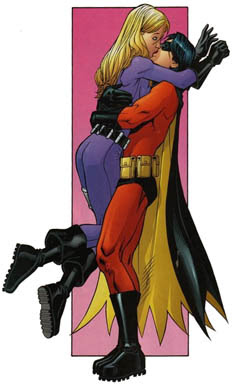
Now Stephanie's back. And as you can see in this image from the latest Robin, drawn by Chris Batista and Cam Smith, Tim's very pleased to see her. (Yes, he does have a bo staff on his belt, but he really is pleased to see her.) One question now is whether Stephanie Brown was popular because she was unfairly treated and cruelly killed off, or because of some internal appeal of her personality that can keep her around.

Next month brings a one-off Robin/Spoiler magazine. The cover by Rafael Albuquerque (at top) pays tribute to Carmine Infantino's iconic image from the late 1960s of Batman and Robin on a rooftop. Visit the ad-heavy Bat-Blog to see the original and some previous homages.

24 May 2008

Curious Indeed

Several genres of short, full-color, hardcover books mimic picture books for kids, and are even marketed as such, but really aren't. Among them are parodies, those I-love-you-more books for new mothers, many celebrity picture books, and graduation gifts.

And among this season's graduation gifts, I noticed during Karen Day's No Cream Puffs signing last week, is Curious You: On Your Way! To create this title, Houghton Mifflin commissioned a non-narrative text from Kathleen W. Zoehfeld (not that you'd know her name from the cover or catalog), and then digitally pasted those words over the illustrations from Curious George Takes a Job (and perhaps some other Curious George books by H. A. and Margret Rey).

As a Curious George fan from way back, I think I'd have been charmed to receive a crisp new copy of Curious George Takes a Job when I left college. I'd have been less than pleased by this volume. Most "gift books" feel like they've been designed for people who aren't comfortable with real books, and are really looking for a greeting card with a $16 price on it.

23 May 2008

Why Does the Cows’ Laptop Click, Daddy?

I'm grateful that Gail Gauthier pointed me to this Slate slide show assembled and annotated by Erica S. Perl of recent picture books (plus Richard Scarry) and how they reflect modern technology--or often don't.

Why do the cows in Click, Clack, Moo practice Typewriter Realism for readers who may never have seen a typewriter, especially one that doesn't have to be plugged in? Does that actually reflect the typewriter nostalgia of grown-up picture-book creators and buyers?

As for cell phones versus land lines (which is what we used to call "phones"), I have a picture-book manuscript whose plot depends on a character tripping over the cord that connects a phone to a handset. If I sell that, I'm not sure any of the target audience will have seen such a phone cord. Unfortunately, I've said that for years, and have come no closer to polishing the dummy for submission.

Back to the slide show: I especially admire the The Sure Thing reference.

22 May 2008

Tin Men on Parade

These "Tin Men" were created by members of the Sheet Metal Workers International Association, local 17 in Boston (photograph by Jason Dowdle). They're part of an exhibit called "Keepers of Tradition: Art and Folk Heritage in Massachusetts" sponsored by the Massachusetts Cultural Council and now on display at the National Heritage Museum in Lexington, Massachusetts.


And here's a more journalistic photograph of sheet metal workers as "tin men" in Boston's Saint Patrick's Day parade, recruiting new members.