08 December 2007

Akkordionspieler Carnival Returns

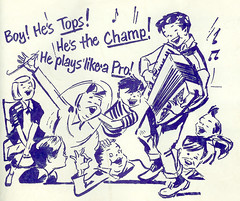
In August 2006, as I was trying to figure out this blogging custom called a "carnival," I hosted the self-proclaimed Akkordionspieler Carnival--all links supposed to be about German kids in tents with accordions.

Unfortunately, it proved very tough to meet all those criteria, so the Akkordionspieler Carnival committee is being more relaxed this time. So relaxed that this whole carnival is simply a Flickr search.

Clearly, the star of the image on the left (from Portugal) is the chihuahua.

What gives this photograph (from Germany) its pent-up energy is the unicycle on the right. Alas, we never get to see the fellows use it.

A lot of the accordion-playing kids in these photos are buskers or, to use the less quaint and colorful term, beggars, like the lad on the right (from Rhodes).

But some young accordionists are playing for the sheer joy of music. And for the girls, of course.

07 December 2007

The O'Connor Oeuvre

This week the Boston 1775 blog featured a two-part review of Journey into Mohawk Country, a nonfiction graphic novel by George O'Connor.

This is the same George O'Connor who worked at Books of Wonder in New York and illustrated several Oz-related books from that store's press, including David Hulan's Glass Cat of Oz [features inside jokes about Bruce Coville!] and L. Frank Baum's American Fairy Tales and The Enchanted Island of Yew. I have to admit I wasn't won over by those early illustrations, especially O'Connor's cover art for Yew; the book's hero, Baum reminds us over and over, is a slight youth, not an armored he-man.

But I really liked O'Connor's Journey into Mohawk Country; his art and artistic imagination brings life and humor to an unpromising historical document, prodding readers to think about how to interpret such sources. O'Connor also created Kapow! and Ker-splash!, picture books about preschool superheroes. See, it all ties in together.

06 December 2007

Half in the Shadows

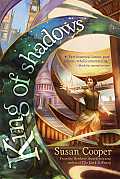
Yesterday I started writing about my look back at Susan Cooper's King of Shadows after hearing her speak of the book's genesis in a story about gay love between Shakespeare and a young actor. When Cooper decided she was writing the boy Nat's story for young readers, what happened to the sexual themes?

The whole novel takes place among two theatrical troupes: a group of American boys recruited to perform Shakespeare's plays in the recreated Globe Theatre, and Shakespeare's own players in Elizabethan London. Not one person in either time is identified as gay. Arby, the flamboyant impresario who heads the boys' troupe, lives with a woman named Julia. The Elizabethan Nathan Field is said to have been known, like other theatrical professionals, for his "success with women."

I spotted only two moments in which characters mentioned heterodox notions of sexuality or gender. When a young member of the boys' troupe says his mother thinks the theater is dangerous, a sardonic teen answers, "She thought her beautiful little boy'd get attacked by nasty molesters?" Later, when Nat is in Elizabethan England, he gets angry at a street-toughened older teen calling him "little lass."

However, unlike other boy actors in both the modern and Elizabethan scenes, Nat is never assigned a female role. Nat says he has no interest in playing "lovey-dovey roles," and Shakespeare agrees that he's "not a romantic beauty." What's more, there is not a word in the modern scenes about the implications of boys dressing as women: no teasing, no arguments, no comments at all. Instead, one of the loudest themes in the book, introduced on page 2 and repeated often afterwards, is the idea of a theatrical troupe as a "family."

Cooper passes up other opportunities to address ideas of homosexuality. Shakespeare gives Nat a copy of his sonnet beginning "Let me not to the marriage of true minds / Admit impediments." This is usually identified as one of the batch dedicated to a "fair [male] youth." However, Cooper's Shakespeare says he wrote it "for a woman."

Shakespeare tells Nat to read that sonnet as about "thee and thy father," which illuminates how Cooper eventually restructured her characters' relationship in what turned out to be "a children's story." She had originally planned to write about Shakespeare's homosexual love for a young player, but in the finished book Shakespeare is Nat's surrogate father and Nat is the playwright's replacement son.

This becomes clear in the scene beginning on page 73, when Nat dissolves in tears before the playwright and reveals his father's suicide for the first time. Shakespeare in turn talks about losing his son Hamnet, who was about Nat's age. It turns out that Nat's father was a writer, too. Shakespeare later speaks of visiting his wife and surviving children at Stratford. In this context, when the playwright moves the young player into his rooms for more rehearsal, that comes across as Nat regaining something of his life with his father (his mother had died years earlier) rather than as a potentially romantic relationship.

Well, at least from one side. Even though Shakespeare shows only paternal fondness for Nat, the boy develops some sort of crush on the playwright. "I'll never leave you. I want to act with you forever," Nat thinks, and later asks to be Shakespeare's apprentice. Nat misses the man terribly when he returns to the 20th century. And although he never identifies his feelings as romantic love, he comes to sees his portrayal of Puck alongside Shakespeare's Oberon as a "spirit in love with his master."

Thus, while the William Shakespeare in King of Shadows doesn't appear to be gay or bisexual, it's certainly possibly to read Nat as at the start of realizing his homosexuality. Of course, that mix of filial and romantic love can be disquieting, especially in a young boy--hence the explicit emphasis on finding a family.

Earlier I quoted an interview Cooper gave to a British newspaper in 2000, in which she mentioned the genesis of King of Shadows in the love between Shakespeare and a young player. Perhaps she said the same to American journalists, but as the book was coming out in 1999 she emphasized a different inspiration in an interview with Publishers Weekly:
About 10 years ago, I had a flicker of an idea that I would like to write about a boy who is acting at the new Globe and finds himself going back in time to act at Shakespeare's Globe. But I thought, "Oh, God, all that research!" I had just finished The Boggart, and the [main character] hadn't quite left my head, so instead of doing my Elizabethan boy, I wrote a sequel. But the Elizabethan boy didn't leave my head either. So then I did bite the bullet.
Though some readers have latterly wondered about Cooper's Shakespeare being gay, the book's earliest reviewers picked up its clear theme of Nat finding a replacement family rather than its misty whiffs of romance. Publishers Weekly said "Shakespeare [is] cast as a wise, intuitive father figure," and Library Journal spoke of the playwright and Nat's "father/son relationship."

Seeing Cooper shift her story from a love story to a tale of rebuilding a family makes sense when we consider her oeuvre. In her books, families are sources of stability and strength, not tension and anger. She writes little about romantic love and sexual attraction; as she described in her Cambridge Forum presentation, that's one reason she likes writing about pre-adolescent kids. (The recent movie The Seeker was particularly un-Cooperish because the screenwriter gave Will Stanton a teenage crush and a treacherous sibling. We can find such things in Diana Wynne Jones's novels, but not in The Dark Is Rising.)

05 December 2007

Out of the Shadows?

Back in October, I asked what major characters in children's fantasies were identified as gay before J. K. Rowling's post-publication comments on Albus Dumbledore. With some commenters' help I came up with a very short list of characters, none of them humans explicitly identified as gay.

I didn't include William Shakespeare in Susan Cooper's King of Shadows on that list even though the real poet wrote love sonnets to a young man. That was because, as far as I could recall, there was no sign of homosexual interest from the character who appears in the novel.

At last month's Cambridge Forum, however, Cooper described her book as having its seed in imagining Shakespeare's attraction to a young male actor. Mentioning Dumbledore, an audience member had asked her why so many recent fantasy stories for children appear to advocate tolerance. (Not unlike most other modern American children's literature: "tolerance is good" is an almost inevitable theme.) Cooper reply included these remarks:
It is hard to do something on purpose without being didactic, and I had intended King of Shadows to be a book about a gay relationship between--a homosexual relationship since the word “gay” meant something quite different in the 17th century--between this boy and Shakespeare, and it wasn’t spelled out in the book. And one of the nicest things anybody has ever said to me about a book is when a friend of mine said, “I wish I’d had that book when I was a gay boy at ten.” So it was there--something--it was as if it was still there in the book for someone who wanted to take it out.
(MP3 download of this talk here.)

That genesis for King of Shadows isn't just a post-Dumbledore revelation. In a 2000 interview with the Guardian, Cooper said:
Initially, my idea was to write a story about Shakespeare's repressed homosexual relationship with one of his boy actors--but then the boy, Nat, got stronger, and by the second chapter I knew that it was a children's story.
Some King of Shadows readers have evidently seen hints of a homosexual relationship in the book. In October, Horn Book editor Roger Sutton wrote cheekily, "I still maintain that, in Susan Cooper's time fantasy King of Shadows, young hero Nat and the Bard of Avon totally had it going on". And a reviewer on Epinions wrote in 2005:
There were several times when I half expected Shakespeare to make a play for Nat - all of the signs seemed to be leaning in that direction - but it never happened. I don't know if that ambiguity was intentional or not, but I'd have greatly preferred that either something had happened or that there'd have been no signals that things might go in that direction. I found constantly wondering if something was going to happen distracting.
So I took another look at King of Shadows. And I still don't see Shakespeare showing any sexual interest in other males. Indeed, I think the book passes up opportunities to address issues of sexuality and gender, and heavily emphasizes other aspects of the relationship between Shakespeare and Nat. Which isn't surprising, considering the abiding themes in Cooper's other fantasies for children.

TOMORROW: What might it mean for King of Shadows to have become "a children's story"?

04 December 2007

Looking Out for Iorek Byrnison

As soon as I received the last issue of The Atlantic, I turned to Hanna Rosin’s article “How Hollywood Saved God,” which was said to be about how the people making the Golden Compass movie had altered Philip Pullman’s Dark Materials saga to make its Gnosticism less troubling to non-Gnostics (not that those themes appear much in the first book).

I was disappointed to realize soon enough that that the reporter obviously hadn’t seen either the shooting script or the finished movie, and thus had no evidence on which to base any conclusions.

I did, however, note one passage about how the New Line studio came to option the book:

In 2003, when describing what sold him on the movie, Toby Emmerich, New Line’s president of production, explained, “It was two words: Iorek Byrnison.” Iorek is an “insanely awesome character,” he added.
That much-deserved praise for Pullman's armored polar bear came back to me this weekend when I read Charles McGrath’s story in the New York Times, “Unholy Production With a Fairy-Tale Ending.” Writer-director Chris Weitz initially declined to direct the movie because he felt it would be too big for him to handle.
The studio then turned to an even more unlikely director, Anand Tucker, known mainly for “Shopgirl,” based on the Steve Martin novel, who impressed the executives with storyboards suggesting how the movie might look. But Mr. Tucker and New Line soon ran into the kind of impasse that in Hollywood is called “creative differences.”

“You know, sometimes that’s really what they are: creative differences,” Mr. Emmerich said. From Mr. Emmerich’s own account and that of others, it appears that the problem with Mr. Tucker’s “Golden Compass” was that it was paradoxically both more expensive than the movie New Line was hoping for and smaller in scale. The deal breaker may have been when Mr. Tucker, as a cost-cutting move, decided to eliminate the bear fight, the movie’s great set piece.
Yes, that seems like a very quick way to lose a job: eliminate the most important scene for the studio head’s favorite character!

(Though, plotter that I am, I can’t help but wonder whether Tucker was simply proposing to eliminate that scene in order to force Emmerich to raise the production budget enough to get it back in. When federal agencies do that with their budget requests to Congress, it’s called the “Washington Monument ploy.” It doesn’t always work.)

The movie opens this weekend.


03 December 2007

Lots to Chew On

In October, Lisa Spangenberg at Digital Medievalist posted a two-part consideration of a murder case from Ireland. Michael Cleary and some associates were convicted of murdering his wife Bridget after he became convinced that her body had been taken over by a changeling fairy. This all happened in 1895, when the island had both a Royal Irish Constabulary and "fairy doctors" offering cures based on herbs, "new milk," and fire. (I learned about these posts from the History Carnival.)

Spangenberg in turn links, through the theme of “the Other,” to a three-part essay by MacAllister Stone on “Magical Negroes, expendable queers, and other well-worn tropes.” Along the way she touches on Ursula K. Le Guin, Obi-Wan Kenobi, Stephen King, Buffy the Vampire Slayer, and Aristotle.

I was less impressed with Slate's slide show titled "Where the Wild Things Came From: How children's books evolved from morals to madcap fun," based on Drawn to Enchant, by Timothy G. Young. The book and online exhibit are based on items from Yale's wonderful Beinecke Library, but that proves a limitation to showing typical material. What's available doesn't strongly support the exhibit's conclusions.

The second item, for example, is an illustrated alphabet manuscript by Caroline Ketcham Eaton (not Easton, as the website has it), wife of Yale botany professor Daniel C. Eaton. The online exhibit notes that this book was "never published"--so it doesn't typify children's books, merely Eaton's understanding of them. Furthermore, the manuscript's not in a state to be published as technology then existed. I'm not convinced Eaton ever meant to publish it; it looks like an in-joke for her son George, then a graduate student, that merely adopts the traditional form of alphabet books. At least the Beinecke's Political Alphabet was actually put into print.

02 December 2007

Batman's Ace in the Hole

In The Great Comic Book Heroes, his pioneering look back on America's early superhero comics, Jules Feiffer declared:

I couldn't stand boy companions. If the theory behind Robin the Boy Wonder, Roy the Superboy, The Sandman's Sandy, The Shield's Rusty, The Human Torch's Toro, The Green Arrow's Speedy was to give young readers a character with whom to identify, it failed dismally in my case.

The super grownups were the ones I identified with. They were versions of me in the future. But Robin the Boy Wonder was my own age. One need only look at him to see he could fight better, swing from a rope better, play ball better, eat better, and live better--while I lived in the east Bronx, Robin lived in a mansion, and while I was trying, somehow, to please my mother--and getting it all wrong--Robin was rescuing Batman and getting the gold medals. He didn't even have to live with his mother.

Robin wasn't skinny. He had the build of a middleweight, the legs of a wrestler. He was obviously an "A" student, the center of every circle, the one picked for greatness in the crowd--God, how I hated him.
Reading this as a lad made me wonder, again, whether I was mistaken in not loathing the character of Robin from an early age. But again, I did the math.

Feiffer's response to Robin, however deeply felt, was a minority view. Many more readers liked the character. Robin's presence might have helped Batman last through the late 1940s and 1950s while so many other superheroes were canceled and forgotten. According to Bob Kane's memoir, sales for the issue of Detective Comics that introduced Robin on its cover were double the usual. Understandably, the next 115 covers also featured the boy wonder. Of the first hundred issues of Batman magazine, Robin appeared on all but three.

Another reliable yardstick of Robin's popularity is how so many other superheroes quickly gained their own young sidekicks. Feiffer himself listed six, yet still left out Bucky, companion to Captain America; Captain Marvel, Jr., and Mary Marvel; and the Star Spangled Kid and Stripesy, an unusual pairing in which the adult was the sidekick, apparently because the kid was upper-class. (Feiffer also disliked boy companions enough to misremember the name of the Shield's partner; he was, the internet assures me, Dusty the Boy Detective.)

There were also whole series about groups of young heroes with little adult supervision: the Young Allies, a Captain America spin-off; the Boy Commandos, which shared Detective with Batman during World War II; the Newsboy Legion, who bumped the Star Spangled Kid off the cover of Star Spangled Comics; and on to such small-timers as the 1951 creation Dan Tayler, Boy Detective.

Boy sidekicks remained de rigueur in DC's superhero comics as the decades passed, with writers creating young companions for Tomahawk, Aquaman, the second Flash, and (in the person of Jimmy Olsen) Superman. The company also devised adolescent versions of Superman and Wonder Woman to have their own adventures.

One of Marvel's innovations in the 1960s, the decade when Feiffer assembled his book, was to create superheroes without young sidekicks. Or perhaps it's better to say that the company had one teen companion, Rick Jones, doled out to several heroes in turn. Yet the stellar success of Marvel's Spider-Man and later of The X-Men showed how many young comic-book readers were still happy to read about heroes close to their own age--even if they did have unusual strengths and didn't have to live with their mothers.

01 December 2007

The Dark Side of Gene Kelly

Last week the post office delivered a special supplement to The New Yorker called Movies Rock. It was so special that it also arrived with Vogue, as if that magazine weren't already heavy enough to herniate eight or nine postal carriers a year.

As content, this Condé Nast publication seems about half a step below Entertainment Weekly's Oscar issues, gossipy articles prepared long in advance to hold the ads apart. But I much appreciated one feature: a useful addition to the study of the supposed synchronicity between Pink Floyd's Dark Side of the Moon album and the MGM Wizard of Oz.

A few years ago, you may recall, the rumor went around the internet that the Dark Side of the Moon CD was correlated to the VHS videotape of the Wizard of Oz. Even though, of course, CDs and videotapes hadn't existed when Dark Side of the Moon was recorded in 1973, and the technology of the time would have thrown off the coincidences' delicate timing over the course of an hour.

People saw meaning in such correlations as the Tin Man inviting Dorothy and the Scarecrow to listen to his chest just when the album fades out to the sound of a beating heart. Of course, the whole point of that moment in the movie is that Dorothy and the Scarecrow can't hear anything beating.

What all those breathless postings about the album and movie lacked was a control--a comparison of other albums and movies to determine whether we humans, having evolved as pattern-spotting animals, would perceive similar synchronicities anywhere. That's where Movies Rock comes in. Hard-hitting journalist Jim Windolf sat down to look for meaningful moments in these pairings:

  • Gone With the Wind and James Brown's Revolution of the Mind: Live at the Apollo, Volume 3. (Why not the original Live at the Apollo?)
  • Idiocracy and Britney Spears's Oops!...I Did It Again. (Why not her Live at the Apollo? Oh, yeah. Live singing not her strength.)
  • Last Tango in Paris and Barry White's All-Time Greatest Hits.
In two cases, Windolf reports seemingly meaningful coincidences of picture and sound. Which shows that we can find anything if we look hard enough.

In other movie news, I'm responding to the death of Evel Knievel with a hearty recommendation of the 1977 movie Viva Knievel! The movie has the drama and production values of your great-aunt's snapshots of a vacation in Mexico. As a lead actor, Knievel exhibits all the charisma you'd expect from someone who made a name for himself almost jumping a motorcycle over stuff.

But it's the supporting cast that raises this movie from mere exploitation into monumentally hootable entertainment:
  • Leslie Nielsen wearing the most ridiculous collection of leisure suits ever collected on one man!
  • Oscar winner Red Buttons!
  • Former child evangelist Marjoe Gortner!
  • Model and rising starlet Lauren Hutton!
  • Dabney Coleman as a nasty doctor!
  • And, playing Knievel's mentor, mechanic, and comic relief, Hollywood legend Gene Kelly!
Knievel's other contribution to American entertainment that year was being the first man to "jump the shark," piloting his motorcycle over a tank of sharks during the post-Jaws hysteria. That inspired a similar stunt on waterskis on the following season of Happy Days, which in turn has made "jumped the shark" a label for once fine entertainment that was undeniably headed downhill. Like Gene Kelly.

30 November 2007

Rhythm, Rhymes, and Gzonks

Though we remember Dr. Seuss for his narrative books, such as Horton Hears a Who and The Cat in the Hat, he also wrote a number of plotless picture books that relied on the sheer power of accumulating nonsense. These include If I Ran the Circus, If I Ran the Zoo, and the venerable And to Think That I Saw It on Mulberry Street.

In the latter category, my favorite was probably On Beyond Zebra!, which took the normal form of an alphabet book but discussed letters no other author had used. (Other alphabet books I recall vividly from childhood were those by Richard Scarry, P. L. Travers, and H. A. and Margaret Rey.)

Tony DiTerlizzi plays similar tricks with the alphabet book form in G Is for One Gzonk! Each letter of the alphabet introduces a creature not found anywhere else, such as the eponymous gzonk. The pages show of DiTerlizzi's creature-creating talent, honed from illustrating Magic cards and co-creating the Spiderwick series.

The young bespectacled stand-in for the author-illustrator vows to make his alphabet different by not pointing out anything else on the page that begins with the crucial letter. Though he can't resist ponting out what he's not pointing out. And then some Woos, who resemble hovering water balloons with numbers attached, keep invading the pages, trying to turn the alphabet book into a number book. Their contributions to the text appear in a different color and type style from the narrator's.

With all the arguments and twists, G is for Gzonk! requires 80 pages to get through twenty-six letters of the alphabet and one number. That's an unusually large investment for a picture-book publisher, reflecting DiTerlizzi's success with Spiderwick and The Spider and the Fly.

Unfortunately, the book's rhyming text is just as irregular as its alphabet, and less intentionally. As I always say about stories in verse, rhyme is easy; rhythm is hard. Here are the book's first two stanzas, with the naturally emphasized syllables in capital letters:

HelLO! And WELcome TO my BOOK!
A BOOK THOUGHT up by ME.
I am the AUTHor and ARTist
(as SOON you'll PLAINly SEE)

of this ALphaBET of CREACHlings!
A TWENty-six-LETter menAGerIE!
But I MUST conFESS,
as you MAY have GUESSED,
it WON'T teach you A b C.
The lines never settle into a steady rhythm, iambic or otherwise. Compare the bumpy patterns above to "and to THINK that I SAW it on MULberry STREET." The most solidly metrical lines, such as "(as soon you'll plainly see)," add little to the text's meaning.

Dr. Seuss's nonsense texts showed his mastery of language, but I fear Gzonk's verse, like the Woos, show language overwhelming the author.

29 November 2007

Several Forms of Irony

MotherReader hosts the month’s Carnival of Children’s Literature, which has lots of tips on blogging, parenting, and reviewing books. Though I admit my favorite part was her reference to “the ever literary Oz and Ends” a mere four days after I’d featured a comic-book panel of a zombie rabbit.

But just to justify that judgment, I’ll reply to MotherReader’s plea (in the truly useful “Funny Writer Tips”) for “an ironic font — and no, the little winking emoticon isn’t enough.”

As far back as 1793, when William Thornton published Cadmus: or, A Treatise on the Elements of Written Language, authors have expressed a desire for some visual sign of irony within written text. Perhaps earlier writers had stated the same need, but literacy and irony may also not have been widespread enough to create a serious problem before. I hate smileys, too, but must admit they’re the first widely recognized solution to that challenge.

Thornton’s suggestion was:

A mark of Irony should be invented, for its use must be acknowledged, by those who are acquainted with language; and it should, like all the rest, be placed before and after the sentence---(+) this mark may serve.
Putting special punctuation before as well as after sentences (as Spanish typography already does with its ¿) was meant to signal readers about the nuance of a sentence before they plunged into it. Of course, some irony depends on not revealing itself too early. +We may need another two centuries to figure this out.+

Finally, outside the carnival Bottom Shelf Books imagines picture-book superheroes Max and Pinky interviewing for jobs with the Justice League. (No, a mere ahistorical allusion to Robin doesn’t make this our weekly Robin.)