31 May 2006

Sing-a-long Oz in Massachusetts

The Reagle Players of Waltham, Massachusetts, will host a "Wizard of Oz Sing-a-Long" on Saturday, 3 June: 1939 MGM movie, master of ceremonies, bag of props, and thoughts of how far Baby Boom parents have come since The Rocky Horror Picture Show.

Lost Girls unmoored

For audiences more mature than I, the Comic Wire offers a three-part article with thumbnail pictures about writer Alan Moore and artist Melinda Gebbie and the publication of Lost Girls, their pornographic graphic novel using teenaged versions of Dorothy Gale, Wendy Darling, and Alice.

As far as I can tell from articles and interviews like this, Alan Moore is famous in the comic-book world for two things:

  • reimagining characters created by other writers that are now in the public domain and thus available to him for free, as in this volume and The League of Extraordinary Gentlemen.
  • complaining bitterly about how people adapting his work into movies and other media, such as V for Vendetta, have paid him large sums and then reimagined his characters.
Discuss.

30 May 2006

E. Nesbit and the language barrier

One of the toughest challenges of writing about characters moving from our world to another is having them communicate believably to the folks they find in that other world [or time, or country, or level of reality, or junior high]. You can't just stop the plot for months of language-training. Well, that's what Philip Jose Farmer did in A Barnstormer in Oz, and the result wasn't pretty.

Usually fantasy authors ignore this problem, trusting their readers to go along. Deep down most of us believe our native tongue is the natural one, so of course it would also be the language of mermaids, medieval knights, or aliens who look like giant dust clouds.

But there are some cleverer treatments of the problem out there. Douglas Adams, working on the original and still-the-greatest form of The Hitchhiker's Guide to the Galaxy for radio, invented the babelfish; he made evolution solve his language problem, then bankshot that idea into a logical and theological joke. One of my writing-group colleagues has made her heroine's ability to communicate with everyone part of her plot; the girl becomes the new society's translator, which is interesting enough that we stop caring about how she came to have that ability.

My award for canniest use of intrusive narrative voice to meet this challenge goes to E. Nesbit in The Story of the Amulet. In chapter 3, she describes how the magical amulet speaks to the four children we met in Five Children and It:

I cannot tell you what language the voice [of the amulet] used. I only know that everyone present understood it perfectly. If you come to think of it, there must be some language that everyone could understand, if we only knew what it was.
Thus, the groundwork is laid for the children's first visit to another world. The next chapter offers Nesbit's longest attempt at explanation--or a semblance of it, in the form of an explanation from an adult who realizes that she is not making sense and is rather cross that the children might found her out.
Now, once for all, I am not going to be bothered to tell you how it was that the girl could understand Anthea and Anthea could understand the girl. You, at any rate, would not understand me, if I tried to explain it, any more than you can understand about time and space being only forms of thought. You may think what you like. Perhaps the children had found out the universal language which everyone can understand, and which wise men so far have not found. You will have noticed long ago that they were singularly lucky children, and they may have had this piece of luck as well as others. Or it may have been that...but why pursue the question further? The fact remains that in all their adventures the muddle-headed inventions which we call foreign languages never bothered them in the least. They could always understand and be understood. If you can explain this, please do. I daresay I could understand your explanation, though you could never understand mine.
Fortunately, that difficult moment is over, and the narrator feels no need to relive it in chapter 6:
(I think I must have explained to you before how it was that the children were always able to understand the language of any place they might happen to be in, and to be themselves understood. If not, I have no time to explain it now.)
And by chapter 8 the narrator is quite convinced that this is old business, and we readers know we could never convince her otherwise, anymore than we could convince nanny to let us stay up till midnight or set fire to the cat.
I really am not going to explain again how it was that the children could understand other languages than their own so thoroughly, and talk them, too, so that it felt and sounded (to them) just as though they were talking English.

29 May 2006

Pullman and Baum tackle the same scene

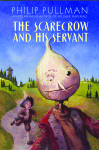
Philip Pullman's The Scarecrow and His Servant and L. Frank Baum's The Marvelous Land of Oz both describe boys looking after artificial stick men who are always in danger of losing their heads and other parts. Both books contain a character named the Scarecrow and a character named Jack, though Baum's Jack Pumpkinhead is more like Pullman's Scarecrow than Baum's Scarecrow is. (That sentence makes sense, but only to pumpkinheads.) But the similarity doesn't end there.

Both books contain a scene in which a child pretends to translate between two characters who speak the same language, convincing each that what sounds like intelligible speech from the other actually means something different.

In Pullman's scene, young Jack "interpets" for the Scarecrow and the king of the birds since each is too proud to be sufficiently deferential to the other. Thus, the boy's strategem actually plays a role in the plot, at least of that episode.

Baum's scene is characteristic vaudeville. It has no consequences, and there's nothing at stake but little Jellia Jamb's mischief toward the bigger people. But it's fun.

"Why, it's little Jellia Jamb!" exclaimed the Scarecrow, as the green maiden bowed her pretty head before him. "Do you understand the language of the Gillikins, my dear?"

"Yes, your Majesty, she answered, "for I was born in the North Country."

"Then you shall be our interpreter," said the Scarecrow, "and explain to this Pumpkinhead all that I say, and also explain to me all that he says. Is this arrangement satisfactory?" he asked, turning toward his guest.

"Very satisfactory indeed," was the reply.

"Then ask him, to begin with," resumed the Scarecrow, turning to Jellia, "what brought him to the Emerald City."

But instead of this the girl, who had been staring at Jack, said to him: "You are certainly a wonderful creature. Who made you?"

"A boy named Tip," answered Jack.

"What does he say?" inquired the Scarecrow. "My ears must have deceived me. What did he say?"

"He says that your Majesty's brains seem to have come loose," replied the girl, demurely.

The Scarecrow moved uneasily upon his throne, and felt of his head with his left hand.

"What a fine thing it is to understand two different languages," he said, with a perplexed sigh. "Ask him, my dear, if he has any objection to being put in jail for insulting the ruler of the Emerald City."

"I didn't insult you!" protested Jack, indignantly.

"Tut--tut!" cautioned the Scarecrow "wait, until Jellia translates my speech. What have we got an interpreter for, if you break out in this rash way?"

"All right, I'll wait," replied the Pumpkinhead, in a surly tone--although his face smiled as genially as ever. "Translate the speech, young woman."

"His Majesty inquires if you are hungry," said Jellia.

"Oh, not at all!" answered Jack, more pleasantly, "for it is impossible for me to eat."

"It's the same way with me," remarked the Scarecrow. "What did he say, Jellia, my dear?"

"He asked if you were aware that one of your eyes is painted larger than the other," said the girl, mischievously.

"Don't you believe her, your Majesty," cried Jack.

"Oh, I don't," answered the Scarecrow, calmly. Then, casting a sharp look at the girl, he asked: "Are you quite certain you understand the languages of both the Gillikins and the Munchkins?"

28 May 2006

Arkadians lives and legends

Lloyd Alexander tends to take his inspiration from the mythology of different cultures, and in The Arkadians he draws on the legends of ancient Greece. However, his inspiration is equally the anthropological explanations for those legends that have taken hold over the years, such as saying that people imagined Centaurs after mistaking mounted riders for man-horse combinations (as if horse heads are easily concealed or ignored).

Thus, the Arkadians episode in which characters must wrestle bulls gets yoked both to the story of Theseus and the Minotaur, and also to the bull-leaping tradition of ancient Crete, known through archeology. The novel implies that the maze Theseus must traverse is inspired by the crooked and winding streets of an unfamiliar town, and so on. Some characters have classical names, such as hero Lucian. Others are literal translations of Greeks names, such as his love interest Joy-in-the-dance (Terpsichore).

A few recognizable Greek legends appear as stories: moral tales, after-dinner entertainment, tribal self-justifications. Fronto the poet responds to these storytelling episodes with the sort of nitpicky criticism we now usually find in blogs like this one, and (nonetheless?) protagonist Lucian decides that his role in life will be that of storyteller.

This can't help but have a debunking effect on the book's fantastic elements. When the Odysseus archetype speaks of a one-eyed blacksmith and we recognize that anecdote will be transmogrified into the horror of the Cyclops, we naturally worry less about actual monsters threatening our growing group of travelers. When characters justify stories by their entertainment value rather than as truth or even routes to spiritual truth, then the ancient Greek legends seem to hold no more weight in this novel's universe than the novel itself has in ours. Most of the “magic” we see in The Arkadians appears to be hypnosis or wishful thinking.

And yet that poet Fronto has been turned into a donkey. A talking donkey. The character who most promotes the idea that Greek myths have been puffed up by audience-pleasing storytellers is also the novel's one undeniable example of magic. And magic based in an overweaning supernatural/spiritual force in the world. It feels like Alexander wasn't sure which approach to Greek mythology pleased him more, the replication or the unmasking.

27 May 2006

Black Cauldron ever to bubble up again?

Entertainment Weekly has a periodic little item called "Remake This!", urging Hollywood executives to remake movies that could actually be better or more relevant the second time around, rather than only those that are already excellent. The magazine's latest issue gives the remake nod to The Black Cauldron, Disney's animated adaptation of Lloyd Alexander's "Chronicles of Prydain" series.

Of course, the magazine isn't suggesting that cartoon is worthy of imitation. Back in 1998, EW's critic Ty Burr (now reviewing for the Boston Globe) called Disney's Black Cauldron videocassette second worst release of the year--"Shoddily animated, charmlessly written, too creepy for small fry." The only place you'll hear worse words about the Disney version is at Disney itself. The Black Cauldron movie has become a corporate scapegoat--the poor animal that symbolizes the animation studio's pre-Katzenberg doldrums and must be driven away. (The movie was actually released the year after Jeffrey Katzenberg arrived at Disney, but had been in development for years before. Since it was a huge flop, he was especially eager to distance himself from it.)

There's plenty of untapped potential in the Prydain series. Not only are there four other books, but Disney didn't even really tackle The Black Cauldron. As Alexander said in an interview with Scholastic-selected schoolchildren, "I have to say, there is no resemblance between the movie and the book." And now that Hollywood has discovered the money-coining power of fantasy series, screenwriters might be able to map out more than one movie.

In comparison to other fantasy series, however, the following for Alexander's lacks breadth and fervor, with a few fan sites here and there. It also lacks a genuine British genesis; though Alexander was inspired by Welsh mythology, he's a Pennsylvanian. With the cost of entry for a fantasy movie these days in the low nine figures, given the cost of CGI, it may be a while before studio executives decides Taran's saga is worth that big a gamble.

26 May 2006

Velveteen Rabbit audiobook with extra foam

In 1984 the already Academy Award-winning Meryl Streep read Margery Williams's The Velveteen Rabbit for an audiobook company called Rabbit Ears, with music by George Winston.

This week Random House and Starbucks issued a press release announcing that that book-audiobook package will make a "long-awaited return-to-market," with a four-month exclusive at Starbucks coffee shops in the U.S. and at Starbucks's music website.

Publishers Weekly's email newsletter describes this audiobook as part of the "lauded and long-out-of-print Rabbit Ears Collection of celebrity-narrated recordings," to be brought back at last through Random House's Listening Library.

In fact, there was a 20th-anniversary rerelease of Rabbit Ears's Rabbit less than three years ago. Sure, it came from a Japanese label and has a correspondingly high price tag, but this is a global webbed economy. What we call "not available on the market" increasingly means "not available at a price I think is reasonable." Starbucks and Random House know that as well as anybody.

25 May 2006

Dr. Pipt's "sovereign simple"?

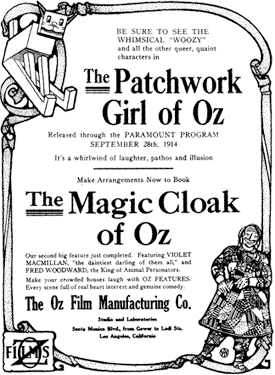
I received my copy of the spring 2006 Baum Bugle this week. (That's the scholarly journal of the International Wizard of Oz Club, for folks still in the Great Outside World when it comes to Oz.) This issue focuses on the Oz Film Manufacturing Company of the mid-1910s. One article is a compilation of that studio's few reviews, and in Moving Picture World's response to The Patchwork Girl of Oz (released, 1914) a phrase caught the Bugle editor's attention:

He [Dr. Pipt] finds an old recipe in one of his black books setting forth that "a seven-leaved clover, three hairs from a woozy's tail and water from a dark well" are a sovereign simple [sic] for petrification.
That "[sic]" apparently signals the editor's mystification at the preceding phrase, or his belief that some readers wouldn't recognize it. This one didn't.

What is a "sovereign simple," I wondered, and how did this phrase come about? It's certainly lost whatever currency it once had. Google produces only eleven examples of "sovereign simple" in all the web it knows, and nine of those are mere juxtapositions of the words. But the two examples of a unified phrase have the same contextual meaning as in the Patchwork Girl review.

The cover story about FDR in the 2 Jan 1933 issue of Time says:
The prestige of 1929's Man of the Year, Owen D. Young, world financier, friend to Samuel Insull, is still great but even he has produced no sovereign simple for prostrate business.
Another site quotes F. M. Cornford's The Origins of Attic Comedy, published in 1934, as follows:
For if in the Knights of Aristophanes the “egghead” cook exemplifies his role by a highfalutin manner of speech (e.g., “humans” for “people,” “ovines” for “sheep,” “aspersed condiments” for “salt”), he is blood brother to the Learned Doctor of the Canborne mummers’ play, who claims to cure “the hipigo, limpigo, and no go at all” with “a few drops of my helly-cum-pain [i.e., elecampane!],” or to that of the Shipton-under-Wychwood version, who possesses a sovereign simple for “all the rantatoroious boxes [i.e., poxes].”
So a "sovereign simple" is a cure or antidote. But whence does it arise? This is when it's good to have an Oxford English Dictionary in my office--if only it wasn't the one-volume microtext edition. But after a fair amount of eyestrain I find:
  • sovereign = efficacious or potent in a superlative degree
  • simple = medicament composed or concocted of only one constituent
  • "soueraine simple" = phrase appearing in Perimedes the blacke-smith, a 1588 play by Robert Greene
So the movie Dr. Pipt's remedy, containing as it does three ingredients, is not a "sovereign simple" after all. The reviewer was simply using "a highfalutin manner of speech," to borrow words from Cornford. But now if I decide to use the medicinal phrase in some fiction, I'll know not to make the same mistake.

The Patchwork Girl of Oz movie is in the public domain, so it pops up periodically on videotapes and DVDs. Hungry Tiger Press has pressed CDs of the movie's original music.

24 May 2006

Harry Potter and the order of recycled paper

I suspect people will recognize the following scene. It's from page 458 of the U.S. edition of Harry Potter and the Order of the Phoenix, the fifth volume of J. K. Rowling's monumental fantasy series.

“Did you kiss?” asked Hermione.

Ron sat up so fast that he sent his ink bottle flying all over the rug. He stared at Harry. “Well?”

Harry looked from Ron’s wide eyes and smirk to Hermione’s slight frown. He nodded.

“HA!” Ron pumped his fist and guffawed loudly enough to make several second years over by the window jump. He rolled around on the hearthrug, laughing.

Reluctantly, Harry grinned. Hermione gave Ron a sour look and returned to her letter.

“Well?” Ron peered up. “How was it?”

Harry considered for a moment. “Wet.”

The snort Ron let out may have indicated jubilation or disgust, Harry couldn’t tell. “Because she was crying,” he added.

“Oh.” Ron’s smile faded. “Are you that bad at kissing?

“Dunno.” Now Harry felt rather worried. “Maybe I am.”

“Of course you’re not,” said Hermione, still scribbling away.

“How do you know?” Ron demanded.

“Because Cho spends half her time crying these days. She does it at mealtimes, in the loos, all over the place.”

Ron grinned. “You’d think a bit of kissing would cheer her up.”

“Ron,” said Hermione in a dignified voice, dipping the point of her
But this isn't really page 458 of HP5. All the dialogue is the same, and all the dramatic details are there; it's a rather nice scene, with a lot going on among the three principal characters and real feeling for adolescent anxiety. But I took the liberty of cutting words and phrases that didn't seem necessary to me. Anyone with a copy of HP5 (and I understand there were a few sold) can assess whether I missed important points in the original.

That original is 250 words, 31 lines. The version above is 192 words (23% shorter) and 22 lines (29% shorter). Now tight writing is supposed to be crucial for magazine articles and for picture books, and helpful for new novelists. But if you're already a bestselling author, what's the benefit of cutting unneeded words?

Let's imagine if the whole of HP5 were only 10% shorter. Its text runs 870 pages, so that would be a saving of 87 pages. It would still be one very large children's book, especially by the standards of only a decade ago, but that's a lot of pages to save. An entire middle-grade novel, in fact.

And then there are HP5's out-of-this-world sales to consider. The British edition sold 12 million copies in 2003, according to the Telegraph, and CNN reported similar numbers for the US. The book will sell for many years to come in different editions, but let's start with the 24 million figure. That number of copies times 87 pages, divided by two since each sheet of paper holds two pages, means that shortening HP5 by 10% would have saved 1,044,000,000 sheets of paper. Harry would call that "one hundred million," but since I'm American I call it a billion.

Conservatree.com estimates that a single tree can produce a bit over 8,000 sheets of copy-grade paper. That may not be the exact figure for book stock, but it's close enough. (Environmental Defense has an algorithm for calculating such usage as well.) It took approximately 130,000 trees to produce the 1,044,000,000 sheets of paper filled by 87 pages of HP5--pages which may not have been necessary.

It seems apropos to note that this month Random House, the largest US publisher, has made a plan to increase its use of recycled paper to 30% by 2010. At that level, the company expects to save "more than 550,000 trees annually." Might we writers do our part by making sure we don't use any extraneous words?

23 May 2006

Runaway sales and Runaway Bunny

Canada's National Post ran an article this month on Love You Forever, by Robert Munsch, illustrated by Sheila McGraw. I'm too old to have had this book as a child, and, since I'm not a parent, no copies have been pressed on me by eager friends and relatives. I know Love You Forever from checking it out in bookstores and from hearing it periodically described by children's-book fans as either wonderfully affecting or creepy and maudlin.

I found the Post's article interesting on multiple counts. I hadn't known that Munsch also wrote The Paper Bag Princess. I thought it significant that the manuscript disquieted his usual publisher; this book wasn't an easy sell. Finally, the National Post states that ten million copies of the book have been sold in Canada--a country with only slightly over thirty-two million people.

Love You Forever is part of a genre that I recall hearing an editor (quoting her publisher) call the "I Love You More Than That Other Book" books. Though they take the form of kids' picture books, these titles rack up big sales numbers as gifts for adults. Not that children don't respond to their words if they sense those words have emotional meaning for the adults in their lives. But these books offer words for parents.
Love You Forever, Maryann Cusimano Love and Satomi Ichikawa's You Are My I Love You, Nancy Tillman's On the Night You Were Born, and other examples are in the parents' insistent voices.

All of which made me think about the "I
Love You More..." book that I grew up with: grandma of them all, Margaret Wise Brown's The Runaway Bunny, with pictures by Clement Hurd. Why does The Runaway Bunny work so well as a story for children? [And of course it must be better than more recent books; did I mention that I grew up with it?] The mother rabbit is just as loving as the mothers in those other books. She's just as persistent as the mother in Love You Forever, who climbs into her grown son's bedroom at night (that's the part some people find maudlin and creepy).

What's different is that the young bunny, not the momma, drives the action. The bunny tries out autonomy by running away, or at least pretending to. The bunny exercises his imagination by dreaming up new hiding-places, producing fantasy fiction for toddlers. And yet the reassuring mother rabbit is always there.