24 November 2019

Tom Lyle and the Robin Miniseries

In 1986 Tom Lyle, an aspiring comic-book artist in his thirties, went to a comics convention in Philadelphia. There he met Chuck Dixon, a young writer who was scripting Air Boy for Eclipse. Based on Lyle’s samples, Dixon got him the job of penciler on a related title, Sky Wolf. In a chat with Comics Interview magazine, Lyle credited that as “the event that triggered my career” in comics.

Lyle was recruited by DC Comics to draw Starman in 1988. After a couple of years, as he was wrapping up that assignment, Lyle asked Batman group editor Dennis O’Neil if he had any openings. O’Neil was planning a miniseries focusing the newly created Robin, Tim Drake.

“I’ve never been real thrilled with the Robins,” Lyle told his interviewer. “Dick Grayson, the original Robin, I couldn’t have given a flip about when I was a kid; it was like, ‘Get out of the way, kid, I want to see Batman.” But a job was a job.

O’Neil’s team wanted to make Robin into a martial-arts expert, so they needed a writer who understood the martial arts. Lyle suggested Dixon. He got the assignment and went on to be DC’s most productive writer of the decade. (On the occasion of his 40,000th comics page in 2017, Bleeding Cool noted Dixon wrote 106 issues of Robin, 89 issues of Detective Comics, 77 issues of Nightwing, 46 issues of Birds Of Prey, and 22 issues of Catwoman, to name a few.)

Dixon and Lyle’s first issue of the first Robin series carried a cover date of January 1991. The character of Tim Drake had been created by Marv Wolfman in issues drawn by George Pérez, Jim Aparo, and Norm Breyfogle, and his costume was designed by Neal Adams. But Dixon and Lyle’s portrayal fleshed him out by showing him on his own. Lyle was especially good at portraying Tim as a thirteen-year-old, lithe but not a powerhouse, the littlest guy in the fight who needed to think harder than anyone else to stay alive.

In the gritty, pouched, and overpumped 1990s, Robin was the equivalent of counterprogramming on broadcast television—standing out by doing something different. And it worked. According to Lyle, DC expected to sell about 200,000 copies of the first issue of the Robin miniseries. Instead, it sold three times that number.

DC asked the Dixon-Lyle team for a second miniseries about Tim Drake going up against the Joker, issued at the end of 1991. Then came a third, featuring the character the Huntress for an interesting contrast. That was the height of the speculative boom, and those magazines are festooned with holograms and other gimmicks.

Dixon and Lyle also collaborated on issues of Batman and Detective Comics showing Batman and Robin together. One of those magazines introduced Stephanie Brown as the Spoiler, who went on to become Tim Drake’s love interest, a fan favorite, and eventually Robin and Batgirl herself for limited periods. Lyle was also the artist for the first Robin Annual and the 1992 public service ad in which Tim decides to learn the facts about AIDS.

During that time, Lyle also plotted and penciled the early issues of The Comet for DC’s Impact imprint. In 1993 he started working for Marvel Comics on Spider-Man stories. That same year, DC launched the Robin monthly series with Dixon as regular scripter.

After another ten years or so, Lyle left monthly comics to become an art teacher at the Savannah College of Art and Design. Earlier this year he suffered an aneurysm, and last week he died, aged 66. Friends and fans have set up a Go Fund Me page for his family.

15 November 2019

Breakdown

Let’s imagine that Donald Trump paid millions of dollars—assuming he actually has that much money to spend—to officials of a foreign government to announce a criminal investigation into his leading political opponent.

The officials didn’t even have to conduct the investigation. After all, Trump doesn’t criticize notoriously corrupt regimes, has cut the budgets of international anti-corruption programs, and is ignoring multiple laws and norms in the US. But for these millions of dollars Trump clearly wanted a big public announcement of that criminal probe that would damage his opponent.

Obviously, that would be a crime: bribing a foreign government for political purposes.

Now let’s imagine that Donald Trump took $391 million that the US Congress had allocated for a particular program and diverted it for his own political benefit. Again, that would obviously be a crime: a form of embezzlement and abuse of power.

Donald Trump did both those things at the same time.

07 November 2019

The Real Legacy of He Walked by Night

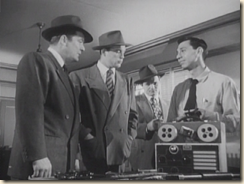
He Walked by Night didn’t influence The Third Man, but it definitely did influence American popular entertainment.

To start with, it appears to be the first movie that includes a scene of self-surgery. The bad guy stitches himself up after being shot, using a mirror and a lot of grit. I’ve seen variations of that scene in The Terminator, Ronin, and Master and Commander, but this might be the original.

Even more clearly, He Walked by Night gave birth to the most visible and long-lasting form of the dramatized police procedural. It even starts with an announcement that the story was based on real crimes, and that “names have been changed to protect the innocent.”

One of the supporting characters in the movie is a police lab technician played by Jack Webb. He’s young and almost winsome in the role.

At the time, Webb’s most prominent parts were as the star of the radio dramas Pat Novak, for Hire, about an unlicensed investigator who works at a pier, and Johnny Madero, Pier 23, about a pier manager who undertakes investigations. As was standard in hard-boiled mysteries, the cops in those stories were at best a rival for the hero, at worst a hindrance.

While working on He Walked by Night, Webb met the movie’s technical advisor, Detective Sergeant Marty Wynn of the Los Angeles Police Department. Their conversations and the movie’s format gave Webb the idea of creating a radio drama about a police detective, inspired by real crimes and portraying realistic law-enforcement techniques.

The LAPD also loved that idea and got behind it. Dragnet premiered in June 1949 with Webb in the starring role of Sgt. Joe Friday. It ran for more than eight years on radio. For most of those years, a version also ran on television for nine years, and there was a movie adaptation as well. Then the TV show was revived in 1966 with a TV movie and more than four more years of episodes. Webb expanded the procedural franchise in the 1970s by producing Adam-12 and Emergency!

Dragnet made Webb’s Joe Friday character a national icon, cementing his image as an actor and even his politics. That means it’s very striking to see him play a different personality in He Walked by Night, or to hear him as a cornet player during Prohibition in the fine radio drama Pete Kelly’s Blues.

06 November 2019

Going Deep for a Climactic Chase

He Walked by Night is a 1948 police procedural that gets better as it goes along, largely because the original director, journeyman Alfred L. Werker, left the project and the up-and-coming Anthony Mann took over.

The cinematographer, John Alton, stayed the same, so the whole movie has the same look. It’s a noir docudrama. Many of the opening scenes have no more zip than an educational film. But scenes with the bad guy, played by Richard Basehart, are strong, and the climax is terrific. The police chase the killer through the Los Angeles sewer drain system. Mann and Alton used light and dark, angles and shapes, tracking shots, and sound with no music to build up tension.

The sewer chase immediately brings up a comparison with The Third Man, directed by Carol Reed and released the following year. Did a B movie produced by a British-American distribution company that had just got into production influence that prestige project filmed in Europe with an international cast of stars? The similarity is striking, but it’s just a coincidence.

Producer Alexander Korda recruited Graham Greene to write a new screenplay for Reed after they had worked together well on The Fallen Idol. Korda had the idea of setting a story in Vienna, its policing divided among the Allied powers. Greene had one sentence in an old notebook about someone spotting an old friend a week after attending his funeral.

In early 1948, Greene traveled to Vienna to research and come up with more. Discussions with various people gave him two ideas: black-market penicillin and patrols of the city’s old sewer system. Greene went to Rome and drafted a novella incorporating all those elements, then adapted his prose into a screenplay. Filming on The Third Man began in October.

Meanwhile, Eagle-Lion Films was making He Walked by Night, inspired by the case of murderer Erwin Walker. In April 1946, after a shootout with police, Walker had escaped through Los Angeles’s storm drains. He did the same thing the following month. Walker was finally arrested in December 1946 in his apartment, the police having received a tip-off.

According to The Crime Films of Anthony Mann, the original scenario for He Walked by Night didn’t include scenes of the killer in the sewer. Instead, the climax was a chase at the Los Angeles Coliseum, which Werker probably filmed in the spring of 1948. When Mann took over, he reworked the screenplay. He and his chosen writer, John C. Higgins, changed the climax to be an extended capture in the storm drains. Those scenes were a technical challenge, but Alton and Mann captured that footage in reshoots in July 1948.

In November, Eagle-Lion released He Walked by Night in Los Angeles. That same month, Orson Welles arrived in Vienna and performed in a few shots of The Third Man. One of those involved going down into the sewer. But Welles famously balked at filming underground surrounded by actual drain water. The company had to build sewer sets in London and film the movie’s climax months later. Still, that timing shows how the sewer scenes of The Third Man were already mapped out by the time He Walked by Night was released.

Thus, the two movies’ chase scenes through drainage systems developed independently, each based on real events. Both scenes take advantage of the darkness and watery reflections of underground drainage tunnels. But they end up offering a strong visual contrast that reflects the two cities above. LA’s drains are all modern concrete, with smooth surfaces and sharp angles and arcs. Vienna’s Old World tunnels (or the studio reproduction of them) are bumpy brick and stone, filmed at vertiginous tilted angles. And both scenes are excellent.

03 November 2019

Restorative Young Justice

I was intrigued by the news that Brian Michael Bendis was reviving DC Comics’s original Young Justice team, featured from 1998 to 2003. I didn’t pick up the comic books, however, because I was already confused enough by the publisher’s continuity changes in recent years. The alternate universes that got us to this reboot seemed even more tortuous.

I’ve now read the first collected volume of that series, Young Justice: Gemworld, and I’m just as confused as I anticipated.

Bendis has indeed restored the core of the original team: Tim Drake as Robin, Conner Kent as Superboy, Bart Allen as Impulse, and Cassie Sandsmark as Wonder Girl. In addition, he’s added three more girls, versions of established heroes/trademarks: Jinny Hex, Amethyst, and Teen Lantern (leaving out the original Young Justice’s Secret, Artemis Arrowette, and later members). Bendis has also established that the team has always been part of this DC universe’s history but wiped from memory by a bunch of hand-waving—the same hand-waving that brought those characters back together. But as for the story itself, it felt thin.

Of course, the original Young Justice series was far from deep. Launched by Todd Dezago and then taken over and scripted almost entirely by Peter David, it was a sitcom. It had catch phrases, laugh lines, villains and supporting characters whose names were based on puns. Sure, there were many moments of teen angst and very special episodes and all that. But fundamentally that series didn’t take itself too seriously. This team formed because a bunch of young superheroes liked hanging out, not because they had a crucial mission or psychological need. That’s why the unorthodox artwork of Todd Nauck worked.

Bendis has restored the group, but he hasn’t restored that tone. To be sure, these first issues are devoted to reintroducing and introducing the team through one breathless flashback after another. But I recall only two jokes fondly, one of them repeated and the other almost lost in small panels.

The new series doesn’t need to follow the same path, of course. So far, however, there just isn’t enough adolescent drama (as in Teen Titans at its best) or threats to this world (as in the intermediate, TV-spin-off Young Justice magazine) to make up for the loss.

31 October 2019

The Deep Roots of Willow Cove

Next summer will bring The Witches of Willow Cove, a new novel for tweens by Josh Roberts, one of my writing group colleagues.

Here are some extracts from Josh's interview at Writers' Rumpus:

Growing up, I lived in a three-story Victorian funeral home, complete with creaky floors, drafty windows, and a secret room sealed off from the rest of the house, so I spent a lot of my childhood making up stories to spook myself and my friends. . . . When I was younger, some of my friends were afraid to sleep over because the house was so spooky. But I have a lot of great memories from living there, too. And obviously it provided some fuel for my imagination.

I’ve always believed that the best spooky stories are the ones that feel like they could be happening to real people in real places. I knew from the beginning that THE WITCHES OF WILLOW COVE would be set in a small New England town like the one I grew up in. I knew I wanted it to be upper-middle grade, too, with characters right on the cusp of their teenage years, caught in that moment of their lives when they’re not quite grown up yet, but also not quite kids anymore. And I knew that my take on it would be: What happens when you find out you’re one of the spooky things that everyone’s afraid of? . . .

I think there’s a sort of comforting thrill that comes along with reading a spooky story—the promise that eventually the scary part will be over and things will generally sort themselves out. That release of tension is just as important as the frightening part. Maybe more so.
The Witches of Willow Cove will come from the appropriately named Owl Hollow Press, and the sequel, I happen to know, is already in the works.

23 October 2019

Raymie: “Everybody’s Kind of Movie”?

I’ve been noodling out a story about kids in a seaside town, so I tracked down the 1960 movie Raymie for visual inspiration.

Raymie came from Allied Artists Pictures, which grew out of the Monogram, one of the “Poverty Row” studios of the 1930s. Allied still took pride in keeping budgets low. There’s a small cast, a limited number of settings, only one action scene, and not a little stock footage.

I hoped the picture would be an interesting exploration of the young title character, played by Hollywood scion David Ladd. Raymie is indeed at the center of the story, his quest to catch a legendary barracuda defining the plot. But there’s a lot more footage of adults discussing Raymie than of the boy expressing himself. Some scenes are outside of his point of view. I believe Ladd was twelve when the movie was made, but he’s playing a simple nine-year-old.

Instead of a character study, Raymie really lays out the culture of a fishing pier somewhere along the California coast. A bunch of white men who have nothing better to do spend their days fishing off the pier, trading stories and jibes. Raymie’s widowed mother works at a diner on the pier, so he gets to fish, too, without paying.

One of the men is a grouch who dislikes Raymie’s presence. The rest use him as an object of their opinions and advice. There’s a wealthy older man who suffers a health crisis partway through the movie. There’s an African-American worker who shares wisdom in scenes with Ladd and no other actors, making me think they were shot separately and possibly ready to trim for certain audiences. And there’s John Agar as Ike, an off-season construction worker who’s trying to woo Raymie’s mother, played by Julie Adams.

In a vaguely Freudian way, some of the action turns on a fishing knife that Raymie inherited from his late father. (The father died in the Korean War, when the boy was an infant.) After resisting for two-thirds of that movie, Raymie trades that knife for the bait he needs to catch the barracuda. Then at the climactic moment he picks up Ike’s knife instead. That change presages how Raymie’s mother, seeing Ike standing up for her son, finally accepts him as a suitor.

Raymie’s mother doesn’t know that, much earlier in the movie, Ike dove off the pier to protect her son from a shark. Presumably she would have warmed up to him earlier if she were aware. But all the men on the pier, and Raymie, conspired to deceive her about how he got knocked into the water. In other words, the pier culture stretched out the movie.

The Raymie theme song was recorded by Jerry Lewis, then at the height of his stardom. He was even featured on the posters, as shown above. I’ve seen reports that a legal dispute over that recording has prevented the movie from being rereleased in any new format. Whether or not that’s true, in order to watch Raymie I had to download a bootleg file made from a scratched 16mm print found a few years back in Australia. It’s available for the curious, but I’m not recommending it as a sadly lost classic.

14 October 2019

Casting Aspersions

In The Voyages of Doctor Dolittle, Hugh Lofting (in the voice of Tommy Stubbins, the shoemaker’s boy) described Dr. John Dolittle as “a little round man with a very kind face.”

Lofting’s own sketches for the books show a short, plump man with curly hair receding from his forehead.

As of 2020, according to a trailer released today, this character will have been played in the movies by:
  • Rex Harrison
  • Eddie Murphy
  • Robert Downey, Jr.

03 October 2019

Hard to Read

One reason the Waukegan Public Library may have chosen not to portray native son Ray Bradbury as a little boy (as I discussed yesterday) is that the site is already chock full of metal kids with books.

The library’s Stimson Sculpture Garden contains no fewer than seven bronze sculptures depicting ten little kids reading, along with a few fairy-tale animals.

There used to be two more children reading, but in 2012 they were stolen and melted down as scrap. Since those statues were bronze, other castings survive, such as Jane Rankin’s “Little Scholar” shown here.

Last time I checked, my public library has two such bronze statues of little kids with books. It looks like this is a genre with solid demand, and artists like Gary Lee Price, Randolph Rose, and Rankin are happy to supply the market.

Someday art historians will write monographs on this form and the studios and patrons behind it, like the studies of Civil War statuary.

02 October 2019

Ray Bradbury’s Rocket

I am not taken with the Ray Bradbury sculpture erected in his native town of Waukegan, Illinois, and unveiled this summer.

Zachary Oxman sculpted the figure of a young Bradbury riding the outline of a rocket, steampunk gears inside. The steel figure waves a copy of Fahrenheit 451.

The design is deliberately “retro” to fit with the mid-20th-century library building nearby, where Bradbury bequeathed his book collection. But the result strikes me as cheesy, diminishing the themes he wrote about instead of celebrating them. “I send my rockets forth between my ears,” Bradbury wrote in a poem, and this turns that metaphor into something solid and heavy again.

I also wouldn’t recognize Bradbury from this statue. I picture him from photos and TV appearances in my youth as a somewhat rounded bespectacled middle-aged man, a chatty dean of American science fiction.

It would make sense for a Bradbury statue in Waukegan to depict him as he looked when he was living in Waukegan. That would be a little kid since the family moved to Arizona when he was six. A young boy dreaming of the future could be iconic but not recognizable. Here’s Bradbury at age three, from the Knopf collection of the Harry Ransom Center. Here he is again, said to be in 1923 but probably a couple of years later.

By age 14, Bradbury was a working writer in LA with hints of how he’d appear as an adult. But I haven’t found any photo of Bradbury looking like the young man in that sculpture. He didn’t wear his glasses for photos in the 1940s, and he had a crew cut through the 1950s. The statue’s combination of spectacles, floppy hair, and svelteness seems like a composite. (Or perhaps Oxman worked from family photos I haven’t seen.)

Lastly, I have to admit, when I see someone clinging to a rocket like that, I can’t help but think of Bucky Barnes about to be blown up by Baron Zemo.