11 November 2014

“Perhaps the women are made of cast-iron”

In The Marvelous Land of Oz, L. Frank Baum introduces the character of General Jinjur, leader of an army of girls. She aims to depose the Scarecrow as ruler of the central part of Oz. Why? “Because the Emerald City has been ruled by men long enough, for one reason,” she says.

Jinjur is thus a comedic version of turn-of-the-century suffragists. And soon she succeeds in conquering the Emerald City. When the Scarecrow returns with his friend the Tin Woodman and others, they find domestic society turned upside-down:
As they passed the rows of houses they saw through the open doors that men were sweeping and dusting and washing dishes, while the women sat around in groups, gossiping and laughing.

“What has happened?” the Scarecrow asked a sad-looking man with a bushy beard, who wore an apron and was wheeling a baby-carriage along the sidewalk.

“Why, we’ve had a revolution, your Majesty as you ought to know very well,” replied the man; “and since you went away the women have been running things to suit themselves. I’m glad you have decided to come back and restore order, for doing housework and minding the children is wearing out the strength of every man in the Emerald City.”

“Hm!” said the Scarecrow, thoughtfully. “If it is such hard work as you say, how did the women manage it so easily?”

“I really do not know” replied the man, with a deep sigh. “Perhaps the women are made of cast-iron.”
At the end of the book, Glinda conquers Jinjur and crowns the young princess Ozma. As for the conflict between the genders, Baum writes:
At once the men of the Emerald City cast off their aprons. And it is said that the women were so tired eating of their husbands’ cooking that they all hailed the conquest of Jinjur with Joy. Certain it is that, rushing one and all to the kitchens of their houses, the good wives prepared so delicious a feast for the weary men that harmony was immediately restored in every family.
Baum was on record as a supporter of woman suffrage, and had even written about a female US President by the 1990s. His mother-in-law, Matilda Gage, was one of America’s most radical feminist authors. Without that history, however, I don’t know if people would be so quick to read this part of the book as a gentle parody of feminism rather than a dismissal of it.

10 November 2014

Hellcat Press Wants Horror Comics from Female Creators

Lindsay Moore, a Boston comics writer who has had several stories published in Hellbound, In a Single Bound, and other local anthologies, and who has shepherded her own pop-music superhero comic The Quartette into print, has announced the formation of Hellcat Press to publish horror comics.

Hellcat’s first anthology, scheduled for publication next fall, will be titled Dark Lady. From the press’s Facebook page, here are extracts from that call for submissions:
Dark Lady is an all-female horror anthology. If you’re a woman with a horror story to tell, then Hellcat Press wants to read it!

All stories must fall under the horror genre. That being said, the horror genre is vast and all-encompassing.

Can I adapt a pre-existing short story (such as “The Black Cat” by Edgar Allan Poe) into comic-book format?
No. We are looking for original work.

If my story is accepted and published, can I still print minis and sell them at conventions?
Yes.

If my story is accepted and published, can I still submit it to other anthologies?
Yes.

What will I get out of this?
In addition to having your work published, you will receive one (1) free copy of the book and ten (10) dollars. As of right now, ten dollars is all that Hellcat Press can provide. You may receive more depending on sales.

What are the specs?
The book will be printed in black and white. The pages are 8.5 x 11 inches (standard magazine size). Keep all type 1/4" away from the edge to ensure that no text is cut off. Please keep your stories ten pages or under.

Is there a submission process?
Yes, there is! Please email me with your pitch before February 1, 2015. Please send in either a detailed outline/synopsis of your story or a full script (if you have one). Anything submitted after February 1, 2015 will not be considered. If your proposal is accepted, you will be notified as quickly as possible.

What is the deadline for finished artwork?
August 1, 2015.

Where will you be selling this book?
Hopefully, at all the conventions that the Boston Comics Roundtable attends (Boston Comic Con, MECAF, MICE, Hartford Comic Con, New York Comic Con, etc). I also hope to get it into a few local stores (Comicazi, The Million Year Picnic, The Outer Limits, Comicopia, etc). Once Hellcat Press’s website launches, we will also sell copies online.

Can you pair me with an artist/writer?
I cannot guarantee anything, but I will try.
Future collections may feature male artists and writers, or other themes.

Here are the technical specs for people preparing files to submit, an announced on the email list of the Boston Comics Roundtable:
The book will be printed in black and white. The pages are 8.5 x 11 inches (standard magazine size). Please keep your stories ten pages or under.
Safe image area: 8" (width) by 10.5" (height)
Full bleed: 8.75" (width) by 11.25" (height)
Trim size: 8.5" (width) by 11" (height)
NOTE: Keep all type 1/4" away from the edge to ensure that no text is cut off.
Please deliver files as .pdf files at 300 dpi, grayscale, at the final size. Please flatten your files before sending them.
These long wintry nights are a fine time to start working on stories for next year.

09 November 2014

“No other comic-book character has lasted as long”

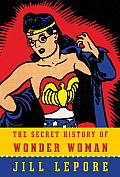
In articles derived from her new book, The Secret History of Wonder Woman, Jill Lepore has been talking up that comic-book heroine’s place in superhero history.

In Smithsonian:
Wonder Woman is the most popular female comic-book superhero of all time. Aside from Superman and Batman, no other comic-book character has lasted as long.
In The New Yorker:
Superman débuted in 1938, Batman in 1939, Wonder Woman in 1941.
Who’s missing from this discussion? “The Sensational Character Find of 1940,” of course.

Dick Grayson has appeared in stories for nearly three-quarters of a century, about a year and a half longer than Wonder Woman. He’s been a major character in two movie serials, a television series, and two feature films. Plus, half a dozen television cartoons have featured some version of Robin.

I suspect Robin is a pop-culture reference as recognizable as Wonder Woman. In fact, the name “Dick Grayson” might be better known than Wonder Woman’s occasional alias, “Diana Prince.”

Of course, Robin has always been a sidekick to Batman, and thus a supporting character or one in an ensemble instead of a lead. Though he appeared on more comic-book covers in the 1940s than Batman, not until the 1990s was there a comic book with the Robin name in its official title. In contrast, there’s been a Wonder Woman magazine since 1942 (with a yearlong break in 1986-87), and she’s usually worked on her own as well as with the Justice Society and Justice League.

So I’m not arguing that Wonder Woman is less prominent than Robin, just that he qualifies as a famous, long-lasting comic-book crime-fighter on the same level.

(And I won’t even mention that Archie Andrews made his debut in comic books in the same month as Wonder Woman, so those two comic-book characters have lasted the same time.)

08 November 2014

Where Serials End Up

Someone else considering the workings of serial fiction this week was Linda Holmes, writing for NPR on the public-radio-related podcast Serial, reinvestigating a murder.

Holmes notes how many listeners are trying to view the podcast through the lens of the recent limited television series True Detective, Fargo, and Lost. In other words, they’re asking for a clear conclusion even if (as in two of those examples) it ends up disappointing a lot of the audience.

Holmes writes:

What’s good about this wrinkle, and what seems healthy about it, is that it raises the question of what stories are for. Must there be a lesson or a moral? Must we sense a particular idea about life at the end, and can it be futility? If you raise a question, do you have to answer it? In real life, of course, Chekhov’s gun need not come to anything in the third act just because it was shown in the first. If this makes a good true story but would not make a good piece of dramatic fiction, why is that?

Assuming people do find the [Serial] ending satisfying despite what almost must be its messiness, is it possible that a piece of serial crime reporting with no conclusion will point to the idea that we've perhaps become overly obsessed in judging an entire piece of storytelling on whether we get the perfectly symmetrical, flawless, balanced, wry, doubt-drowning ending we deserve?
I find it telling that Holmes’s essay doesn’t mention what until recently was the necessary name-drop in any article on quality television: The Sopranos. That show famously ended without resolution, just a sudden black screen. And people were pissed. So it fits right into Holmes’s thesis.

07 November 2014

Aggregation

This is a snapshot from Talking Points Memo, my favorite site for political news. It shows the aggregation of several polls over recent weeks about Americans’ attitudes toward our two main political parties.

As you can see, Americans thought much worse of the Republican Party, and yet favored its congressional candidates by a slight edge. Which is what we saw in the mid-term election this week. And enough slight edges across the country’s competitive districts turn into a strong run of victories for those unfavored Republicans.

But as to how voters can reconcile those attitudes in their minds, that’s a mystery. Part of the answer is turnout. Part is that we the electorate are almost evenly divided, making slight edges more crucial—this is the fourth of the last five election cycles that swung sharply against the previous vote for Congress.

And part might be underlying OIP Derangement Syndrome, in which some voters, sensing a problem in the national government, blame President Barack Obama despite agreeing in the abstract with his policies and methods.

06 November 2014

A New Chapter in Chapters

At The New Yorker’s Page Turner blog, Nicholas Dames has probed the history of the chapter, starting with ancient naturalists and early Christian theologians and moving to the development of the novel:
Henry Fielding,…in “Joseph Andrews” (1742), explained “those little Spaces between our Chapters” as “an Inn or Resting-Place, where he may stop and take a Glass, or any other Refreshment, as it pleases him.” Chapter titles, Fielding proceeded to explain, were like the inscriptions over the doors of those inns, advertising the accommodations within.

Novels have always been good at absorbing and recycling, taking plots and devices from other genres and finding new uses for them. With the chapter, novelists began, in the eighteenth century, to naturalize an informational technology from antiquity by giving it a new cultural role. What the chapter did for the novel was to aerate it: by encouraging us to pause, stop, and put the book down—a chapter before bed, say—the chapter-break helps to root novels in the routines of everyday life. The chapter openly permitted a reading oriented around pauses—for reflection or rumination, perhaps, but also for refreshment or diversion.

Laurence Sterne’s “Tristram Shandy” insisted that “chapters relieve the mind,” encouraging our immersion by letting us know that we will soon be allowed to exit and return to other tasks or demands. Coming and going—an attention paid out rhythmically—would become part of how novelists imagined their books would be read. . . .

Thus the novelistic chapter: that modest, provisional kind of closure, a pause that promises more of the same later, like the fall of night. As the modern novel developed, explanations like those of the Fieldings became less necessary. Chapter titles themselves lost their overt connection to the “in which” or “concerning” syntax, virtually a plot summary, which derived from Biblical capitula.

Charles Dickens’s “The Pickwick Papers” could still pull off the old sort, as in “Chapter 38: Mr. Samuel Weller, Being Entrusted With a Mission of Love, Proceeds to Execute it; With What Success Will Hereinafter Appear”; by the eighteen-seventies, Anthony Trollope could title a chapter simply “Vulgarity.” As the chapter ceased seeming peculiar, it also grew in length; the average Victorian chapter was around thirty-five hundred words, roughly twice the eighteenth-century norm.
This article reminded me that chapters predated serialization in magazines, meaning that the breakup of novels wasn’t driven by the format and technology in which they first appeared. Rather, the established use of chapters made it easier to create divisions for each magazine issue.

05 November 2014

Before Frank Quitely Was Quite Quitely

Frank Quitely is one of the most respected artists working in superhero comics today, known for his distinctive drawing style, dynamic compositions, and willingness to experiment with form.

Which makes his statements in this interview at Comics Beat more interesting:
When I started out, I didn’t know a lot about storytelling because I never got a formal training in comics. It ended up being kind of intuitive and my main thing was about trying to make it clear and interesting. You know, I wasn’t really thinking in terms of narrative flow, it was more just about clarity and trying to make it as good as possible. Gradually, over the years, I just became more interested in storytelling.

There was a DC editor I worked with named Dan Raspler – the Lobo editor amongst other things. He was my editor on JLA: Earth 2 and before I did JLA, I did a short Lobo story for them and it was the first mainstream DC thing I’d done; I’d been working for [the imprints] Vertigo and Paradox for a couple years.

I sent him the pencils and it was the best thing I’d done up to that point and I thought “he’s going to phone me back and tell me how good this is” and he didn’t phone for a week. I was really panicking by the time he phoned; he started the conversation with “dude, I don’t know how to tell you this…”

Basically what he said was my drawings were really lovely, but my storytelling was really boring. He went through and told me what I should be thinking about and that was kind of a real milestone. As it was, that book never came out for different reasons. For JLA: Earth 2, he made me fax a rough for every page because he wanted to see that I could do art that makes sense in rough with a sharpie, then I could do it properly. . . . That was a big leap for me.
DC Comics published JLA: Earth 2 back in 2000. That was one of many collaborations between Quitely and scripter and fellow Glaswegian Grant Morrison.

As for the “short Lobo story” that Quitely mentioned, that was Lobo: The Hand-to-Hand Job, also subtitled It’s a Man’s World, scripted by another Scotsman, Alan Grant. It was never printed. This webpage on unpublished comics says, “Although the publisher has never commented publicly on the comic, the disappearance of the project could be chalked up to the reported nakedness of Lobo for at least half the issue, as well as a scene involving sexual self-gratification by a league of asteroid miners.” Yes, that would do it.

04 November 2014

The Return of the Cowardly Lion

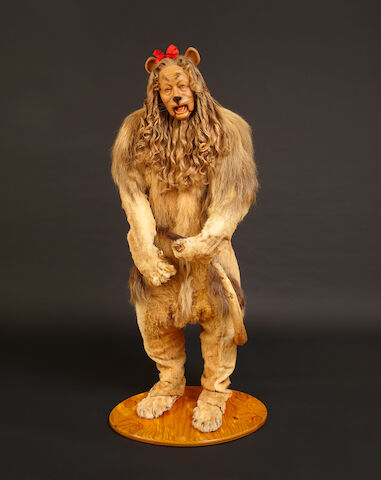
On 24 November, the Bonham’s auction house will offer a collection of Hollywood memorabilia that includes Bert Lahr’s Cowardly Lion costume from the 1939 MGM Wizard of Oz.

The auction house says:
For famed MGM costume designer Gilbert Adrian, the only option for creating a realistic lion costume in 1938 was to fashion it out of actual lion hides. He was challenged with locating several that visually matched each other so a few costumes could be made and used interchangeably throughout filming. Adrian soon discovered, however, that every available lion hide had very distinctive colors, hair patterns and scars, so he had no choice but to dress Lahr in a single costume for much of the filming.
An auction house expert told the Los Angeles Daily News states:
“According to various histories of the film, Lahr’s costume was drenched with sweat at the end of every day, and so (it) was removed and placed in drying bins overnight so it could be used again the next (day),” Williamson says.
She added that another lion costume survives which Lahr probably wore for publicity stills, and there was at least one for Lahr’s double or stand-in as well. But only this one matches the details in scenes throughout the movie.

Back in 2006, the Profiles in History company sold that other Cowardly Lion costume for over $800,000. In 2011 the owner of this costume also offered it through Profiles in History with an estimated price of $2 to $3 million. Evidently bids didn’t meet the reserve because it’s available once again, in the movie’s 75th-anniversary year.

03 November 2014

Quote Unquote

In an article for Slate, Andrew Heisel probed the growth of an unorthodox use of single-quote marks:

For several years now in teaching writing classes to college freshmen, I’ve noticed some students adopt another rule: double quotes for long quotations, single quotes for single words or short phrases. They’ll quote a long passage from Measure for Measure accurately, but when they want to quote one of Shakespeare’s words, a cliché, or some dubious concept like “virtue,” they’ll go with single quotes.

It took me a while to understand what was going on, but after thoroughly studying it I developed a rigorous explanation for this staggering decline in standards: kids today.
But then Heisel began to see that same pattern in colleagues’ writing. In news stories. Online. In 2008 I reported the single-quote style’s appearance in novels by Madeleine L’Engle and Scott Turow going back to 1973.

And yet it remained unsanctioned by any modern authorities. For a while Wikipedia said, “some style guides specify single quotation marks for this usage, and double quotation marks for verbatim speech.” Heisel looked at “38 different style and usage manuals” and didn’t find one that stated that as a rule. A handful acknowledged it as an occasional practice, especially in abstruse disciplines that deal with language. Most experts still looked askance at the style.

But Heisel also found—online, not in a library—The King’s English, published in multiple editions a century ago by H. W. Fowler and F. G. Fowler. After establishing the use of double-quote marks for quotations, that book states: “Some of those who follow this system also use the single marks for isolated words, short phrases, and anything that can hardly be called a formal quotation; this avoids giving much emphasis to such expressions, which is an advantage.”

Heisel quotes Harvard English professor Marjorie Garber as noting that quote marks can signal opposing meanings: “both absolute authenticity and veracity…and suspected inauthenticity, irony or doubt.” In the second group I also see writers including things characters generally feel or say or have said, but not necessarily in those exact words at a specified time, and thus not as a verifiable direct quotation.

The pattern raises some questions:
  • Is the usage different in modern Britain, where since the postwar punctuation shortage most books use single-quotes for direct quotations?
  • Is there enough value in distinguishing between those two types of quotations—direct and sort-of—for this usage to become useful and eventually standard?
  • Since the practice seems fairly widespread despite the apparent lack of any authority requiring or even suggesting it since the Fowlers a century ago, do writers gravitate toward this use of single-quotes because it seems logical or natural?

02 November 2014

“That history will always be in the background”?

In an interview with Comic Book Resources, Grayson co-scripter Tom King spoke of his particular fondness for the character of Dick Grayson:
You’ve said a few places that Dick was always your favorite DC character thanks to his accessibility. With that in mind, what were the big stories that first brought you into his world? Are any of them the kind of thing you’ll look to fold into the background of this book?

I came into DC comics with Tim being Robin and Dick being the ex-Robin, the man who had gone through that uniquely frightening experience and emerged as someone uniquely brave. I remember buying my first trade, A Lonely Place of Dying, and obsessing over the Tim/Dick/Batman interaction. There was this essential question there about how do you leave childhood without losing who you were as a child. I read that thing to pulp. The first time I got to write my own complete script for the series, I titled it “Only a Place for Dying,” as a tribute to that experience.

Some of my other favorite Grayson stories are:

Birds of Prey #8 (the Barbara/Dick date issue), which is where Agent 8 from Grayson #3 gets her name; Batman #156 (“Robin Dies at Dawn”), which will play a role in an upcoming issue; and, probably my favorite Dick Grayson story of all time, Secret Origins Annual #3, which I haven’t yet figured out how to squeeze story out of — but I will! Dick Grayson has a 74-year history, and though Grayson is a book solidly set in the New 52 featuring a very modern take on the hero, that history will always be in the background and will always haunt and elevate our hero.
That’s almost sad. Secret Origins Annual, #3, was a story scripted by George Pérez in 1989 which synthesized the whole history of the Titans up to that point, both pre- and post-Crisis on Infinite Earths. It sought to build coherence and depth from the illogical late-1960s storylines of Bob Haney, revealing a series of villains to be one foe in different guises trying to undermine Dick Grayson.

That story also restored a version of Betty Kane, the first Bat-Girl, who had been abandoned with the “New Look” back in 1964. It reestablished the basics of Titans history as written in the 1960s, 1970s, and early 1980s within DC’s new continuity. And in doing all that, it reflected the importance of Nightwing and his team to the company at that time.

In contrast, the “New 52” reboot of the DC Universe that King and his co-writer Tim Seeley are working within wrote off Dick Grayson’s version of the Titans, and most of the characters and relationships that Pérez’s story stitched together. Grayson has left the character even more alone within the DC Universe. The scripts might contain slight allusions to beloved older stories for long-time fans, but I don’t see how this Dick Grayson can be haunted by a history that he never had.