21 August 2013

What Fell Out of 52 Pickup

It was a warm, clear day when I heard that crime novelist Elmore Leonard had died after well over eighty years and forty books. That news reminded me that I’d been meaning to write about the experience of recently reading one of his novels—52 Pickup, to be exact—in digital form.

Like many caper novelists, Leonard wrote lots of short scenes and jumped from one point of view to another as needed. When one of those shifts occurred within a chapter, his print publisher followed the usual format of leaving extra space between the end of one section and the start of another. If those blank areas wound up at the bottom or top of a typeset page, the publisher hauled out the simple • dingbat to alert readers to the otherwise hard-to-spot section break. 

Typesetting conventions for ebooks are different, however. Most notably, the standard ebook format follows most web pages (including this one) by putting an extra line space between paragraphs and not indenting the first line of each new paragraph. 

In converting 52 Pickup to its digital format, HarperCollins ebooks reformatted the paragraphs: no indent, extra space in between. But it also wiped out the extra spaces between one section and the next. If there was a dingbat on the printed page, the • also appeared in the digital form, but most shifts from one point of view and scene to another come with no such signal for readers. That meant Leonard’s transitions, originally smooth, were bumpy, requiring me to notice the shift, stop, and look back to confirm when it happened.

The copyright page of the 52 Pickup ebook says it was converted in 2002. I hope the process has grown more sophisticated since, but then I’d hope it would have been applied to older books. It’s an easy fix, and Leonard and his readers deserve better. 

20 August 2013

Market Report on “Oz Incorporated”

Earlier in the summer I caught a performance of Circus Smirkus’s “Oz Incorporated” show. Each year this traveling youth circus has a theme, lately one based on some cultural milieu of the twentieth century: superheroes, journalism, pirates, westerns, science fiction. Sometimes those shows have had narrative arcs.

This year’s production took its inspiration from The Wizard of Oz (mostly the 1939 movie rather than the book). But it didn’t really try to retell the story; rather, the show relied on audiences recognizing moments and characters from the source material and tying those together for themselves.

This show also shifted the setting of Oz to a modern office building and corporation—think How to Succeed in Business Without Really Trying. Thus, the Wizard is a charlatan CEO, Glinda his executive assistant, and the Munchkins hand-puppet workers in a phone bank. The usual arch to the backstage was treated as an elevator door. I’m not sure how much of that biting satire the youngest members of the audience got.

The Scarecrow came on as a mop-headed, mop-wielding janitor in the building. The Tin Woodman was introduced through a juggling act, with a juggling club doubling as his oil can. And the Cowardly Lion was a big fellow in a suit, too soft-hearted for the corporate world. Interestingly, the Wicked Witch of the West was played by a young man in a stylized modern performance.

But I don’t want to put too much weight on Smirkus’s narratives because they’re really just strings to hold the pearls of the acrobatic and clowning acts. Thus, the Emerald City guards performed on unicycles and trampolines, the Flying Monkeys on trapeze, and the lions and tigers and bears on slack and tight ropes. The Wizard performed several bits of poor magic and also came out as a giant head on stilts.

When I first saw Circus Smirkus perform decades ago, the performers came in a wide range of ages. The same held true when the organization was featured on the Disney documentary series Totally Circus. But today most of the cast are in their mid-teens, young adults rather than older kids.

Every year I hope to see Smirkus present tricks I hadn’t seen before, and the show rarely disappoints. This year those were slack-wire techniques, new moves with juggling clubs, and a unicycle with three wheels. Like this.

19 August 2013

Is Analyzing The Killing Joke Like Dissecting a Frog?

Retiring Batman scribe Grant Morrison went back on Kevin Smith’s Fat Man on Batman podcast this month and proclaimed his interpretation of The Killing Joke, a landmark graphic novel from 1989. As Robot 6 and Comics Beat reported, Morrison declared:
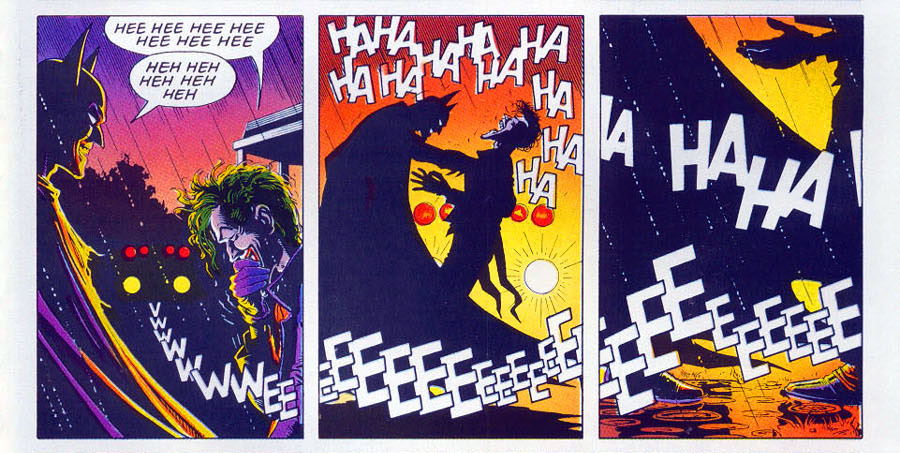
No one gets the end, because Batman kills the Joker. . . . That’s why it’s called The Killing Joke. The Joker tells the “Killing Joke” at the end, Batman reaches out and breaks his neck, and that’s why the laughter stops and the light goes out, ’cause that was the last chance at crossing that bridge. And Alan Moore wrote the ultimate Batman/Joker story—he finished it. . . . the laughter stops, it abruptly stops, it’s quite obvious. . . .

But he did it in such a way that it’s ambiguous, so people will never have to be sure, which means it doesn’t have to be the last Batman/Joker story. It’s brilliant!
This wasn’t a new theory. One can find traces of such speculation or interpretation on the internet for years. Artist Brian Bolland joked about the perceived ambiguity in his afterword to a recolored edition without resolving the questions. But letterer Richard Starkings recalls Bolland saying that he didn’t try to show Batman killing the Joker.

Prof. Scott Eric Kaufman rejected Morrison’s interpretation wholly, in part in a skilled interpretation of art and words and in part because it came from Morrison.

In fact, fans who think Batman kills the Joker don’t even agree on the method. Does he, as Morrison said, wring or snap the man’s neck (and, if so, where is the sound effect)? Or does Batman jab the Joker with one of his own poisoned needles (and does Joker venom even work on the Joker)?

The folks at Bleeding Cool did the important journalistic work of digging up Alan Moore’s script for that final page—which it say the site lifted material from the feed of transcriber Mr. Phil Jackson.

Moore didn’t write that Batman kills the Joker. He didn’t ask Bolland to depict the scene with any ambiguity, and he was quite explicit about motivation, symbolism, and multiple meanings elsewhere. (As I noted before, Moore opened this script by writing paragraphs about the endpapers of the book—that’s detailed.) Bolland’s drawings for the final page closely follow Moore’s very detailed descriptions.

But the sound-effects lettering is significantly different from what’s in the script. As Moore wrote the scene, the laughter ended in panel 5, the center of the nine-panel grid. Police sirens appeared in panels 5 through 7, in 8 “we can no longer hear the sirens” [I can’t bring myself to capitalize like Moore], and in 9 the sirens resume—presumably as the police take the Joker away.
Ultimately the book followed a different timing. The laughter continues for through panel 6 and off the right side of the grid. The sirens don’t recur for the last panel—which is a major improvement over having a bunch of EEEs breaking into what Moore sought for that image: “more an abstract design than anything else.”

Who made those changes and when? The evidence currently available doesn’t say. They probably occurred in the editing process as Moore, Bolland, and their editors discussed the book. So whatever Moore might have meant originally could have changed by the final product. But Bolland would still have needed to know what to draw.

Furthermore, Morrison’s interpretation puts a lot of weight on how “the laughter stops,” a phrase he repeated. But in the final book, the laughter doesn’t stop in panel 5 when Batman touches the Joker. Nor does it stop in panel 6—it continues off the right side.

So what have we learned or relearned from this worldwide discussion?
  • Grant Morrison likes people to think he has secret knowledge. (And to be fair, sometimes he really does.)
  • Superhero comics are a collaborative art form. The storytelling is the product of the writers, artists, letterer, and editors, with only the final product containing all their contributions.
  • A lot of fans really wish Batman could kill the Joker.
18 August 2013

Spotting a Familiar Name

A few months back there were a lot of pictures of Damian Wayne with Death from Neil Gaiman’s Sandman, but I don’t recall having seen this one in my feeds. (Of course, there were a lot.)

This picture comes from Luciano Vecchio, an artist from Argentina. I first saw his work when I was editing the International Wizard of Oz Club’s Oziana fiction magazine, and art director Marcus Mébès recruited him to illustrate some stories. When I contacted him directly a while later, Luciano told me he’d gotten too busy with paying jobs to do more volunteer fan work, and I told him that was the best news an aspiring professional artist could share.

I ran across Luciano’s name in the second collection of comics spun off the Young Justice TV show. He drew a couple of issues of that magazine, as well as cartoon-style comics about the Avengers and Green Lantern. Earlier work includes the Sentinels, about a second-generation superhero team, from Drumfish. Here’s Luciano’s Deviant Art page.

Starting soon, Luciano will be the regular artist on the new Beware the Batman! magazine written by Ivan Cohen, which DC promoted this spring with a free preview comic scripted by Scott Beatty.

17 August 2013

Wild Goose Egg Chase in Colorado

In the November 2012 presidential elections, 2,569,516 people voted in Colorado. The Obama-Biden ticket won 51.5% of the state’s vote, with a 137,858 (5.4%) margin over the Republican ticket.

When Scott Gessler was elected Colorado’s Secretary of State in 2010, he made a priority of increasing restrictions on voting, a popular cause and tactic with others on the American right. For example, he ordered county clerks not to send ballots to some troops deployed overseas.

In the months leading up to the 2012 election, Gessler tried to purge voter rolls, but found such piddling evidence of a problem that he gave up the effort. He had identified only 141 names to challenge, the equivalent of 18.1% of the 779 citizens whose registrations his office might have lost through a software problem.

This year Gessler had his office compile a list of 155 people who he said might have voted illegally in 2012, not being citizens. That number of alleged illegal voters was .006% of the total electorate, well below the count needed to change the presidential result. In fact, all together those voters would not have been enough to knock the Socialist Equality Party off the last place in the official results.

Gessler sent his lists of suspicious voters to the district attorneys of the counties where those voters lived. The DA for Boulder County, Stan Garnett, received 17 names, or 11.0% of the list. Boulder County contained only 5.8% of Colorado’s population in 2010. But it’s a heavily Democratic area.

This week Garnett announced the results of the investigation his staff had to do on those voters for the Secretary of State. All 17 “were citizens and were able to easily verify their status.”

Gessler’s rate for finding illegal voters in Boulder County was thus 0.00%. But he’s still making the suppression of allegedly illegal votes a priority.


16 August 2013

Judging Chuck Grassley’s OIP Derangement Syndrome

Among the fights quietly going on in Washington is the effort by Republican senators to slow or stop President Barack Obama’s nominations to the federal judiciary.

With the President characteristically nominating moderates to the bench whose records raise no substantive objections, and without a majority in the Senate, the Republicans’ main weapon remains the filibuster.

But Sen. Chuck Grassley, Republican of Iowa, has come up with a new tool: a proposal to cut three seats on the DC Circuit while adding two elsewhere. In a curious claim, Grassley argued that having one fewer federal judge will lessen the workload on the rest.

Grassley rests his case on the fact that the DC Circuit handles far fewer cases than other federal appeals courts. But there are several big holes in his argument for efficiency and fairness:
  • The DC Circuit’s cases are more complex than those arising in other parts of the country, and often more influential. Chief Justice John Roberts has written, “It is when you look at the docket that you really see the differences between the D.C. Circuit and other courts” (PDF article).
  • The Judicial Conference, which is the voice of federal judges, asked for more appointees elsewhere than Grassley’s bill would provide, but didn’t suggest a reduction in the DC Circuit (PDF letter).
  • As Doug Kendall pointed out for Reuters, Grassley “proposed that his bill take effect immediately on passage, rather than at the start of the next presidential term—which is the usual practice.” In other words, it’s an unprecedented limit on this President.
  • In his first thirty years in the Senate, Grassley never tried to shrink the DC Circuit Court so drastically. Only now that President Obama faces three openings on the DC Circuit does the senator perceive a need for—what a coincidence!—three fewer seats.
In fact, under President George W. Bush, Grassley voted to confirm the tenth and eleventh judges on the DC Circuit—the same bench he now claims should have no more than eight judges. And since those votes, the workload on those judges has gone up rather than down.

Grassley has complained, “members on the other side were convinced seats didn’t need to be filled a few years ago.” But according to the Washington Post, that refers to bills aimed at reducing the DC Circuit to its current number of eleven judges, not to eight. (Grassley voted for that particular bill, but it died in the Republican House.)

Tussles over judicial nominations are common in the American system, of course. There’s plenty of hypocrisy in that area, but Grassley’s bill is more hypocritical than other efforts.

Furthermore, his performance went beyond hypocrisy into hysteria when he claimed five times in one hearing that President Obama was “packing the court.” As Sen. Sheldon Whitehouse and numerous commentators reminded the Iowan, that term refers to Franklin D. Roosevelt’s proposal to change the number of seats on the Supreme Court so he could appoint more justices. Grassley was actually born in the year Roosevelt took office, so he really should remember that history better.

The only person trying to change the number of judges on a court to affect their decisions is Sen. Grassley himself. In implying that President Obama was trying to do the same, he exhibited the dissociative symptoms of OIP Derangement Syndrome.

15 August 2013

Where to Find the Runaway Bunny

Fuse #8’s catalogue of public children’s-literature statuary in the US alerted me to the Runaway Bunny statue outside the Westerly Public Library in Rhode Island. The bronze figure, by Connecticut sculptor Joan Binney Ross, was installed in 1998.

Earlier this summer the sculpture was vandalized, painted with “vulgar graffiti and the letters ‘KKK’,” as the Providence Journal reported, based on now-unavailable story from the Westerly Sun. Depending on the grammatical connection between the vulgarity and the initials, that could have been either a pro-KKK or anti-KKK message.

The library and park staff had difficulty removing the paint, so they contacted Ross, who recommended a cleaner. The AP reported that the bunny was restored to its original condition.

The Stonington-Mystic Patch carried an image of the vandalized bunny. Noting that similar graffitti had been painted elsewhere in the area, it asked readers if they recognized the “tag,” but there don’t appear to have been any breakthroughs. That site also posted a video of the cleanup.

Some of those articles referred to Margaret Wise Brown, author of The Runaway Bunny, but none named the book’s artist and designer of the original bunny, Clement Hurd.

13 August 2013

No Place Like the Hospital

This month Entertainment Weekly’s website reported on a new Oz-themed TV show, sort of:
CBS is taking a big swing with a new project with a higher-than-high concept: Wizard of Oz medical drama.

The broadcaster has inked a deal to develop a series titled Dorothy, described by the network as “a medical soap based in New York City, inspired by the characters and themes immortalized in The Wizard of Oz.”
There’s no more information on the drama than that, as far as I can tell, yet the news has already kicked up a lot of talk on television websites.

Which is the point. Without the link to a beloved property like The Wonderful Wizard of Oz, this would be just another medical drama set in the big city. The executive producers pulled a similar trick with Elementary, spun off the public-domain Sherlock Holmes mythos and promoted as such.

I don’t doubt that the show’s creators might take inspiration from the basic Oz story: a young female character named Dorothy looking for a home, three male companions who feel inadequate, and so on. But if The Wonderful Wizard of Oz weren’t both famous and free, the network would never mention that vague inspiration. No, Dorothy would then be an entirely original show, any resemblance between it and preceding stories entirely coincidental.

12 August 2013

“You do Batman stuff all the time.”

As long as I was talking about Ty Templeton’s Batman work, it seemed like a good time to share his autobiographical “Bun Toons” webcomic about being a father of teenagers.

Click through to see what impresses Templeton’s kids even more than dinner with the Governor-General of Canada.