11 August 2013

The R Stands for Hope

While I was disappointed that the second episode of Batman 66 doesn’t use any digital storytelling tricks, the story by Jeff Parker is fine. Robin plays a crucial role, rightly embodying the “idealism of youth” and receiving praise from Batman at the end.

Ty Templeton drew the Boy Wonder with a classic design, green gloves and bare legs, even while climbing on an iceberg. In contrast, Jonathan Case’s pictures in the first issue showed pale tights and darker, almost black gloves, as Burt Ward often wore on the television show.

10 August 2013

Guided View Gone

I was disappointed to find that the second episode of the Batman 66 comic (digital issues #4-5, paper issue #2) does not have the digital tricks of the first.

As I described back here, the first story combined ComiXology’s “guided view” method of sliding from one panel to another with the sequences of similar panels as pioneered by Thrillbent to create a digital comic that has almost 300 “page turns,” or new elements, appearing over the course of the story.

Jonathan Case drew extra art to take advantage of that format so that readers could, for example, see three sequential pictures of Batman shinnying up a rope to the Riddler’s biplane. A single panel in the printed version served as up to half a dozen in the digital format, which the publisher modestly labeled “DC2.”

In contrast, the second story has fewer than fifty page turns, each simply a shift to the next half-page of the printed comic. (Each digital page is the top or bottom half of one page in the printed version.)

Ever alert for conspiracy theories, the Bleeding Cool website suggested that the reason for the change was a patent dispute. ComiXology’s “guided view” might infringe on patents from 2006-2012 owned by Disney, now owner of Marvel Comics.

However, commenter Hsielke at reported a more mundane explanation:
I contacted comixology and found out that not until chapter 10 will [Batman 66] be DC2 again. I also saw in an interview with the writer that they will not be doing all in DC2 because if they did they would not be able to hit their deadlines.
Which makes sense: drawing more pictures takes more time. Learning the new storytelling tricks takes more time. But I think it will be time well spent.

09 August 2013

Eric Cantor’s Upside-Down OIP Derangement Syndrome

This week’s prime example of OIP Derangement Syndrome is House Majority Leader Eric Cantor, whose ideas of up and down have apparently become reversed since the election of President Barack Obama.

In a television interview this week Cantor said of his Republican Party’s legislative strategy:
What we are trying to do is fund the government and make sure also that we take away the kinds of things that are standing in the way of a growing economy, a better health care. And all the while keeping our eye focused on trying to deal with the ultimate problem, which is this growing deficit. And that means when we get to the issue of the debt ceiling, it’s not some sort of fictional process or just a process that we go through. What raising the debt limit means, it’s increasing the credit limit. For too long now, Washington has disregarded the fact that that does — what that does is it burdens our kids and theirs.
As numerous commenters pointed out, there is no “growing deficit.” The federal budget deficit did grow significantly in the aftermath of the Bush-Cheney recession. Cantor was in office at the time, so he should have noticed. But since we regained a “growing economy” under President Obama, the deficit has shrunk.

Cantor’s politics have actually been “standing in the way of a growing economy, a better health care,” as when he tried to steer the US government toward default and led votes to end health-insurance reform. But again, OIP Derangement Syndrome evidently makes Cantor see things in reverse.

Cantor’s comments on the debt limit likewise have a “down is up” quality. During the Bush-Cheney administration he voted to increase the debt limit five times. That was a period in which the deficit actually grew, starting from a surplus at the end of the Clinton administration. Only when a new President took office did Cantor suddenly decide that it “burdens our kids” to raise the debt limit—i.e., to actually pay for the goods and services that the Congress he nominally helps to lead has already ordered.

08 August 2013

Our Cover Story

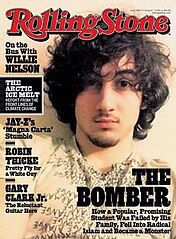
Back in April, when the FBI released surveillance-camera photographs of its main suspects in the Boston Marathon bombing, a number of people recognized Dzokhar (Jahar) Tsarnayev: his high-school wrestling coach and teammates, other classmates from Cambridge and UMass Dartmouth, and so on.

Some students in Jahar’s dorm even joked about the resemblance between their friend and one of the bombers. But no one called the police because no one believed Jahar would commit mass murder.

The Tsarnayev brothers were caught the next day after they had apparently committed one more murder and other violent acts. Someday we in greater Boston might look back on that day and acknowledge how much went wrong: the shootout with lots of stray bullets against two guys with only one gun, the police officer nearly killed by fellow officers’ bullets, the search cordon that missed Jahar Tsarnayev’s hiding-place even as business shut down in several surrounding towns (including my own). Right now we’re still too pleased that that Friday ended as well as one would want.

But we’re still left with the paradox of the terrorist whom people recognized but no one could believe. Rolling Stone magazine explored that reality in its recent cover story about Jahar Tsarnayev, with the cover line “The Bomber: How a Popular, Promising Student was Failed by His Family, Fell Into Radical Islam and Became a Monster.”

In some countries, identifying a suspect as “The Bomber” and “a Monster” before he’s tried and convicted would be seen as prejudicial. But here lots of folks reacted to the magazine cover as an outrage, suggesting it “glamorized” Tsarnayev because Rolling Stone’s cover usually features rock stars. Of course, it rarely calls those stars monsters.

On WBUR’s On Point, host Tom Ashbrook kept repeating that the Tsarnayev image was a “selfie,” as if that compounded the glamor. In fact, that means Tsarnayev took the picture himself with a cell phone, not a fancy camera, and with no makeup artist, hairdresser, or other handlers. That’s how he wanted to present himself online, but that’s also how he looked—which is really what’s so troubling about the image.

In response to the Rolling Stone cover, a state police photographer leaked images of Tsarnayev’s capture. That violated rules about evidence, prejudicial material, and secrecy, but the man was outraged. Why Tsarnayev supposedly looked less sympathetic when he was bleeding, helpless, and surrendering I don’t understand.

Reports keep coming out about the Tsarnayevs, most recently the news that older brother Tamerlan subscribed to various conspiracy-theory periodicals. Today’s Boston Globe noted that in searching the brothers’ apartment and confiscating relevant material, the FBI took away books on Islam but left behind non-Islamic right-wing conspiracy books. “Maybe it’s because it didn’t fit into their thinking about him,” mused one neighbor.

If we’re ever going to figure out what happened with the Tsarnayev brothers, and how to head off trouble from other young men in similar situations, we’ll have to stop fitting people into our thinking and accept some troubling facts: that friendly, handsome boys can turn into murderers; that overreaction can be just as fatal as the initial crime; that ideologies can be excuses for violence instead of spurs.

07 August 2013

Our Cancers, Ourselves

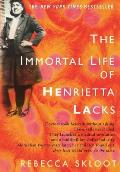
Today Nature announced an agreement between the National Institutes of Health and the heirs of Henrietta Lacks, the woman whose cancerous cells, denoted “HeLa,” have proved remarkably long-lived and therefore useful for medical research.

As described by Rebecca Skloot in The Immortal Life of Henrietta Lacks, Lacks had a hard life even before developing that virulent cancer. Her family received no compensation and minimal recognition for her contribution to modern medicine. Under the new agreement, family members will be on a committee that considers requests for research and publication of genetic data using the HeLa cells, restoring the principle of people being in charge of their own tissue and biological information.

There’s an irony in this situation, of a sort I first noticed in another case of horrible medical care given to an African-American in Jim-Crow America. In 1947 San Francisco doctors diagnosed Elmer Allen, a Pullman porter, with bone cancer. Considering his leg (or simply Allen himself) untreatable, they injected that leg with plutonium in order to study how the radioactive element affected the human body. Three days after the injection, the doctors amputated that leg and sent him home to die.

Allen lived for forty-four more years. He died in 1991, one year before reporter Eileen Welsome connected him to the records of the plutonium experiment. He never knew how badly his doctors and government had treated him, but Allen was reportedly bitter all his life about having lost his leg and career. Yet that amputation, as heartless as it was, may in fact have saved him from the bone cancer.

Similarly, Henrietta Lacks’s descendants view her undying cells as a surviving part of her, yet if she had had the option of killing or getting rid of that cancer she would surely have been glad to take it, and to think of those cells as something apart from herself.

06 August 2013

Why Thompson Oz Books Smell a Little Like Vanilla

Back in 2009 I wrote fondly about the smell of Ruth Plumly Thompson’s Oz books, as originally published by Reilly & Lee in the 1920s and ’30s. Lots of American books of that era shared the same perfume, though perhaps not as strongly, given that publisher’s low budgets.

This summer the Smithsonian blog noted an article from the International League of Antiquarian Booksellers on the chemistry of that smell:
Scientists say that “old book smell” is more than just mustiness; it contains hints of grass and vanilla. That’s because all the compounds used to make the book release distinctive odors as they break down. For example, lignin, which is present in all wood-based paper, is closely related to vanillin. As it breaks down, the lignin grants old books that faint vanilla scent.

It’s even possible to approximate the age of a book based on its smell. Chemists have identified 15 substances often present in books (known as VOC’s) that degrade (and therefore emit a gas) at a predictable rate.
The abstract of the underlying scientific paper, published in 2009, goes into more detail:
The main volatile degradation products of paper, constituting the particular “smell of old books”, were determined using headspace analysis after a 24 h predegradation procedure. Using supervised and unsupervised methods of multivariate data analysis, we were able to quantitatively correlate volatile degradation products with properties important for the preservation of historic paper: rosin, lignin and carbonyl group content, degree of polymerization of cellulose, and paper acidity.
Those scientists, some working with the Centre for Sustainable Heritage in Britain, appear to have been most interested in the preservation and dating of books. But I can also imagine interest in their findings from people who wish to create books as luxury items. What could be more luxurious than a book that smells wonderfully old but is actually in great shape?

05 August 2013

A Tale of Two Pandas—or Was It Three?

Last week the Hollywood Reporter noted the end of a lawsuit against Dreamworks concerning copyright claims on its movie Kung Fu Panda. A Massachusetts artist alleged that the studio had violated his copyright on a martial-arts panda character, registered in 2000. He could document that he had submitted his work to Dreamworks and received a form letter in reply saying that the company didn’t look at such work, but hadn’t received the full submission package back.

The plaintiff offered such exhibits as this, positioning one of his drawings alongside some images from Kung Fu Panda or its marketing.

However, Dreamworks’s lawyers came back with their own exhibits, including this juxtaposition of the plaintiff’s work alongside images from a Disney coloring book published four years earlier:
That obviously made it harder for the artist to maintain, as he had testified, that his own work was entirely original. The judge was already displeased that he had destroyed the paper and pixel trail leading up to the creation of his work just after seeing the first preview of Kung Fu Panda, when it would theoretically have been most important. Last week he withdrew his claim permanently.

04 August 2013

Bishop’s Gotham Knights

I spent the afternoon at the Boston Comic-Con, where my first purchase was a keychain from the collection of DrawingBishop.com, also available through Etsy. I chose the 1996-2011 Nightwing, not shown in this gallery but obviously available. No “New 52” versions, as I recall.

My eye was first caught by this “Flying Wayne Sons” print, but on closer examination I thought it was just encouraging bad behavior from Damian.

03 August 2013

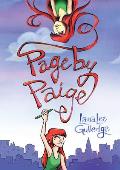
Page by Gulledge

In her graphic novel Page by Paige, Laura Lee Gulledge harnesses the power of surrealism to explore the inner life of a teen-aged artist new to Manhattan.

That visual invention is what really carries the book because, although there’s tension involved in Paige’s search for friends and confidence, her journey doesn’t run her into any wrenching twists or setbacks.

Like The Plain Janes, this story involves absurdist guerrilla public art. Apparently that’s a thing kids do now. Or wish they could.

01 August 2013

Wisest Thing I’ve Read Today

From the Reddit “Ask Me Anything!” discussion with Ethan Nicolle, co-creator of Axe Cop, on how his brother Malachai has developed as a writer from age five to age nine:

He also has begun to get a better understanding of story, why it is good to give the bad guys a motive and to make the good guys almost lose. These were concepts that made no sense to him when he was five. He likes surprising and tricking his audience now.
And as for the violence in the comic:
I always…try to envision it the way HE sees it and not the way it would happen in reality. He think[s] in video games and toy battles. One very revealing moment was when we watched this fan-made live action Axe Cop movie, which is basically episode 1 verbatim, shot for shot in real life. When Malachai saw it, he had to shut his eyes, and it scared him. He is not thinking in reality. That is why when he says something that would be really violent in real life, I don't draw it that way. Most of the bad guys heads pop off like toys. I think that kids are much better at discerning cartoons from reality too.
And Malachai himself on when he might stop writing Axe Cop:
I think I will stop when I don't have that crazy imagination any more. Around 18.