26 January 2013

Fast Food and the Caped Crusader

I recently read a study in Pediatric Obesity titled “What would Batman eat?: priming children to make healthier fast food choices.” Unfortunately, it left me with a lot of questions.

The study was small, involving only 22 children. (Interestingly, just six of those were non-Hispanic whites.) During weekly lunches at Burger King the researchers asked the kids, “Do you want apple fries or French fries with your lunch?”—“apple fries” being the chain’s term for apple slices.

At the outset only 9% of the kids chose the fruit. But when shown “12 photos of (6 admirable and 6 less admirable) real and fictional models” and asked what those folks would choose, the kids’ choice of apples went up to 45%. Not even half, but still a significant jump.

Alas, the study doesn’t list all the people in those photos. Two of the admirable figures were Batman and Spider-Man (spelled without the hyphen in the abstract). One of the “less admirable” figures was the Penguin—a villain whom Dick Grayson chuckled at in 1941 (see below) and who has only gotten more roly-poly and villainous since.

The other nine figures remain unknown. Did they include the Hulk, an embodiment of id with no regard for body issues—yet usually on the “admirable” side? What about Bouncing Boy of the Legion of Super Heroes, chubby and heroic? What about Stephen Hawking? What about a villain in excellent physical condition, like Deathstroke?
(One of the early Bruce Wayne’s brief attempts to be mature and parental. Within a few panels he was referring to the Penguin as “that fatty.” But then the man turned out to be a criminal, so it was okay to look down on him.)

25 January 2013

OIP Derangement Syndrome Comes Out of Recess

Today a panel of judges on the US Circuit Court for the District of Columbia ruled that President Barack Obama overstepped his authority in some recess appointments he made a year ago. Ordinarily the Senate would have been in recess at that time, but constitutional maneuvering by the House of Representatives had forced it to remain in pro forma session.

The Senate’s Democratic leaders had in fact come up with that pro forma gambit in the last years of the Bush-Cheney administration as a way to prevent recess appointments. It had never been challenged in court before, so the judges’ decision against President Obama involved a new question without clear guiding precedents.

On the other hand, the judges didn’t just rule against recess appointments while the Senate was in pro forma session. They went beyond that question and also ruled that a President can make such appointments only during a formal recess by the Senate (long ago legally dubbed the “intersession”) and not during any of its shorter breaks during the year (so-called “intrasession” recesses).

That contradicted precedents from the 11th Circuit Court in 2004, the 9th Circuit Court in 1985, and the 2nd Circuit Court in 1962. It also contradicted actual practice by Presidents, supported by Justice Department rulings, going back to the early 1900s.

The DC Circuit judges also stated that President Obama could use his recess appointment power only to fill vacancies that arose during that recess, not those occurring because the Senate (or, in this case, a minority of the Senate using the filibuster) hadn’t acted on nominations. That part of the new decision contradicts practice and rulings going back to 1823.

Personally I think that the recess appointment clause did get stretched, particularly with a ruling in 1884 that officials appointed that way can remain in position even after the Senate formally considers and rejects them. I also think the Senate filibuster, which is inextricably bound up in Obama’s recess appointments, has been increasingly abused and is outside the spirit of the Constitution. But I don’t get to impose my preferences arbitrarily.

The US Fourth Circuit panel can try to do just that. In this case, they decided that President Obama could not operate by the same rules as every other President for the past century. And that looks like OIP Derangement Syndrome.

24 January 2013

“Strong inky lines” and “swift composition”

The Poopsheet Foundation, which reviews indy and small-press comics, has nice things to say about The Greatest of All Times Comics Anthology, and in specific about my contribution:
J.L. Bell & Braden Lamb deliver the greatest spy of all time, and I’d love to see something feature length from these strong inky lines and the swift composition of the storytelling on display.
There are also fine words for many other contributors, especially Line Olsson (“I’d kill for a piece of her original art”).

Braden also featured a page from our story on his Tumblr site. Doesn’t that make you want to obtain a copy from Ninth Art Press?

22 January 2013

Grant Parsley’s Wizard of Oz in Relief

Grant Parsley of Dallas has shared three of his illustrations for The Wonderful Wizard of Oz on Behance.net and other sites.
At the Little Chimp Society, Parsley wrote: “The illustrations are executed with a digital relief technique.” Which leaves me just as much in the dark as before.
Parsley’s Tumblr page shows a variety of styles and subjects, and his Deviant Art gallery shows his superhero renderings.

20 January 2013

Reading the Memo on Damian Wayne

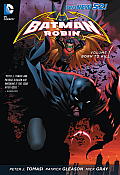
One of the most interesting elements of Batman and Robin: Born to Kill, by Peter J. Tomasi and Patrick Gleason with Mick Gray, is the “story proposal” printed at the end of the book. Of its fourteen paragraphs, all but three are an analysis of the relationship between Bruce and Damian Wayne.

The other paragraphs introduce the story’s villain and his motivation, rooted in his history with Bruce Wayne, but not his powers or working methods. Also missing from the proposal is a storyline with plot points, emotional moments, rising action, and so on. It mentions only one corner of the plot, the climax at the end of what turned out to be issue #7.

Instead, Tomasi’s memo is all about Batman and Robin’s differing symbolism, motives, and approaches to attacking crime. All very important in the superhero genre, but I doubt such a memo would have been enough for DC Comics’s editorial team if it hadn’t come from Tomasi. He was a DC editor himself until a few years ago and a successful utility player since. As the company planned its “New 52” reboot, its honchos probably wanted to keep working with Tomasi. The question was how to make this Batman book different from half a dozen others. His proposal supplied an answer:
Our “A” story, the emotional and psychological backbone of the book[,] will be laser-focused on the relationship between Bruce and Damian.
Eventually the story reaches a common point in superhero comics: the hero appears to face dire consequences unless he compromises his values—in this case, Bruce Wayne’s commitment not to kill. Of course, Damian Wayne has a different approach to that dilemma.

Indeed, Damian is quite the troubled ten-year-old in this volume. He sits at a drawing board sketching gory pictures—a hobby that could lead only to the horror of being a comic-book artist. He crushes small animals. (The story proposal says he kills “a sick bat that’s fallen to the cave floor,” but that’s not how the scene plays out.)

I’ve seen some readers complain that this volume doesn’t show Damian having learned and grown from his training with Dick Grayson. In fact, some of the story’s noteworthy moments echo similar moments from earlier months: Damian insists on going out by himself, the R symbol gets ripped from his chest, another crime-fighter tempts him to change mentor, etc. And at the end, he can’t match his father’s commitment.

But if Damian changes greatly, there would be no story. The difference between the two Waynes isn’t simply the subject of this volume. It’s also the Unresolvable Foundational Conflict of this series. In issue #8 the villain is gone and there’s no trouble for the heroes after page 6—except the trouble they pose for each other. And that’s one of the most compelling chapters of the volume. The relationship really is the “A” story.

Tomasi expresses his theme as “nature versus nurture.” At least as Bruce sees it in issue #2, “I have to find a way to push him past the obscene indoctrination of his early years and hope nurture wins out over nature.” That seems like a misunderstanding of what “nature versus nurture” means, however. The conflict is between the two ways Damian has been nurtured by his two parents. We don’t know how he would have developed normally. We don’t know what his innate qualities are.

Another notable element of Tomasi’s proposal is how he linked his new villain with Grant Morrison’s Batman, Inc. narrative, about a worldwide crime-fighting enterprise led by Bruce Wayne and a worldwide criminal enterprise led by Damian’s mother. The villain had a personal reason to attack Batman, but Tomasi had him resent Batman, Inc. I think Tomasi is still loyal to the pitch he heard from Morrison as an editor years ago. The other main Batman comics seem to be working independently of Morrison’s storyline, but Tomasi is still trying to keep the continuity together.

18 January 2013

The NRA’s OIP Derangement Syndrome

This week the organization that claims to speak for America’s gun fandom, the National Rifle Association, released an online ad calling President Barack Obama an “elitist hypocrite” because of his daughters’ school. As the Washington Post’s Fact Checker column reported, the NRA’s ad was false in multiple ways:

  • It claimed that President Obama opposed having guards in schools. In fact, he supports that idea but doubts, like the overwhelming majority of Americans, that it’s a complete solution.
  • The ad claimed that the “school Obama’s daughters attend has 11 armed guards.” It has a small security staff (eleven people over two campuses), but as a Quaker institution does not arm them.
The NRA managed thus to be doubly wrong on facts and disrespectful of religious principles.

Furthermore, when called on the ad, An NRA spokesperson claimed, “If anyone thinks we’re talking specifically about someone’s children, they’re missing the point completely. This isn’t an issue about comparing the president’s kids.” Except that the ad said, “Are the president’s kids more important than yours?” Of course that’s “comparing the president’s kids”! How stupid does the organization think its audience is?

The Post awarded the NRA’s effort four Pinnochios out of four, the rating it reserves for “whoppers.”

Shortly afterward, gun fans on talk radio, FOX News, and elsewhere then worked themselves into a dudgeon over the fact that some children who had written to President Obama about gun violence were part of his announcement of how the administration will address that problem. How dare he use children as political props? those commenters demanded, though not all in such polite terms.

Never mind that the NRA had just tried to use President Obama’s two daughters. And never mind that those same commenters made no such squawks about President George W. Bush having children all around him when he announced his policy on funding medical research using stem cells.
And when he signed his education bill.

Patently false statements about this President? Applying double standards to his behavior? Intimations that the Obama family is getting above their station? Those are the hallmarks of OIP Derangement Syndrome.

In this case, the right wing’s usual resentment is probably aggravated by some underlying guilt. The national debate over gun safety was invigorated by the horrific massacre in the Sandy Hook Elementary School. The NRA and its allies are desperate to separate children from the debate over gun rights and responsibilities because of the inability to separate children from actual guns.

17 January 2013

Martin Luther King and “A Right Delayed”

An awful lot of websites and books published in the last twenty years quote Dr. Martin Luther King, Jr., as saying “A right delayed is a right denied.” Those publications come from both the left and the right, but the citation is currently spreading with people who want to buy more and more guns. (Apparently they can’t see the incongruity of quoting a pacifist murdered by a right-winger with a gun.)

And I don’t think King even said those words. None of those attributions provide a specific article, speech, or book as a source, which is always suspicious. The phrases don’t appear in authorized collections of his work. Instead, the line seems to be a poor rendering of something else King wrote repeatedly: “Justice too long delayed is justice denied.” (Which makes sense—“justice” can be delayed, but “a right” either exists or not.)

However, King never claimed to have coined that line. In a December 1961 speech to the AFL-CIO titled “If the Negro Wins, Labor Wins,” he stated: “There is a maxim in the law—justice too long delayed, is justice denied.”

King quoted the line again in his “Letter from Birmingham Jail” in April 1963. In different versions of this text, King ascribed the quote to “one of our distinguished jurists” and “the distinguished jurist of yesterday.”

In the 9 Mar 1964 Nation, King wrote: “This is the test to which concerned national leaders are put—not by civil rights leaders as such, but by conditions too brutal to be endured, and by justice too long delayed to be justified.”

In “Civil Right No. 1,“ published in the New York Times in March 1965, King wrote: “The delays inherent in test cases, where the U.S. Supreme Court must ultimately rule, make sadly pertinent the comment of Chief Justice Earl Warren in the school desegregation cases: ‘Justice delayed is justice denied.’” Clearly King was trying to invoke authority for his side of the argument, just as people try to invoke King’s name for theirs now.

I can’t find Warren writing those words in a desegregation decision, but I found an essay in which the Chief Justice wrote, “Justice delayed is often justice denied.” However, as King initially stated, that was a legal maxim, not Warren’s coinage. Those same words also appeared in an issue of The Outlook in June 1909. And former Colorado governor C. S. Thomas delivered a speech titled “Justice Delayed is Justice Denied” to the Iowa Bar Association in 1910.

So how far back can we go? In March 1868, during debate in Parliament over the disestablishment in Ireland, William Ewart Gladstone said:
But, above all, if we be just men, we shall go forward in the name of truth and right, bearing this in mind—that, when the case is proved and the hour is come, justice delayed is justice denied.
And further back! The British writer Walter Savage Landor used the line “Delay in justice is injustice” in an “Imaginary Conversation” between “Peter Leopold and President Du Paty” published before 1846.

And back still further! On 19 Dec 1825 Condy Roguet, a grumpy American diplomat in Brazil, wrote: “Justice, too long delayed, ceases to be justice.”

On the other hand, if folks want an exact source for “A right delayed is a right denied,” its earliest appearance seems to be the transcript of a Senate Committee on Foreign Relations hearing on the “Czechoslovakian claims fund” in 1957. Much less inspirational than Martin Luther King.

15 January 2013

Become a Munchkinland Mogul

Last fall Spooky Cool Labs released a Warner Bros.–licensed Wizard of Oz game on Facebook. I, of course, haven’t played it. And even though several of my Facebook friends come from the world of Oz scholarship, I haven’t seen a lot of notifications about “Jenny has killed two Kalidahs!” or the like. Maybe I finally figured out how to work my settings correctly.

I therefore turned to Peter Davison’s review at Inside Social Games for more information. The game uses images, sounds, and footage from the 1939 movie, and the sight of Munchkinland above suggests it also owes something to McDonaldland (and thus to Sid & Marty Krofft).

Davison explains the gameplay this way:
Dorothy…meets Glinda the Good Witch of the North and discovers her quest to follow the Yellow Brick Road and make her way to Emerald City. Thus, most players would probably expect some sort of adventure/role-playing game experience, with players taking control of Dorothy (and later her companions) as they attempt to make the perilous but colorful journey.

Instead what we get is a title that is rather similar to CityVille at first glance. A very well-presented CityVille-alike, yes, and one with a few surprises up its sleeve, but a CityVille-alike nonetheless.

The player’s time in The Wizard of Oz is spent primarily rebuilding Munchkinland by constructing houses and resource-gathering buildings. More houses mean a higher population of Munchkins, who can subsequently be assigned to the production buildings in order to generate the resources required to continue building.
That doesn’t seem much in the spirit of either the movie or L. Frank Baum’s books. The latter eventually proclaimed that Oz was a moneyless economy with everything owned by Princess Ozma and distributed free on the basis of need—a system that no doubt works better in a land where bread and shoes grow on trees.

But social-media games have to make money in this world. Not only is the key to success in this Oz harnessing the work of little people, but players can use real money to buy emeralds that work as Ozian currency and speed up the process.

14 January 2013

A Bent for Thrillbent

Yesterday I commented on the content of Insufferable, the online superhero story from Mark Waid, Peter Krause, and team. I was even more interested in Insufferable’s format. Waid and Krause chose to break from the demands of print publication and format their work for the iPad and other computers.

The most obvious difference, also reflected in DC Comics’s digital-first offerings, is that the “page” is aligned horizontally rather than vertically. The lettering is slightly larger than for a print comic book. Even more important is the change in what a “page turn” means. It can be a whole new set of images, as in regular comics. But it can also be the same image with a significant change:

  • more of that image than was in the frame before (as if a camera was pulling back to reveal more).
  • a new panel appearing.
  • a character’s shifting facial reaction or other change within the panel.
  • a word balloon, the “page turn” communicating a pause in the conversation.
  • captions (tweets in the case of Insufferable) filling up the screen.
  • a version of the movies’ “rack focus,” in which the foreground goes out of focus and the background becomes crisp, or vice versa.
Waid conceived of Insufferable as a way to show the potential of that new approach, and it clearly has storytelling potential.

I preferred to download the episodes of Insufferable in PDF form from Thrillbent and then read them on my iPad with the Stanza program. That reader provides a way to switch from one page to the next instantly without the “sliding” function that iPad programmers love to show off. That matters for the new types of “page turns” I list above.

Having the episodes also let me check back, not just on the story but also the underlying technique. Late in the adventure I began to feel that each installment contained less “story” than at the start. Yet each episode remained about 20 screens. That suggests either that Krause and Waid were playing more with the new page turn techniques as they got used to them, or that I was getting impatient.

ComiXology recently started selling issues of Insufferable, each containing a month of the original weekly installments. I don’t know if they differ at all from the experience of reading the Thrillbent PDFs. (ComiXology has a system for guiding the eye from one balloon or panel to the next, useful in the transition from print to digital but not seemingly needed for a comic conceived for a screen to begin with.) Those files include the sort of extras that comics fans have come to expect in collections: early sketches, creator commentary, etc.

The first storyline of Insufferable ends with the heroes once in partnership and some mysteries yet to be solved. However, one of those mysteries seems to be when the next storyline might pick up. In mid-2012, Waid also announced several more stories from other established creators and Top Cow’s “Pilot Season” program of test series would appear on Thrillbent this year. He tweeted that Insufferable would be back after a “short break.”

But as of this evening, Waid’s personal website is down. The last blog entries that appeared there and at Thrillbent in October. Thrillbent has been besieged by hackers before. I’m hoping its small staff is gearing up for a big leap ahead because the format has so much storytelling potential.

13 January 2013

A Duo with an Unhealthy Dynamic

This month Mark Waid, Peter Krause, and team finished the first storyline of their superhero adventure Insufferable on Waid's digital comics site Thrillbent. Since the concept is obviously inspired by the Dynamic Duo, it's an appropriate topic for the weekly Robin.

For BOOM! comics, Waid wrote two linked series called Irredeemable (drawn primarily by Krause) and Incorruptible, which explored what could happen if one of the cornerstones of the Superman mythos was kicked away. What if the alien with powers beyond anyone else on Earth suddenly turned hateful and destructive? And, conversely, what if one of his worst nemeses decides that it’s now up to him to turn his life around and save the planet?

Insufferable starts by remixing some basic ingredients of the Batman and Robin mythos. Nocturnus is a dark, unemotional, technology-driven crusader against crime. Kid Galahad was his young sidekick. But there are two major differences:
  • Nocturnus is Kid Galahad's real father, not a father figure.
  • Kid Galahad is not Dick Grayson; he's just a dick.
In other words, what if Robin is, if not evil, far from a good role model?

Years before this story begins, Kid Galahad broke with his father and blew their secret identity. Since then he’s built a lucrative business around his persona, and Nocturnus has retreated further into the shadows. But a new threat from an old villain forces them to work together again. There are, of course, layers within layers, betrayals, unforeseen allies, and so on. Waid knows how to write superhero stories.

Some aspects of the original Batman and Robin’s relationship are replicated here: Kid Galahad is more emotive, Nocturnus a better planner. As Waid has acknowledged in a summer 2012 interview, the opening chapters were designed to show Galahad’s perspective: “Nocturnus doesn’t seem to get as much play, but that’s only because we’ve made a conscious choice to not look too deeply at his thoughts and to veil him in mystery.” Meanwhile, Galahad just can’t keep his feelings to himself.

Yet the story’s sell line invites readers into Nocturnus’s point of view: “What happens when you’re a crimefighter and your sidekick grows up to be an arrogant, ungrateful douchebag? What on Earth could draw the two of you back together again?” Despite (or because of) his vociferousness, the story strongly implies that Kid Galahad’s big problem is Kid Galahad, and Nocturnus’s big problem is…Kid Galahad. If the kid sidekick is bad, the whole universe goes to pot.

Another theme that Waid explores in Insufferable is the power of social media. Kid Galahad has a big online following. His fans tweet about his latest appearances and exploits. (The Twitter handles of some of those fans match those of real comics fans.) Cameras are everywhere to catch Galahad’s mistakes and boasting. His smartphone plays a role in several scenes. To some extent that reflects the way we live today. But it’s in part also a commentary on online comics discussion, where vitriol goes well beyond what’s merited by fiction about people kicking each other in the face.

TOMORROW: The Thrillbent format.