21 September 2012

Talking Out of Both Sides of His Mouth

This week as part of his extended attempt to change the subject, please, Mitt Romney told a Sarasota rally:
We face a Washington that’s broken, that can’t get the job done. The president today threw in the white flag of surrender again. He said he can’t change Washington from inside, he can only change it from outside.
Back in 2007, while he was running for President against Sen. John McCain, Romney said:
I don’t think you change Washington from the inside. I think you change it from the outside.
Not only had Romney repudiated his own words, he had (as so often) quoted Barack Obama selectively. The President’s entire statement was:
I’ve learned some lessons. Most important is you can’t change Washington from inside, only from the outside. That’s how some of our biggest accomplishments like health care got done—mobilizing the American people.
Obviously he was talking about a success, not a surrender.

This could count as simply another example of Romney reversing himself completely over the years in an attempt to please a different audience. But since it also involves a erecting a double standard in order to criticize the President, it meets the definition of OIP Derangement Syndrome.

20 September 2012

Another Relic from the Typewriter Age?

At StackExchange, Paul Stanley wrote about what’s become the American standard for business letters, reports, memos, many magazines, and a lot of the other things we read—but not most books. And that’s the 8.5-by-11-inch sheet of paper.

Stanley starts with the given that for readers “the optimum line length is broadly somewhere between 60 characters and 75 characters.” That apparently has to do with how much we can take in, how easily our eyes can find the start of the next line, and so on.

As it happens, we have ended up with paper sizes that were never designed or adapted for printing with 10-12 point proportionally spaced type. They were designed for handwriting (which is usually much bigger) or for typewriters. Typewriters produced 10 or 12 characters per inch: so on (say) 8.5 inch wide paper, with 1 inch margins, you had 6.5 inches of type, giving ... around 65 to 78 characters: in other words something pretty close to ideal.

But if you type in a standard proportionally spaced font (worse, in Times -- which is rather condensed because it was designed to be used in narrow columns) at 12 point, you will get about 90 to 100 characters in the line.
Thus, like non-curly quotation marks, the double hyphen in place of an em-dash (as in Stanley's posting), and the double space after a period, our “letter size” page was based on working within the limitations of a typewriter in the early 1900s.

Stanley goes on to discuss various ways text designers can produce more easily read text on that standard sheet.

Note, however, that at the bottom of that page commenter Alfe says that the limit of 60-75 characters is itself a cultural norm, not a scientifically validated fact.

19 September 2012

The Goal

From Judith Matloff”s article “Fighting Words” at the Columbia Journalism Review discusses the problem with common martial euphemisms:
My 11-year-old son was astounded to hear that “friendly fire” was not friendly at all. “You’ve got to be kidding,” he nearly spat when he learned the definition: killing fellow troops by accident. “I thought it meant you shot at but didn’t hurt someone. Why don’t they just say it’s like a home goal?”
Incidentally, “home goal” appears to be a recent, perhaps egg-corned version of “own goal,” the venerable soccer term for putting the ball into one’s own net. Though far less popular on the web than its predecessor, “home goal” has started to appear in newspaper headlines.

18 September 2012

Allegro non Toto

Some puns work better than others.

This is from an ad for the New England Conservatory’s Contemporary Improvisation training, celebrating its 40th year. It deserves points for trying.

17 September 2012

Upcoming Events in Boston Teen Lit

On Tuesday, 18 September, Boston GLOW is sponsoring two panel discussions on the theme of “Fight Like a Girl” at Hosteling International, 19 Stuart Street in Boston.

The middle-grade panel (ages 8-12) starting at 5:00 P.M. will feature authors Linda Mullaly Hunt, Padma Venkatraman, Erin Dionne, Jennifer Carson, and Ellen Booraem. The YA panel (ages 12+) follows at 7:00, and will include Terry Farish, Gina Damico, A.J. Paquette, Diana Renn, and Susan Carlton.

Boston GLOW is “a nonprofit aimed at fostering leadership skills among girls and women.” Its poster for the event is here.

The Boston Teen Author Festival is being organized by Emerson College’s publishing-program undergraduates with support from the Boston Book Festival. It is scheduled to take place on Sunday, 28 October, from 1:00 to 6:00 P.M., at the Bill Bordy Theatre of Emerson College, 216 Tremont Street in Boston.

Authors scheduled to attend are A.C. Gaughen, Amelia Atwater-Rhodes, Caitlin Kittredge, Daniel Waters, Diana Renn, Erin Dionne, Huntley Fitzpatrick, Jack Ferraiolo, Karsten Knight, Laurie Stolarz, Leigh Fallon, Marissa Doyle, Steven Goldman, Susan Carlton, and Wendy Wunder.

Dark Horse Stumbles?

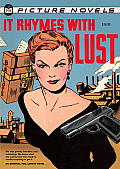
There’s only one reason that Dark House Books reprinted It Rhymes with Lust, script credited to Drake Waller and art to Matt Baker and Ray Osrin: it’s one of the first American attempts to publish a novel-length story in comics form. In other words, it’s a candidate for being the earliest graphic novel.

But you couldn’t tell that from the reprint. Nowhere on or inside the book is the date of its original publication in 1950; instead, the date on the copyright page in 2007, when Arnold Drake wrote the afterword. Nowhere does the book state that its author is a pseudonym for Drake and Leslie Waller. Indeed, Drake’s afterword doesn’t even make clear that what it calls “that first story” is the same volume one is holding.

Nowhere on or inside the book is a statement—even a single sell line—about the book’s significance in comics history. Instead, Dark Horse has carefully recreated the front and back covers of the original, with all the breathless, melodramatic text. In combination with a 2007 copyright date, the result looks like a parody or a nostalgic attempt to recreate comic noir.

Given that the market for stories about family dysfunction and corruption in post-WW2 mining towns is probably small, I think Dark Horse missed a bet in how they packaged this book. They found space on the copyright page for a list of publishing personnel (something one rarely sees from mainstream American publishers), yet nowhere said, “This book is a piece of comics history, and here’s why…”

I guess the company thought its target readers would find the book in comics shops and recognize its significance from Wikipedia. And some people might say those assumptions reflect a larger problem with the American comics industry.

16 September 2012

The All-Too-Successful Career of Cassandra Cain

This chart is based on sales figures that Comics Chronicle back-calculated from reports by the Diamond distributor. It shows the relative performance of Batgirl (in black) and Robin (in red).

The protagonist of Batgirl in this period, as I’ve been discussing, was Cassandra Cain. She was a teen-aged protégée of Batman, dealing with issues of identity, values, and heritage, so her coming-of-age story was parallel to that of Tim Drake as Robin. But she was a new character, especially fresh since she was female and of Asian extraction.

When Batgirl launched in 2000, the magazine outsold the much older Robin by about 50%. Then its sales started to slide—as the industry has come to expect for all its titles. The sales of Robin could slide, too. The January 2002 rise for both magazines came during a crossover. The big jump in Robin sales in 2004 was when DC got a case of the Stephs. But the long-term trend is clear: while Robin bobbed along, Batgirl gradually ran out of its original gas.

And what was that fuel? I submit that it was the main character’s Unresolvable Foundational Conflicts. When Cass Cain’s story started, she was suffering the effects of a horrendous upbringing as a child assassin: she couldn’t read, could barely speak, and was haunted by her past deeds. Those burdens drove her quest for justice and made it much harder. They balanced out and humanized her preternatural martial-arts skills.

But then Cass Cain learned to read speak. She temporarily lost her powerful ability to read body language in fights, forcing her to recognize the trade-offs in her life—but she overcame that problem, too. Cass confronted and defeated her father, the nasty assassin David Cain. She confronted and defeated her mother, the slightly less nasty killer Lady Shiva. She overcame her feelings of guilt. She built friendships with other crime-fighters. In sum, Cass resolved all her main Foundational Conflicts.

And that left little fuel for future stories. To be sure, there were other factors—most importantly, the original creative team of writer Kelley Puckett and artist Damion Scott moved on. But other characters have survived such changes.

The fundamental problem was that Cass Cain won. Bruce Wayne and Tim Drake never resolved their Foundational Conflicts that way in the main storylines. Clark Kent and Dick Grayson did resolve theirs, in Alan Moore’s “Whatever Happened to the Man of Tomorrow?” and the Batman stories of 2010-11, respectively—but those storylines led immediately into reboots that restored the characters’ original Foundational Conflicts. In a series, the problem with a happy ending is that it’s an ending.

DC ended the Batgirl magazine with its Infinite Crisis reboot. I suspect that the company editors set out to restore Cass Cain’s Unresolvable Foundational Conflict by taking her back to her roots as an assassin. By editorial mandate, she reappeared as the villain in a Robin storyline.

Cass’s characterization in the resulting issues is almost unrecognizable—once non-verbal, she now filled panels with expository dialogue. Once almost suicidally committed to justice, she was now a supervillain. Far from restoring Cassandra Cain as an interesting badass, that story and subsequent, more creatively successful appearances alienated her old fans and brought in few new ones.

Bruce Wayne’s death led to a reshuffling of the team he had assembled, with a new Batgirl. Cass Cain simply disappeared for a while. Eventually DC portrayed her fighting crime back in Asia, still linked to the Batman team through Tim Drake but comfortable working on her own. She had traveled farther than any of Batman’s male protégés and come of age. But as a protagonist, as opposed to a supporting character, she had nowhere else to go—not without a new Foundational Conflict.

And in DC’s latest universe, Cass Cain hasn’t yet appeared at all.

15 September 2012

Those Words Don’t Mean What Governor Romney Thinks They Mean

On Tuesday the US Embassy in Egypt issued this statement:

The Embassy of the United States in Cairo condemns the continuing efforts by misguided individuals to hurt the religious feelings of Muslims—as we condemn efforts to offend believers of all religions. Today, the 11th anniversary of the September 11, 2001 terrorist attacks on the United States, Americans are honoring our patriots and those who serve our nation as the fitting response to the enemies of democracy. Respect for religious beliefs is a cornerstone of American democracy. We firmly reject the actions by those who abuse the universal right of free speech to hurt the religious beliefs of others.
Mitt Romney personally approved a campaign release condemning that embassy statement as:
  • a “first response” to events that actually occurred later.
  • coming from the White House, which was not involved.
  • an apology, or “akin to an apology,” as he claimed the next day.
As many observers noted, the embassy’s message is in no way an apology. It contains no form of the word “apologize,” nor phrases like “very sorry” and “sincere regret” that we should expect in an apology.

Rather, that statement condemns an obvious attempt to offend all the adherents of a very large religion. It should be no surprise that diplomats, of all people, would condemn deliberate offensiveness.

And so did Romney, speaking two days later on TV:
I think it’s dispiriting sometimes to see some of the awful things people say. And the idea of using something that some people consider sacred and then parading that out a negative way is simply inappropriate and wrong. And I wish people wouldn’t do it. Of course, we have a First Amendment. And under the First Amendment, people are allowed to do what they feel they want to do. They have the right to do that, but it’s not right to do things that are of the nature of what was done by, apparently this film. . . .

I think the whole film is a terrible idea. I think him making it, promoting it showing it is disrespectful to people of other faiths. I don’t think that should happen. I think people should have the common courtesy and judgment—the good judgment—not to be—not to offend other peoples’ faiths. It’s a very bad thing, I think, this guy’s doing.
That was no more and no less of an “apology” than the words Romney had complained about two days before.

I nevertheless see a notable difference between the statements. The State Department referred to “the universal right of free speech.” Romney instead said, “we have a First Amendment.” The First Amendment limits the US government and, under later court decisions, state and local governments in the USA. It offers no guarantees to people in other countries, as Romney’s “we” implies.

In contrast, the US Embassy’s statement expressed belief in a universal right, not limited by national jurisdictions and constitutions. If someone truly believed in natural rights, whether endowed by God or deserved simply by virtue of being human, then the First Amendment should be an afterthought. It’s one nation’s important and early expression of a broader freedom that people deserve everywhere. But does Romney truly think that way?

14 September 2012

Surveying OIP Derangement Syndrome

Earlier this month Public Policy Polling released surveys of voters in Ohio (PDF) and North Carolina (PDF) that included this question:
Who do you think deserves more credit for the killing of Osama bin Laden: Barack Obama or Mitt Romney?
Barack Obama was, of course, the President who gave the order for the attack on bin Laden’s hideout in Abbottabad. The commander-in-chief who chose a commando raid rather than an airstrike to be more sure of the result. The chief executive during the preceding two years of military and intelligence operations that had finally tracked down the terrorism organizer.

All that time Mitt Romney was preparing to run for President again. He’s never worked in the federal government, the military, the intelligence field (to our knowledge), or law enforcement. He has no connection whatsoever to the bin Laden raid.

So the choice of which of those two men has more responsibility for the death of bin Laden should be ludicrously obvious. Public Policy Polling explained the rationale for such a silly question on Twitter: “It was to see if Republicans were willing to give Obama credit for anything”.

And the upshot? By a big margin most people responding to PPP’s automated questionnaires gave Obama more credit. But in Ohio, 62% of the Republicans surveyed wouldn’t answer that President Obama deserves the most credit. In North Carolina, that figure was 71%. Both figures include 15% of Republicans who answered that Romney deserves more credit. The rest of the Republicans took a hard look at the question above and answered “I don’t know.”

There was a similar result in the groups that labeled themselves Somewhat and Very Conservative, with reluctance to give the President credit ranging from 59% to 68%. There were some distinctions by sex and racial category, but only minor differences in age.

Now it should be perfectly possible to oppose President Obama’s policies while acknowledging that he deserves more credit for this one event than a man who wasn’t involved at all. But not when one is suffering from OIP Derangement Syndrome.

13 September 2012

The Carrot and the Stick

Among the equine-related expressions whose original meanings we’re losing is “the carrot and the stick.” This refers to two types of incentives: reward and punishment. (Some people therefore prefer the phrase “carrot or the stick.”) However, for many people that phrase conjures a picture of someone dangling a carrot from a long stick in front of steed, fooling it into moving forward. (Thus, those people would say, “carrot on the stick.”)

The early uses of the phrase clearly refer to the carrot and the stick as separate. At a press conference on 25 May 1943 Winston Churchill stated: “We shall continue to operate on the Italian donkey at both ends, with a carrot and with a stick.” After the war articles in The Economist and Time applied that metaphor of “sticks or carrots” to workplace management.

But the contrast of carrot and stick goes back decades earlier—as we’d expect from a phrase based on managing horses. Or, more often, donkeys. Here are three examples from children’s literature.

Belinda, “Our Pet Donkey,” The Children’s Prize (London), October 1872:
If any little boy or girl has a donkey who is sometimes sulky and obstinate, I should very much like them before using the whip or stick to try what a little persuasion will do in the shape of a bit of bread, or a slice of carrot; and, I will venture to say, that a far greater victory will be won by these means than by any whip that was ever made.
Anonymous, Ups and Downs of a Donkey’s Life (London: 1876):
“The child will do; question is as to the donkey. Some will learn, some won’t—and if they won’t, why they won’t, go that's the end of it,” said the showman.

“Minna can get him to do anything; besides, here’s my stick—he knows that,” said Sam, grimly.

“Oh, bother sticks! I believe in carrots, myself. We’ll give ’em a month and see—it’s slack time now.”
D. B. M., “Contributors to Seaside Pleasures,” Chatterbox (Boston: 1891):
The writer of this once saw two boys deliberately beat a starved-looking donkey with a thick stick, till the weapon broke in their hands, and it is this cruel habit of tormenting donkeys which teaches the animal to retaliate with a kick or a vicious bite. Every boy should aim at winning the love of the humble animal which contributes so much to the amusement of his seaside holiday. Why should he not even be thoughtful enough to put a crust of bread or a morsel of carrot in his pocket, with which to reward it at the close of the hour’s ride? To see the poor donkey’s enjoyment of the offered dainty would be a sufficient reward for his thoughtfulness to any boy with a kindly heart for dumb animals.
Already writers were making an analogy between managing a donkey and managing people, as in this passage from “The Reality of Duty,” Lord Blachford’s analysis of the autobiography of John Stuart Mill for The Contemporary Review (London), August 1876:
…praise and blame were to him mere instruments for the formation of expedient characters, by an arbitrary association of pleasurable ideas with expedient actions. They were to man what carrots or sticks are to a horse or an ass—engines of manufacture, not revelations of truth. It was this carrot and stick discipline to which Mr. John Mill was subjected, and which he accepted dutifully as flowing from that perfect wisdom of which up to this time his father had been the representative.
Michael Quinion also noted that several other European languages have variations on the “carrot and stick” phrase.

To be sure, there are early examples of the “carrot on a stick” image. One of Quinion’s correspondents mentioned that in 1851 a German humorist had described such a scene. Then it came into English, probably first in visual form.

Rev. William Arnot, “This Present World,” The Family Treasury (London: 1872):
I have seen a pair of pictures which, by way of parable, represented the two principal propelling forces in action as applied to an ass. In one of the pictures a brace of boys are belabouring a loaded donkey on the hinder parts with stout sticks, but all in vain; for the poor brute has evidently made up his mind that on the whole it is better to bear the blows, than trudge to market with his burden. He prefers meekly to bear the lesser ills he knows, than fly to others that he knows not off [sic]: he therefore stands stock-still on the road.

In the other picture an old woman is comfortably seated on her donkey’s back above a couple of panniers staffed with vegetables. She is armed with a long, slender pole like a fishing-rod; but in this case it has neither a fly at the one end nor a fool at the other. A fine fresh carrot by way of bait is attached to the point of the pole, which the cunning angler keeps dangling a few inches before the donkey’s nose; and he, in the fond hope of overtaking the savoury mouthful, is carrying mistress and panniers at a rattling pace towards the market-town. The wise woman casts out of the canvas a leer of satisfied superiority at the baffled boys as she gallops past.

Thus, there are two methods of urging forward a donkey or a man; one is both more easy and more successful than the other.
Even when describing a character dangling a carrot from “a long, slender pole,” however, Arnot’s main point was the contrast between enticing a donkey with a carrot and beating it with “stout sticks.”

A generation or two later, other writers referred to the same sort of comical picture or story.

Thomas Stevens, Through Russia on a Mustang (New York: 1891):
But that morning, as I rode along, there flashed into my mind a cartoon I had once seen of a donkey race, in which the victory had been won by an ingenious jockey who held a carrot on the end of a stick a foot or two in front of his ass’s nose. In its eagerness to reach the carrot, the donkey put on such a tremendous burst of speed that it immediately outstripped its competitors and won the race.
Editorial, The Railroad Worker (Chicago), March 1917:
…it might be like the proverbial method that it is said the London costermonger employs to secure speed from his donkey, “the tieing of a carrot on the end of a stick and keeping it a distance from the end of his nose, so that the poor donkey will, as the saying is, chase it, in hopes of catching up with the carrot which cannot be done.”
“The Donkey and the Carrot,” Public: A Journal of Democracy (New York), August 1919:
…the whole situation is admirably typified in the old cartoon which showed Punch riding a donkey which he urged to greater speed by holding a carrot on a stick in front of the animal’s nose. In this combination the donkey represented labor, the carrot prices, while Mr. Punch combined in his person the landlord and the monopolist.
Those passages don’t discuss an actual method of getting a donkey to move. A 1912 volume of Every Woman’s Encyclopaedia did describe a “stick and carrot race” as a fun party game for children “at the seaside, where donkeys can be hired for about ninepence an hour”: “Each competitor tries to incite her steed to its top speed by dangling a fine carrot before its nose.”

However, there were many practical guides to working with equines published in the 1800s, just as there are manuals on automobile maintenance today. And none recommends dangling a carrot from a stick while seated on the back of a donkey.

Probably with good reason: donkeys aren’t stupid. If they see the carrot keeps moving away from them when they walk, they usually stop wasting their energy. If we had to spend more time with donkeys today, we’d know that.