15 September 2012

Those Words Don’t Mean What Governor Romney Thinks They Mean

On Tuesday the US Embassy in Egypt issued this statement:

The Embassy of the United States in Cairo condemns the continuing efforts by misguided individuals to hurt the religious feelings of Muslims—as we condemn efforts to offend believers of all religions. Today, the 11th anniversary of the September 11, 2001 terrorist attacks on the United States, Americans are honoring our patriots and those who serve our nation as the fitting response to the enemies of democracy. Respect for religious beliefs is a cornerstone of American democracy. We firmly reject the actions by those who abuse the universal right of free speech to hurt the religious beliefs of others.
Mitt Romney personally approved a campaign release condemning that embassy statement as:
  • a “first response” to events that actually occurred later.
  • coming from the White House, which was not involved.
  • an apology, or “akin to an apology,” as he claimed the next day.
As many observers noted, the embassy’s message is in no way an apology. It contains no form of the word “apologize,” nor phrases like “very sorry” and “sincere regret” that we should expect in an apology.

Rather, that statement condemns an obvious attempt to offend all the adherents of a very large religion. It should be no surprise that diplomats, of all people, would condemn deliberate offensiveness.

And so did Romney, speaking two days later on TV:
I think it’s dispiriting sometimes to see some of the awful things people say. And the idea of using something that some people consider sacred and then parading that out a negative way is simply inappropriate and wrong. And I wish people wouldn’t do it. Of course, we have a First Amendment. And under the First Amendment, people are allowed to do what they feel they want to do. They have the right to do that, but it’s not right to do things that are of the nature of what was done by, apparently this film. . . .

I think the whole film is a terrible idea. I think him making it, promoting it showing it is disrespectful to people of other faiths. I don’t think that should happen. I think people should have the common courtesy and judgment—the good judgment—not to be—not to offend other peoples’ faiths. It’s a very bad thing, I think, this guy’s doing.
That was no more and no less of an “apology” than the words Romney had complained about two days before.

I nevertheless see a notable difference between the statements. The State Department referred to “the universal right of free speech.” Romney instead said, “we have a First Amendment.” The First Amendment limits the US government and, under later court decisions, state and local governments in the USA. It offers no guarantees to people in other countries, as Romney’s “we” implies.

In contrast, the US Embassy’s statement expressed belief in a universal right, not limited by national jurisdictions and constitutions. If someone truly believed in natural rights, whether endowed by God or deserved simply by virtue of being human, then the First Amendment should be an afterthought. It’s one nation’s important and early expression of a broader freedom that people deserve everywhere. But does Romney truly think that way?

14 September 2012

Surveying OIP Derangement Syndrome

Earlier this month Public Policy Polling released surveys of voters in Ohio (PDF) and North Carolina (PDF) that included this question:
Who do you think deserves more credit for the killing of Osama bin Laden: Barack Obama or Mitt Romney?
Barack Obama was, of course, the President who gave the order for the attack on bin Laden’s hideout in Abbottabad. The commander-in-chief who chose a commando raid rather than an airstrike to be more sure of the result. The chief executive during the preceding two years of military and intelligence operations that had finally tracked down the terrorism organizer.

All that time Mitt Romney was preparing to run for President again. He’s never worked in the federal government, the military, the intelligence field (to our knowledge), or law enforcement. He has no connection whatsoever to the bin Laden raid.

So the choice of which of those two men has more responsibility for the death of bin Laden should be ludicrously obvious. Public Policy Polling explained the rationale for such a silly question on Twitter: “It was to see if Republicans were willing to give Obama credit for anything”.

And the upshot? By a big margin most people responding to PPP’s automated questionnaires gave Obama more credit. But in Ohio, 62% of the Republicans surveyed wouldn’t answer that President Obama deserves the most credit. In North Carolina, that figure was 71%. Both figures include 15% of Republicans who answered that Romney deserves more credit. The rest of the Republicans took a hard look at the question above and answered “I don’t know.”

There was a similar result in the groups that labeled themselves Somewhat and Very Conservative, with reluctance to give the President credit ranging from 59% to 68%. There were some distinctions by sex and racial category, but only minor differences in age.

Now it should be perfectly possible to oppose President Obama’s policies while acknowledging that he deserves more credit for this one event than a man who wasn’t involved at all. But not when one is suffering from OIP Derangement Syndrome.

13 September 2012

The Carrot and the Stick

Among the equine-related expressions whose original meanings we’re losing is “the carrot and the stick.” This refers to two types of incentives: reward and punishment. (Some people therefore prefer the phrase “carrot or the stick.”) However, for many people that phrase conjures a picture of someone dangling a carrot from a long stick in front of steed, fooling it into moving forward. (Thus, those people would say, “carrot on the stick.”)

The early uses of the phrase clearly refer to the carrot and the stick as separate. At a press conference on 25 May 1943 Winston Churchill stated: “We shall continue to operate on the Italian donkey at both ends, with a carrot and with a stick.” After the war articles in The Economist and Time applied that metaphor of “sticks or carrots” to workplace management.

But the contrast of carrot and stick goes back decades earlier—as we’d expect from a phrase based on managing horses. Or, more often, donkeys. Here are three examples from children’s literature.

Belinda, “Our Pet Donkey,” The Children’s Prize (London), October 1872:
If any little boy or girl has a donkey who is sometimes sulky and obstinate, I should very much like them before using the whip or stick to try what a little persuasion will do in the shape of a bit of bread, or a slice of carrot; and, I will venture to say, that a far greater victory will be won by these means than by any whip that was ever made.
Anonymous, Ups and Downs of a Donkey’s Life (London: 1876):
“The child will do; question is as to the donkey. Some will learn, some won’t—and if they won’t, why they won’t, go that's the end of it,” said the showman.

“Minna can get him to do anything; besides, here’s my stick—he knows that,” said Sam, grimly.

“Oh, bother sticks! I believe in carrots, myself. We’ll give ’em a month and see—it’s slack time now.”
D. B. M., “Contributors to Seaside Pleasures,” Chatterbox (Boston: 1891):
The writer of this once saw two boys deliberately beat a starved-looking donkey with a thick stick, till the weapon broke in their hands, and it is this cruel habit of tormenting donkeys which teaches the animal to retaliate with a kick or a vicious bite. Every boy should aim at winning the love of the humble animal which contributes so much to the amusement of his seaside holiday. Why should he not even be thoughtful enough to put a crust of bread or a morsel of carrot in his pocket, with which to reward it at the close of the hour’s ride? To see the poor donkey’s enjoyment of the offered dainty would be a sufficient reward for his thoughtfulness to any boy with a kindly heart for dumb animals.
Already writers were making an analogy between managing a donkey and managing people, as in this passage from “The Reality of Duty,” Lord Blachford’s analysis of the autobiography of John Stuart Mill for The Contemporary Review (London), August 1876:
…praise and blame were to him mere instruments for the formation of expedient characters, by an arbitrary association of pleasurable ideas with expedient actions. They were to man what carrots or sticks are to a horse or an ass—engines of manufacture, not revelations of truth. It was this carrot and stick discipline to which Mr. John Mill was subjected, and which he accepted dutifully as flowing from that perfect wisdom of which up to this time his father had been the representative.
Michael Quinion also noted that several other European languages have variations on the “carrot and stick” phrase.

To be sure, there are early examples of the “carrot on a stick” image. One of Quinion’s correspondents mentioned that in 1851 a German humorist had described such a scene. Then it came into English, probably first in visual form.

Rev. William Arnot, “This Present World,” The Family Treasury (London: 1872):
I have seen a pair of pictures which, by way of parable, represented the two principal propelling forces in action as applied to an ass. In one of the pictures a brace of boys are belabouring a loaded donkey on the hinder parts with stout sticks, but all in vain; for the poor brute has evidently made up his mind that on the whole it is better to bear the blows, than trudge to market with his burden. He prefers meekly to bear the lesser ills he knows, than fly to others that he knows not off [sic]: he therefore stands stock-still on the road.

In the other picture an old woman is comfortably seated on her donkey’s back above a couple of panniers staffed with vegetables. She is armed with a long, slender pole like a fishing-rod; but in this case it has neither a fly at the one end nor a fool at the other. A fine fresh carrot by way of bait is attached to the point of the pole, which the cunning angler keeps dangling a few inches before the donkey’s nose; and he, in the fond hope of overtaking the savoury mouthful, is carrying mistress and panniers at a rattling pace towards the market-town. The wise woman casts out of the canvas a leer of satisfied superiority at the baffled boys as she gallops past.

Thus, there are two methods of urging forward a donkey or a man; one is both more easy and more successful than the other.
Even when describing a character dangling a carrot from “a long, slender pole,” however, Arnot’s main point was the contrast between enticing a donkey with a carrot and beating it with “stout sticks.”

A generation or two later, other writers referred to the same sort of comical picture or story.

Thomas Stevens, Through Russia on a Mustang (New York: 1891):
But that morning, as I rode along, there flashed into my mind a cartoon I had once seen of a donkey race, in which the victory had been won by an ingenious jockey who held a carrot on the end of a stick a foot or two in front of his ass’s nose. In its eagerness to reach the carrot, the donkey put on such a tremendous burst of speed that it immediately outstripped its competitors and won the race.
Editorial, The Railroad Worker (Chicago), March 1917:
…it might be like the proverbial method that it is said the London costermonger employs to secure speed from his donkey, “the tieing of a carrot on the end of a stick and keeping it a distance from the end of his nose, so that the poor donkey will, as the saying is, chase it, in hopes of catching up with the carrot which cannot be done.”
“The Donkey and the Carrot,” Public: A Journal of Democracy (New York), August 1919:
…the whole situation is admirably typified in the old cartoon which showed Punch riding a donkey which he urged to greater speed by holding a carrot on a stick in front of the animal’s nose. In this combination the donkey represented labor, the carrot prices, while Mr. Punch combined in his person the landlord and the monopolist.
Those passages don’t discuss an actual method of getting a donkey to move. A 1912 volume of Every Woman’s Encyclopaedia did describe a “stick and carrot race” as a fun party game for children “at the seaside, where donkeys can be hired for about ninepence an hour”: “Each competitor tries to incite her steed to its top speed by dangling a fine carrot before its nose.”

However, there were many practical guides to working with equines published in the 1800s, just as there are manuals on automobile maintenance today. And none recommends dangling a carrot from a stick while seated on the back of a donkey.

Probably with good reason: donkeys aren’t stupid. If they see the carrot keeps moving away from them when they walk, they usually stop wasting their energy. If we had to spend more time with donkeys today, we’d know that.

12 September 2012

Our Anachronistic Equine Vocabulary

There’s no Y in “linchpin.” Lots of people have taken to spelling the word with a Y in place of the first I because we hardly ever see linchpins. Those used to be very important because they held wheels onto the axles of wagons. I guess people are more used to seeing variations on the word “lynching.”

There’s no G in “free rein” or “tight rein” or “to rein in someone.” Those are metaphors derived from a horse’s reins, but people now seem to interpret them as related to a monarch’s reign and add the G. That’s what linguists have lately taken to calling eggcorns, attempts to make better sense of a word when folks don’t know its original derivation or context.

Those terms have become unfamiliar because they grew out of a horse-based economy. We no longer have the daily context to remind us of their original usage and meaning.

Similarly, people are now saying they’re “straddled with” problems instead of “saddled with” them because horse saddles are no longer part of our lives. People wonder what “riding roughshot” means because we no longer have to wonder about having a horse “roughshod”; that refers to horses shoed with the nailheads sticking out a little for extra traction, and I had to look it up myself. “Souped up” started as racing-track slang; now some people are using “suped up,” probably inspired by Superman.

Our language has lots of terms derived from the horse-based economy. Some are obvious (looking a gift horse in the mouth), others less so (long in the tooth), and some on their way out through obscurity (kick over the traces).

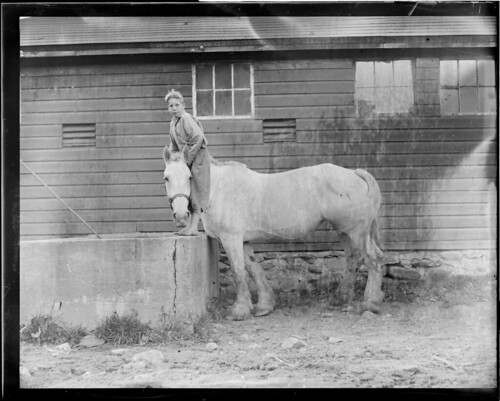
Those phrases survive like the traces of our physical equine infrastructure. In the center of my home town there’s a flower planter at the ideal height for a horse—because it was originally a fountain where drivers and riders could water their animals. But most of the unneeded parts of that infrastructure—small ponds, hitching-posts, stables, ferriers’ shops—have disappeared, swept away like manure from the streets.

As technological change has sped up, we’re probably making once-familiar phrases into anachronisms faster than ever. Kids today have never touched a telephone or television “dial.” A friend told me about having to explain to a college student what “drop a dime” meant. When I was a lad, an “E ticket” meant you could go on the very best rides at Disneyland; now it’s what I don’t bring to the airport. Soon people may be interpreting “champing at the bit” to refer to data.

TOMORROW: The carrot and the stick.

(Image above from the Boston Public Library’s Flickr stream.)

11 September 2012

Little Ragdoll

This is one of the variant covers for Marvel’s The Road to Oz, #1, by Eric Shanower, Skottie Young, and colorist Jean-François Beaulieu, adapted from the story by L. Frank Baum.

Somebody’s clearly looking ahead two whole books to The Patchwork Girl of Oz. Indeed, in this interview at Comic Book Resources, Young mentioned Marvel’s head of sales, David Gabriel: “He’s dying to see me draw the Patchwork Girl, so I’d like to make it that far so he can see that happen.”

If sales hold up, this won’t be the only scrap of that book we’ll see.

09 September 2012

Batgirl’s Unresolvable Foundational Conflicts

Last week I started quoting from former DC Comics editor Scott Peterson’s recollection of the creation of the second Batgirl in the late 1990s. At first he was reluctant, but his boss insisted.
And then somewhere on the way back to my office I had this crazy vision of a new Batgirl. She was young—late teens, I thought—and Asian, because, well, at the time we had an awful lotta white faces in the DCU, and I thought, if we’re creating a brand new character in the DCU, why on earth would we make her white when other races are under-represented? And in my vision, she was cheerful and chipper and always up and good-natured and she had a complete and total death wish.

This did not seem like a good idea. In fact, it didn’t seem to even make any sense. But it wouldn’t go away.

So I called [writer and former editor] Kelley Puckett. And I said, “Hey, new Batgirl. Young—late teens, I think—and Asian. And cheerful and chipper and always up and good natured and she has a complete and total death wish.”

“But,” he replied reasonably, “that doesn’t even make any sense. . . . That’s completely contradictory.”
But the built-in contradiction was, as Peterson probably realized, the point. In serial fiction the best characters are fueled by contradictions. As I’ve written before, they face an Unresolvable Foundational Conflict that provides distinct characterization and an ongoing overall story arc.

Peterson’s original conception of Batgirl having “a complete and total death wish” but being “cheerful and chipper and always up” had to potential to be an Unresolvable Foundational Conflict. As it turned out, Puckett dropped the “cheerful and chipper” part.

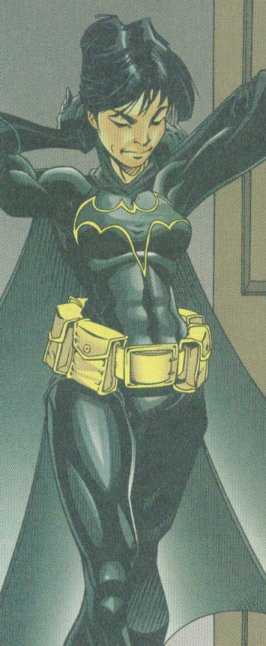
Instead, the character he imagined, Cassandra Cain, was totally serious most of the time. She rivaled Tim Drake for being earnest and Bruce Wayne for being unsmiling. Which made the moments when she did smile or laugh or enjoy life all the more surprising and special.

But Puckett did give Cass Cain an Unresolvable Foundational Conflict—at least one. She was ridden with guilt for having been raised as a child assassin, but indefatigable about making up for that. Her upbringing gave her an extraordinary ability to read body language, useful in fights, but she had trouble with spoken language and couldn’t read at all. Physically she was small and slight and of course a girl, but she could beat Batman in hand-to-hand combat.

Cass Cain debuted in the mighty “No Man’s Land” crossover, Dennis O’Neil’s grand exit from the Batman desk. Having taken the mantle of Batgirl but in a new costume, in 2000 she started to appear in her own magazine, scripted by Puckett and drawn in a strikingly idiosyncratic style by Damion Scott. As protagonist of her own serialized story, she went about fighting criminals, and she went about wrestling with her Unresolvable Foundational Conflicts.

COMING UP: And how did that work out?

07 September 2012

Ryan’s Reputation and Refutations

Before being selected as the Republicans’ Vice Presidential candidate, Rep. Paul Ryan of Wisconsin had grown a reputation as a truth-teller. A guy who knows numbers in particular. His budget proposals as head of the House Budget Committee have basically defined recent Republican policy outside the social sphere.

But when Ryan delivered his speech at the Republican National Convention, observers immediately judged it as deceptive and dishonest in many ways. Middlegirl at the Daily Kos has been rounding up all those refutations. The most interesting, I think, is Ezra Klein’s anguished column in the Washington Post, because he clearly hoped things would be different.

Likewise, David Brooks of the New York Times spoke highly of Ryan on 22 August, but after the speech resorted to blaming speechwriters: “If you’ve got a guy famous for truth-telling, why feed him a bunch of semi-deceptions?”

In the same vein, Roger Ebert opined that the problem with Clint Eastwood’s convention talk was that party operatives had pushed him to hit certain talking-points. That analysis based on past friendship looks like a way to get around the simpler explanation that Eastwood is a cranky opponent of the President who’s happy to project his own hostile feelings onto an empty chair.

Similarly, Brooks’s claim that Ryan was “famous for truth-telling” misses the question of whether Ryan ever deserved that reputation, even by Washington standards. Careful observers had already noted that Ryan’s bold proposals actually contained a lot of fudges and blanks. His budgets were based on unrealistic expectations, and they never specified where he’d cut programs to reach his fiscal goals.

Well before his convention speech Ryan was complaining that President Obama’s stimulus package was too big while also asking for more funds for his own district. He did the same with the Affordable Care Act. And despite lauding the free market, Ryan lobbied to bend the auto bailout his way.

Ryan could have argued against Obama’s policies while telling the whole truth. But he hasn’t done that for a long time. For years he’s criticized the President for not supporting the Bowles-Simpson commission’s recommendations without acknowledging that he himself had already rejected that report and pulled the whole Republican House along with him.

With the increased coverage and scrutiny of a national campaign, Ryan has now had to retract a claim about his marathon time, which in turn forced him to devote time to substantiating a claim about mountain-climbing. Those are private matters, but easily understood, and they’ve helped shred his reputation as a truth-teller—especially about numbers.

To tell the real truth, Ryan never deserved that reputation. He discovered his budget-balancing zeal at almost exactly the moment President George W. Bush was being replaced by President Barack Obama. Was his turnaround truly newfound fiscal honesty or just OIP Derangement Syndrome?

06 September 2012

Picture Book, a Holiday in August

During my trip to California this summer, I saw a new trend in tourism: green-screen tourist photography.

I first noticed this at the Hearst Castle in San Simeon. Before boarding a bus to go up the mountain to William Randolph Hearst’s very impressive complex, folks had the chance to have their photos taken in front of a bright green plastic sheet.

At the end of your visit, you could pay a large sum for that photograph of yourself digitally manipulated to look like you had visited…exactly the site you were visiting. Usually the only value in photographs of yourself posing front of a tourist site is to demonstrate that you were there—but these photos would be a reminder that you stood in front of a sheet of green plastic pretending you were a short distance away.

The next week I saw the same thing inside the lobby of the Sony Studio building and on the crowded plaza of Grauman’s Chinese Theater.

I suppose the benefit is that your vacation photos don’t include all those other tourists who’d otherwise be in the frame. Just as you won’t appear in their pictures. In the case of Grauman’s Chinese, which was very crowded, this would completely fictionalize the experience.

I might have been interested if the services offered more imaginative options: having oneself inserted into a snapshot beside William Randolph Hearst, Marion Davies, and Hollywood celebrities of the 1930s, for example. Or helping Freddie Bartholomew leave his footprints in cement.

In future, sites could team up and let tourists green-screen themselves in front of other places that they don’t actually want to visit. That’s what’s happening in the photo above, from the “Texas on Tour” booth at the California State Fair.

05 September 2012

Make Your First Novel a Murder Mystery?

Physicist turned science-fiction novelist and social commentator David Brin recently shared this advice for new storytellers:
No matter what genre or style they want to create for a living, I recommend that new authors make their first major project a murder mystery.

The reason is simple. All other genres let the author get away with flaws in plotting and suspense, by distracting the reader with genre-specific razzle-dazzle, e.g. romantic tears or dying dragons or scifi tech-speak. But in a murder mystery, just one question is paramount; did the dramatic, whodunit revelation pay off? Was it simultaneously both well foreshadowed and surprising?

Does the reader experience a pleasurable moment of shock and self-loathing? "It was all there and I just missed figuring it out! I'm sooooo stoooopid!" If that's how your reader feels, at the crucial moment of whodunit disclosure, then she or he will buy your next book. That's the wonderful, ironic fact.
You might see why David calls his blog Contrary Brin.

This advice also shows the value of a distinction I invented for an SCBWI presentation a few years back: between genre and mode. Mystery is a genre, defined by readers’ expectations for the plot. Science fiction, fantasy, historical fiction, futuristic dystopia, melodrama, farce, and contemporary realism are modes, defined by what readers expect can happen in different worlds—i.e., elements of the setting. A mystery (or a romance, or a dead-dog story, or a heist caper, or almost any other genre) can be told within different modes. That’s how a science-fiction novel can also be a murder mystery.

As another example of this overlap, the new Soho Teen imprint publishes nothing but mysteries and thrillers for young adults. But, as editor David Ehrenhaft said at Cynsations, some of those books have fantastic or dystopic settings. Mystery is the genre; paranormal is the mode.

Now if I keep defining and using those terms for twenty years, maybe they’ll catch on.

04 September 2012

You Can’t Walk on a Rainbow

This weekend, the French cartoonist Boulet shared the English version of his childhood opinion of the MGM Wizard of Oz movie.

It’s part of Boulet’s longer meditation on suspension of disbelief in childhood, and/or the difference between real childhood and the childhood adults may wish children to have. It’s also a follow-up to his commentary on real childhood imagination.