13 July 2010

How Much Can Change in Two Years

Eric Gjovaag’s Wonderful Blog of Oz notes an Ozzy challenge on Jeopardy last night, and notes that the “answer” was inaccurately worded in two ways. The more interesting error was that, having died in 1919, L. Frank Baum was in no position to publish or manage any active verb a year later.

I’d seen this challenge in the show’s daily New York Times ad, and also noted that inaccuracy. In addition, I was struck that the category for this challenge was “1920s LIT.” Glinda of Oz was published in 1920, and thus indeed entered the cultural discourse of that decade. But it could only reflect the previous decade when Baum wrote. Like Billy Budd, which Herman Melville left unfinished when he died in 1891 but came into print in 1924, the book is part of two cultural eras.

Of course, a lapse of two years between composition and publication doesn’t mean much for Glinda. Hey, authors today have to expect to wait at least that long! (Good thing they can work on their book trailers.) But in one respect I think we can see that time gap affecting Baum’s last three Oz books.

Baum apparently wrote The Tin Woodman of Oz, The Magic of Oz, and Glinda of Oz one after another in 1917-18. He finished Magic in the fall of 1917, and Glinda in February 1918 (as I reconstructed events in an article for The Baum Bugle a few years back).

All three of those books depict soldiers or war, none in particularly favorable terms. They don’t show the boosterism of Baum’s Army Alphabet and Navy Alphabet rhyming books from 1900. We don’t see any military as an efficient source for good, like Glinda’s army in The Marvelous Land of Oz (1904).

Instead, Baum’s last two books revolve around wars motivated by egotistic, greedy manipulators. The Tin Soldier in the preceding novel is a stiff personality, not particularly useful, and harder to love than the Tin Woodman. We never see the harmless bumbling of Ozma’s army in Ozma of Oz.

However, larger events soon changed the environment for those books. In mid-1917 Woodrow Wilson decided not to keep us out of war after all. Baum’s eldest son, Frank Joslyn Baum, rejoined the army. (He’d previously served in the US attempt to subjugate the Philippines.) Both personally and politically, poking fun at warriors probably became harder for Baum.

I think we can see that atmosphere affect The Magic of Oz, even though the World War was over by the time it was published in 1919. At one point a villain plots to turn each of several monkeys into “a giant man, dressed in a fine uniform and armed with a sharp sword.” The “sword” suggests Baum pictured the sort of comic-opera soldiers who had appeared in his previous stories. But John R. Neill drew those giants as modern US soldiers straight off a recruiting poster.

Similarly, Magic shows the Nome King conning animals into a war that’s in nobody’s best interest, the way people against US entry into the World War described that situation. Yet Baum’s dedication says:

I dedicate this Book to the Children of our Soldiers, the Americans and their Allies, with unmeasured Pride and Affection.
Baum’s manuscript indicates that he added that line months after writing his story.

12 July 2010

Tommy Kovac on Oz and Oz Fandom

Comics Should Be Good! reminded me of this interview with scripter Tommy Kovac about his comics series with Andy J. Hirsch, The Royal Historian of Oz, which just came out from Slave Labor Graphics.

Among other things about L. Frank Baum’s series, Kovac says:

I started reading the original books when I was in about 3rd grade. . . . Before that, like every other human being in the civilized world, I had seen the movie, and of course loved it.

But once I became attached to the blond & sassy version of Dorothy in the original books (due largely to illustrator John R. Neill, who illustrated 13 of the 14 Baum books), I completely rejected Judy Garland’s whiny, weepy, chicken-shit portrayal.
Kovac’s story includes (again, among other things) an Official Oz Society, enforcing particular portrayals of Oz, as shown in the preview pages accompanying that interview. Its power depends on an “eternal copyright,” which of course doesn’t exist. (It would be unconstitutional in the US, though Jack Valenti and the Great Ormond Street Hospital are willing to overlook that.)

In fact, Baum’s Oz books and many of their sequels are in the public domain, meaning anyone can do anything they want with those texts, their characters, and their ideas. The challenge isn’t getting permission or (these days) getting printed; it’s getting anyone else to notice or care.

The Official Oz Society is really, Kovac admits, a parody of every avid Oz fan’s wish not to see that fantastic place and its citizens depicted in ways he or she dislikes.
I'm sort of making fun of myself with my version of the Official Oz Society, because my knickers get majorly twisted when I see someone take Baum’s creative property and do something I think is lame or just plain wrong. . . . It’s because those characters are so real in my head, seeing them fucked with is like slander, or defamation.
Of course, one fan’s slander is another’s brilliant new idea.

11 July 2010

The Two Paths of Jason Todd

As the last weekly Robin described, in 1987 Max Allan Collins turned Jason Todd into a new kind of Robin, offering new storytelling possibilities. He explored Jason’s criminal background, rashness, and anger for a handful of issues, and then left the Batman magazine.

Meanwhile, at Detective Comics Mike W. Barr was writing a very traditional and fun set of Batman and Robin adventures. Alan Davis drew many of those stories, depicting Jason as a cute, spindly-legged kid in his early teens. (Greg Burgas has profiled the Barr/Davis run of Detective for Comic Book Resources.)

This run of issues straddles the period when Collins introduced Jason’s new origin, but Detective made almost no reference to the boy’s now-troubled past. Instead, Barr’s Robin acts very much like Dick Grayson from the 1940s through the 1960s, fulfilling the usual reasons for the character:

Barr’s scripts did edge into the darker universe that DC was trying to create in the late 1980s. Detective, #571, ends with an image of Jason’s tombstone, albeit an imaginary one. In issues #573-4 Jason gets shot, forcing Bruce Wayne to examine the danger he exposes his sidekicks to. Those stories show the dark side of Batman himself. In #570, he almost beats up a helpless Joker, but Jason holds him back—because Barr’s characterization also fulfilled Reason for Robin, #10: Robin Isn’t Evil.

Barr’s last story gave Jason another encounter with Two-Face, who killed his father. To his surprise, Jason discovers he can pity the villain. Those two issues, illustrated by Jim Baikie, depict Jason in his late teens, and in addition to growing up physically he’s clearly grown up emotionally.

However, over at the Batman magazine new scripter Jim Starlin moved in the opposite direction, going deeper into the dark side of Jason Todd that Collins had established. Starlin worked mainly with artist Jim Aparo, who had already illustrated many Batman stories in The Brave and the Bold and Batman and the Outsiders.
In a 2001 interview, Starlin declared that the character of Robin simply didn’t make sense: “The idea of taking a kid along to fight crime is ludicrous.” Barr had probed that very topic, but for Starlin the remedy was more drastic: “I wanted to kill off Robin as soon as I started writing Batman.” At least that’s what he said over a decade after that fact.

Back in late 1987 Starlin’s built stories around conflicts between Jason and established characters. In issue #416, he brought Dick Grayson back to Gotham to meet the new Robin, and to confront Bruce Wayne over their break-up. The result was an emotion-packed issue, worthy of reprinting. In the end Dick praises Jason’s potential. But for a lot of readers that tale probably turned them against Jason Todd.

Because it’s one thing to show Jason sassing Batman, acting cocky, or roughing up criminals. It’s quite another to show Jason disrespecting Nightwing—the leader of DC Comics’s most popular team, the character readers had grown up alongside, the one hero who’s most assuredly not evil. Jason was in serious trouble.
This recent panel from The Black Cat captures the character of Jason Todd by late 1987, tugged between competing portrayals.

COMING UP: Jason goes to the dark side?

10 July 2010

Book Trailers—Why and Whither?

I’ve given book trailers a shot, and they aren’t doing anything for me.

Part of the problem is that my computer set-up and the number of other programs I tend to run mean that videos can be slow to download. And even if they do display smoothly, I usually find myself just listening to the audio while I work on something else. It’s not like I have to see what suit Jon Stewart was wearing.

But even among internet videos, book trailers keep striking me as a solution in search of a problem. I understand they can be part of branding—creating an appropriate feeling about the book and the author. Trailers might be effective at enticing reluctant readers, though I can’t help thinking that truly reluctant readers would simply go on to more videos.

Of course, trailers do help to occupy authors as they wait and wait for their books to be produced. And they do give publishers a way to assure booksellers that those authors are raring to market their wares.

But for me, I feel like I’m much further along if I spend the time that book trailers demand reading about the book in question, or even reading the book itself.

Yet trailers may be becoming necessary. I say this after watching the trailer for M. T. Anderson’s Suburb Beyond the Stars. Here’s an author who’s developed a following for types of books without even having a website until earlier this year. But of course that website needs a book trailer.

Naturally, the trailer is well done. There’s some funny Rutles-like deconstruction of the form, as I would expect. And the visual surprises that Betsy Bird warned us about. But this is M. T. effin’ Anderson. If the prose doesn’t win over potential readers, will footage of bare trees and cellars in Vermont do the job?

I fear book trailers will become like author blurbs. Blurbs are a pain to generate, some are better than others, and no one in the business believes they mean much. But people fear that an absence of blurbs means a lot. A book without blurbs (or extracts from previous laudatory reviews, which are better anyway) looks like it has no support. And you wouldn’t want your book to be the only one left out, would you? Would you? So we keep chasing blurbs.

Am I missing something about book trailers? Do they actually reach new readers, and how? Do publicists push for them? Do authors enjoy making them? Are they a flash in the pan? Will they be tacked onto digital book reissues, like DVD extras? Has this simply been an excuse to type “M. T. effin’ Anderson”?

08 July 2010

Must Be 18 or Older to Go to Oz?

Michael Cart reported on last month’s International Wizard of Oz Club convention at the Arne Nixon Center for the Study of Children’s Literature at Cal State Fresno.

I was, myself, a devoted Oz fan when I was a kid and typically received at least one Oz book every Christmas. In 1952, though, I received two—The Shaggy Man of Oz, by Jack Snow, and Hidden Valley of Oz, by Rachel R. Cosgrove.

How do I know this? Simple: on the page before the half-title page of each, I find written—with a flourish—“Michael Cart, Date: December 28, 1952; Age: 11. 1319 Sycamore Street. Logansport, Indiana.” Ah, good times . . .
Those were nearly the last titles in the series from Baum’s publisher, published in 1949 and 1951, respectively.

On a different note, Cart reports on the program’s scholarly papers:
titles such as “L. Frank Baum and Harriet Beecher Stowe: Using Sentimentalism to Inspire a Female Audience” and (my personal favorite) “Eroticism in the Emerald City: The Awakening of Dorothy’s Sexuality in Oz as Discussed in Alan Moore’s Lost Girls.” (A note in the conference program stipulated that you “must be 18 or older to attend this session”; since my emotional age is still about 12, I skipped it.)
I had to skip the whole event since I was speaking at another conference on another side of the country, so I’m grateful for reports like this one.

06 July 2010

Crogan’s Moral Uncertainty

Crogan’s Vengeance, by Chris Schweizer, is a nicely told pirate comic. I especially liked the panels’ timing. There’s a moment on page 56 when I lost the narrative logic, but the other 184 pages sailed by.

Schweizer draws in a “cartoony” style and offers lots of visual humor. His lettering is thick, usually leaving space for only one character to speak per panel. That overall look makes for a curious mix with characters who take themselves very seriously and a story with a high body count.

The main story includes no female characters with dialogue, but it is set on a pirate ship, after all. There’s an important female character in the framing story, but she’s the antagonist, an elderly lady who wants kids to stay off her lawn.

That narrative frame for Crogan’s Vengeance raises the biggest questions in my mind. In the first six comics pages and the last three, young Eric Crogan’s father sets up the story of their pirate ancestor as a lesson in dealing with “a situation of moral uncertainty.”

So what do we learn from the pirate yarn in between? Like most pirate tales, it’s full of attacks, counterattacks, subterfuges, mutinies, storms, shipwrecks, strandings, brawls, whippings, and duels. There’s also a treasure, though we hear about it more than we see it.

Also like most pirate tales, the story is close to amoral. Readers root for one greedy, sneaky group instead of another because:

  • The first group is slightly less ruthless than the second, and/or
  • The narrative point of view forces our hand.
Both factors apply in Crogan’s Vengeance.

In the end Catfoot halts a particularly bullying pirate from sacking a port on a English-speaking Caribbean island. To me that would come across as more heroic if the story hadn’t established that Catfoot has several selfish reasons for doing what he does: personal revenge, winning back treasure, keeping the region safe for pirates, simple survival.

As a reward Catfoot receives a British letter of marque—a license to commit piracy on other empires for the duration of whatever war has just broken out. Of course, the British officials we’ve seen are craven incompetents, not worthy of such protection. This simply extends how Crogan’s Vengeance depicts all life at sea as an unjust struggle to survive. The reward thus comes across not as Crogan’s redemption in a “situation of moral uncertainty” but as another excuse for amoral behavior.

Or, as Eric’s dad explains, “Catfoot was given free rein to plunder…provided he kept to a set of rules.” How’s that for a valuable lesson about life?

(Here's a glimpse of Catfoot Crogan later in life, imparting a valuable lesson to his own son.)

05 July 2010

Picturing Scientists

Yesterday’s Boston Globe mentioned this small study from Fermilab, which was conducted ten years ago but recently picked up by Restructure and Geek Feminism.

Thirty-one seventh-graders were asked to describe and draw their ideas of a “scientist” before and after a visit to Fermilab, where they met actual scientists. The before sketches often depicted stereotypical mad scientists in lab coats. Following the field trip, the students were more likely to refer to scientists as “normal people,” and to depict them in normal dress.

There was a striking contrast between girls and boys in the small sample. Before the visit, 36% of the girls drew a female scientist. Afterwards, 57% did.

Among boys, before the visit 100% drew male scientists. Afterwards…100% did.

04 July 2010

Jason Todd Remade: ”Promises to Be a Real Thriller”

In late 1986, two new writers took over the Batman stories from Doug Moench: Mike W. Barr on Detective Comics and Max Allan Collins on Batman. Around the same time, Dennis O’Neil returned to DC Comics as editor of the Batman magazines.

Early in 1987, four issues of Batman were turned over to Frank Miller and David Mazzucchelli’s telling of Bruce Wayne’s first year fighting crime in Gotham City, which set a new, grittier tone for the series. Then Collins returned and tackled the challenge of Jason Todd, the current Robin.

At the time Collins was also scripting the daily Dick Tracy comic strip and the Ms. Tree comics with Terry Beatty, featuring a hard-boiled female detective. He would go on to write Road to Perdition, a bloody crime drama. He proposed a way to make Jason Todd part of Batman’s new, rougher milieu.

In Batman, #408, subtitled “The New Adventures,” Collins zipped readers into a new “continuity” for the Dynamic Duo. Dick Grayson’s departure to become Nightwing was no longer a drawn-out but peaceful story of a young man discovering his adult role. Jason Todd was no longer a second boy trapeze artist with murdered parents who found a new home in Wayne Manor.

Instead, the Joker shoots Dick, Bruce Wayne “fires” Dick as Robin out of poorly expressed concern for his safety, and Dick leaves to become Nightwing with the Titans. (New Teen Titans was still one of DC’s bestselling titles, so that last part was a given.) This sort of retroactive rewriting of characters’ history is known among fans as a “retcon.”

As for Jason, he now enters the scene by stealing the tires off the Batmobile in Crime Alley, the same place where Bruce’s parents were killed. When the Caped Crusader tracks down the young thief, he turns out to be living on his own in an abandoned tenement. This scene raises a number of logical questions. How can a young teen boost four tires from a supercar with a state-of-the-art security system? What abandoned tenement still has electricity, and how does Jason keep that stereo from being stolen? Where did he get those red jeans, and why does he wear a vest (aside from his clothes offering visual links to the Robin costume)?

But hey—it’s a superhero comic. Logic matters less than what the new character symbolized. Criminal activity, black vest, hard rock, even (gasp!) smoking—those markers showed us that this Jason Todd was bad!

In the following Batman issues, as Jason takes over the Robin role, Collins revealed that his father was a criminal. Jason learns that his father was murdered by the villain Two-Face, and for a time is devoured by rage, only to learn a valuable lesson about life.

From a storytelling perspective, Collins’s idea was very good. The new Jason was distinct. As reader Anne Guerra said in a letter four issues later:

[Jason’s] first origin was much too similar to Dick Grayson’s and, let’s face it guys, it wasn’t very original. This latest explanation shows imagination and promises to be a real thriller. . . . A gifted writer like Max Allen [sic] Collins could have a field day with a potential storyline like this.
Readers noted how Jason’s new past and personality reshaped the dynamic of the Dynamic Duo, opening the door for never-before-told stories. In that same letters column Adam Schultz wrote:
I hope Jason will remain belligerent for awhile, even after he becomes Batman’s partner. It will be an interesting change from the idol-worshipping that we can usually expect from Robin.
Dick sometimes took impulsive gambles because he was too eager to help. Jason could take the same aggressive risks, even knowingly disobeying Batman’s orders, out of anger at the criminal world. This Robin’s coming-of-age story could thus explore choosing values as well as learning skills.

But there was a problem with a Robin who has a criminal past, who’s driven by questionable motives, who habitually disobeys. DC’s creative team didn’t realize the importance of one thing the character represents:

COMING UP: The two paths of the second Jason Todd.

03 July 2010

Makeover

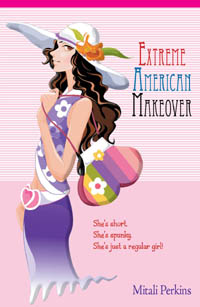
At a critique-group meeting earlier this week, Mitali Perkins showed us a new cover for Extreme American Makeover, the start of her First Daughter series about a teenaged girl adopted from Pakistan whose father runs for President of the U.S.

One of these covers is for HarperCollins’s Indian edition of Extreme American Makeover, and the other is for Dutton’s American hardcover. (The American paperback has yet a third design.)

We thought this was an interesting dot in the “whitewashing” controversy because the American cover depicts the heroine with darker skin than the subsequent Indian cover.

Of course, for US audiences the intriguing premise of the book is the possibility of a foreign-born, “foreign”-looking girl in the White House—hence the flag motifs. The Indian publisher appears to have eschewed the red-white-and-blue iconography in favor of emphasizing glamor that knows no borders. But does that mean pink skin?

02 July 2010

Tigers and Dogs and Blogs, Oh My!

Hungry Tiger Press now has a blog. Of course, the specialized press has been sharing goodies on its website for many years, but this format looks like it will allow publisher David Maxine more flexibility to share announcements of new books, stories behind one of the country’s great Oz collections, and little-known writing and art from Oz creators. Forgive me if I suggest entering by this door.

Eric Gjovaag’s Wonderful Blog of Oz notes that tonight Turner Classic Movies is showing the 1939 Wizard of Oz musical, and that this year the channel focuses on one featured performer: Terry.

Terry? That’s the little Cairn terrier who played Toto. TCM will run two more movies in which she played significant roles, Fury and George Washington Slept Here. See Classic Movie Musicals for more of Terry/Toto’s films.