15 January 2009

New Pooh?

This report from The Bookseller, a British publishing-industry journal, has already been echoed around the world:

An authorised sequel to A A Milne’s The House at Pooh Corner is to be released by Egmont Publishing in October. The contents of the book are a closely guarded secret but will reflect Milne’s idea that "whatever happens, a little boy and his bear will always be playing," said author David Benedictus.

The forthcoming title, Return to the Hundred Acre Wood, will be published in a similar format to the existing Classic Winnie-the-Pooh books. The text will be illustrated by Mark Burgess who has already illustrated a number of Winnie-the-Pooh titles.
At first I was a little troubled that the Milne and E. H. Shepard estates were chasing more bucks before their lucrative copyrights run out in 1926. We've seen the heirs of Margaret Mitchell, J. M. Barrie, and James Joyce do that in various ways, and the results have been mixed.

I began feeling a little better about the idea when The Bookseller went on to report:
  • Benedictus wrote this new book after working on some Pooh adaptations and then submitted it to the Milne and Shepard estates for their authorization; the estates didn't set out to commission a sequel.
  • The estates had actually turned down some other "suggested sequels."
But then I recalled that the Disney Company bought a lot of the rights to Pooh about ten years ago, paying the heirs a lump sum--which means they won't see more money unless they produce new intellectual property. There has been a long series of lawsuits among those heirs, the Slesinger family who originally licensed the Pooh characters, and Disney, running up lawyers' tabs. So the estate's decision to authorize Benedictus's book might not be based purely on literary merit. We can only hope it is.

I resist an automatic reaction against latter-day sequels. I've enjoyed some of those stories very well. Others not only miss the target, they seem to miss the point of the original.

ADDENDUM: Today's Publishers Weekly report added more food for thought about the genesis of this project:
While working on post-production for those audiobooks--which required the approval of the Trustees of the Pooh Properties--he [Benedictus] decided to write a pair of stories about Pooh and send them to the trustees (the four trustees own the copyright for the text and represent the estate of Pooh illustrator E.H. Shepard).

Eight years passed, according to Benedictus, but in 2006 he got a call from the trustees. Over the years the trustees had seen several proposals for sequels. “We had looked at a number of people, including my own poor efforts,” said Michael Brown, chairman of the trust, adding that the idea for authorizing a sequel had been in his mind “for a very long time.” But he said that the timing of the book’s release this year was a matter of various pieces coming together--including finding the right contributors.
So Benedictus wrote his first Pooh stories in 1998, and the estates started to pursue the idea with him in 2006. How do those years match up to the business timeline?

14 January 2009

Is Our Grownups Reading?

Earlier this week the National Endowment for the Arts, under chairman Dana Gioia released an optimistic report called "Reading on the Rise," available for downloading.

I detect a bit of cynicism in Publishers Marketplace's article on the report: “Outgoing NEA Chairman ‘Proves’ He Helped Raise Reading.” That article went on to say, “Aside from the yeoman efforts of the NEA chairman, what could possibly explain the sudden change? ‘In 2008, the survey introduced new questions about reading preferences and reading on the Internet.’”

And indeed, in small print at the top of page 3, the report says, “In this report, ‘literary’ reading refers to the reading of any novels, short stories, poems, or plays in print or online.”

At the time of the last such report in 2002, I complained (without having Oz and Ends to do so) that defining “literary” to exclude all non-fiction skewed the survey. That meant “literature” excluded complex and well-written histories, autobiographies, political arguments, scientific explorations, philosophical essays, sports books, etc. Having excluded those books from consideration, the surveys have, not surprisingly, found fewer men reading “literature” than women. (That finding remains in this year’s report.)

In 2008 that restriction on “literature” remains, but the survey expanded the definition of “reading” to include online works. I've also complained (this time with the vast resources of Oz and Ends) that saying children spend too much time on the internet to read misses the fact that you basically need to read to get around online. (You just don't need to punctuate or spell.)

Gioia's preface reflects the old view that reading pixels instead of print didn't really count:

A decline in both reading and reading ability was clearly documented in the first generation of teenagers and young adults raised in a society full of videogames, cell phones, iPods, laptops, and other electronic devices.
Yet now this survey does include as "literary" any novels or short stories read via "cell phones, iPods, laptops, and other electronic devices."

So I'm glad the NEA and Census Bureau have added online reading to their question. However, that fudges the data, doesn't it? To see real trends, we have to compare like to like. Since the 2002 survey asked only about “literary” reading in print, what's the comparable data in 2008? Well, I don't see how to extract it from the NEA's published report. There’s no way to compare print-only data for successive years, nor to separate out respondents who read online only.

But we can see some of the effect in finding #4: "Literary reading has increased most rapidly among the youngest adults," aged 18-24. And in the graphic for finding #11: Twenty percent of that age group stated that they read "literature" online. So the biggest rise appeared in the group that does the most online reading. That seems significant.

Hillel Italie's report for the Associated Press zeroed in on the one decline noted among the findings, and that fudged by the emphasis on absolute numbers rather than percentage:
10. Book-readers have grown in absolute numbers but declined slightly as a percentage of the U.S. adult population.
The AP article says:
In a preface to the new report, being released shortly before Gioia steps down after heading the endowment for seven years, he cites a nationwide effort and says the results demonstrate that "our faith in positive social and cultural change was not misplaced."

But the preface does not mention a countertrend: a drop among people not obligated to read. Adults who read books of any kind--fiction or nonfiction, online or on paper--that were not assigned by a teacher or employer dropped from 56.6 percent of adults in 2002 to 54.3 percent last year. The fall was greatest among those younger than 55.

And while the number of adults who say they read a non-required book is 3.5 million higher than in 2002, the report notes that that the total adult population increased by 19 million, meaning an increase in the number of people who didn't voluntarily read books of 15.5 million, a huge disparity confirmed by NEA research director Sunil Iyengar.
And once again I point to something I wrote about the last reading survey: once a study excludes reading “assigned by a teacher or employer,” we're no longer looking at overall reading. An American (especially a student) could be reading literature or other complex books all the time, yet show up on such a survey as a complete non-reader if all that reading is required. In headline form: More Homework Assignments Mean Less Time to Read for Pleasure.

I should say that I had the pleasure of briefly meeting Dana Gioia and hearing him speaking about the poet H. W. Longfellow in 2007. I found him smart and smartly dressed. He also has a background in marketing, and knows how to sell a survey.

13 January 2009

What Were They Thinking?

This Brooklyn-based public art project from Color Me Katie is cute, but I'm posting the link mainly because it uses the phrase "thought bubbles."

What Really Rescued the Caped Crusader

Yesterday I argued that, contrary to what Bob Kane believed and a lot of comic-book historians have written, DC Comics wasn't really planning to cancel Batman in 1963 and 1964. By all other indications, the character was still one of the company's most popular, and the magazines featuring him still among its top sellers.

So why did DC's top brass tell Kane that they were thinking of canceling Batman entirely? I think the answer lies in his unusually expensive 1947 contract. The problem with Batman comics probably lay not in their income but in their costs.

The publisher wanted Kane to give up his high per-page rate and his stultifying creative control. I suspect its head, Irwin Donenfeld, used brinkmanship to open new negotiations, and that tactic worked. DC was able to move the Batman comics in a new direction.

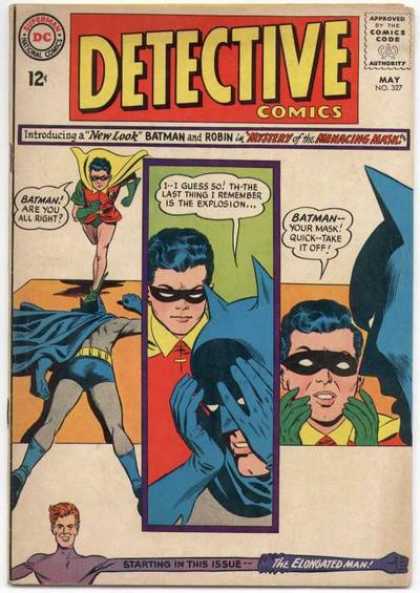
It's notable that the June 1964 issue of Detective, touting the "New Look," also included a two-page autobiographical article from Kane. Was the company mollifying his considerable ego after it had squeezed out contract concessions?

Naturally, the editor and artist involved in creating the "New Look"--Julius Schwartz and Carmine Infantino--were pleased to think that they had helped to save a classic character. They certainly brought in new creative energy. And once fans got used to the new style, the rescue of Batman became a heroic narrative. But the character had remained relatively popular, and the sales numbers hadn't been that bad to begin with.

Nor did the sales rise that much afterwards. When DC began reporting figures for its hero comics in 1965, after a two-year gap, Batman was once again ranked ninth among all magazines on the list, selling 454,000 copies. Sales had grown slightly over the 1962 figures, but were still behind the numbers from 1961. Superman comics were still solidly in the lead, but Batman books were more popular than those of any other DC character.

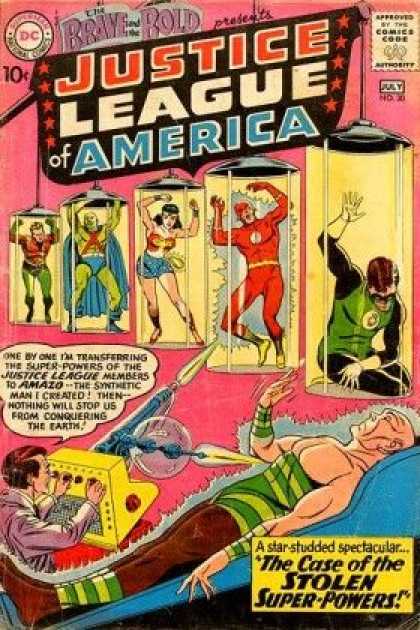
There was a huge change in 1966, with the debut of the Batman TV show. Suddenly Batman was the top comic book of all, selling almost 900,000 copies. In late 1964, Batman began to appear more often on the Justice League of America comics; after 1966, he often dwarfed other figures on those covers. The "New Look" of 1964 reversed a sales decline, but television put Batman on top.

And then television took it all away. By 1969, Batman was yesterday's fashion, which is even worse than being old-fashioned. Sales were down to 356,000 per month. (To be fair, DC was issuing ten issues a year instead of eight, as in 1964.) And at that point, the law governing periodicals changed, and DC Comics stopped reporting average sales.

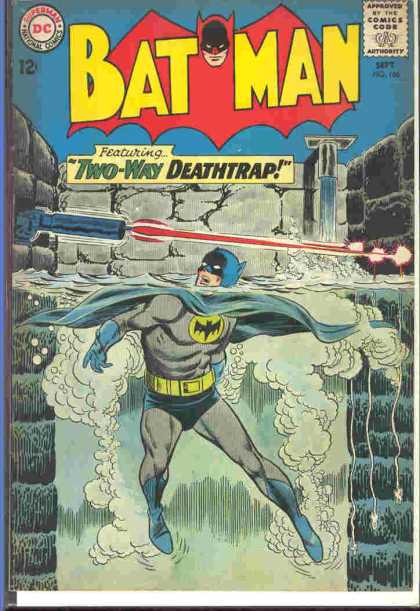
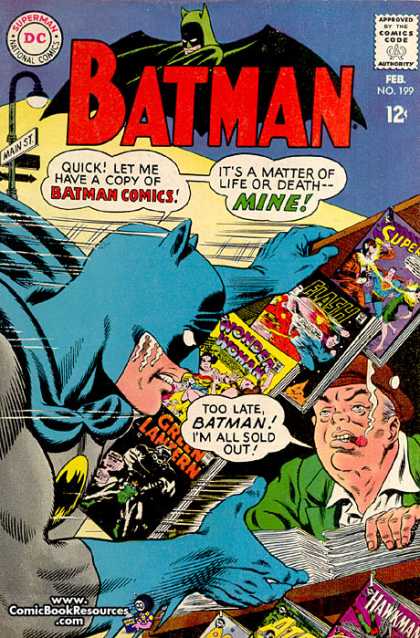
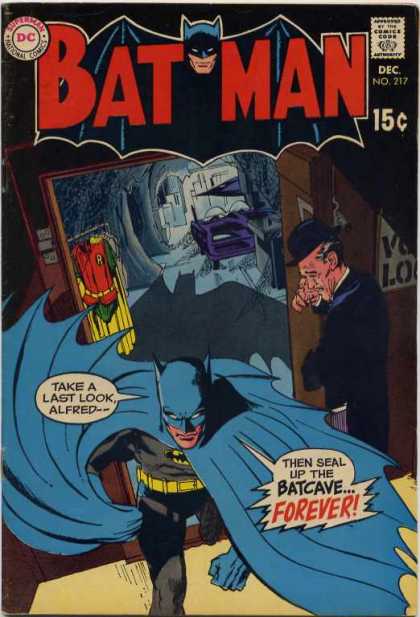
I therefore have no way of knowing how Batman's second revamping in the 1960s affected the comic books' sales. In reaction against the TV show's camp, artist Neal Adams, writer Dennis O'Neil, and their colleagues created a more serious Batman in 1969. Dick Grayson went off to college, as shown here, and Bruce Wayne moved into an apartment in Gotham. Those stories were supposed to be more about solving crimes than chasing goofy criminals--though there was an awful lot of supernatural stuff in the next few years.

We like to believe that new inspiration on the creative side--the "New Look" designed by Infantino, the newer look designed by Adams--leads to increased popularity. I'm not sure it always does. Certainly its effect can't come close to that of a prime-time TV show.

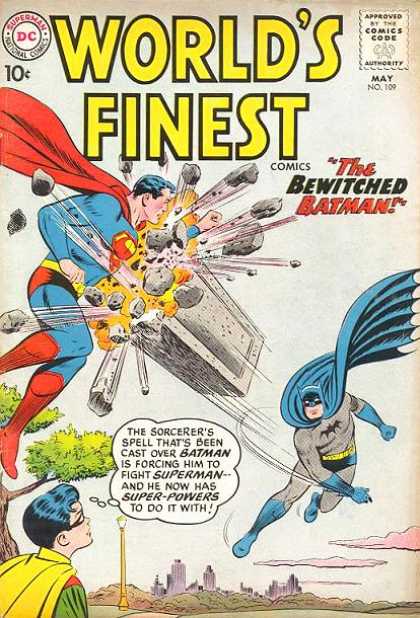
(All images courtesy of Cover Browser.)

12 January 2009

This Looks Like a Job for Ordinary Boy!

Simon & Schuster has chosen Jon Anderson to head its children's division, starting later this month. Publishers Weekly calls this "somewhat of a surprise choice," presumably because Anderson comes from outside the company, and from a smaller publisher: Running Press.

However, Running Press is a pioneer among medium-sized publishers in combining print and online media in its Cathy's Book project. Anderson has experience at the market-oriented Price Stern Sloan imprint at Penguin and as a buyer at Barnes & Noble.

Plus, under the pseudonym William Boniface, he's author of the Ordinary Boy series, So he's seen the business from that side as well.

How Bad Were Batman’s Sales in the Early 1960s?

On Saturday I summarized the standard historical picture of Batman comics in the early 1960s: not good. This is widely accepted. For example, at Captain Comics and the Legion of Super(fluous) Heroes, Commander Benson's essay on the "New Look" begins: "By 1963, the Batman titles were dancing on the edge of cancellation."

But I'm not convinced that DC Comics really thought the Batman character was that unpopular. If that were so, I ask, why did the company keep featuring Batman on the covers of its magazines?

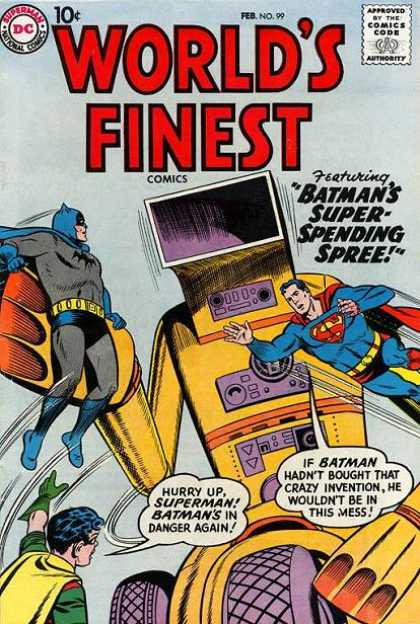
If Batman was no longer popular, why feature him in every issue of World's Finest? The company could have had Superman team up with one of its new superheroes instead. Why give Batman cameo appearances in the Justice League of America stories if he was newsstand poison?

Why not drop Batman from the cover of Detective Comics and move a more popular feature up to the lead? That's what happened in the late 1940s when Tomahawk replaced Robin as the featured character in Star Spangled Comics. Robin continued to have solo adventures, just not as prominently; it took more issues before his stories disappeared altogether.

And if finding a way to save Batman was a dire corporate emergency, why did the DC wait for the 300th issue of Detective Comics featuring Batman to launch the "New Look"?

As I prepared this series of essays, I discovered that in a discussion at The Fifth Branch Pat Curley of the Silver Age Comics blog expressed the same doubts. Except he did it using hard data—DC's reported sales numbers:

If you look at DC’s sales in the early 1960s, while Batman and was slipping relative to the Superman books, they were well ahead of most of DC’s other comics. In 1962, Batman was reportedly the 10th best selling comic, with 410,000 copies per issue sold.

That’s quite a bit more than JLA or Flash, or Green Lantern, or 20 other mags that DC was publishing at the time. It’s almost three times as many copies as DC was selling of Fox & Crow, a title that continued for years afterward. Unfortunately, DC did not publish circulation figures for many of their major mags in 1963 and 1964 (including Batman).

Batman’s circulation was down in 1962 quite substantially from 1961 (485,000) and 1960 (502,000), which is a bad trend, and one which probably led to [editor Jack] Schiff’s eventual reassignment. But I have a hard time believing that it could have dropped so low in 1963 that DC was seriously considering canceling the feature rather than doing what they did, which was restaffing the editor’s desk.
Canceling the Batman comics would have been especially drastic if Gerard Jones's Men of Tomorrow is correct about Bob Kane's 1947 contract. Cancellation would have caused all rights in the character to revert to Kane. DC would have given up what was still its second-biggest property forever. I strongly doubt the company would have done that without trying less drastic options.

TOMORROW: So why in 1963 did DC's top brass tell Bob Kane that they were thinking of canceling Batman entirely?

(All images courtesy of Cover Browser.)

11 January 2009

“Another Bizarre Character with a Fantastic Weapon!”

Yesterday I wrote about the doldrums that the Batman comics seemed to be as the 1960s began. Histories of the character agree that those magazines were in a creative rut, with dire sales, before the visual revamp called the "New Look," which appeared in May 1964.

I have doubts about part of that history, as I'll describe tomorrow. But I won't argue that the creative side of Batman publishing was uninspired as the 1960s began.

Nominal creator Bob Kane was fobbing off his work to ghost artists and focusing on other projects. But there was also a lot of slack in the DC Comics editorial office.

This weekly Robin shows successive issues of Detective magazine, #284 through 287, all on sale in late 1960.

Comic-book editors had the task of designing covers to catch readers' eyeballs and show off the story inside. And the Batman editor of this period, Jack Schiff, appears to have given up on new ideas.


Observe how the acrobatic Batman has only two poses over four covers. Note how three times he exclaims, "Great Scott!" Observe the repeated use of Robin as the readers' stand-in. Covers like these gave rise to the "Shocked Robin" cover generator, which I described back here.

Schiff was apparently a nice man, particularly to writers. This period of Batman stories includes some fine stories, and might be underrated. But there's no doubt Batman comics were starting to look stale as soon as they hit the newsstands.

To be sure, every so often Schiff and his team might shake things up. For instance, on the fourth cover of this run they put Robin on the other side!

Covers courtesy of the Grand Comics Database.

10 January 2009

The Legend of Batman’s “New Look”

In the late 1940s, American comic-book readers moved away from superhero stories to other genres: comics about romance, crime, horror, the western frontier, aliens, monsters, wacky teenagers, and funny ducks, among other types of tales. Batman and Robin were among the few costumed crime-fighters who appeared continuously through the 1940s and 1950s.

In the late 1950s, DC Comics found success with new versions of their old trademarks, starting with the Flash in 1956. By 1960, the company also had new versions of the Green Lantern, the Atom, and Hawkman. It teamed those revamped characters with Wonder Woman and with the Green Arrow, Aquaman, and the Martian Manhunter, superheroes who'd survived as backup features. But Superman was still the most popular of all.

In 1960 Batman and Robin appeared regularly in three magazines, with the following reported average sales, as legally reported back then by DC Comics and gathered by the Comics Chronicles:

  • Batman, three new stories every other month; 502,000 copies.
  • World's Finest, one team-up story with Superman as the lead feature eight issues a year; 476,000.
  • Detective, lead feature every month; 314,000 copies.
By 1962, however, those sales were slipping. Batman at 410,000 copies had fallen behind World's Finest at 420,000, and Detective was selling only 265,000--all having dropped more than 10%.

DC apparently didn't report figures for the next two years, but insiders' recollections of the time say the situation became dire. The comprehensive but often breathless Dial B for Blog offers this account:
It was late 1963. Sales of the Batman titles were low, and getting lower. “It's this simple: Batman is dying. We're giving you two guys six months to fix it. If not, it's over.” That’s what DC publisher Irwin Donenfeld told editor Julie Schwartz and artist Carmine Infantino. Batman, an American institution, faced cancellation.

"The book was at 32 percent sales,” Infantino recalls. “Which is a heavy loss. [Batman creator] Bob Kane hadn't even been doing the work--he was farming it out to others. He hadn't touched the drawing for years. What he was turning in was too old-fashioned.”
Kane recalled the same crisis in his autobiography, Batman and Me. He's not a reliable source, and in this instance didn't accurately recall the date of the problem, but the emotional shock he felt comes through clearly:
After a quarter century of continuous publication, Batman started to decline in popularity in 1965. My publisher informed me that unless sales picked up the next year, it would mean the demise of the Caped Crusader.

This was one of my darkest periods--I had built my whole life on drawing Batman, and it was only vocation I knew. I felt unqualified to do anything else. I didn't reveal my feelings to my family and friends, but privately I felt very apprehensive about the future.
Facing a choice between lower income from Batman or the prospect of none at all, Kane agreed to a new contract with DC. He gave up his exclusive credit on all Batman stories. Under the new deal, editor Julius Schwartz could make stylistic changes to the character. The result was Batman's "New Look," launched with great fanfare in May 1963.

Here's an artistic analysis of the "New Look." Last November Heritage Auction Galleries sold the splash page from Infantino's first Batman story as an especially significant piece of comics history. The stories starting in May 1964 are seen as so important that DC has issued them in a separate archive series, skipping ahead in time from the 1940s.

According to the standard history of Batman, the "New Look" saved the character. A less cartoony style of illustration, a turn away from science fiction and back toward eccentric criminals, a leaner supporting cast, and a yellow oval behind the bat symbol on his chest were all that Batman needed to become popular again.

I don't believe it.

COMING UP: The real threat to Batman in 1963, and it wasn't sales.

(Comic-book covers courtesy of Cover Browser.)

09 January 2009

Bob Kane’s First and Second Batman Contracts

In 1938 Bob Kane (shown here, courtesy of NNDB.com) started supplying material for Detective Comics. That material was written by Bill Finger, but Kane kept his scripter's contributions quiet for as long as he could. As a hungry young artist, Kane signed some sort of work-for-hire agreement which granted the magazine publisher full ownership of his material and characters in exchange for some compensation.

Seeing the money that Jerry Siegel and Joe Shuster were earning for their Superman character, Kane decided to create his own costumed crimefighter. In 1939 he and Finger came up with Batman. No one knew that the character would still be incredibly lucrative sixty years later. Kane sold the Batman character to the company that would become DC Comics under the same contract as his previous stories.

Soon Batman was more than just the cover feature of Detective magazine. There was a quarterly, then bimonthly, Batman magazine. There was a Batman adventure each season in World's Finest Comics. There was a movie serial. There were appearances on the Superman radio show. And starting in 1942 there was a daily newspaper comic strip.

That added up to more comics material than Kane and his small studio could put out, so DC commissioned other writers and artists to create Batman stories under his name. Meanwhile, Kane hired his own ghost writers and artists. He apparently gave the most attention to the newspaper strip, just as in this period Joe Shuster chose to draw the Superman strip instead of the comic books.

Robert C. Harvey's The Art of the Comic Book offers an economic reason why syndicated strips were more appealing: "The book cartoonist could hope to increase his income only by increasing the number of pages he did...while the strip cartoonist’s income goes up quite independently of the quantity of his output” because it depends on the number of newspapers running the strip.

In 1946, Kane's situation changed in two important ways. First, the Batman and Robin newspaper strip was canceled. That probably hurt his income substantially, even though he had to share the strip's revenue with DC and his ghost writers and artists.

Second, according to Gerard Jones's Men of Tomorrow: Geeks, Gangsters, and the Birth of the Comic Book, late in 1946 Siegel and Shuster contacted Kane to suggest they all renegotiate their contracts with DC at the same time. The Superman creators felt they weren't receiving the rewards the company had promised from ancillary products (radio show, movie cartoons, etc.).

Instead of forming a united front, Kane apparently went to the head of DC Comics and told him about Siegel and Shuster's plans. And then Kane started to renegotiate on his own, using a novel approach. He said that he'd been a minor back when he'd signed his original DC contract--which was therefore unenforceable.

It seems clear that Kane was lying about his age. As Comics Should Be Good! pointed out in September, when Kane registered with Social Security, he stated that he'd been born in 1915. His photo appeared in Batman #1 early in 1940 alongside text describing him as age 24. In 1998 his New York Times obituary said both that he died at age 83 (i.e., born in 1915) and that he'd created Batman in 1939 at the age of 18 (i.e., born in 1921).

Other comics creators had met Kane as a fellow high-school student, so they knew he was lying. But DC couldn't prove it. There was no government record of Kane's birth, and his family was backing up his story. Furthermore, with the Superman lawsuit coming up and business going down, the company was eager to nail down rights to the Batman character.

[ADDENDUM: The January 1946 issue of Real Fact Comics included a five-page comics article on “The True Story of Batman and Robin.” It showed Bob Kane working alone to create Batman, Robin, the Joker, and the Penguin--all joint creations. It also strongly implied that he'd brought the idea for Batman to DC Comics while he was still high-school age, as he was then claiming. One panel shows an eyeshade-wearing editor saying, "You've created an exciting character, son." All part of the myth-building.]

Under a new contract signed in 1947, Jones writes:

[DC] reportedly returned partial legal ownership of Batman to Kane, including rights of reversion and permission to veto its sale to any other company, then guaranteed him a certain number of pages per month at a staggering page rate and a percentage of subsidiary rights.
Les Daniels's Batman: A Complete History cites Sheldon Moldoff, Kane's principal ghost artist from 1953 through 1967, as recalling that this contract required Kane to supply 365 pages of Batman comics each year. The "staggering page rate" was high enough that Kane was able to have Moldoff and others do all his work while he played the role of Batman artist.

TOMORROW: Batman's next crisis point, in the early 1960s.

08 January 2009

Captain Marvel, Jr., Meets the Post Hoc Fallacy!

Yesterday I quoted Elaine Dundy’s 1985 book Elvis and Gladys on Elvis Presley's admiration for the comic-book hero Captain Marvel, Jr., one of the Shazam! family. Presley liked that character so much, Dundy wrote, that he adopted Junior's look, his behavior, and his symbols.

What led Dundy to that conclusion? As I noted yesterday, her book didn't quote Presley or his friends speaking of a special connection to Junior, nor point to comic books that Presley had saved featuring the character.

Dundy has since explained how she made the link on her website:

Back in London where I was living at the time I did some sleuthing on my own. Elvis was often quoted as saying that he was the hero of every comic book he'd read. One day I sat down in a Comics bookshop to look at those popular when he was growing up. I looked at all those double identity heroes he must have read from Superman to the Spirit. Then I came across Elvis’ face staring at me from its pages: It was the face of Captain Marvel Jr.
So Dundy started with a general quote from Presley about comics ("hero of every comic book") and her psychological theory about what haunted the singer ("all those double identity heroes"). She then singled out one particular character as Presley's childhood favorite because of his physical resemblance to Presley as an adult--after the man had dyed his hair black, grown sideburns, and started wearing jumpsuits and capes on stage.

Thus, Presley's later appearance was Dundy's evidence that Captain Marvel, Jr., was his favorite, and Captain Marvel, Jr., being his favorite was Dundy's explanation for his later appearance. That's circular reasoning, as well as an example of the common fallacy post hoc, ergo propter hoc. There's still no real evidence of a connection.

In Elvis and Gladys, Dundy didn't lay out that reasoning process. Instead, she simply stated many times, with no hint of doubt, that Junior was Elvis Presley's favorite comic-book hero and model for life. And those statements have been picked up and repeated uncritically by other writers since.

It's very likely that Presley read about Captain Marvel, Jr., as a boy. The Shazam! comics were among the most popular in the country, especially the Midwest, where the Fawcett company was located founded. But he read apparently a lot of other comics, too.

Presley did take to wearing capes in the last years of his career. But so did many other performers of the same period: Jimi Hendrix, Roger Daltrey, James Brown, Rick Wakeman, ? of the Mysterians, and so on. And of course the Shazam! family weren't the only comic-book heroes who wore capes. Many other favorites did as well.

Yet another supposed piece of evidence is how Presley adopted a lightning bolt symbol for his "TCB" crew. The Shazam! family got their powers when lightning bolts struck. However, there are many explanations for Presley's symbol, some with supporting documentation or first-hand memories instead of speculation.

In expounding on Dundy's hypothesis, Robby Reed at Dial B for Blog quoted Presley's cousin and personal assistant Billy Smith on the Shazam! connection:
  • “If you go back and look at a drawing of Captain Marvel Jr., it looks a whole lot like the seventies Elvis--one-piece jumpsuit, wide belt, boots, cape, lightning bolt and all.”
  • “One of the comics Elvis read when he was a kid was Captain Marvel Jr. He went after Captain Nazi during WWII. And he had this dual image--normal, everyday guy and super crime-fighter. Sounds like Elvis, don’t it?”
  • “The lightning bolt came from his army days. It was the insignia of his battalion. Or maybe in the back of his mind, he identified it with Captain Marvel Jr. That’s where he got the idea for the capes. From the comic books.”
The first two quotations are general observations of similarity--the same "evidence" that Dundy relied on. The third actually states another source for Presley's TCB symbol, mentioning comic books only as a possibility, and in an afterthought. Surely if Presley had displayed a particular interest in Junior, then Smith--a cousin who grew up with him and then worked for him--would have more evidence to share than that.

Reed's web essay didn't cite a source for those Smith quotes. I’d like to know whether they predated Dundy’s 1985 book, which has been influential in molding the public's understanding of Presley. Graceland and other tourist sites devoted to him now display comic books featuring Captain Marvel, Jr. Only the curatorial records could say for sure, but I suspect those copies were bought from dealers to reflect what Dundy wrote rather than plucked out of Presley's own collection--that the "evidence" was gathered to support the theory rather than the theory developed from hard evidence.