10 July 2008

Who Said That?

While I was in London, the Financial Times ran Anna Metcalfe's interview with Philip Reeve, author of the highly enjoyable Hungry City and Larklight series.

I was a little surprised that a business newspaper would interview a children's fantasy author not named Rowling, even if (a) he just won the Carnegie Medal, and (b) he gives good interview.

But when I looked for this page on the web to make the link above, I was more surprised by the formating. Folks at FT, let's be more consistent about typographically setting off the questions from the answers! The HTML's not that hard. Italics, boldface--the choice is up to you. But choose something.

You Can’t Make This Stuff Up

From Sheryl Gay Stolberg’s dispatch to the New York Times about the recent G-8 summit:

“Amigo! Amigo!” Mr. Bush called out cheerily in Spanish when he spotted the Italian prime minister.

09 July 2008

There Will Always Be an England (and Scotland)

Three entries from the letters column of the Guardian newspaper during my recent visit to the British Isles.

26 June:

In Alfred Hickling's review of Monkey (June 21), he wrote: "The character of the Monkey usurped the narrative ... which is rather like the Scarecrow taking top billing in the Wizard of Oz." What's wrong with that?

Hilton McRae (currently rehearsing as the Scarecrow in the Wizard of Oz at the Royal Festival Hall)
London
27 June:
Actually the Scarecrow (along with the Tin Woodman) did take top billing in Baum's 1902 stage adaption of The Wizard of Oz, devised as a showcase for the popular double act of Montgomery and Stone (Letters, June 26).

Harry Robertson
Edinburgh
2 July:
It has come to our attention that our colleague, the Scarecrow, has been implying he is the starring role in The Wizard of Oz at the Royal Festival Hall this summer (Letters, June 26). In fact we, the Lion and Tin Man, carry the entire story and the Scarecrow is merely a subplot. We are sorry he seems to have an inflated sense of his importance. He is clearly clutching at straws, as he hasn't got a brain.

Gary Wilmot and Adam Cooper
London

08 July 2008

L. Frank Baum’s First Oz Series

Ozma of Oz coverLast week I started to muse about how open-ended series are different from those with a planned ending, given how storytellers have to maintain some dramatic tension and character conflicts rather than resolve them. How, one might ask (if one were I), does that apply to L. Frank Baum's Oz books?

Baum wrote The Wonderful Wizard of Oz with no thought to a sequel. Therefore, it ends with the Scarecrow, Tin Woodman, and Cowardly Lion's problems solved, each established as a ruler of part of Oz. The Wicked Witches are dead, Dorothy is back home, and we can all go home, too. But the success of that book and especially its stage adaptation prompted Baum to write a sequel, The Marvelous Land of Oz.

Because Wizard hadn't left dangling questions or conflicts, Baum had to start Land with a new set of characters. Oz turned out to have more wicked witches, a missing dynasty, and a rebellious female army. The book features the Scarecrow and the Tin Woodman since they had become stars on stage, and they were still interesting. The Cowardly Lion is nowhere to be seen because a brave lion isn't an interesting character; it's a cliché. Again, Baum finished Land without expecting to follow it up with any more books about Oz.

The success of both those books, and a generous contract from Reilly & Britton, convinced him to expand the series further. The next four books constitute the first Oz series conceived as such, with a new title each year. And I think Baum had an overall narrative arc in mind as he wrote them, vague though it probably was.

Baum started by returning to Dorothy and the roots of that character. Even before the cyclone carries her to Oz, what had he written about her? She's a Kansas farmgirl, and the uncle and aunt raising her are old, poor, and sad. Baum's next four Oz books therefore address the problems of Dorothy's family.

The first of that four-book series, Ozma of Oz, starts with Dorothy and Uncle Henry on a trip to Australia for his health. Along the way, she makes her second journey to fairyland. She meets Ozma (protagonist of Land), reunites with the Cowardly Lion (once again feeling a lack of courage, and therefore interesting), and becomes a princess of Oz. The second and third books also show Dorothy traveling to Oz, each time with a different animal companion and a different set of humans. Having gone by air in Wizard, she makes the journey over the water, through the earth, and by magic.

Ozma also introduces the villainous Nome King. Although he's defeated at the end of that book, he's not destroyed like the Wicked Witches. The next titles tie off some loose ends from Baum's previous writing. Dorothy and the Wizard of Oz brings the Wizard back to the Emerald City and tries to resolve some moral questions about his conduct (in the stage show, the Wizard was a villain). The Road to Oz unites the Oz books to the universe of most of Baum's other fantasies by having their characters visit Ozma for her birthday.

Emerald City of Oz coverFinally, The Emerald City of Oz brings Baum's Oz saga to a close. Dorothy and her family, having lost their farm to a mortgage holder, move permanently to the Emerald City, thus resolving the problems established in the first chapter of Wizard. The Nome King returns with an army of immortals, but Ozma and her allies manage to dispatch them--seemingly forever--without compromising her values.

Finally, we come to Glinda, the sorceress who rules the southern part of Oz. In the first two books, she was the dea ex machina who provided the power and knowledge to resolve the plots. She plays little role in the next three, however. Baum turns to her once again to bring the series to a close. In order to protect Oz from invasion, Glinda cuts off the country from our Great Outside World. The series was over, Baum told his readers. And indeed most of the lingering problems and questions had been resolved.

Bankruptcy due to plowing too much of his money into a new stage show later caused Baum to return to writing Oz books. And when he did, he approached the series as open-ended, without the thematic unity or overall plot of the four books between Ozma and Emerald City.

06 July 2008

Robin’s “Storytelling Engine”

As I wrote yesterday, at Fraggmented John Seavey writes an ongoing series of posts called "Storytelling Engines," which analyze the situations that drive different superhero comics. These are the dilemmas, paradoxes, and never-resolved desires and questions that keep successful comic-book serials rolling year after year.

Last Monday, Seavey discussed Robin, both the original (Dick Grayson) and current (Tim Drake) incarnations. I suspect that two recent developments influenced how Seavey analyzed the Boy Wonder:

  • Fans are working themselves into a fever about the upcoming second Batman movie from Christopher Nolan, many debating whether the expected third movie could or should include the character of Robin.
  • Chuck Dixon, who scripted the first several years of the Robin comic (1993-) and the first few years of the Nightwing comic (1996-), recently returned to Robin, only to suddenly part ways with DC Comics.
Seavey's essay discusses what having a young sidekick has brought to Batman's stories since 1940:
The Boy Wonder is an essential element of Batman's storytelling engine, and has been for generations. He's a handy audience identification figure for younger readers who want to imagine themselves adventuring side by side with their hero, he's a handy means of providing exposition (so that Batman doesn't have to talk to himself quite so much), and as a crimefighter slightly less competent than the Darknight Detective, he's a useful source of plot complications if the writer needs to extend the story. (And he's also a source of comic relief, if your source of humor trends towards terrible puns...)
In the last twenty years, DC Comics writers have emphasized a couple of other ways that Robin adds to Batman's stories. He represents the innocence that Bruce Wayne lost when his parents were murdered, and he can talk back to the Caped Crusader when almost everyone else is afraid to. But those are relatively recent developments; they don't explain why Robin was immediately popular in 1940, and I agree with Seavey's explanations.

Off and on, DC published solo Robin adventures. The first batch appeared in Star-Spangled Comics in late 1940s and has been collected in the Archive volume shown at top. Another set appeared starting in the late 1960s, when Robin was the "Teen Wonder"; some are reprinted in the cheaper Showcase volume at right. However, neither set was really compelling.

Dick Grayson became a widespread favorite in his own right in the early 1980s when he was the leader of the New Teen Titans. DC had him take on a new identity as Nightwing. Eventually the company created Tim Drake as Batman's new young partner, giving this Robin some miniseries and then (when Bruce Wayne was temporarily replaced as Batman) his own magazine. Seavey writes:
So now, instead of one Robin who doesn't work as a solo hero, we have two that do (three, if anyone here actually cares about the resurrected Jason Todd. Anyone? Anyone? No, didn't really think so.) What made the difference? Arguably, Chuck Dixon. As a writer who's always been concerned with the nuts and bolts of good storytelling, he made sure to surround his characters with the elements that made their storytelling engines work. He made sure the characters had easy access to story ideas, if for no other reason than it made his job easier, and it made those characters work in a way they hadn't before...and in a way they haven't since. . . . A hero without a good supporting cast, a good setting, and a good antagonist is really just a sidekick.
Unfortunately, I don't think Seavey's essay ever gets to the question of what has made Robin's and Nightwing's solo stories successful enough to sell year after year. It's all very well to praise Dixon for creating good supporting casts and sticking with them, but the heroes themselves need to have interesting conflicts and challenges that arc from issue to issue. So here are my thoughts on those two characters' storytelling engines.

Nightwing's solo series began after he left the Titans in the early 1990s. (He's returned to that group at least twice since, but no matter.) Within the Titans, Dick had a role and even a family. Without them, he feels adrift and unaccomplished. He has to find a place in the superhero world outside of Batman's shadow and in the civilian world outside of Wayne Manor. Above all, he has to live up to the impossible standards he's inherited from his mentor.

As for Tim Drake, he was the first and most successful of several teen-aged heroes that DC launched in the 1990s. One ongoing theme of his magazine is what a young man has to do to grow up as a hero, but that theme also appears in the stories of the second Superboy and the speedster Impulse.

What's made Tim Drake's adventures last longer than those others is how clearly he sees the dark side of being a costumed hero. He admires Batman, but from the beginning he sees the harm that Batman can do to himself and others. Tim wants to learn, but he also wants to figure out how to avoid his teacher's mistakes.

For most of Robin's run, Tim also sought his father's respect, yet had to hide his nocturnal crime-fighting. More recently, his father and several friends have been murdered, and that's made Tim closer to and more worried about sliding into a dark, Batman-like adulthood.

Those challenges and paradoxes have run from issue to issue, evolving but never resolved. They were often more interesting than the villain of the month. They comprised this Robin's storytelling engine.

There's more commentary on Seavey's Robin essay at Comics Should Be Good.

05 July 2008

What Keeps Open-Ended Series Going?

Back in November 2006, I wrote about series of books as a genre unto themselves, different from the single novels that make up such series.

We can also make a useful distinction between:

Within the latter group are series in which the sequence of individual volumes is either invisible or unimportant: it's not necessary to read the Hardy Boys or Magic Tree House titles in order, if they even have an order.

Series in the first group have an overall plot that runs through the books, encompassing or parallel to the titles' individual plots. There's a major problem to be resolved (e.g., to destroy the Ring, to fight the Dark). The main characters go through important and permanent changes (e.g., leaving school, finding a family).

Those conditions don't pertain to open-ended series. While the protagonists may defeat villains, they never destroy evil itself or remake the world. Otherwise, there would be no story left. In the more interesting open-ended series, the protagonists have problems (or merely dilemmas or paradoxes) that make them interesting and individual. These personal problems often link thematically to the various stories' plots, but the protagonists can't resolve those problems without erasing some of their driving force and appeal.

Creating a successful open-ended series, especially in a mass-market form, requires more than telling a satisfying story. It requires creating a situation that leaves readers interested in (or perhaps dissatisfied enough to go on to) the next story.

A open-ended series is thus defined not by an overarching plot but by what John Seavey at Fraggmented calls "Storytelling Engines," which he writes about in the context of superhero comics. When constructed and used correctly, storytelling engines generate ideas for new stories, set out the themes those stories explore, and define the central characters' strengths, weaknesses, and basic appeal.

In addition to some books and many comics, the dominant storytelling medium dependent on ongoing plot engines is the television series. American TV has usually told open-ended stories. (In contrast, many British series are conceived for a specified number of episodes; that produces the artistic difference between The Prisoner and The Man from U.N.C.L.E.) Lost is an exception to the American rule, with its producers now working toward a definite end date.

People who create ongoing series rarely get to bring their series to a close because the whole point of the exercise is never to reach an end. Agatha Christie was unusual in writing a final case for Hercule Poirot to be published after her death. The Fugitive on TV concluded with Dr. Kimball finding the one-armed man. Peter David was able to plan out the end of his Young Justice comic because DC's editors told him when they would move its main characters into a new Teen Titans series.

It's interesting to explore what elements of a series' storytelling engine are crucial. In the Time Warp Trio books, Joe's struggle to learn magic, Sam's fears, and Fred's dumb impetuousness are rarely at the center of the plots. But if the boys ever resolve those challenges, then their comic interactions will fade and that series will lose most of the appeal that carries from book to book.

As long as the crucial parts of a storytelling engine remain intact, details can change. Our Miss Brooks required Eve Arden's character to be looking for a serious boyfriend; which man didn't matter, and the show went through multiple male leads. On the other hand, Cheers and Friends could play with the romantic entanglements among their lead characters because those situation comedies didn't depend on an unchanging situation but rather on tensions among personalities.

Sometimes it's surprising what elements in an open-ended series turn out not to be crucial. For many years the world assumed that part of Superman's storytelling engine was that Clark Kent was in love with Lois Lane, but she was enamored of Superman and looked down on Clark, who could never reveal his secret identity. However, in DC comics since 1996 (and two decades earlier on Earth 2), Clark/Superman and Lois have been happily married. It turns out the frustrated infatuation that Jerry Siegel and Joe Shuster created in 1938 wasn't so crucial after all.

04 July 2008

Cheers to the British

On this Independence Day, having just returned from England, it seems right to comment on yet another little way American English has differentiated itself from British English, or vice versa.

When I returned the sunglasses a man was about to leave behind on the Underground (having to work hard to get his attention to do so), he was quite pleased and answered, "Cheers!" That got me listening for other uses of the word, which the English-to-American Dictionary defines this way:

informal substitute for “thank you.” Somehow derived from its use as an all-purpose toast.
The Best of British holds that "Cheers" is a bit more tricky:
This word is obviously used when drinking with friends. However, it also has other colloquial meanings. For example when saying goodbye you could say "cheers", or "cheers then". It also means thank you. Americans could use it in English pubs, but should avoid the other situations as it sounds wrong with an American accent. Sorry!
Lynne Guist at Separated by a Common Language has the most thorough discussion, of course. She has a lot more to say about the use of "thank you" in three different languages, and remarks:
Cheers is interesting because it is so flexible. In AmE, it is simply used as a salutation in drinking (or sometimes with a mimed glass in hand, as a means of congratulations). In BrE it has this use, but is also used to mean 'thank you', 'goodbye' or 'thanks and goodbye'.
In my own experience, especially in commercial transactions, I came to think of "Cheers" as signaling this feeling:
This has been all quite nice, and I'm glad to have interacted with you, but now we're done.

03 July 2008

Stitched Together

Shelley Jackson is the illustrator of The Chicken-Chasing Queen of Lamar County, written by Janice N. Harrington, winner of the 2007 Cybils Award in the Picture Book category. The judges' citation for that book says:

The illustrations are a perfect match in spirit, and they move the tale along with equal verve, using the rich texture of collage, skilled brush strokes, celebratory colors and charming whimsy.
FSG's webpage for Jackson says she's "the author-illustrator of several picture books and author of adult fiction. She lives in Brooklyn, New York."

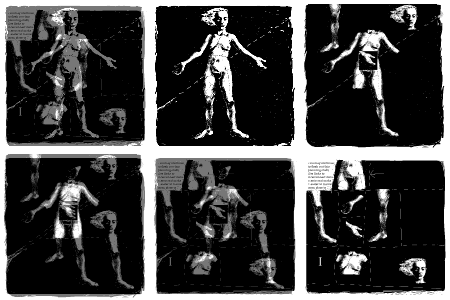
Shelley Jackson is the ground-breaking author of the hypertext novel Patchwork Girl, published in 1995. It takes off of Mary Shelley's Frankenstein and L. Frank Baum's Patchwork Girl of Oz.

After that, Jackson published a novel called SKIN through the tattoos of volunteer pages, as well as a conventionally printed books The Melancholy of Anatomy and Half Life. Having earned a degree in fine art, Jackson has also illustrated some books, including Magic for Beginners by Kelly Link, and her own picture books Sophia: The Alchemist's Cat and The Old Woman and the Wave. She lives in Brooklyn, New York.

The second Shelley Jackson maintains a website called Ineradicable Stain, which includes a rundown of other Shell(e)y Jacksons. Though two Shelley Jacksons who are Brooklyn-based novelists and illustrators would surely get mixed up a lot, this list pointedly does not include the first Shelley Jackson.

All this makes perfect sense given how a recurring theme of the second Shelley Jackson's work is the rending and rendering of human identity and the human body. And it also shows how good the Cybils are at identifying talent.

02 July 2008

Tales from the Darkside

From today's Guardian newspaper, a story called "Painting by Numbers" by Emma John:

Last year, Tom Becker won the Waterstone's prize for children's fiction with his first novel, Darkside; last week he won another award, the Calderdale children's book prize. The talk among agents and publishers has been about his suspenseful prose, his great potential. But few people have been talking about a more salient fact: that the book's concept and story was generated not by Becker, but by focus groups.

The company behind Darkside is Hothouse, a London-based business that aims to give children what they say they want from stories, rather than what adults think they want. Becker's book was the company's first attempt at book-by-focus-group, and it is part of a successful supernatural horror series aimed at boys aged up to 12, published by Scholastic. In April, Puffin books launched a new series, Fright Night, also conceived and delivered by Hothouse.

Hothouse uses a market research company to put story ideas to children, who are observed from behind a one-way mirror. Using dummy covers, short excerpts and blurbs to prompt conversation, researchers ask the children their opinions on which characters, plots and ideas they enjoy most. Each child is also visited at home by a researcher, who finds out what kind of books they already own and read. Drawing on this research, Hothouse commissions a team of writers accordingly.
Some observations on this report:
  • It's interesting that the two projects to come out of Hothouse so far are both in the horror genre. The two awards that Darkside has won aren't the most prestigious in British children's publishing, but they also indicate that adult readers see Darkside as more than hackwork.
  • British newspapers no longer even try to set off titles of books or other works with italics (as in books and magazines) or quotation marks (as in American newspapers). Just a capital letter or two, and moving on.
  • How did Becker get this gig? On projects of this type, the packager usually chooses writers by balancing two factors: cheapest possible price versus proven reliability at delivering solid text on deadline. As a first-time author, Becker probably had the right price tag, but he had no track record--under his own name. He may well have worked as a ghost writer or editor, but I haven't found any mention of that on the web.
Two more Darkside books have been published in the UK, but Becker also wants to write in other genres. The focus group-generated formula might soon feel too confining.

01 July 2008

Mad, Mad I Tell You!

In April Paul Collins at Weekend Stubble did the world a great favor by identifying what so far appears to be the earliest recorded use of the phrase "mad, mad I tell you!"

He quotes page 293 of Caroline Hyde Butler Laing's 1855 novel The Old Farm House:

For a moment Mrs. Lorraine made no reply--then she said:

"You call her my daughter's child! I had no daughter, Amy, she was a serpent that stung the breast which nourished her--and he--he! Amy, I shall go mad--mad I tell you, if you don't take that child from my sight!"
Collins even dug up a portrait of this deathless author.

Thanks to Caleb Crain's Steamboats Are Ruining Everything for the pointer.