10 April 2008

Some Origami

This example of "wet paper" origami art by Michael LaFosse is called "Wilbur the Pig." It's part of an exhibit of origami at the Peabody Essex Museum in Salem, Massachusetts, which I thoroughly enjoyed with my godson and his family last weekend.

Many of the folded-paper sculptures on display were inspired by geometric patterns and by nature, but a surprising number reflect the artists' pleasure in fantasy literature. Among those is Brian Chan's "Attack of the Kraken" (giant squid attacks two-masted sailing ship, all folded out of one piece of paper) and Joseph Wu’s “Grand Dragon,” both visible in the website’s slide show. I recall the exhibit also included a "St. George and the Dragon" and some Tolkien creatures.

In the hands-on room beside the exhibit gallery, I made a butterfly by following the instructional video also available here. Video makes beginning origami so much easier than diagrams! For folks in New England, this exhibit will be at the Peabody Essex only until 8 June 2008, and I highly recommend it.

09 April 2008

The Way They Live Now

From a letter by Dan Niven published in yesterday's Boston Globe:

Judging a 10th-grade English class's poetry slam last week gave me insight on why there is a gender gap in eighth-grade writing levels in Massachusetts. . . .

Seven of the 10 boys competing waxed on about their Xbox 360s with the same tenderness Romeo used to describe Juliet. Four of the six girls in the slam drew from their extensive Facebook repertoire and included the line "No one knows the real me" in their opening stanzas. The poetry was wretched, but, as Irene Sege points out in her article "Dear blog..." (Living/Arts, April 5), girls are at least regularly engaged in the writing process.

Last fall, while hiking in the Berkshires, I passed a family of four trudging up a trail. Like ducklings, the tween daughter and son dutifully followed their parents' footsteps. But unlike his sister, the boy's head was bowed in concentration as he both negotiated the trail and played on his Gameboy.
Of course, if the cell-phone reception were better, the girl might have been texting her friends.

08 April 2008

Two Years of Bully's Life

Among the things I can't presently do because my commute usually runs from my bedroom to my desk downstairs is to read lots of books while waiting for the subway to ever start moving again. So I'd never be able to keep up with Bully's Wodehouse a Week project.

After all, diligently reading a P. G. Wodehouse book a week is an undertaking of slightly less than two years. As Bully explains:

Consider this when you want to mull the length of P. G. Wodehouse's writing career: he published his first book a year before the Wright Brothers' flight at Kitty Hawk. He published his final book during his lifetime five years after Neil Armstrong stepped on the moon.
Rather than reading in order, or by series, Bully appears to be picking titles nearly at random from all periods of Wodehouse's oeuvre. I say "nearly" because he seems to be saving the best titles for later, with the understandable exception of Joy in the Morning. Thus, I'll have to check back for Bully's thoughts on Leave It to Psmith, Summer Lightning, and Hot Water, among my other favorites.

But Bully can even appreciate the lesser books:
The beautiful thing about Pearls, Girls, and Monty Bodkin is not its originality or uniqueness, oh no no no.
Of course not. Late Wodehouse was just a fun riff on middle Wodehouse. But early Wodehouse? Well, that can be strange territory indeed, as he tried out different modes before confirming that his strength lay in a certain type of comedy rather than, say, the serious themes of The Coming of Bill, the broad farce of The Swoop, or even the children's story William Tell Told Again.

Bully analyzes each book with generous excerpts, and offers occasional other remarks, such as these in regard to Psmith in the City, Wodehouse's transition from school stories to novels of young men about town:
both [Mike and Psmith] wind up working as junior clerks at The New Asiatic Bank, a thinly disguised City of London financial institution not unlike the Hong Kong and Shanghai Bank in London Wodehouse himself toiled at for two years in the early twentieth-century. Ah, isn't that a name that takes you back? "The Hong Kong and Shanghai Bank." It seems to suggest romance and adventure and far away places. It's a pity there aren't any such banks these days, isn't it? Well, actually, stand on a street corner and look around. Can you spot a HSBC bank anywhere near you? Same company. Had I known this when I was looking for a new bank in Manhattan, I would have trotted into the lobby of the HSBC on Fifth and Thirty-Ninth, placed my clinking bag of dimes on the counter, fixed the teller with a stern stare and declared "I would like to deposit my money in a bank that Mister P. G. Wodehouse once worked in." And if they knew what I was talking about, then boy howdy, that's the bank for me.

But I digress.
Each review also comes with important bibliographical tips for folks who like their popular literature cheap:
The Swoop is back in print in at least a couple public domain editions. Mine (printed by Bibliobazaar) features the odd design choice of a peacock on the cover. There are no peacocks in this book.
Since many Wodehouse novels were published with different titles in the UK and the US, this is helpful for keeping them sorted out. (For more complete dissections of different editions, you can try PGWodehouseBooks.com.)

I should also note that Bully's blog is nominally about comics, so it's also generous enough to offer this tribute to Charlton Heston and a summary of "For the Man Who Has Everything", a Superman story by Alan Moore and Dave Gibbons that was probably the first Jason Todd's finest hour as Robin.

07 April 2008

Choice Words on the Children’s Choice Book Awards

As the Oz and Ends staff has been tracking, the Children's Book Council recently changed how it operates to become more marketing-oriented. Part of that effort has been to move Children's Book Week, a tradition since 1919, from November into May.

Another new initiative is the Children's Choice Book Awards, with children invited to vote online to determine the winners. This new honor grew in part out of the CBC's 34-year-old Children's Choices program. However, the shortlists of nominees also reflect popularity as measured by bestseller lists.

There are two types of awards. One is for recent books in three age categories: grades k-2, 3-4, and 5-6. These nominees "were determined by the IRA-CBC Children's Choices program."

The other type of award designates children's favorite author and artist for the year, and the CBC website says:

These finalists were compiled from a review of bestseller lists, including those prepared by BookScan, The New York Times and USA Today.
The awards thus appear to represent two sides of the CBC's efforts, and of publishing culture in general: highlighting quality, as chosen by dedicated readers and reviewers, and rewarding popularity, as determined by sales to the public. Of course, books can be both excellent and widely read.

It will be interesting to see which type of Children's Choice award gets more attention in the press. I suspect that the strange energy of celebrity will bend attention toward the individual book creators, even though they don't need extra sales as much as little-known but good books do.

Miscellaneous further thoughts:
  • Both the 3-4 and 5-6 categories include titles in comics form: Camp Babymouse (also a Cybils nominee) and Beowulf: Monster Slayer.
  • There are several nonfiction titles among the nominated books, particularly for the older grades: one third of all those titles. But none of the nominated authors or illustrators is known primarily for nonfiction.
  • The "favorite authors" category includes Jeff Kinney, who both wrote and illustrated The Diary of a Wimpy Kid; that book's illustrations are crucial to its appeal.
  • The "favorite artists" category includes Brian Selznick, who both wrote and illustrated The Invention of Hugo Cabret; that book's text is crucial to its appeal.
Maybe in future years the children's-book field will have to come up with separate awards for authors, illustrators, and author-illustrators.

06 April 2008

Out of the Robin Costume at Last

This is not yet another weekly Robin essay about the costume of Robin the Boy Wonder. No, these are remarks on the costume that Dick Grayson, the original Robin, adopted after he gave up that crime-fighting moniker.

In 1984, Dick was a central character in DC's most popular comic book, The New Teen Titans. But he was also still an occasional supporting character in various Batman comics, meaning that the New Teen Titans creative team, Marv Wolfman and George Pérez, had to consult with the Batman squad on any major events involving him. "A trip into space to visit his gorgeous alien girlfriend's parents and, incidentally, save the planet? Sorry, not this month--he has to be in Gotham to stumble onto a payroll robbery and get tied up by crooks."

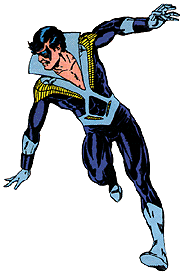
Eventually the company decided to have the Batman team create a new Robin (the first Jason Todd), while Wolfman and Pérez got to portray Dick adopting a new persona: Nightwing! That name, and the mostly dark blue costume he started wearing, were tributes to Batman (and, for those in the know, Superman), but the new identity was also a signal that Dick Grayson had come of age. After over forty years, he'd left the protection and shadow of Batman's cape. He didn't even need a cape of his own.

Some fans today find the original Nightwing costume quaint. Criticism centers on the "disco collar," but I'm sure practical people also find fault with the neckline that leaves so much chest exposed, and how the light blue and yellow would stand out at night. (Since most Titans missions took place in the daytime, that wasn't a problem.)

Since I was a New Teen Titans fan before I stopped reading comics altogether for quite a while, this Nightwing costume looks just fine to me. After all, a handsome man looks good in anything he wears.

Except a mullet.

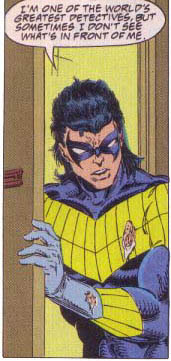
At some point in the early 1990s, for reasons I don't understand and the World Wide Web wasn't around to record in detail, Dick started wearing a new Nightwing costume. It had more bright yellow areas, and something resembling feathers folded between the arms and the chest.

Dick also grew his hair long in the back. At times he wore it in a ponytail, such as when he had to fit it inside the Batman cowl during a brief period of standing in for Bruce Wayne. Around 1995, in the Nightwing: Ties That Bind miniseries, Dick's hair reached full Fabio proportions, as shown to the right.

This costume also allowed Nightwing to glide through the air in a prone position. Apparently all that we humans need to become aerodynamic is to wear some yellow fans in our armpits. The panel below shows Dick traveling that way while Tim Drake, the fourth Robin, swings on a rope in more traditional fashion. (They may appear to be making catty remarks about their acquaintance Jean Paul's taste in capes, but it's a passionate discussion about the previous stand-in for Bruce Wayne.)
During the Ties That Bind miniseries, Dick Grayson received yet another Nightwing costume, but this one looked really good. No yellow anymore--just black highlighted with a jagged blue stripe from the fingers of one hand to the fingers of the other. And in the first issue of Nightwing magazine in 1996, some bad guys sliced off Dick's ratty ponytail, thank goodness.

Since then, the Nightwing look has remained generally consistent, as shown in the big picture below. Dick's hair has sometimes been long and messy, but never again in a style made famous by hockey players. The simplicity of the costume lets artists put their attention to the acrobatic body it sticks to.

Nightwing doesn't need to fly, as the cover image to the left shows. Through his extraordinary athletic ability and readers' willingness to suspend disbelief, Dick can jump off buildings and catch himself on the way down. This picture also shows the eskrima sticks that Nightwing adopted as his signature non-lethal weapon at some point.

For a brief period in 2005 Nightwing started to wear a red and maroon variation on his regular outfit, as shown on the Renegade collection. That costume lasted about five issues, which I haven't seen. Most comics fans seem to think that storyline better forgotten.

The image below, created by Ryan Sook, appeared on a 2007 issue of Nightwing magazine and then on the Lost Year graphic novel, issued last month. It shows Dick Grayson in his current costume with two of his previous outfits reflected in the windows around him. It's a very handsome portrait, but I still wonder why we don't see the real Nightwing costume with the spiffy collar.

05 April 2008

Running the Numbers on a New Publishing Model

Yesterday's New York Times Business section reported:

HarperCollins Publishers is forming a new publishing group that will substitute profit-sharing with authors for cash advances and will try to eliminate the costly practice of allowing booksellers to return unsold copies.
Good luck to Robert S. Miller, who's leaving Hyperion after seventeen years to head this venture. He's going to need it.

Allowing bookstores to send back unsold copies for full credit is a standard industry practice that dates back to the Depression. The first publisher to offer those terms was Simon & Schuster, which had stumbled onto a gold mine with the first crossword puzzle collections. Most of its initial titles were crosswords books. Those were ideal for experimenting for fully returnable sales; customers couldn't do the puzzles and then return the books to the stores to return them to S&S.

Today, "fully returnable" is standard in most of the book industry. Mass-market paperback publishing works on the basis of "cover returns," meaning stores don't even have to send back the whole book. Booksellers, who think their financial situation is just as precarious as authors' and publishers', will be skeptical of any non-returnable deal unless it also offers them better-than-usual terms, such as a discount higher than 50% off the cover price. And even then the people likely to suffer most from non-returnable terms are new, unproven authors; booksellers will be wary about stocking their books in case those copies don't sell and the store is stuck with the inventory.

And now that I've broached the arithmetic of the situation, the Times article reports that Miller hopes to "offer authors a 50-50 split of profits." How will that really work? Profit-sharing has long been on literary agents' wish lists. I recall hearing the Publisher of the book division I worked for, David C. Miller (now a literary agent, and no relation to Robert S. Miller), describing how an agent had said that would be part of his ideal deal.

David also pointed out the following math. When a publisher commits to a standard 10-15% royalty on the cover price of a hardcover book, but sells that book to a wholesaler or bookstore at a discount of close to 50%, then the royalty amounts to 20-30% of the publisher's gross revenue. Even a 7% paperback royalty translates in about 14% of the gross. Under the new HarperCollins model, authors would give that up for 50% of the net profit, presumably after the costs of production, printing, and marketing.

Anyone who's spent more than a few months in Hollywood knows that actors, writers, and directors never see a percentage of the net profit if that's what their contracts promise; the only deals worth fighting for stipulate a slice of the gross revenue. Hollywood accounting is legendary for its trickiness, of course. Publishing accounting is more straightforward, but publishing companies have never had an incentive to calculate a low net profit before. Authors have always been paid out of the first revenue the book earns, not the last.

The Times erroneously states:
Typically, authors earn royalties of 15 percent of profits after they have paid off their advances. Many authors never earn royalties.
The 15% royalty is typical of hardcover sales only after a certain number (say, 10,000 copies) sold at lower royalty levels. Royalties have nothing to do with "profits," as described above. And while many authors never see royalty payments after publication, their books do earn royalties as long as they sell.

Indeed, the advance system that this HarperCollins division will try to avoid lets authors receive money from their books' royalties even before those books are published and start earning those royalties. Hence the term "advance." Will authors and their agents really prefer the uncertainty of profit-sharing over guaranteed cash up front?

The key to understanding this new sort of publishing economics seems to lie in the types of books Miller's division will publish. Again with the Times:
The new group...will most likely publish hardcover editions priced at the low end of the market, around $20 a copy. She pointed to some of the titles that Mr. Miller had published while at Hyperion as models, including The Five People You Meet in Heaven by Mitch Albom and The Best-Loved Poems of Jacqueline Kennedy Onassis.
In other words, books from household names who have already created blockbuster bestsellers, aimed at the vast middlebrow market, and priced to go immediately onto the next bestseller list. This model can't work with anything less than a guaranteed mega-seller. For a guaranteed mega-seller, bookstores would be willing to forgo returns. For a guaranteed mega-seller, profit-sharing would make more sense for an author than an advance against royalties. But only for a guaranteed mega-seller.

Of course, everyone in publishing would like to identify guaranteed mega-sellers. No one can. That's why the current system of advances, royalties, and returns evolved as it did.

04 April 2008

It May Sound Harsh

The first Jack of Fables collection, The (Nearly) Great Escape (script by Bill Willingham and Matthew Sturges; art by Tony Akins and Andrew Pepoy) offers a--well, let's say rare picture of the most beloved Oz characters.

At some point I'll praise Willingham's Fables comics in more detail, but for now I'll just report that this volume is based on the premise that a bunch of characters from fairy tales, nursery rhymes, and fantasy literature are being held captive in a prison camp surrounded by tigers. (Don't you hate when that happens?)

The title character, Jack--as in Horner, Beanstalk, being nimble, etc.--masterminds a mass escape. And among the characters who make a dash for the fence are Dorothy, her three famous companions from Oz, and her little dog, too.

Dorothy is pictured as a teenager in cowboy boots, jeans, tight stomach-baring top, and hairband. Such a depiction is only to be expected in the Fables comics, since they're published by the adult division of DC and they show other human fairy-tale characters dressed (or undressed) like pretty young things of today. Plus, we've seen similar Dorothys in many other recent comics.

As this Dorothy and her friends climb the fence, a tiger roars up. Toto starts to snap and bark at it, just as he barks at the Cowardly Lion when they first meet.

And the tiger eats Toto. We see this in some detail. It's like a National Geographic special for a couple of panels.

Then Dorothy tells her other friends, "It may sound harsh, but I'm kind of relieved. That's the first time that flea-bitten mongrel's quit yapping in a hundred years!"

A couple of pages later, other characters explain, "killed Fables often get magically replaced by new versions of the same Fable." That should reassure us about Toto's ultimate fate, but the same panels offer another look at his half-eaten hindquarters.

Did I mention that the Fables comics are written for adults?

03 April 2008

Back to Comics and Picture Books

The latest Notes from The Horn Book newsletter contains this exchange from editor Roger Sutton's interview with Françoise Mouly on the debut of the first TOON books--comics for beginning readers.

2. What’s the difference between a comic book and a picture book?

Both have pictures, but the similarities end there. Comic books offer a visual narrative, with words as only one of the elements intertwined with the pictures. The visual narrative in a comic book helps kids crack the code of literacy, teaching them how to read from left to right, from top to bottom. Speech balloons facilitate a child’s understanding of written dialogue as a transcription of spoken language. In a sense, comics are similar to face-to-face interaction. Comics blend words, images, and facial expressions with panel-to-panel progression, sound effects, and even shifts in type size to engage readers and propel the story. Many of the issues that emerging readers have traditionally struggled with are instantly clarified by comics’ simple and inviting format.
I don't fully agree with some of Mouly's statements, but heartily concur with others. The quibbles:
  • Both picture book and comics forms have pictures in sequence. (In fact, "sequential art" was one of Will Eisner's "will you respect us now?" attempts to relabel comics. Unlike his "graphic novel," it doesn't seem to have leaped the fence from the comics field to the larger world.) Neither form is simply a collection of pictures; the sequential images make it possible to tell stories.
  • Both forms usually have pictures and words. There are wordless picture books and wordless comics, of course, but those are the exceptions. (We don't have to say "wordful picture book" or "worded comic.")
  • Some of the elements of comics that Mouly highlights are also elements of picture books:
    • Left/right (at least in our culture), top/bottom progression.
    • "Words, images, and facial expressions."
    • Digital layout and typography have made it possible for picture books also to use "shifts in type size," as well as:
      • shifts in type color.
      • shifts in type placement.
      • okay, I didn't really need this list, but I wanted to see what would happen if I kept adding new layers of bullet points.
As the key features that differentiate comics from picture books, I emphasize the number of pictures on a page spread and the way comics "show the invisible" through speech balloons, sound effects, and some other elements Mouly doesn't mention, such as the motion and emotion lines in this sample from TOON Books's Benny & Penny in Just Pretend, by Geoffrey Hayes.

I think those ingredients could indeed lead to comics being easier for some beginning readers to understand. The left/right, top/down progression that appears in both book forms is more apparent when a child can see several sequential images at once. The speech balloons' little tails provide a non-verbal link from characters to their dialog for someone who already has enough work to do puzzling out that dialog.

On the other hand, when children hear stories from their parents, what they hear is more like prose than like comics. In telling tales, we can rarely point to different people to indicate who said what; instead, we use verbal dialog tags like "he said." We describe events and actions rather than act them out. So for some children, a traditional prose picture book might be an easier transition from hearing to reading.

Of course, there's no reason for families to choose one form or the other.

02 April 2008

Shivering Shafts, What’s Got Into Her?

The first superhero teams were brought together by that powerful force, cross-marketing. The Justice Society of America, the Seven Soldiers of Victory, and similar groups were simply collections of second- or third-tier comic-book heroes owned by one conglomerate and unable to carry a whole magazine on their own.

As overall superhero comics sales slipped in the late 1940s, companies dropped their top characters into team books as well. Timely/Marvel built the All-Winners Squad around Captain America, the Human Torch, and the Sub-Mariner, and DC let Superman and Batman spend more time with the Justice Society.

Meanwhile, comic-book giants Joe Simon and Jack Kirby had developed another type of team: a bunch of boys with complementary personalities. There could be, for example, a tough kid from Brooklyn, a jolly fat boy, a rich toff, a hilarious black stereotype, and so on. The Young Allies included the sidekicks of Captain America and the Human Torch as well as "normal" kids, while the Boy Commandos shared Detective Comics with Batman. Such groups could even be made up of men, as in Red, White & Blue; the Blackhawk Squadron; and the Challengers of the Unknown.
After DC began the "Silver Age" of superhero comics by resurrecting the Flash, Green Lantern, and other old names in new forms, it also restarted the superhero team with the Justice League of America. Like before, that was simply a conglomeration of heroes, brought together because the company saw sales potential in putting them all onto one magazine cover.

Over at DC's rival Marvel, the chief executive saw the sales of that Justice League book and challenged editor Stan Lee to come up with something similar. Lee and Kirby then created the Fantastic Four, conceiving of a whole superhero team at once and giving them powers that complemented each other but personalities and interrelationships that promised drama. And the result was an immediate hit.

Soon writers created more superhero groups: the the Doom Patrol at DC, and X-Men back at Marvel. Marvel tried combining second-tier heroes in the Avengers, but discovered the formula worked better with characters who didn't have their own magazines but had interesting chemistry. This was the atmosphere in 1965 when DC created the Teen Titans by grouping the young sidekicks of its stars.

By that time, comic-book editors had stumbled onto some useful rules for creating these sorts of groups:

  • You need someone who's super-strong: the Thing in the Fantastic Four, Robotman on the Doom Patrol, Mr. Incredible in the Incredibles. Often this guy also has a rough, tough personality, but in the original X-Men, Lee went against type by making the super-strong member, Beast, an intellectual.
  • You need someone who can fly: the Human Torch in the Fantastic Four, Negative-Man on the Doom Patrol, Angel in the X-Men. It helps with some missions, and it just looks cool.
  • You need a female. As soon as DC realized that females could be superheroes, it had added Wonder Woman to the Justice Society (she served as secretary during meetings). The Justice League also had Wonder Woman, the Fantastic Four had the Invisible Girl, the X-Men had Marvel Girl, the Doom Patrol had Elasti-Girl. But it was a rare group that needed more than one female member.
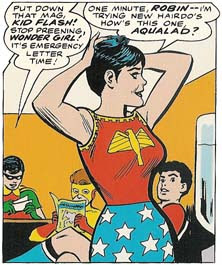
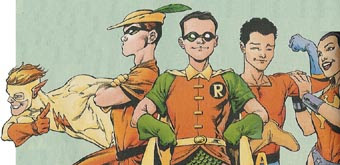
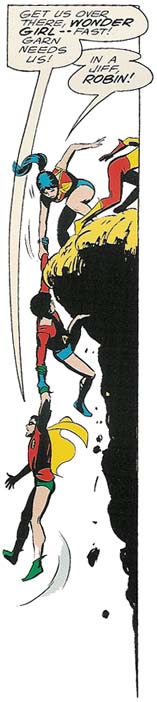
How did these rules work on the Teen Titans? That team grew out of a meeting of Robin, Kid Flash, and Aqualad, but when they became a formal team Wonder Girl arrived.

Until then, Wonder Girl had simply been a young version of Wonder Woman, as Superboy was to Superman. Through some sort of Greco-Roman god magic, Wonder Girl and Wonder Woman had appeared in comics together, but they weren't supposed to be separate characters. No one at DC bothered to complain when Wonder Girl was shipped off to play with the boys, though.
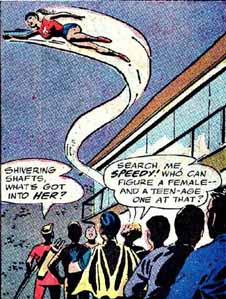
Because the Teen Titans desperately needed her. None of the boys was super-strong. (Well, Aqualad has above-average strength since he has to withstand underwater pressures, but he also dries out quickly, so it's a wash.) None of the boys could fly; in the first issue of Teen Titans, Robin, Kid Flash, and Aqualad parachuted into South America while Wonder Girl just flew down from the plane.

And, of course, Wonder Girl was a girl, so she added something to the group dynamic. Like a consuming interest in hairstyles! The power to totally mystify teenage boys! And someone else for Robin to order around!

And we wonder why so few girls enjoyed superhero comics back then.

01 April 2008

It Was Mary Something, I Think

Ron at Media Bistro's Galley Cat ran a couple of brief items last week about Editorial Departments responding to some author submissions with letters signed by fake names. [Yet another.] In one he wrote:

one reader assures me, sending out rejection letters under false names, in the hopes of avoiding long, tiresome correspondence with would-be writers, really has happened--at at least one company.
Indeed, the use of a business pseudonym for some rejection letters was a policy at the publishing company where I started to work in 1987. Can I recall the fake name now? No, it was supposed to be generic and unmemorable. But if I heard it, I'd immediately remember.

I was told, but can't vouch for, the story that one persistent author kept asking for that non-existent editor so many times that some female Editorial Assistant was drafted to portray her for the length of a phone conversation.

I didn't use the name much, if at all. A few years later we phased out that policy. The volume of slush, especially after some of our titles hit the New York Times bestseller list, eventually forced us to adopt a checklist response to most unsolicited submissions. And I left ten years ago.

I can vouch that:
  • Some hopeful authors come to publishing company offices to meet with editors despite having no appointments--or, for that matter, words on paper.
  • Some hopeful authors have severe mental difficulties. One caller wanted to write about a friend who he knew was a vampire--he'd seen the man's fangs just as clearly as he'd earlier seen Christ holding a plastic lamb in a meadow.
  • These two categories can easily overlap.