09 February 2026

Another Addition to the Jackie Condon Filmography

Discontented Wives was a five-reel melodrama directed by and starring J. P. McGowan, released in September 1921.

The American Film Institute summarized it this way:
Ruth Gaylord gives up her home in New York to marry John Gaylord but grows discontented with the loneliness and desolation of life in the West and leaves her husband. After returning home, she hears that he has struck one of the richest gold veins in California. A letter surrendering her interests in the mine falls into the hand of Kirk Harding, an eastern capitalist; and John, tricked into surrendering his rights and discovering the truth, struggles with Harding. Ruth awakens, discovering it was all a dream, and decides not to leave her dedicated husband after all.
At the end of a review in the 16 October 1921 Seattle Daily Times came this paragraph:
The cast in Mr. McGowan’s support, besides Fritzi Brunette, includes Jean Perry, Andy Waldron, C. S. McGregor and little Jackie Condon.
Now lost, Discontented Wives is thus another entry in Jackie Condon’s pre-Our Gang filmography.

The mention of Jackie’s name might imply that his face and tousled hair were becoming known to movie exhibitors or audiences.

The first short in the Our Gang series that Hal Roach and Pathé released in September 1922 was “One Terrible Day.” The poster for that film, shown above, doesn’t depict the whole gang. Instead, it features only the two kids who would have been most familiar to viewers because of their previous work: Ernie “Sunshine Sammy” Morrison and little Jackie Condon.

08 February 2026

“So completely captivated with little ‘Jackie’ Condon”

A couple of weeks before the Los Angeles Evening Herald profiled two-year-old movie performer Jackie Condon (as quoted yesterday), the paper ran an anecdote about a movie he was making.

The 5 Apr 1920 edition reported:
$300 Gold Watch Given Boy Who Appears in Film

When Neely Edwards, the star of the Hall Room Boys comedies, went on location the other day he conferred with his co-star, Hugh Fay, and his director, Malcolm St. Clair, and decided to shoot some exterior scenes that would require the front entrance to a prominent mansion.

Mr. St. Clair being personally acquainted with Mr. W. A. Clark, jr., the son of the famous senator, induced Mr. Clark to allowed him to film his mansion on West Adams street.

They all went to the Clark home and worked all that day on the lawn and porch of the house. Mr. Clark was so completely captivated with little “Jackie” Condon of the party that he gave him a solid gold watch worth over $300.

The watch will now be used in the picture as a befitting climax to it. The Hall Room Boys comedies are released by Jack and Harry Cohn in New York.
Perhaps that solid gold watch is why Jackie’s recent earnings were so high according to the Herald’s 23 April story.

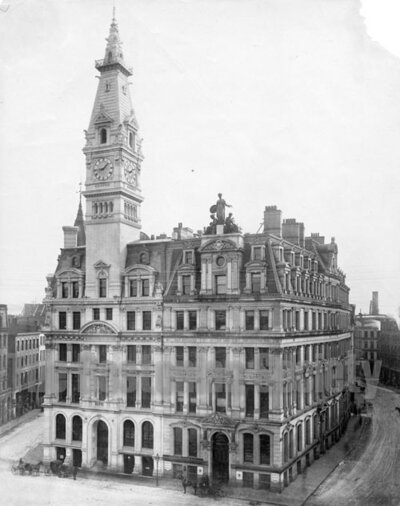
William Andrews Clark, Jr., was an heir to a mining fortune, attorney, book collector, and philanthropist, by 1920 founder of the Los Angeles Philharmonic and funder of the Hollywood Bowl. Clark’s house at the corner of West Adams and Cimarron, somewhat modified, appears above, courtesy of the Adams Boulevard blog. Having been widowed twice, Clark was living there with his teen-aged son; his lover, Harrison Post; and no doubt a large staff.

Clark’s house and grounds appeared in several movies around 1920, including “Fresh Paint,” featuring Snub Pollard (but not, contra IMDB, Ernie Morrison) and directed by Charley Chase. Other productions offering glimpses of the estate include “The Tourist,” with Jimmy Aubrey and Oliver Hardy, and Harold Lloyd’s Dr. Jack.

The Hallroom Boys was a comic strip that H.A. MacGill launched in 1904. It spun off a couple of film series. The young male comedians who played the main characters were swapped out several times. According to IMDB, only one Hallroom Boys movie starred Neely Edwards and Hugh Fay with Malcolm St. Clair as director: “Tell Us, Ouija!”

Released in September 1920, this movie played off the ouija board craze. More pertinent to our inquiry is this portion of the advance review from the 20 May 1920 Film Daily, as quoted in The Palgrave Encyclopedia of American Horror Film Shorts, 1915–1976:
One scene in which a child is seen first in a derby hat, only the sky-piece being visible at first, provokes a giggle. When, however, they employ a similar scheme showing a pair of large and well-worn shoes protruding from under a bed, what actually amounts to the same gag is offered again, for the youngster soon appears wearing them.
St. Clair’s signature style as a director evidently used a lot of close-ups and reveals like this. The youngster in those scenes was most likely Jackie Condon.

COMING UP: A melodrama.

07 February 2026

“Jack’s been around again”

Jackie Condon surely appeared in more movies before “Our Gang” than the seven listed yesterday.

The 23 Apr 1920 Los Angeles Evening Herald reported on his acting success shortly after he turned two. “Young Film Player Amasses $3000 in Short Career Before Camera” was the headline.

The story said the little boy began his career “at the age of six weeks.” (In later press about Jackie, that age was halved.) “In the last three weeks he has earned $500. During his lifetime he has earned $3000.”

The story went on:
But when Baby Condon is “off duty” he is the “terror of the neighborhood.” When the neighbors discover broken shrubbery, when they discover the sides of their houses marked with chalk or a pencil, they say, “Jack’s been around again.”
While touting Jackie as the Condon family’s main earner, the article also noted that two older siblings were also appearing in movies: Geraldine, aged 5, and “Billie,” aged 8. Billy Condon would have a prominent role in “Our Gang” but not appear in any of the subsequent series.

According to the Lucky Corner website, Jackie and Billy each earned $7.50 per day for their week of work on “Our Gang” in January 1922. When Hal Roach committed to making a series, Jackie was the second kid he signed to a long-term contract (after Ernie Morrison), and the salary was $40 per week with no pay when there was no filming.

That’s a long way down from $500 in three weeks, the figure the Herald reported. Either Jackie’s earning potential plummeted after he turned three, or the newspaper story was exaggerated—as newspaper stories about Hollywood usually were. But with press like that, we can see why so many parents were eager to get their children into moving pictures.

Because little Jackie Condon was almost always an uncredited supporting player, and because so many of Hollywood’s early movies have been lost, finding his pre-Gang work relies on luck piecing together what information survives. I’ve spotted two additions to his filmography.

COMING UP: A tale of a watch.

06 February 2026

Jackie Condon’s Career Before “Our Gang”

Jackie Condon was the youngest player in the first Our Gang movie ever shot in early 1922, establishing the role of the tagalong little brother. Born in March 1918, he was going on four years old.

Among the kid actors in “Our Gang,” however, Jackie was probably second only to Ernie Morrison in filmmaking experience. He’d been appearing on camera since he was a babe in arms.

IMDB and the Lucky Corner list seven movies Jackie appeared in before “Our Gang” was filmed:
  • Jinx, a Mabel Normand feature in 1919—as shown by press reports.
  • “Italian Love,” a Billy West short directed by Charley Chase in 1920—a viewing on YouTube confirms Jackie appeared in it, in the flesh. 
  • “A Convict’s Happy Bride,” an Alice Howell short—also on YouTube, with Jackie quite active. 
  • “The Morning After,” a Snub Pollard one-reeler released in 1921, now lost—Jackie’s work was identified by Robert Demoss through Rolin/Hal Roach Studio records. (In this period Ernie Morrison was Pollard’s regular sidekick, so this was the first movie Ernie and Jackie both appeared in before Our Gang.)
  • Little Lord Fauntleroy, the Mary Pickford feature—in the opening scene, Jackie gets undressed to play in a sprinkler.
  • “At Your Service,” a Hallroom Boys short—only one reel survives, and Jackie doesn’t appear in that footage; I don’t know the basis for listing him in the cast.
  • Penrod, a Wesley Barry feature made in 1921 and released in 1922, adapted from Booth Tarkington’s novel—I don’t think this movie survives, but the press material includes Jackie in the long list of young cast members.
In fact, Penrod was a significant precursor to the Our Gang series launched a few months later. Hal Roach lent Ernie Morrison to be a featured player in it, and its cast also included Peggy Cartwright, who became the “leading lady” in several of the earliest Our Gang shorts.

Wesley Barry’s stardom in the early 1920s probably also influenced Roach’s thinking about the Our Gang series. For Rebecca of Sunnybrook Farm (1917), producer-director Marshall Neilan had young Wesley act for the first time without greasepaint covering his freckles. The young actor caught the eye of moviegoers. He rose quickly to be a featured player, then a star in Dinty (1920). Wesley Barry established the archetype of the freckle-faced “reg’lar” American boy that Mickey Daniels, Jay R. Smith, Harry Spear, and Donald Haines would play in the Our Gang movies.

Dinty also showed its young white hero having an African-American kid and a Chinese-American kid as his playmates. Many reviewers mentioned that favorably. Of course, that movie, and that press coverage, played up the racial stereotypes of the day. But at least those characters were friends.

COMING UP: New additions to Jackie Condon’s filmography.

03 February 2026

Two More Tales of Oz

The 2025 edition of Oziana, the International Wizard of Oz Club’s creative magazine, is now available for purchase through Lulu.

This issue contains two stories by me.

“The Piglets and the Tin Soldier” is another short slice-of-life tale inspired by L. Frank Baum’s Little Wizard Stories of Oz, taking a couple of his established characters and bouncing them off each other.

The Nine Tiny Piglets first appeared from the Wizard’s pockets in Dorothy and the Wizard of Oz and made small cameos in the Emerald City after that, never getting individual names. 

Captain Fyter, the Tin Soldier, marched onto the scene in The Tin Woodman of Oz. At one point in that book the heroes meet the piglets’ parents. Afterward the soldier says, “I hope I’m not too particular about my associates, but I draw the line at pigs.” So there was a natural tension to work with.

David Valentin created digital artwork of the Tin Soldier and his basket of piglets for this story of a journey through the Munchkin Country.

“The Missing Key” is a mystery featuring Snip, the button boy who was a protagonist of Ruth Plumly Thompson’s The Lost King of Oz. She introduced Snip sneaking into Mombi’s kitchen and then spying on her, establishing him as a curious kid. Several years ago, I used that trait to bring Snip into a story called “Invisible Fence.” More recently I realized that would make him a good investigator for a mystery.

In this story, Snip sets out to retrieve the wind-up key that’s vanished from Tik-Tok’s back. David Lee Ingersoll supplied the illustrations, including one of Snip pinned to the ground by string-wielding field mice, inspired by scenes in The Wonderful Wizard of Oz and Gulliver’s Travels.