25 November 2026

Upcoming Panels on “250 Years of Cartooning in Boston”

As part of next week’s Massachusetts Independent Comics Expo (MICE), I’ll be part of two panel discussions on “250 Years of Cartooning in Boston.”

Tuesday, 1 December, 6:30 pm
Old South Meeting House
Register here

Sunday, 6 December, 3 pm
MICE, 808 Commonwealth Avenue (big lecture hall)
Register here

The second session will be recorded and eventually uploaded on the MICE Media YouTube channel.

The National Endowment for the Humanities awarded a grant to the non-profit that organizes MICE, the Boston Comic Arts Foundation, to organize an event related to America’s 250th. I’ll supply that content, making it possible for my fellow panelists to cover more recent comics history.

The speakers will be:
  • Me, showing cartoons engraved, lithographed, and otherwise made in Boston from 1751 to 1861, covering Paul Revere, David Claypoole Johnston, and lesser known artists like Peter Fleet, Sarah Henshaw, and the always popular Anonymous.
  • Artist and scholar Dan Mazur on the flowering of newspaper comics in Boston in the late 1800s and early 1900s.
  • Tony Davis, proprietor of the venerable Million Year Picnic comics shop, about how a comics community developed in the late twentieth century.
  • Claudia Friedel about the resources on local cartoonists in Boston University’s Special Collections & Archives.
Claudia won’t be at the Old South session, and Tony may be too busy selling graphic novels at the MICE show for the second session.

At both events audiences will see me display the earliest cartoon yet found in the Boston press, three years before Benjamin Franklin unleashed his “Join, or Die” snake on the world. That cartoon is both (a) not safe for work, and (b) probably the work of an enslaved African-American artist.

In other news, as we prepared for this event, Dan, Claudia, and I collaborated to find political cartoons in the Boston Guardian, William Munroe Trotter’s weekly newspaper for the African-American community in the early 1900s. So far as we can tell, those pictures haven’t received any scholarly attention. We’re still trying to learn more about these artists who signed their work “T.O.T.” and “Wm. H. Jackson.”
24 November 2026

An Artificial Wonderful Wizard of Oz

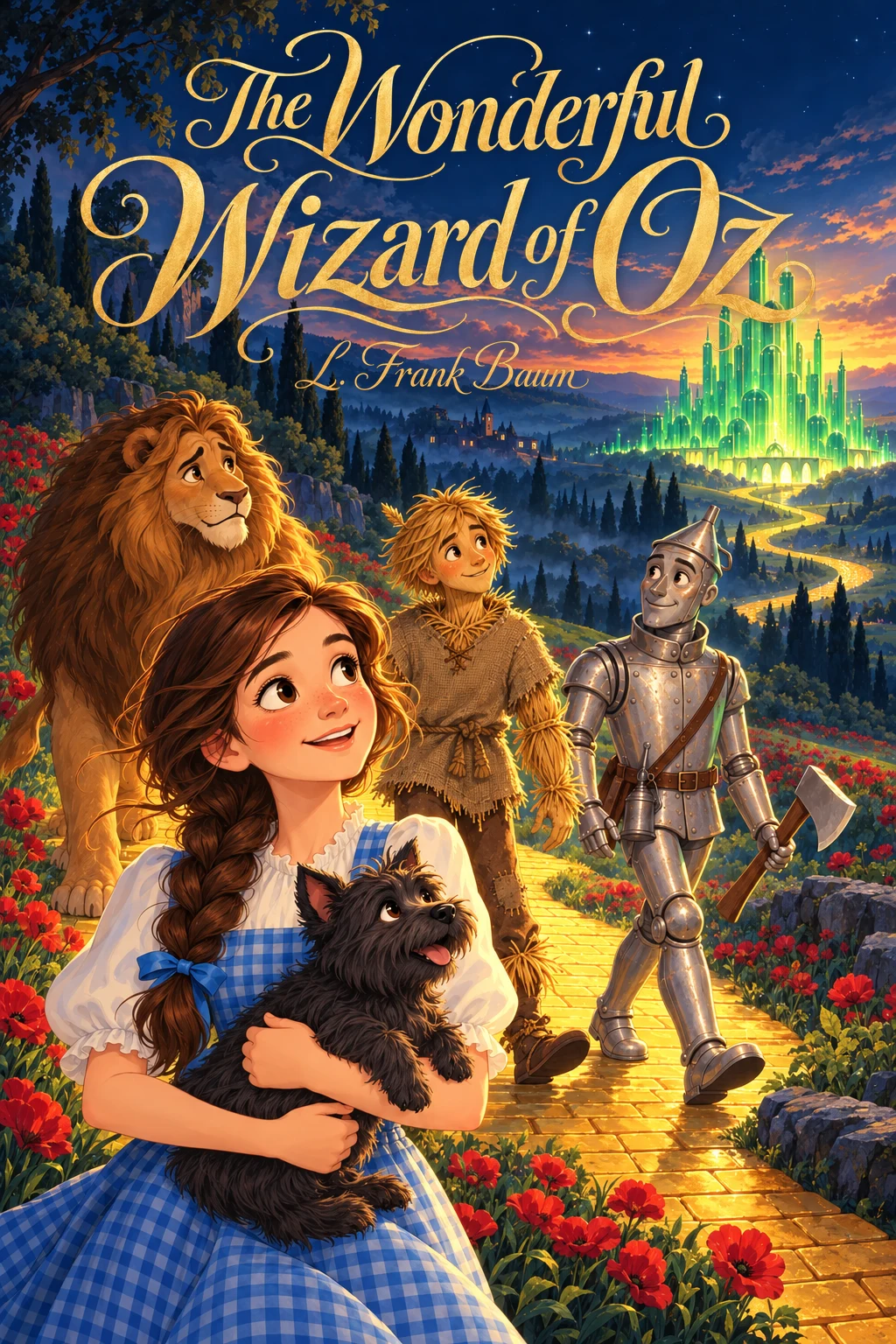
The book cover on the right comes from a new comics version of The Wonderful Wizard of Oz, adapted from L. Frank Baum’s text by…no one.

No creator in the legal, copyrightable sense, that is. This image was generated by the programming at Storieta.com, an AI-driven service that promises to turn prose stories into illustrated texts and comics. The Wonderful Wizard of Oz is one of its samples produced from a famous public-domain text.

There are still a lot of bugs in the system.

The character designs don’t really show a lot of character. The Wizard and Guardian of the Gates have the same facial architecture, for example. Probably influenced by the Wicked stage show, the Scarecrow looks like a cute young man in Scarecrow makeup, not an actual straw man.

The programming does solve AI’s problem of characters changing features from one picture to the next, but mostly by not allowing their appearance to change much at all. In the sample below, you can see Dorothy almost copied from one panel to the next.

In contrast, details of the setting morph between views. Furniture doesn’t quite fit together. The service promises “manga style” and “storybook style,” but those toggles seem to mean simply changing the color saturation.

The program turns prose into panels in a minute or less. However, even in this sample, that produces problems. Toto running away from Dorothy as the cyclone approaches is a crucial plot point, but the AI has muddled it terribly. It think the program did what predictive text does and extrapolated, so Dorothy’s plan to go down into the cellar with Toto got illustrated, and then suddenly they have to be back in the house as it gets carried away.

Later, the program has extra trouble showing the Good Witch of the North balancing her pointed hat on the end of her nose and turning it into a slate; presumably there are few visual models of that action to copy from. Panels show Dorothy starting to wear silver shoes immediately on arriving in the Munchkin Country, not when she starts out on her journey.

In Dorothy’s conversation with the Good Witch, lines of dialogue are missing and out of sequence. The program offers subscribers some control over balloon and caption text, placement, and size, so those details could be improved manually. Likewise, Storieta promises the ability to ask for changes to portions of an image. But I can’t tell how a user might change the panel breakdown and layout itself.

The fact that a program can take a prose story and quickly produce a recognizable attempt at illustration or comics is impressive. But the results also show how much better human artists are at understanding nuance, depicting life, and adding creative spark.